January 21, 2025
This series is intended to evaluate each product of the James Bond film franchise through a feminist lens, and the relevance of the Bond archetype to shifting ideas of masculinity in the 2020s.
Diamonds are Forever (1971, directed by Guy Hamilton)
Sean Connery is back! This is probably the Bond film I saw the most on the 4 O’clock Movie in the seventies. Watching it five decades later, it pretty much sucks. Eon Productions was Bond-less after George Lazenby agreed to only make one film, On Her Majesty’s Secret Service. Numerous actors were considered, including Americans Clint Eastwood, Burt Reynolds, Robert Wagner, and Batman’s Adam West. Ultimately, Connery was lured back with a promised $1.5 million payday. To recapture the glory, Goldfinger director Guy Hamilton was brought back, as was theme song singer Shirley Bassey. Early 70s 007 looked a lot like early 60s 007.

Diamonds are Forever begins with Bond hunting down Blofeld, presumably because he killed his wife in On Her Majesty’s Secret Service. However, his wife is never mentioned and James shows zero signs of grief or even vengeance. He’s been trying to kill Blofeld since 1963 in From Russia With Love. One could assume that Lazenby’s Bond may have been married but Connery’s never was. Diamonds are Forever is much more of an American film than any previous Bond movie, with most of the action taking place in Las Vegas. (One of the reasons American Tom Mankiewicz was hired to work on the script.) I loved the scenes in Circus, Circus and Bond racing cops on Freemont. That Vegas is long gone (although you can still shoot water into balloons at Circus, Circus). Diamonds also gives us our first American Bond girl, Tiffany Case (played by 70s-80s TV fixture Jill St. James).
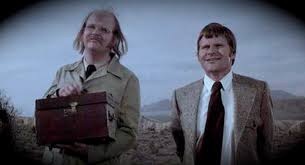
The attempt to recreate the magic gives us Bond staples, including Blofeld (and his darn cat), CIA agent Felix Leiter, James gambling in a casino (craps, this time) and, of course, an underground lair. Also space lasers and an elephant that plays slot machines. Added to Blofeld’s bad guy team are Mr. Wint and Mr. Kidd, a pair of sociopathic gay assassins. This might have fit a “homosexuals are deviants” narrative in 1971, but now it’s just horribly offensive. (I thought it was creepy when I was a kid, but now it just seems really, really dumb.) We do get a bit of globe trotting with a stop in South African diamond mine (no mention of racial apartheid, just black miners smuggling diamonds) and Amsterdam, where James meets a scantily clad Tiffany and says he likes her change of hair color, “provided the collars and cuffs match.”
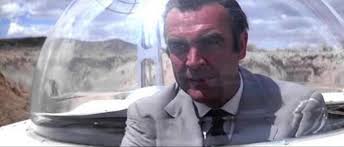
Diamonds are Forever premiered in Munich, West Germany on December 14, 1971, three days before East and West Germany signed a historic agreement allowing for more open travel across the Berlin Wall. The film was a box office blockbuster but reviewers saw it as more silly than sexy. Maybe that was due to the fact the the special effects budget was sacrificed to pay Connery’s salary. The scene of Bond driving a moon buggy through the Nevada desert, being chased by henchmen on dirt trikes, is particularly goofy. But you do get Bond in his white dinner jacket scaling the Las Vegas Hilton (the “Whyte House” in the film) and Jimmy Dean (the sausage guy) playing a character based on billionaire Howard Hughes, who was friends with Bond producer Cubby Broccoli.
Seventies Bond may fair better. Let’s drop Diamonds into our matrix.

Driver of Action – Diamonds are Forever is classic Bond. We get brief cameos from M, Q, and Miss Moneypenny. Felix and his CIA team play a minor support role, especially when 007 encounters Bambi and Thumper, Blofeld’s bathing suit-clad guardians of Willard Whyte. Part of the story drifts into heist film with James and Tiffany as a team, but, rarely fully clothed, she seems to be just brought along for added sex appeal. Producers had Connery back and were going to make sure he was in nearly every frame.
Role of Violence – The film starts with Bond on a killing spree as he tries to find Blofeld. That includes finding a woman on a beach, ripping off her bikini top, and strangling her with it. Ultimately, after killing someone in Blofeld’s lab (with mud), Bond kills Blofeld. Or a Blofeld.(“Welcome to hell, Blofeld.”) There’s a scene where Bond kills a diamond smuggler after a pretty intense fight in a Dutch elevator and the now routine scene where Bond slaps his Bond girl. Most “fun” is when Bond realizes that Blofeld is alive (THE GUY THAT KILLED HIS WIFE – BUT NOT MENTIONED). In fact, there are apparently multiple “cloned” Blofelds and cats. He’s faced with two Blofelds (this time played by Brit Charles Gray, who played an MI-6 agent in You Only Live Twice). With a 50-50 chance, Bond shoots and kills the wrong Blofeld. “Right idea, Mr. Bond,” says Blofeld. “But wrong pussy,” says Bond. Oh yeah, there’s a climatic shoot out on an oil rig between the CIA and the Henchmen that kills a grip of dudes.
Vulnerability – Nope. Zero mention of Bond’s dead wife. Not even a hint that that’s why he’s after Blofeld. Older Bond is all business.

Sexual Potency – James might be losing his touch. He hooks up with a casino trollop named (ready?) Plenty O’Toole (played by Natalie Wood’s little sister, Lana). He gets her dress off but before he can get his pants off, some mobsters throw her out of a hotel window, into a pool. He tells the gun-toting goons, “Well, I’m afraid you’ve caught me with more than my hands up,” which, I assume, is a reference to the Bond Boner. Of course, Bond does bed Tiffany Case. (Her smoking in his bed the next morning is the clue.) At one point, while his body on hers, she asks, “What’s going to happen to me?” “I’m on top of the situation,” James says. Snort. But the required three sexual conquests is not achieved in Diamonds are Forever. Gee, maybe he was thinking about Tracy.
Connection – Maybe Connery was just tired of playing Bond, but 007 doesn’t really seem to care about anybody in this film, including M, Felix, Moneypenny, or Plenty (who gets tossed out of a tenth story window). There is some connection with Tiffany, who seems to want to be a spy as much as a diamond smuggler. The film ends with James and Tiffany, wait for it it, in a boat! This time it’s an ocean liner. But we’re not quite done. Here come Mr. Wint and Mr. Kidd, the homicidal homosexuals, posing as waiters with bomb souffle to kill Bond. They end up on fire and blown up, over the side as James and Tiffany sail away to short-term happiness.
Toxic Masculinity Scale: 4
Summary Seventies Bond still has a problem with race. The primary cast is lily white and we’re still stuck with “the sun never sets on the British Empire” ethos. (Did Richard Nixon have anything to say about British agents running amok in Vegas?) There’s a scene in Circus, Circus where a black woman is transformed into a gorilla for the amusement of children. And the mobsters of Slumber, Inc are caricatures of Italian mafiosos. Some of this will be both fixed and made worse in the next installment, Live and Let Die.

Aside from slapping Bond “girls” or throwing them out of windows, you get the sense that the most misogynist elements of the franchise were running on fumes by 1971. Diamonds are Forever is a cartoon version of a 007 film that tries to balance sexy or sexist Bond quips with more over the top diabolical plans. (There’s a comment from Blofeld that if his space laser destroys Kansas, nobody will know about it for four years.) It’s all just dumb. They should have made Gloria Steinem a Bond girl and had her repurpose MI-6 and the CIA to raid the underground lair of patriarchy. Ms. Bond, we need you.
Next: Live and Let Die (1973)
The James Bond Project #7: On Her Majesty’s Secret Service (1969)
The James Bond Project #6: You Only Live Twice (1967)
The James Bond Project #5: Casino Royale (1967)
The James Bond Project #4: Thunderball (1965)
The James Bond Project #3: Goldfinger (1964)
 Watching the Wheels
Characterizing Diamonds Are Forever as a cartoon version of a 007 film is one of the more astute observations you’ve made. The whole film feels lazy, the only lazier one is Never Say Never Again, with Connery again phoning it in. The only good thing about Diamonds is that Tiffany Case gives us a tiny glimmer of what a slightly more than two-dimensional Bond girl has the potential to be. She is the first early prototype of the “2nd Act Bond Girl” that is a character of more substance with her own motivations than the “1st Act Bond Girl” (Plenty O’Toole).
LikeLike