My little brother didn’t have the best life. I wasn’t the kindest sibling but we seemed to be destined to be on two very different paths from the start. Instead of playing the role of nurturing mentor, I was the perpetual antagonist. So when it came time to help him through his stage four rectal cancer, I was gifted a chance to make up for some bad childhood mojo. But ultimately, it was too little too late.
I was on a work trip to DC when I got a late night call from my mom. I knew what the news was. Ron had finally succumbed to his cancer.
He had asked me to send his body back to be buried in Cartersville, Georgia, where he had been “living off the grid” for ten years. I looked into it and it would have cost over ten thousand dollars that neither of us had. We hit on a reasonable compromise. That I would take his ashes back to the hill in Cartersville that he lived on and spread them at his camp. He found great peace there, living among the owls and squirrels, so it made sense to bring him home.
So on March 23, on what would have been his 58th birthday, Cozy and I hopped a flight to Atlanta, with Ron riding in my suitcase. The next day, with my dad, we drove up to Cartersville. While they waited in the car, I hiked up the hill and found Ron’s campsite that we had broke down two years ago. I could see another tent further up the hill so I didn’t want to linger too long. I spread half of his ashes around he camp, said a few words, and headed down the hill, feeling I had fulfilled Ron’s last request.
But there was another spot that I wanted to take my brother before I said goodbye. Growing up in Stone Mountain, Georgia meant we spent half our childhood at Stone Mountain Park. One of our favorite spots was the gristmill, a 19th century mill whose water wheel was fed by a small creek. Summers were spent at the millpond. We’d swim in the pond, find crawfish, and then slide down the long wooden flume with the rushing water. Right before the water went over the wheel, we’d jump out and do it all over again. Then my mother would buy cornmeal at the mill and we’d walk up the hill to have corn on the cob and boiled peanuts. Summer in Georgia in the 1970s.
I booked a few nights at the new hotel in Stone Mountain Park so I could share some of the fun I had as a kid with Cozy. We climbed the mountain and said rude things to the Confederate “heroes” carved on its face. But mostly we hung out at the mill pond. Ignoring the “Stay out the water” signs, we waded in. Our project was to rebuild the dam they had torn down when they stopped sending water to the mill. We moved boulders in an attempt to revive the pond to its old swimming hole status. With each rock well placed, the water level inched up.
Then, when it felt like the place Ronnie I would splash around in, I poured his ashes into the pond. Some formed a cloud and moved through the dam, down the creek, and to Stone Mountain lake, where our parents would take us canoeing. The rest spread across the pond floor, to forever be a part of our sacred little spot in the woods.
With that, it felt like my brother was finally back home. Ashes to ashes.
This series is intended to evaluate each product of the James Bond film franchise through a feminist lens, and the relevance of the Bond archetype to shifting ideas of masculinity in the 2020s.
A View to a Kill (1985, directed by John Glen)
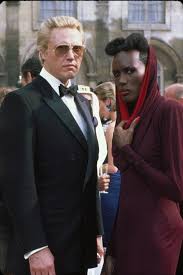
One last time into the breach, with Roger Moore. Probably the most famous thing about A View to a Kill was the theme song that shot Duran Duran to #1 and gave them a Golden Globe award. Eon coaxed Moore, 57, into doing “just one more” Bond film. He apparently was more than reluctant, especially when learning that he was older than his co-star Tanya Robert’s mother. Unlike Never Say Never Again (1983), the film makes zero references to Commander Bond’s age. Instead we get improbable fights on top of the Golden Gate Bridge with an ax wielding Christopher Walken. No sharks, but Walken and Grace Jones, both completely maniacal, are entertaining enough.
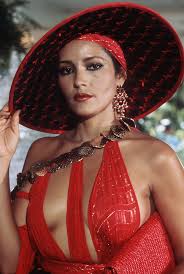
The casting of AVTAK is pretty eighties. Casting Christopher Walken as this episode’s evil capitalist is a delight (although the part was originally offered to David Bowie, and then Sting). There’s a part where Walken is trying to escape in his personal blimp where he screams, “More power!” and I just heard cowbell in my head. This episode’s Bond “girl” is former Charlie’s Angel Tanya Roberts, fast off her acting magnum opus, Beastmaster. The role was intended for Priscilla Presley, but Presley had a conflict due to her role on Dallas. (A pause here to imagine the scenes with David Bowie and Priscilla Presley. What could have been.) This was also the final time we would see Lois Maxwell, 58, in the perennial role of Miss Moneypenny, there from the very start in 1962.
The plot of A View to a Kill is pretty thin. Walker’s character, Max Zorin, wants to destroy Silicon Valley with a manmade earthquake so he can corner the microchip market. (These evil capitalists tend to spend massive amounts of capital on the plots to maybe make a little more capital. Maybe they should just invest in government bonds.) He’s the product of a Nazi genetic experiment, so he’s a bit kooky. He has a girlfriend, who is also assassin, played my great music star Grace Jones as May Day. Jones would release her brilliant album, Slave to the Rhythm, later that year. There’s the usual globe hopping. A ski-chase in Siberia where James skis on one ski (last time it was with one ski pole) and invents snowboarding. There’s a spectacular base jump off the Eiffel Tower that ends with 007 driving half a car along the Seine and then (literally) crashing a wedding party. And there’s James scuba diving in the dirty San Francisco Bay, almost getting sucked into an intake tube. The sexual double entendres are dialed back ( “A little restless but I got off eventually”), but director John Glen knows how to ramp up the Saturday matinee action. The chase scene through the streets of San Francisco with Roberts driving a hook and ladder fire truck and the senior Moore swinging from the ladder is one for the ages.
For Roger Moore’s final James Bond (1973 – 1985), lets put him through the wringer on more time.
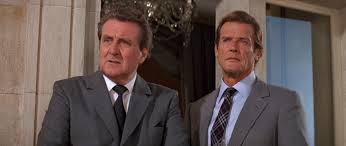
Driver of Action – The film really has two parts. The first involves Zorin’s horse selling business in France. Here, Bond shares the story with Sir Godfrey Tibbett, an MI-6 agent who is also a horse trainer (played by another Avengers alumni, Patrick Macnee). The second part of the story front-actions Stacey Sutton, Roberts’ character, who is a geologist whose father’s oil company was bought by Zorin. In both we get (very thin) backstories, but it does feel like Moore “shares” the story.
Role of Violence – Bond doesn’t really use his license to kill in 1985. He even winces and grabs his hand after punching a henchman in the face. Where the violence comes from is Walken’s character who laughs and smiles as he machine-guns hundreds of his own workers to death. It’s the first bloodbath in a Bond film and it’s jarring. But he IS the product of a Nazi experiment, so…
Vulnerability – Bond does seem genuinely bothered when Tibbett is murdered (by May Day), saying, “Killing Tibbett was mistake” to Zorin. He’s not as bothered when CIA ally Chuck Lee is murdered (also by May Day). Side note: You’d think that MI-6 and CIA agents would know to ALWAYS look in the backseat of the car before getting in. Moore’s Bond is always zipped up tight. He finishes the series as he started in Live and Let Die, stay calm and don’t give a damn.
Sexual Potency – Here’s where the formula comes through – The Eon promise of three + women bedded per film. The opening sequence ends with 007 in a submarine disguised as an iceberg driven by a beautiful blonde. We assume she’s MI-6, but she could be just a local submarine/iceberg driver. James tells her, “Be a good girl and put her on automatic.” Cue Duran Duran song. Bond also has some rough sex with Grace Jones character in France. Then, in SF, he hooks up with sexy KGB agent Pola Ivanova in a hot tub. (The part was written as Major Anya Amasova, but Barbara Bach declined to reprise her role from Live and Let Die.) “Would you like it harder?” He asks as he rubs her back. Then in the film’s closing scene that first zooms in on a bowl with the word “pussy” on it (the cat’s bowl), he bags Stacey in the shower of her house, with Creepy Q watching via his new robot, reporting to M that, “He’s just cleaning up a few details.” I guess since the film started with Bond boning on a boat, they’d let him finish (for once) on land.
Connection – One might hope that Bond approaching 60 would develop attachments to other human beings. He seems even less invested in his MI-6 colleagues, including Moneypenny and Q, than ever. They are just background scenery. You’d think that since Moore was leaving the series after a dozen years (as was Lois Maxwell after 23 years), the screenwriters would have added some sentimentality to the story. Nope. Moore plays Bond as unconnected as ever, fading into the sunset as a caricature of the lonely man.
Toxic Masculinity Scale: 3
Summary
A View to a Kill could have been grand send off for Sir Roger Moore, but Moore himself disliked the film. “I was horrified on the last Bond I did. Whole slews of sequences where Christopher Walken was machine-gunning hundreds of people. I said ‘That wasn’t Bond, those weren’t Bond films.’ It stopped being what they were all about. You didn’t dwell on the blood and the brains spewing all over the place.” We do get some Bond staples, like 007 in a tux and white dinner jacket. There’s not an underground lair, but there is a giant mine cave that’s basically an underground lair. (And I’d like to go back in time and inform Eon Productions that there are SHARKS in San Francisco Bay.)
There are some hints of progress. Women’s names start to pop up in the credits, including casting and unit manager. Producer Cubby Broccoli’s daughter, Barbara Broccoli, had been a Bond assistant director since Octopussy. Bond doesn’t immediately bed Stacey, even after two bottles of wine. He tucks her in and then sleeps in the chair with a shotgun in his lap. (That’s a good grandpa.) When a henchman spots Stacey’s heels on the mine sight, undercover James quips, “It’s women’s lib. They’re taking over the Teamsters.” While we are yet to get a lead female villain, Grace Jones as the bad guy’s #2 is pretty powerful (even if she’s played with a bit of a “black animal” trope).
Side Note 1: This the 16th Bond film I’ve watched in this series and I’ve seen hundreds of rounds of ammunition fired at our James. Maybe thousands. Never has a bullet come close to him. If MI-6 has the technology to make bullets go around their agents, they should tell us!
Side Note 2: I’ve long said that I ever win Powerball, I will first buy a personal blimp. A View to a Kill makes me believe that is possible.
A View to a Kill premiered in San Francisco on May 22, 1985, as cans of New Coke were hitting the shelves. Maybe the world was ready for a change but not sure what that change should be. Near the end of the film, Bond gets a meddle from the KGB for taking out Zorin, the joke being that the Soviets get their technology intel from Silicone Vally. The film was released a year before glasnost came to the USSR. Maybe 007 knew something we didn’t. I’ll leave Moore’s line as horny Bond to close this chapter. “On a mission I am expected to sacrifice myself.” Oh, James.
This series is intended to evaluate each product of the James Bond film franchise through a feminist lens, and the relevance of the Bond archetype to shifting ideas of masculinity in the 2020s.
Never Say Never Again (1983, directed by Irvin Kershner)
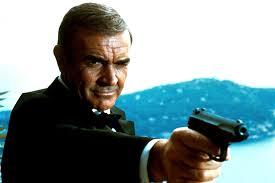
Never Say Never Again has everything you want in a James Bond film; exotic locations and women, Blofeld, cool gadgets, stolen nukes, double entendres, sharks, and Sean Connery. After completing Diamonds are Forever in 1971 and saying he would never play 007 again, Connery was lured back into the role by producers Kevin McClory and Jack Schwartzman. Connery, at 52, was still younger than his Eon Productions counterpart Roger Moore, but the non-canonical Bond film, Connery’s last, would poke fun at the aging agent while still delivering classic Bond tropes.
The return of Ernst Blofeld and his white cat, who were killed off in 1981’s For Your Eyes Only, serves to remind us that we are not in the official BCU (Bond Cinematic Universe). It does however bring back SPECTRE and the thrill of an evil global plot. Blofeld (played by Max von Sydow) directs billionaire businessman and SPECTRE Number 1 Maximillian Largo (played by Klaus Maria Brandauer, who seems to have greatly inspired Elon Musk) to hijack some Navy nukes to extort the world. Sexy assassin SPECTRE Number 12 Fatima Blush is played by Playboy model Barbara Carrera, who passed up a role in Octopussy to work in a Connery Bond film. NSNA’s Bond “girl” was played by Kim Basinger, in the role that launched her career. While NSNA has a less polished feel than the Eon catalog, Irvin Kershner, director of the 1980 blockbuster The Empire Strikes Back, gave the film a tight pace as 007 hops around the world.
The film gives us a younger, more bureaucracy-bound M, and a Q who complains about the bureaucracy. When Bond enters Q’s lab, Q says, “Good to see you, Mr. Bond. Things’ve been awfully dull ’round here. Bureaucrats running the whole place. Everything done by the book. Can’t make a decision unless the computer gives you the go-ahead. Now you’re on this. I hope we’re going to have some gratuitous sex and violence!” And we get that and more, including a return to the Bahamas and the film debut of Mr. Bean’s Rowan Atkinson as Nigel Small-Fawcett.
While not in the “official” 007 catalog, let’s analyze it for fun.
Driver of Action – If you’ve got Sir Sean Connery, you might as well let him drive the whole damn film. From the first jungle battle scene to the last underwater fight scene, this is a James Bond film. We do get the return of CIA agent Felix Leiter (this time played by former San Francisco 49er Bernie Casy) who shows up 57 minutes into the film, but he’s in the usual minor support role. There are no real storylines that compete with the spectacle of 007.
Role of Violence – In the opening scene Bond kills a bunch of dudes with varying means (including a blowdart), but it’s revealed to be a training exercise. He does kill a would-be assassin with his urine (don’t ask) and later blows up Fatima Blush, leaving her smoking high heels on the ground. Old Bond fights a lot but you get the feeling that he’s just not cut out for the fisticuffs anymore.
Vulnerability – Much is made in the start of the film about James advanced age. He laments that M doesn’t have much use for “double O’s” anymore and that he’s “teaching not doing.” M sends him to a health farm to get fit and get rid of his “free radicals,” accusing him of, “too many dry Martinis.” Bond being Bond dutifully goes but smuggles in Beluga caviar, quails eggs, vodka, and foie gras.
Sexual Potency – Sean Connery fans paid for Classic Bond, so the women needed be laid out like a buffet. While the banter with Ms. Moneypenny is tepid (James: Still here, Moneypenny? You should be in bed. Moneypenny: James, we both should be!), James does bed four women in the film. The first is the chiropractor at the health farm, Nurse Patricia Fearing. Then he gets busy with Fatima Blush, on a boat in Nassau. (James: You’re marvelously well equipped. Fatima: Thank you, James. So are you.) Then he’s in the sack with some unnamed woman he met on a fishing boat. Finally, he ends up making sweet love to Kim Basinger’s character, Domino, on a Navy Submarine. In 1983 the AIDS epidemic was still largely confined to gay and IV subcultures, so this was probably our James’ last hurrah.
Connection – In this film we see James Bond wrestling with his age, but still not willing to let his guard down and open up. There is a glimpse at the end. Since two “boat sex” encounters were ticked off in the film, Never Say Never Again ends with James and Domino back in the Bahamas. Domino brings him a fruity drink instead of his martini. He moans and she says, “You’ll never give up your old habits, James.” He replies, “No, you’re wrong. Those days are over.” Is he ready to settle down with the girl from Athens, GA? The film ends with Connery winking at the camera.
Toxic Masculinity Score: 5
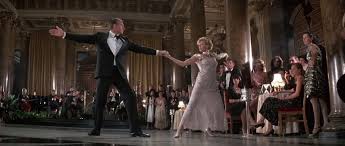
Never Say Never Again comes with plenty of Bond cliches, including watches with lasers, a pool full of bikini clad babes, James in a tux, and all his “Is that about sex? quips. (“Going down, one should always be relaxed.”) As a non-Eon film, the score and the theme song suck. But the rocket motorcycle chase in Nice, France and the scene with the sharks (Are those frickin’ lasers on their heads?) are pretty awesome. The film drags a bit with Connery’s lethargy and there is a really weird scene of Bond and Domino dancing a tango after he beats her boyfriend at a video game that seems way too eighties.
Bond as the sexual conquerer is also paired with his role of the rescuer of women. Domino is tied up on an auction block to be sold as a slave in North Africa. James literally rides in on a horse to save the damsel in distress. Fortunately, she saves him later in the film by shooting a speargun into her former lover as he’s about to kill Bond. There’s also the scene where he kills Fatima after commenting on her “hatred of men.” Seemed misogynistic to this viewer.
Never Say Never Again premiered in the U.S. on October 7, 1983, just four months after Octopussy and sold fewer tickets. There had been some talk about bringing Connery back in for a new series of Bond films to rival the Eon franchise, but you could tell that the Scotsman’s heart just wasn’t in it. Connery would go on to star in iconic eighties films like Highlander, The Name of the Rose, and The Untouchables, and leave 007 behind on some boat with some random damsel in distress.
Many of us watched the February 28th White House meeting with Ukrainian President Volodymyr Zelenskyy is abject horror. One of our most heralded allies was being attacked by Trump and Vance like a child being berated for breaking a window with a baseball. Then it became clear that it was the set up. An ambush for Trump’s Russian bosses. Vance badgering him to apologize. Marjorie Taylor Greene’s boyfriend chiding him about not wearing a suit (when few of Trump’s White House chums have). I wanted Zelenskyy to just say to Trump, “Mr. President, are you aligned with America’s ally, Ukraine, or Putin?”
We know what Trump would have said – “I’m not aligned with anybody.”
In that moment, it was clear that America was no longer the leader of the free world. That our allies could no longer rely on us and that we weren’t going to lift a finger to defend democracy. In that moment, Trump gave Putin the green light to obliterate Ukraine. At the United Nations, we voted with Russia (and North Korea) against the condemnation of Russia’s 2022 invasion. The following actions backed that position up, including halting support of military aid to Ukraine, ceasing cyber operations against Russia, mass firings at the CIA and FBI, and Trump asking to end U.S. sanctions against Russia. What more could Vladimir Putin ask for? (I’m sure we’ll find out.)
Trump’s capitulation to Russia and the falling in line of the MAGA cult rings familiar. In the years before the attack on Pearl Harbor, there were Americans, including in Congress, that thought the United States sending billions of dollars to our European allies to fight Nazi Germany was a big ol’ waste. Those nations weren’t sufficiently “grateful.” This included after Germany began their brutal blitzkrieg of Great Britain in 1940. They wanted England to at least give us some of their islands in the Caribbean for helping them. But FDR said, F that. We’re all in for freedom.
What launched the American century began in the first global conflict. During the “war to end all wars” (aka WW I), isolationist voices had the day, until it was clear that Britain and France REALLY need our help (and a ton of American merchant ships were being sunk by U-boats). On April 6, 1917, we declared war on Germany and shut that shit down. By November of the following year, the war was over. And the United States was the new hot shot defender of freedom, our perfect hair blowing in the wind. Ever since that moment in 1918, lovers of freedom and democracy knew we were their ride or die. Sure there were some ethical lapses, Central America, Vietnam, but for the most part we were the good guys on the planet.
That ended last Friday. The global realignment, long envisioned my MAGA architects, has jettisoned its long held alliance with Europe, viewed as decadent by Steve Bannon and white nationalists, in favor of an allegiance to authoritarian regimes like Russia. France is “socialist” and Moscow has clean subways. Sure, political dissidents are thrown into Siberian prisons, but Moscow has clean subways. We are now a part of the axis of evil and Trump and his handlers could not be happier.
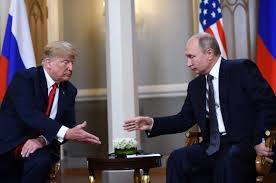
I often tell the story of the time I was at a meeting at the U.S. embassy in London in 2018. I was there as a part of a government-funded trip to study how the British respond to violent extremism. We just happened to be at the embassy the day President Trump was attending a summit in Helsinki, Finland with the Russian leader. We all watched the press conference where Trump famously said that he trusted Putin’s assertion that Russia didn’t interfere in the 2016 election, over the evidence presented by his own intelligence agencies. The shock among the career diplomats I was watching with was palpable. They immediately scrambled to craft a response to the fact that the U.S. President and had just publicly chosen loyalty to the biggest dictator on the planet over his own nation.
We don’t know if Putin has some serious kompromat on Trump (perhaps the pee pee tapes are in a vault in the Kremlin) or Trump just really wants to be an authoritarian (or both), but Trump’s mandate is clear. He’s out for himself. He’s never read the Constitution, or The Bible for that matter. I’d lay odds he’s never read a complete book. He’s the transactional president. If it serves him and the sycophants that kiss his ass, he will throw Americans and their security under the bus. He will wage war on our allies, like Canada and Mexico, and sing the praises of dictators like Turkey’s Erdoğan and Hungary’s Orbán. Whatever fluffs his fragile ego.
Trump is murdering America.
So, sorry Ukraine, and other nations fighting to be free and democratic, we now have our own fight to win.












 Watching the Wheels