Are Third Places Democracy’s Last Hope?

From The Blazak Report (July 24, 2025)

July 24, 2025

My parents met in a bowling alley. A lot of my generational peers’ parents met in bowling alleys. Those days are long gone. As sociologist Robert Putnam detailed in his 2000 classic, Bowling Alone: The Collapse and Revival of American Community, nobody joins clubs anymore and our happiness has suffered for it. We are a nation of miserable loners. No wonder people identify with Trump.

A land of 340 million people staring at their phones does not make for a vibrant democracy. COVID was the nail in the coffin of civic engagement. We were locked down with Netflix and we liked it. Why build community when you can binge Love Island? Why prioritize democracy when you can doom scroll. And now you can share your alienation with your AI girlfriend.

All this loneliness is catnip to fascism. Where we got endorphins from meeting people at parties and pubs, we now get it from likes and algorithms. Fascism will walk in while we’re on TikTok, and be just another 60 second reel.

Let’s hope for a countertrend. And the countertrend is actually pretty cool.
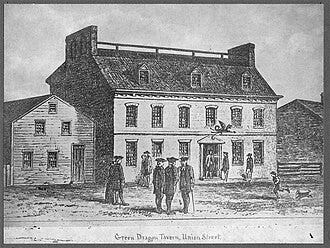
As a college student, I probably over-romanticized the mythology of revolutions and protests being born in cafés and coffeehouses, but there is some truth to those stories. Rejecting British tea, the political discussions in the American colonies moved to coffeehouses. The Green Dragon tavern and coffeehouse, built in 1701 in Boston, became known as the “headquarters of the revolution” after Paul Revere bought it 1764 to give the Sons of Liberty a meeting place.

Sociologist Ray Oldenburg, in his 1989 book, Coffee Shops, Bookstores, Bars, Hair Salons, and Other Hangouts at the Heart of a Community, refers to places like the The Green Dragon as “third spaces.” First place is home and second place is work. Third spaces are the community gathering spots where we have regular interactions with our neighbors. They include bars and barbershops, cafés and churches, local stores and hair salons. Anyplace people hang out. In the new 2025 edition, Oldenburg’s coauthor Karen Christensen argues that third places are the answer to political polarization and climate resilience. It’s like that Sesame Street song, who are the people in your neighborhood?

Third places are vital to democracy to several reasons. Putnam argues these places create social capital among community members, building trust which is key to democratic action. Taverns and barbershops encourage free expression and the exchange of ideas. Many a night in my youth I argued theory at cafés until the chairs were on the tables. Third places become places for building social movements. Yeah, Hitler did it in beer halls, but we can hijack Starbucks to fight fascism. Third places are a cure for isolation as we reconnect with fellow travelers. Finally, democracy requires a sense of shared ownership and salons and local shops can help people to care about public life and bond over shared struggles.
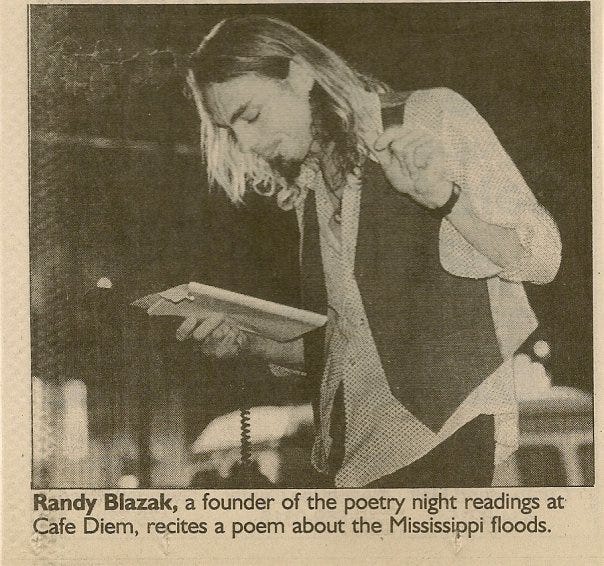
In the 1990s, I had a third place I virtually lived in in Atlanta called Café Diem. To say I held court there would be an understatement. But the realization that inhabiting that space and getting to know owners, employees, and regulars was more rewarding than sitting on a couch in front of a TV made it an easy lifestyle choice. Much bohemian joy came from what we lovingly referred to as “Diemland.” Social media has zapped that impulse in the 21st century. We’re zombies.

But the counter-trend is bubbling off screen. Two years ago a group of dads at my daughter’s elementary school started a poker club and it’s become medicine for my soul. Every other Thursday, cards, whiskey, and good conversation. People are re-discovering their local coffeehouses, not as alternative offices, but place just to talk and share the emotions of this insane moment. Churches, mosques, and temples aren’t just for religion anymore. I actually went to a great local church, called Riversgate, to hear people talk about political civility! It was awesome!

So let’s get out of our first place and find a third place. You don’t have to dive in like a crazy person. “Hi everyone! What the fuck are we gonna do about this fucking fascism?” Ease in like you’re a new kid at school. Third places are relaxed. Belly up to the bar and check the vibe. You might talk about a ball game or the history of the establishment long before you bridge political chat. Maybe you’ll just hang out reading a book until somebody asks you what you’re reading. But that’s your place and those are your people. It’s time to get to know them. Democracy might depend on it.

The American Revolution started in a coffee house. And it will again.

What Do We Do When the Violence Comes?

From The Blazak Report on Substack July 10, 2025

If we’re using history as our guide, we know it’s coming. The state sponsored violence against citizens. It’s already here at the hands of ICE and the violence against women’s body’s in the restriction of reproductive rights. But we can expect more waves of escalation. An ICE abduction that goes sideways when they try to kidnap an armed individual who does not want to be deported to some third country gulag. Protestors shot by National Guard who are unsure of their engagement orders, brains in fight or flight mode. The attempted arrest of Trump’s political prisoners who stand up to the weaponization of federal police. Critics of the regime who end up dead as is common in Putin’s Russia. We are a powder keg nation, one Kent State away from exploding. And that may be exactly what Trump wants.

Trump loves to cosplay strongman. He’s already sent the Marines to Los Angelos. He’s hellbent on turning America into one of those “shithole countries” he shit talks about. The slightest escalation could cause him to bring the hammer down so he can prove he’s an “alpha.” Then he has his pretext for suspending elections and cementing his police state rule. History has told this story before.

So how do we respond to the worst provocations of state violence?

The right has long argued for the need of a second American revolution against the multicultural liberal democracy that has sought to dethrone straight cis WASP men. (Can we start using SCWASPM, or is that too much?) The left is now quoting founding fathers like Thomas Jefferson. “The tree of liberty must be refreshed from time to time with the blood of patriots and tyrants.” Hidden among the peaceful protestors have been anarchists holstering side pieces. Is this the preamble to civil war?

I will admit the thought has crossed my mind. As someone who has had some weapons training, arming up for the coming shit show has been considered. But then I realize that’s a Hollywood fantasy of me protecting my family from Proud Boys and federal forces with an unlimited supply of ammo and slow mo John Rambo rage. It looks super cool in my head.

There will be blood. And there will be calls of retribution.

But, again, if history is our guide, we know that non-violence is the path. This isn’t the 18th century. For the last hundred years the model for the restoration of democracy has been built on mass uprisings that used peaceful means. They don’t always work. I’ll never forget watching the carnage in Tiananmen Square in 1989. But sometimes it has. (I also remember watching The Philippines and the People Power Revolution of 1986.) There will be casualties and it’s going to be heartbreaking. But the dictates of civil disobedience requires us to throw our bodies upon the wheel. Those deaths will be the seeds of a rebirth of democracy in the United States and their names will be cherished.

This moment, this terrifying moment in this terrifying history, could use a singular voice. We need an MLK or a Václav Havel to constantly remind us that the peaceful path is the most effective. To help us to channel our rage. An army of left-wing Timmothy McVeigh’s will not bring us the revolution we need. We can storm the ICE Bastille to liberate the prisoners of Trump’s race war. Or we can use our moral authority to transform those jailers to join us in the great experiment of democracy. In the absence of our Dr. King, we will have to be that singular voice.

We must hold the line and not become them. We’ve got the numbers and the moral arc.

The James Bond Project #24: Quantum of Solace (2008)

This series is intended to evaluate each product of the James Bond film franchise through a feminist lens, and the relevance of the Bond archetype to shifting ideas of masculinity in the 2020s.

Quantum of Solace  (2008, directed by Marc Foster)

July 1, 2025

I wonder if ChatGPT could tell me which 007 movie had the most bullets fired at James Bond. I’m guessing Quantum of Solace would be in the top three. Thousands of rounds. After two dozen films and millions of bullets, I’m convinced our James has a magical forcefield around him. Is it wrong to want to see Bond shot just once? I mean, he’s shot so many people since 1962. Where is the equity?

Quantum of Solace is framed as somewhat of a sequel to Daniel Craig’s first Bond film, Casino Royale, as he seeks revenge for the killing of Vesper, who M described as “someone you loved.” But, because of the writers’ strike, it gets folded into a different film about another Elon Musk-like billionaire trying to corner the market on fresh water in South America. Directed by Marc Foster (Monster’s Ball, The Kite Runner), who in 2013 would direct my favorite zombie film, World War Z, QoS is a non-stop action film. Craig trained for the role this time but still sustained multiple injuries during the film, including losing the tip of a finger.

Maybe because this film was set up as a revenge caper for the death of Vesper in the last film, the fast cracking Lothario Bond is dialed way back and replaced with the one speed demolition man.  This episode’s Bond “girl” is Ukrainian actress Olga Kurylenko, playing Bolivian agent Camille Montes. (Future Wonder Woman Gail Gadot also auditioned for the role.) Kurylenko, who did many of her own stunts, went on to a long action film career, most recently starring as Taskmaster in 2025’s Thunderbolts*. French actor Mathieu Amalric, who plays the villainous Dominic Greene, broke the Bond mold of bad guys having some weird distinguishing characteristic. He’s just a dude.

Besides the endless hail of bullets, there are some Bond staples in QoS; Bond in a suped-up Aston Martin, Bond in a tux, Bond falling out of an airplane without a parachute, and a wide variety of exotic locations, including Haiti (with no references to voodoo!). This film is somewhat of a departure in that M, still played by Judi Dench, takes almost a co-starring role as she both helps Bond and tries to reign him in. It has a different feel because of that so let’s plug it into our matrix.

Driver of Action – James Bond movies will always be “James Bond” movies but I started to wonder if the formula of the femme fatale who was good in a fight, Camille in this picture, was tweaked to have Bond teamed up with a male crime fighter, if the film would have a different feel. With the exception of Michelle Yeoh in Tomorrow Never Dies, Bond’s female accomplices always seem very subordinate. QoS see the return of CIA gadfly Felix Leiter, but he’s relegated to the shadows. What’s different here is the upsized role of Judi Dench’s M. It’s almost a movie about Mom/Mum/Mam trying to discipline her wild boy. Dench was not given co-billing but it feels as much her film as it does Craig’s.

Role of Violence – 007 maximizes his license to kill in this film. Over two dozen bodies stack up, including a traitorous MI-6 agent shot after an insane rooftop chase in Sienna, Italy, a hitman killed in a knife fight in Haiti, and the main bad guy left to die in the driest desert on earth in Bolivia. Bond even instructs Camille how to kill. “Have you ever killed someone? The training will tell you that when the adrenaline kicks in you should compensate. But part of you’s not going to believe the training because this kill is personal. Take a deep breath. You only need one shot. Make it count.”

Vulnerability – QoS Bond is zipped up tight. I don’t think he even smiles once in this film. It’s re-iterated throughout the film how little he cared about Vesper, the last scene not being Bond in a boat with a woman, a flagrante delicto, but Bond throwing Vesper’s neckless into the Russian snow. Even bloodied, he’s laser-focused on the mission, whatever it is.

Sexual Potency – An hour into the film, James finally gets to unzip his pants. It’s with MI-6 underling Strawberry Fields (I’m not kidding). In an act of obligatory sexual harassment of company subordinates that’s become the most persistent cliche of the franchise, Bond gets his romp. There is no flirtation or chemistry. It seems purely contractual and you know that Ms. Fields will be dead before the end of the film. (Her naked body in a bed covered in oil, a nod to the famous scene in Goldfinger.) That’s it for the sex. He briefly kisses Camille, but it’s just sad all the way through for James.

Connection – There is one interesting bond in this Bond film, and that’s between James and M. She comes off as the strict mother, even applying face cream while she frets that her boy has gone off the rails. At the end of the film, she says, “Bond, I need you back.” To which he replies, “I never left.” Bond’s need to prove the threat of Quantum seems purely to prove the threat to M.

Toxic Masculinity Scale: 5

Summary

How can you be unhinged without appearing unhinged? QoS Bond is not a man. He’s a killing machine trying to prove a point that, ultimately, he doesn’t care about. But there’s a weird sense of balance in this film. On one side you have NONE-STOP action scenes, including classic Bond boat chases and airplane chases. On the other side, there’s the chunk of the film that is about M holding MI-6 and the entire geo-political order together. The brilliant theme song by Jack White and Alicia Keys hints at the promise of gender parity in the film, but it all goes off the rails amid the chaos. This includes the complete destruction of a hotel, that for some weird reason, is powered by hydrogen fuel cells. 

It should be mentioned there is an attempted rape scene. A woman working for exiled Bolivian General Medrano attacks her on a bed but is then killed by Camille, avenging the rape and murder of her family by the general.

Despite any real plot, Quantum of Solace was a box office smash, sailing on its over the top action sequences. You can literally hear Daniel Craig’s bones break in these scenes. The filming of this Bond coincided with the rise of the opioid painkiller epidemic so QoS doubles as a direct to consumer ad for OxyContin. The absence of Q and Moneypenny is made up for in the presented mythology of the indestructibility of the “good guy.”

Quantun of Solace premiered in London on October 29, 2008 as the American financial crisis, now known as the Great Recession, was just starting to drive Americans from their homes. QoS, Madagascar 2, and Twilight would give people brief escapes while the global economy crashed into a sinkhole. But steely-eyed assassins would not rescue their hope. It would be a man named Barack Obama.

Next: Skyall (2012)

The James Bond Project #23: Casino Royale (2006)

The James Bond Project #22:  Die Another Day (2002)

The James Bond Project #21:  The World Is Not Enough (1999)

The James Bond Project #20:  Tomorrow Never Dies (1997)

The James Bond Project #19: GoldenEye (1995)

The James Bond Project #18: License to Kill (1989)

The James Bond Project #17: The Living Daylights (1987)

The James Bond Project #16: A View to a Kill (1985)

The James Bond Project #15: Never Say Never Again (1983)

The James Bond Project #14: Octopussy (1983)

The James Bond Project #13: For Your Eyes Only (1981)

The James Bond Project #12: Moonraker (1979)

The James Bond Project #11: The Spy Who Loved Me (1977)

The James Bond Project #10: The Man with the Golden Gun (1974)

The James Bond Project #9: Live and Let Die (1973)

The James Bond Project #8: Diamonds are Forever (1971)

The James Bond Project #7: On Her Majesty’s Secret Service (1969)

The James Bond Project #6: You Only Live Twice (1967)

The James Bond Project #5: Casino Royale (1967)

The James Bond Project #4: Thunderball (1965)

The James Bond Project #3: Goldfinger (1964)

The James Bond Project #2: From Russia With Love (1963)

The James Bond Project: #1: Dr. No (1962)