In this world of soundbites, memes, and famous quotes as commodities, there are few people that are more misquoted or quoted out of context than Martin Luther King, Jr., who we celebrate today. I could make a full-time job out of correcting white people who quote one line in Dr. King’s 1963 “I Have a Dream Speech” to absolve themselves of the accusation of racism or cast the Black Live Matter movement of undermining King’s “dream.”
“I have a dream that my four little children will one day live in a nation where they will not be judged by the color of their skin but by the content of their character.”
They don’t know anything about the speech or why he gave it, other than that line. “Well, I was raised to be colorblind, so we’re good.” A. No, you weren’t, and B. No, you’re not. King was very clear in the context of THAT speech (You don’t have to read anything else!), that that dream cannot be realized UNTIL we dismantle the systemic racism that disadvantages people of color. You don’t get your “colorblind” desert if you have not first fixed the problem of racism. And, white people, we have not fixed the problem of racism. In 2021, MLK’s daughter, Bernice King, tweeted, “Please stop using out of context quotes from my father to excuse not working to eradicate racism. His ‘content of their character’ quote lies within a full speech, ‘I Have A Dream,’ in which he talks about ending racist police brutality and economic injustice.”
There’s another oft repeated line from King that bears revisiting in the contemporary context.
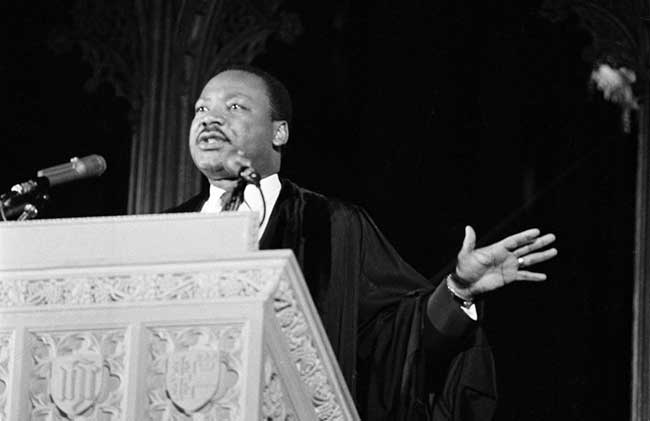
MLK’s last Sunday sermon was on March 31, 1968 at the National Cathedral in Washington DC, where he famously said, “The arc of the moral universe is long, but it bends toward justice.” He was there to preach about American poverty and the Vietnam War. That day he also said, “This day we are spending five hundred thousand dollars to kill every Vietcong soldier. Every time we kill one we spend about five hundred thousand dollars while we spend only fifty-three dollars a year for every person characterized as poverty-stricken in the so-called poverty program, which is not even a good skirmish against poverty.” But it’s the “moral arc” line you will see on social media today.
I always took great comfort in his moral arc quote. It made me feel that I was on the right side of history. That we might lose a battle here and there but the larger victory of social justice would be attained. “We shall overcome, someday.” Someday. That must have been motivating to civil rights activists in 1968, who had experienced their fare share of setbacks. President Obama loved the line so much he had it sown into a rug in the Oval Office.
But the problem is that there is a false comfort in the historical determinism of that line. That the defeat of the forces of inequity is an inevitability. It WILL happen. Now it should be pointed out that for Dr. King, a Christian minister, “justice,” was likely defined more theologically than sociologically. The “moral arc” line was borrowed from 19th century clergyman Theodore Parker. But for the rest of us, it meant that, sooner or later, racism would be vanquished and we could live in Star Trek-world, were things like racism, poverty, and homophobia would be sad relics of ancient centuries.
More I study history, the more I think that is a dangerous idea. Just ask Plato what happened to his vision for a just society. (Quick answer – Romans.)
I like to start all my sociology classes with a discussion of the Enlightenment. In the 1700’s, when we finally began to pull ourselves out of the centuries-long “dark ages,” when the anti-science “church” burned people at the stake, and the landed gentry ripped people’s bodies apart with such regularity, they created some serious intergenerational white people trauma. This “age of reason” gave us our modern sciences and the democratic experiment that is the United States of America. The values of rationality and empiricism guide us to this day, whether it is expanding voting access or sending probes to Uranus.
But will this enlightenment last forever?
Scholars generally mark the intellectual explosion that occurred after the death of Louis XIV of France in 1715 as the start of the Enlightenment. But are we still in the Age of Reason? There was much discussion in the early 2000s, after the 9/11 attack by religious fanatics and George W. Bush’s war on climate science, that the Enlightenment was over. A new dark age was upon us. The rise of anti-intellectual and anti-Democratic aspiring authoritarians like Donald Trump would point us in that direction. The nihilism of the MAGA movement could not be more counter to the basic principles of the Enlightenment.
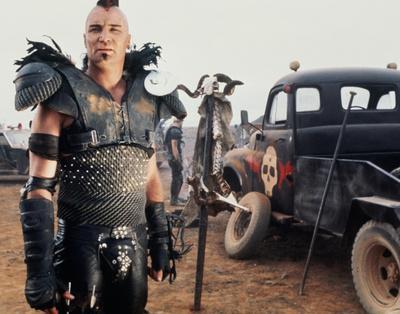
Students of history can easily point out the fallacy of MLK’s “moral arc” claim. History is more like a pendulum than an arc. Two steps forward, one step back. The science (and ethics)-based future we get in Star Trek may be promised, but it is not guaranteed. (And MLK was a Star Trek fan.)The future might look a lot more like Road Warrior. It’s completely reasonable to say that when my daughter is my age, the United States of America might not even exist. There are no DEI programs in the MAGA dystopia.
In the face of a rapidly accelerating climate crisis, an expanding gap between the wealthy and the rest of us, and populist authoritarians, like Trump, who know how to politically instrumentalize our fears, our utopian fantasies of the future, where we live in King’s envisioned “beautiful symphony of brotherhood,” could go off the rails in a flash. The barbarians are at the gate and they have red caps and fully automatic weapons.
The title of Dr. King’s speech that Sunday was, “Remaining Awake Through a Great Revolution.” At the end of that speech, he proclaimed, “If we will but do it, we will bring about a new day of justice and brotherhood and peace.” The faith can’t be in the “moral arc.” Instead it must be in our dedication to redouble our work. Those who want to make America Jim Crow again are marching. Their voices are getting louder every day. I’m betting Martin would urge us to remain awake and put our shoulders to the wheel before the arc of the universe swings us into another dark age.
“And you never ask questions, when God’s on your side.” – Bob Dylan
December 27, 2023
The current bloody conflict in the Holy Land, also known as Israel and Palestine, has me reflecting on the challenges of breaking through religious dogmatism to find anything that looks like common ground. I’m sure there are currently Jews and Muslims alike who feel God is on their side of the conflict. I’m mindful of the 1431 trail of Joan of Arc in which the English were desperate to prove the teenaged “Maiden of Orleans” was a heretic and not carrying out God’s mission to drive the English from France in the Hundred Years War.
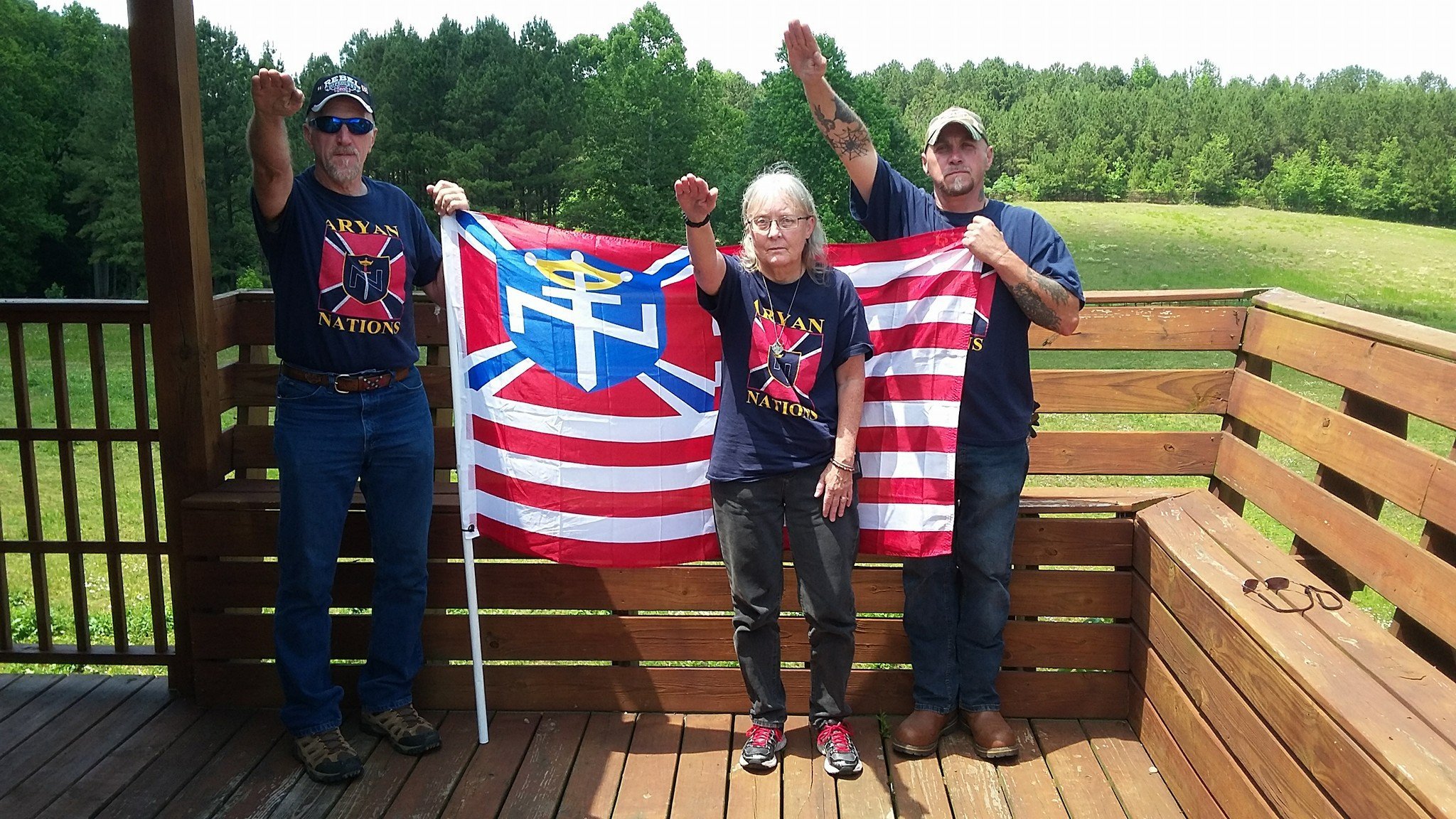
When I was working on my dissertation research on white supremacists, I spent a lot of time with members of the Ku Klux Klan and members of a religious sect called Christian Identity. They were all quite sure the Christian Bible mandated their racism. In fact, the doctrine of Christian Identity states that a white God created white Adam and Eve in his image and the Jewish race are the descendants of Cain and the Serpent (Satan) and are inherently evil. And what about non-white and non-Jewish people? Oh, they are all the offspring of the soulless beasts of Eden. “It’s right here in Genesis!” They would tell me, quoting chapter and verse.
When I would bring up the concept of liberation theology and how Martin Luther King, Jr. found a very different message in their sacred texts, they would tell me that all that was “the devil’s work.”
We are in a similar moment where chapter and verse are quoted around the world to legitimize political positions, whether it’s opposition to LGBTQ rights or in support of Hindu nationalism. While many, and I hope most, people of faith are open to conversations about how their faith frames their political views while honoring that there are alternative faith-based interpretations, there is a significant phalanx in all religious traditions who are quite convinced that they have the one true interpretation of scripture. To those of us on the outside, that dogmatism seems pathological.
While toxic dogmatism can come in all ideological and theological disguises, it can be particularly tricky for us folks on the outside to have productive conversations with those who don’t share our foundational beliefs. When we don’t agree on foundational premises, like in the authority of scripture, or if we use vastly different interpretive lenses to make sense of the same passage, common ground can seem impossible to find.
So how do you talk to someone who has God on their side?
In most settings this might be a situation where a person backs away slowly, so as to not get stuck in the tarpit of religious debate. There’s a great spot in London called Speaker’s Corner where people have those debates/shouting matches as a form of entertainment. The rest of us have more productive things to do, like doom scroll through our social media feeds. However, some of that dogmatism becomes violence very quickly. And we don’t have to go back to Joan of Arc and the Hundred Year’s War to see it. Just turn on CNN.
This project I’ve been working on for the past two years, called Cure-PDX, is charged with reducing political violence and some of that violence has a religious element. For example, there is an evangelical church in the region that has preached that God does not punish violence against gays and lesbians. There is a church right down the street from them that preaches a more inclusive message from the same Bible, and they have experienced vandalism from the anti-gay church. Here is an opportunity for us to bring in the de-escalation work before somebody gets hurt.
One of things that makes our team so well positioned to do the work is that we represent a wide variety of political and social positions; we are liberal and conservative, Buddhist, Christian, and wandering agnostic. We have pastors on our team that help facilitate outreach to various faith based communities and I thought I’d rely on their lived experience and vital insight into this matter. Here’s the question:
Americans often rely on their faith traditions to inform their political opinions. However, there are those who are so wedded to a narrow interpretation of their sacred texts that it often leads to the vilification of those who don’t follow the same interpretation, as well as others, who may all fall under some label of “infidels,” and may become targets for violence. For example, we’ve seen a spike in religiously motivated hate crimes across the country, as well as attacks targeting the transgender community. Given this dynamic, is there a way to talk to the more dogmatic members of faith communities that encourages them to accept more nuanced interpretations of text that allows them to take a step back from more hostile rhetoric?
I asked this question to Pastor Jeff Hoover, who founded and pastored a church in Longview, Washington for 31 years, when he got a new “assignment.” Today, he leads an organization called CitiServe of Cowlitz County, where he walks with pastors and leaders, encouraging, equipping, and uniting the church in the local area and is a new member of our Cure-PDX team.
“I feel the key to having a conversation with someone you may disagree with is curiosity. Instead of going into a potentially difficult conversation wanting to prove or discover who is right or wrong, go in with authentic curiosity about just how the other person arrived at their particular viewpoint. It is astounding just how much we can learn from and about each other if we would simply be open to see things through someone else’s eyes.”
Pastor Jeff hit on a key tool that has been so useful in this project, the power of curiosity; the power of asking instead of telling. Between people’s strongly held beliefs and their relationship with the world is a whole backstory worth investigating. Spending time getting to know a person will likely create more openings in that dogmatic wall than going at it with a sledgehammer of counter arguments.
Sociologists use the term “religiosity,” to describe how committed people are towards their faith traditions. Some completely define themselves by their beliefs and practices, bordering on fanaticism. Others have no engagement with any religious beliefs or practices. Most folks are comfortably somewhere between those two poles. (You will find me at mass most Christmas Eves, on my knees praying for peace, and the other 364 days of the year offering lectures on the problems of religions rooted in Bronze Age thinking.) But, unless there is a mental health issue involved, even people on the “fanatical” end of the religiosity spectrum have a very human story about how they arrived at their conclusions.
We are looking for ways to interrupt violence. Much of this work has to do with finding ways to identify common values with people who may be escalating towards violence. I’m guessing matters of faith provide a perfect place to find those values.
Note: Thank you to team member Ryan Nakade for some of the framing in this piece.
As a “subject matter expert” on right-wing extremism, I often get asked, “What about the left?” There are obviously some stark differences between the two political wings (I would offer bodycount as one measure), but there also might be some parallels worth considering as we look for ways to reduce political violence.
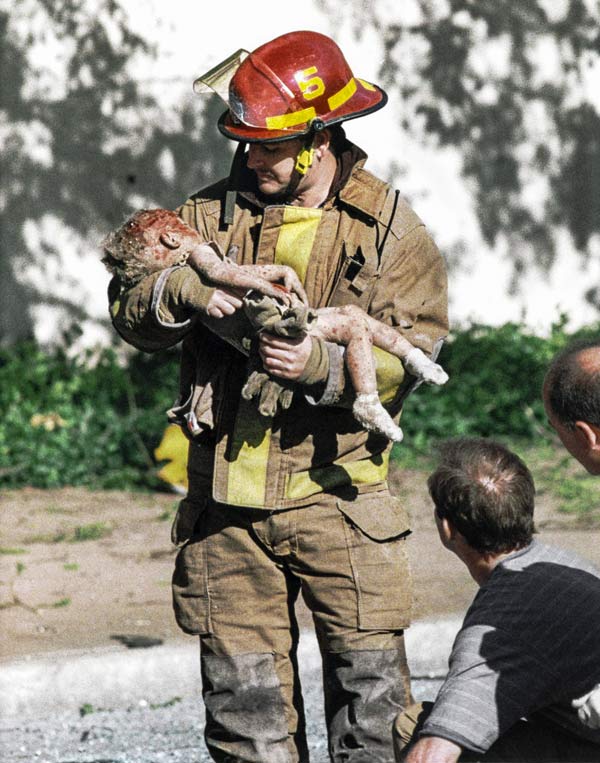
I’ve spent a lot of time in this blog discussing the “militia funnel” that became a useful tool in explaining anti-government violence in the wake of the 1995 bombing of a federal building in Oklahoma City. I even got to sit down and explain it with W. Kamau Bell on CNN’s United Shades of America in 2021 (and CNN turned it into a cool animation). There was a great need after the bombing in Oklahoma City, that included 19 children among the 168 casualties, to explain how “average people” were falling into the world of domestic terrorism.
In April 1995, I was just finishing up my dissertation on right wing extremism, when the news of a massive bombing in the “nation’s heartland” blasted across the news. It was devastating, and the images of dead children in the building’s daycare center brought the country to its knees. I stayed up that night, listening to talk radio from my Atlanta apartment. The talking heads were sure the carnage was the work of the usual suspects, Muslim terrorists. It wasn’t a crazy hunch. Two years earlier, Ramzi Yousef and a small band of jihadists tried to blow up the World Trade Center in New York City, killing 6 people. But Oklahoma was on April 19th, so I knew it was probably one of my guys.
April 19, 1993 was the culmination of the standoff in Waco, Texas that had become a rallying cry for the far-right. That carnage (that included the death of 28 children) was being framed as the result of an out-of-control federal government that was no longer by and for the people. So when on April 20, 1995, a white guy named Timothy McVeigh, who had been at Waco, was arrested for the Oklahoma bombing, I got a chill. These were the anti-government white supremacists I had spent the last seven years studying. The radio hosts who had been quick to blame “Muslim terrorists,” pivoted to the “Wacko from Waco” narrative. It was the act of a crazy person. It certainly couldn’t have anything to do with their aggrieved white male hatred of the government.
The structure of the militia funnel
I learned about the militia funnel from Kenneth Stern’s excellent 1996 book, A Force Upon the Plain: The American Militia Movement and the Politics of Hate. He got it from Ken Toole, at the Montana Human Rights Network. The funnel model explains how people can enter a world that sees violent revolution as the only solution from very mundane starting points that have nothing to do with violence or terrorism. For decades, my work has focused on the movement of people through a ‘right-wing funnel.’ I have written and spoken extensively about this dynamic. At the bottom of this article, I set forth how the funnel analysis applies to current willingness to use political extremist violence among some people in the left wing of politics. First, let’s address how the funnel has been used for the last nearly 30 years to frame pathways to right wing extremism.
At the top of the funnel are just a lot of people who are activated by fairly mainstream conservative issues. They are second amendment gun activists, tax protestors, or think the federal government shouldn’t be taking perfectly good timber land to save spotted owls. They come from a wide variety of backgrounds, including black and Jewish conservative spaces.
Some (importantly, not all) fall into the next level, based in a deep hatred for the federal government. Instead of “we the people,” the feds have too much power and have superseded their Constitutional mandate. Some of these folks are part of the Posse Comitatus movement who believe the highest legal authority is the county sheriff and any constitutional amendment after the first ten is hokum. But the bottom line is the federal government is the bad guy. Growing up in the rural South, the term we’d hear for this was “revenuer.”
At the third level down the funnel, some of these folks start buying into some pretty pervasive conspiracy theories. We are now into the world of Freemasons and the Illuminati and who REALLY killed JFK. Just watch those Nicholas Cage National Treasure movies for a dose of this world. Here the Republican and Democratic parties are both controlled by the same puppet master, leveraging the federal government against hard-working (white) Americans for their own benefit.
Some of those conspiracy believers make it down to the next level, where the conspiracy takes a familiar turn. The elite Bilderbergers are rebranded as simply “the Jews.” In a same way Hitler used anti-Semitic tropes to explain Germany’s downfall, anti-government conspiracy theorists here see a global Jewish cabal behind everything from immigration to gay rights to why their kids are listening to rap music instead of Lee Greenwood.
Again, this is a funnel, so each level has fewer people than the one above it. In the final stage of the model are the revolutionaries. It’s one thing to have analysis, but here is the belief you have to act on it. The people who make it to the bottom of the funnel are consumed with language about a second American Revolution, and a second Civil War, and “Rahowa” (short for Racial Holy War) and a whole bunch of stuff concerning the “blood of patriots.” The funnel starts wide and ends very small, but as we saw in 1995, it only takes a small band of self-proclaimed patriots to change the face of a nation. And McVeigh’s intent was to inspire other like-minded Americans to commit similar acts of terrorism.
The militia funnel in the MAGA-era
The militia model became useful again in the Obama era when anti-government militias roared back into action. Here in Oregon, a militia group occupied a federal wildlife refuge for 40 days in 2016, resulting in one death. Then the surge of militia activists, like the Oath Keepers and the 3 Percenters, under Donald Trump’s MAGA movement made the militia model even more applicable, especially after the January 6, 2021 storming of the U.S. Capitol.
In the Trump years, I regularly updated the 1990s militia model when explaining the “new” right-wing activism. Because of social media and reach of the Trump message, the mouth of the funnel was much wider than it was in the 1990s. It included some of those same conservative issues, like gun rights, but now included “culture war issues,” like opposition to rights for transgender people and hostility to Critical Race Theory, but also a rejection of lockdown mandates to prevent the spread of COVID-19. This wider funnel served to attract not just rural white men who were the 90s candidates for patriot militia groups, but suburban moms, aging incels, and others who thought America was last great before the civil rights movements made “inclusion” a weapon against white privilege.
The rest of the funnel, took an updated sheen. The anti-federal government level was rebranded as “the swamp,” full of libtards and RINOs (Republicans in Name Only). The conspiracy theory level was now the domain of QAnon adherents and beliefs in the “deep state.” Below that were the anti-Semitic theories about “global Jews,” including George Soros, Anthony Fauci, and a belief (spread by Robert Kennedy, Jr.) that COVID was created to kill non-Jews. At the bottom of the funnel, the revolutionaries renamed their call to arms the “Boogaloo,” and began stockpiling weapons. In 2020, I had a chat with a 3 Percenter in a Home Depot parking lot and asked him what he thought about the escalation of violent rhetoric. His only reply was, “We’re locked and loaded.”
That this funnel was exponentially wider at the top meant more Americans were ending up at the violent bottom level. This was evident in the massive turnout for Trump’s “Stop the Steal” rally on January 6th, motivated by the President of the United States, not a fringe website, spreading a fully debunked conspiracy theory that the “deep state” stole the 2020 election. While organized militia groups, like the Oath Keepers, were key players in the attack, many of the over 1,2000 people arrested have claimed they just got “swept up” in the moment. They had fallen down the funnel into the land of Timothy McVeighs and Stewart Rhodes. I half expected to see my Trump-loving father there that day (but his feet are bad).
The value of the militia funnel in this work is that there are multiple points along the pathway down to violence where intervention can take place. Someone who angry about public school dollars going to a student Gay Straight Alliance isn’t automatically destined to become a domestic terrorist, but if they are, there are places where that path can be diverted. Could there be a similar trajectory for activists on the left?
Constructing a left-wing funnel
The origin of the right-left political spectrum, that has its roots in the French Revolution, is all about who should have power. On the right, power should be concentrated and on the left, power should be dispersed. That’s why the far right values fascism and the far left values communism. But all along that spectrum there are values concerning fairness. The liberal is concerned teachers’ low pay is unfair and the conservative thinks their tax dollars supporting a curriculum they think opposes their values is unfair. Oh, yeah, and plenty of people on both sides think the government sucks.
The structure of the militia funnel offers a guide to what a left-wing militia funnel might look like.
At the top level are widely popular liberal issues related to social justice-based matters of equity, including Black Lives Matters, abortion access, and LGBTQ+ rights, along with other stalwart liberal causes. The next level finds strong distrust of the federal government as the historic defender of status quo power dynamics. The feds are “the Man,” who surveilled MLK and protected alleged sex-offenders, like Bill Clinton and Donald Trump. And also, all cops are “bastards.” Further down the funnel, we see the appearance of all-encompassing conspiracy theories that see Republicans and Democrats as puppets of corporations, the monied class (Google “Bohemian Grove”), and the World Trade Organization. Like on the right, there is a darker level that introduces anti-Semitism to the conspiracy theories. This is where Robert Kennedy, Jr. lives and where anti-Zionism slides into a broader anti-Jewish narrative, most recently seen as an element of some pro-Gaza rallies. (It should be pointed out is that anti-Semitism is less visible on the left than it is on the right, but it does rear its ugly head in places.) At the bottom of this funnel is the rhetoric of Marxist revolution, which sees the entire capitalist system, and all its institutions, as corrupt and in need of overthrow.
Those of us who are older than millennials and Gen Z kids will remember that in the 1970s there were hundreds of terrorist bombings in the United States. They weren’t from patriot or neo-Nazi groups. They were committed by radical leftist groups like the Weather Underground, the New World Liberation Front, and the Symbionese Liberation Army. And there were casualties. In 1970, a group of leftists angry about the University of Wisconsin-Madison’s participation in military work related to the Vietnam War, detonated a massive bomb in Sterling Hall, killing one researcher and injuring several others. The FBI has counted 2500 bombings connected to the Weather Underground, including one that killed four people in a Wall Street restaurant in 1975.
When the Right-Left political spectrum becomes a circle
There is also a weird space where the extremes at the end of the left side and right side meet to form a circle. In the 1990s, some neo-Nazi groups began publicly (and financially) supporting the PLO’s campaign against Israel under the guise of “the enemy of my enemy is my friend.” The Seattle WTO protests in 1999 that brought labor union members, environmentalists, and other liberal activists to the streets also saw participation far-right activists, who saw the “global bankers” behind the World Trade Organization as the hand of Jewish control. In the 2000s, the right also joined the left on issues related to climate change. Their angle was the climate crisis was the result of immigration, non-white population growth, and (again) Jewish monied interests.
More recently, the language of “accelerationism” has pervaded extremists on bother the far-right and far-left. The philosophy states that standard democratic forms of social change, like voting, are too hopelessly glued to institutions of power to ever affect real change. Each November we vote for a Tweedle Dum or a Tweedle Dee and hope things will be different. Accelerationists believe the only way to achieve their desired society is to bring the current one crashing down and rebuild the new one out of the ashes. The right and left have radically different visions of what those societies look like. (I know the right has no place for progressive academics like me, but they left would probably see me as a “collaborator” with “the Man” and exclude me from their Utopia, so I’m likely SOL whoever wins fantasy league fanaticism.) We have seen extremists on the right, like Proud Boys and active clubs look at their counterparts on the left in anarchist and Antifa circles, not as enemies, but as allies in bringing the system down. In 2021 a Boogaloo activist said, “Right now it’s about provoking BLM, antifa and militias or 3 Percenters into engaging in violence that will provoke disproportionate police response, which can be used to fuel further unrest.”
If the value of understanding the militia funnel is to interrupt well-meaning conservatives’ slide down the rabbit hole of violent extremism, there should be a similar opportunity for those escalating towards left wing violence. Again, the intent is not to “de-radicalize” anyone one either side, just to prevent the violence that might emerge at the bottom of those funnels. Working on constructive engagement with the government as, not an oppressive entity, but a reflection of our collective will can slow the roll down the funnel. Also, the work on critical thinking skills that disrupt simplistic conspiracy theories can be hugely helpful in dismantling the binary thinking that characterizes extremist ideologies.
The vast majority of activists are doing the important work of putting democracy to the test and advancing their shared values. A small fraction fall into the black hole of political violence. Understanding these paths across the political spectrum allows to us design strategies to reroute those who may see terrorism as a legitimate expression of their political agendas.
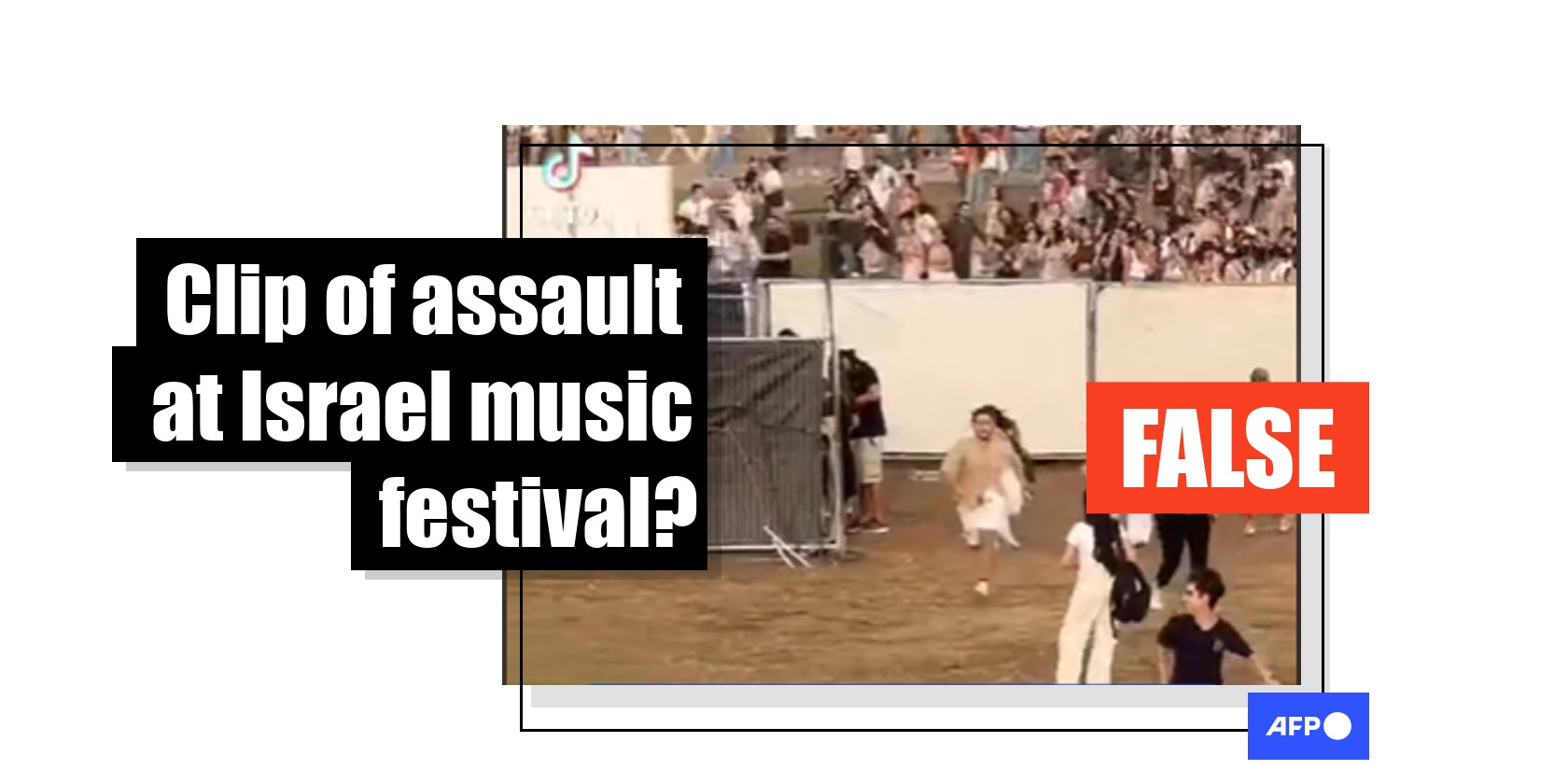
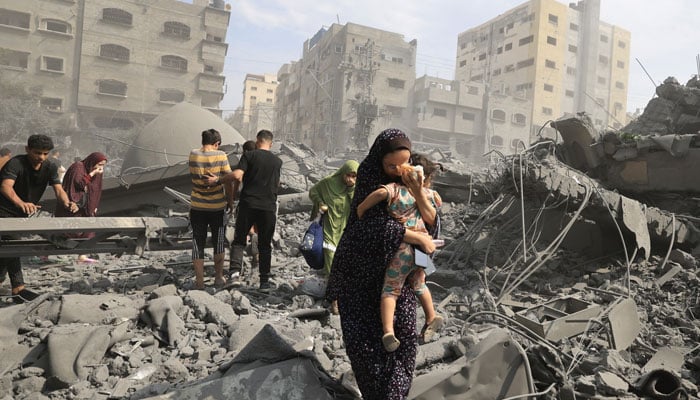
I’m at a complete loss. Tomorrow, it will have been one week since Hamas’ barbaric invasion of Israel that left so many people, especially those beautiful young people at a music festival, dead or kidnapped. Since then, those images and the images of Gaza, the most densely populated place on earth, being bombed into dust have kept me in a constant state of nausea.
I’m at a complete loss on how to talk about Israel and Palestine, in general. I have so many friends on both sides of the issue. Being an undergraduate at Emory (a Methodist university) was a crash course on the Jewish diaspora and how important Israel is to the stability of the Jewish people in the wake of the Holocaust. I read Leon Uris’ 1958 novel, Exodus, like it was first-person history. I’ve also met so many Palestinians, including students of mine, who describe the apartheid they now live in since the state of Israel was created in 1948. They both present the need for their states with such complete legitimacy, it seems insane to even think one side has the most airtight claim on the land.
Since the 1990s, we’ve been able to put our faith in the “two state solution,” that the Gaza Strip in the south and the West Bank in the north will be the nation of Palestine. As a teenager, I watched Jimmy Carter broker a peace deal between Israel and Egypt, so maybe this would work. The deal, which turned the two territories over to the Palestinian National Authority, allowed me to not think as much about Israel and Palestine. The problem was solved, right? But when the terrorist group Hamas, took over Gaza in 2007 and the Gaza Strip became a walled-off prison of 2 million people, I probably should have paid more attention.
I don’t know if this war, which is now almost a week old, ends the idea of a two-state solution. There are already reports of Jewish settlers and Hezbollah militants clashing in the West Bank and media and politicians seem fixated on the war spilling over into a “wider conflict.” Like on 9/11, it does feel like the Earth forever shifted on its axis on 10/7. I saw the image of a child’s bedroom in Ashkelon, Portland’s sister city in Israel. The blood of that child, similar in age to my child, was spattered across the wall by Hamas raiders. I couldn’t hold back the tears. The next image was an apartment block in Gaza City flatted by Israeli rockets, a child, again like my own, covered in dust was searching for her family in the rubble. And again, I cry.
There is a tidal wave of false information already flooding social media about this conflict. Some of it is misinformation that is just wrong on the facts. But much of it is disinformation, purposely shared misinformation to inflame one side or the other, or malinformation, which is true but is shared to cause harm, like the showing of child casualties to enrage viewers to violence. It’s so hard to know what is real. I have to start out with the assumption that most of what I see on social media (and all of what I see on “X/Twitter”) is false. If people are getting their primary information from TikTok, we have a huge problem.
There is also a weird false narrative at work. People (especially non-Jewish Americans) often conflate “Israel” and “Jews,” making anti-Zionism and anti-Semitism fast friends. The opinions among Jews about the policies of Israel are probably as varied as the opinions among non-Jews about the policies of Israel. But there is a parallel line that conflates “Palestinian” with “Hamas.” One could easily argue that the vast amount of suffering in Gaza is because of Hamas. But then this conflation then equates “Hamas” with “Israel,” and that is madness. Israel, like all nations, has all kinds of problems. As in the United States, Israel has human rights issues to answer for. But, unlike Hamas, Israel is a democratic state that submits itself to the scrutiny of its global neighbors. The recent peace talks between Israel and Saudi Arabia are evidence of that. Hamas, harbors genocidal fantasies akin to Hitler’s, and has no desire for “peace.”
So much of my work on violent extremism highlights the role of trauma. And yes, there is a story to be told of generations of Palestinian trauma that would produce the type of mind that could have been capable of slaughtering kids at the “Supernova Sukkot Gathering” music festival last Saturday. But one could argue the history of Jewish trauma is much longer and deeper and doesn’t lead Israelis to rape, murder, and torture anyone in the manner we’ve seen this week. Again, I don’t know how to talk about this because it all defies the limitations of words. I just want to understand how humans are capable of this.
This conversation could go into all kinds of directions. How Putin, neo-Nazis, Iran, arms dealers, and evangelicals who believe Israel will soon be delivered to Christians are the likely beneficiaries of this mess. About how we have already seen a spike in anti-Semitic and Islamophobic hate crimes in the United States in response to the war. About how dare we enjoy our pumpkin spice latte’s and post-season baseball while hundreds are being held hostage in Gaza. I’m just here to say, as a human being, I don’t know how to talk about this.
As a college professor, I find my young students tend to fall into two categories. The first are emphatic and righteous. They firmly believe that “Israel is a terrorist state” or that “Hamas are subhuman aberrations that must wiped from the face off the earth.” The other, larger group are just completely checked out, endlessly watching reels on their phones. They couldn’t find the “Middle East” on a map, let alone the Gaza Strip. I was trying to engage them in class yesterday and they looked me like, “What does this have to do with me?” I don’t know what’s worse, their indifference or the students who are actively cheering for Hamas.
It’s clear that Hamas wants to escalate the violence and kidnapping Israeli babies is a good way to do it. If rockets and a ground assault from Israel leads to the death of thousands of Palestinians, it furthers their dream of a “holy war” in the region. But I don’t know what the alternative is. A zombie apocalypse (a la World War Z)? An alien invasion? A faster, deadlier version of COVID? I told you I don’t know how to talk about this.
I’m at such a loss for words. The trauma being levied on the children of Israel and the children of Gaza will forever shape their brains. Unlike my emphatic students, I have no idea what the solution is. I can urge for de-escalation, but I also understand the impulse to take up arms and fire rockets. Inaction is off the table but what is the action? We must respond immediately but also wait to better assess the situation.
So I’m here to say I have no answers to this. I’m angry and I’m heartbroken and I know this is so much bigger than me. It seems like the international community, especially Muslim nations in the Middle East, need to defend Israel’s right to exist while fully enfranchising the citizens of Gaza and the West Bank. I don’t know. And I’m going to have to be OK without knowing. As a citizen of nation founded in violence, I can’t tell others not to use violence to form their nations. I can only bear witness to this moment of fire and pain.
“Hindsight is 20-20. Looking back, we should have known that would happen.” That is a common refrain for every major historical calamity, from Hitler invading Poland to the January 6, 2021 attack on the U.S. Capitol. We have an entire federal agency, the Department of Homeland Security, created, in large part, to address all the indicators the intelligence community missed in the lead up to the 9/11 attacks in 2001. Will we ever have the science down that accurately predicts some calamitous event so we can prevent it?
The good news is we’re getting better at preventing bad things from happening. After the deadly 1995 Oklahoma City bombing, that killed 168 people (including 19 children), the FBI made the investigation of right-wing militia groups a priority and broke up several plots leading up to Y2K. Since 9/11, there are 44 known terrorist plots that were thwarted by government agents, including a 2012 al-Qaeda plot during the Obama administration to blow up the U.S. Capitol, and 2019 neo-Nazi plot during the Trump administration to kill numerous Democratic politicians and mainstream journalists.
These acts of mass violence are prevented for three main reasons. First, people who are close to the plotters come forward to authorities with concerns that there is some suspicious activity. “Hello, 911? I think my neighbor and his friends are building a bomb in his garage.” Second is old fashioned gumshoe detective work by law enforcement agents. “Our confidential informant in that anti-government militia group is telling us the plan of attack has been made.” But group working on this issue is the not-as-exciting work of data scientists. “The chat on Discord referencing gun training spiked 63.2% following the fourth Trump indictment.” It may be the data scientists that keep us safe at night.
Since 2021, I have been working on a federally funded project that looks for ways to reduce extremist violence across the political spectrum called Cure-PDX. The sheer scope of the attack of the January 6th attack woke up a lot of folks in both public and private sectors to the fact that the stability of our democracy might be more fragile than we ever thought. Part of this work has been utilizing data to find where the flashpoints for political violence are, and it is a sad reality that they are often school board meetings and LGTBQ events. How drag queens managed to trigger the Proud Boys would probably give Sigmund Freud a thrill, but there are real victims in these violent clashes. For example, last March, the Proud Boys and other right-wing activists attacked a crowd at a Drag Queen Story Hour in Manhattan’s West Village, a historically gay enclave of the New York City.
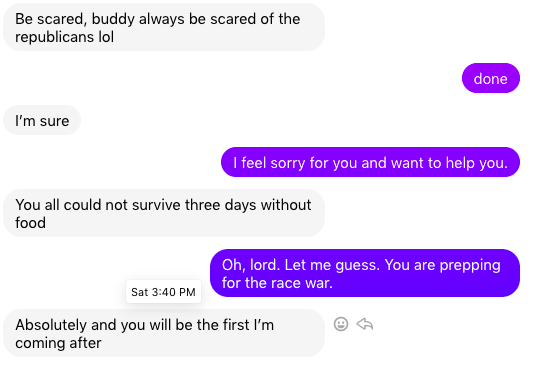
Focusing on the Pacific Northwest, our project has noticed more tension around these flashpoints. Much of this has been fueled by local right-wing groups, like the Portland Active Club, Patriot Front, and the Rose City Nationalists. These groups have been dubbed White Nationalists 3.0 by monitoring groups (and by the activists themselves). The violent skinheads of the 1980s and 1990s were 1.0. The keyboard racists of the “alt right” that rose under Obama and came to the mainstream under Trump were 2.0. These new 3.0 groups are not hiding behind keyboards, and are actively fashioning themselves as foot soldiers in what they believe to be an approaching race war. I was bantering with one last weekend and he was quite clear what his immediate agenda was:
Him: Be scared, buddy always be scared of the republicans lol
Me: done
Him: I’m sure
Me: I feel sorry for you and want to help you.
Him: You all could not survive three days without food
Me: Oh, lord. Let me guess. You are prepping for the race war.
Him: Absolutely and you will be the first I’m coming after
Much like in the Timothy McVeigh-era of the 1990s, there is a growing subculture of heavily armed anti-government activists who are hellbent on a second civil war in which the Confederate values of white supremacy are an organizing principles. Unlike the 90s patriot militia movement, thanks to social media and the encouragement of a certain four time indicted presidential candidate, this well-armed anti-government movement is massive. In the 1990s, it was a handful of guys building bunkers in Idaho. Now, it’s soccer moms, drunk on QAnon conspiracy theories, and suburban mixed martial art clubs training for combat with the “woke mob.”
2024 is gonna be a rough year. Gas prices aren’t coming down. LGBTQ people are not going to be shoved back into the closet, triggering Kid Rock and all his fragile boys who pretend this is the fall of the Roman Empire. The southern border, which has always been a rolling crisis, will be shoved in our faces on the nightly news. There could well be another COVID lockdown (or whatever the next plague will be). And whether Donald Trump wins, loses, or gets thrown in jail, there are going to be some people who will be seriously pissed off.
We’re heading into a dark season and yes, we’re going to need whistleblowers and ace detectives to foil plots. But we’re also going to need an army of data scientists who are willing to scrape the data from the armpits of the internet and other electronic platforms (including CB radios!) where the enemies of civility thrive. With good data, we can plan interventions that include preventing people falling into the rabbit holes of violent extremism. It’s go time for democracy and we need science to save us.
My name is Dr. Randall Blazak. I am a sociology professor and I serve as the chair of the Oregon Coalition Against Hate Crimes and the vice chair of the Oregon Department of Justice Steering Committee on Bias Crimes and Incidents. I grew up in a Georgia Klan town and earned my PhD from Emory University in Atlanta after completing a study of right-wing extremism that included several years spent undercover in the white supremacist movement. I moved to the Pacific Northwest in 1995 because this area, not the deep south, was the growing hotbed of domestic violent extremism.
The Pacific Northwest has a long history of cultivating fringe political movements, especially those in the racist right. The 1980s, saw a wave of terror from a neo-Nazi group called The Order, that fueled their call for a race war in America with a campaign of armed robbery and murder, which ended with a FBI shootout on Whidbey Island in 1984 that made the group’s leader, Robert Matthews, a martyr for many domestic terrorists to come.
More recently, we’ve seen patriot militia groups repopulate the region. Inspired by Timothy McVeigh’s deadly attack on Oklahoma City in 1995, they have rebranded their call for a race war as the Boogaloo. Militia groups like the Oath Keepers and the 3 Percenters were heavily present at the January 6th Capitol insurrection in 2021. Just yesterday three Oath Keepers and one compatriot were convicted of seditious conspiracy because of their role in the January 6th attack.
Beginning in the early 1980s, these groups began formulating a vision they labeled the Northwest Imperative. Since the white supremacist dream of making America “white again,” seemed increasingly unlikely in the face of demographic trends, racists felt they still had a shot at carving out a racial homeland in the Pacific Northwest. They began encouraging fellow racist patriots to move to Washington, Idaho, and Oregon, with the fantasy of driving out racial and religious minorities, LGBTQ people, liberals, and anyone they deemed to be a “race traitor.” This plan included sending members into the military, police, and local government to facilitate the revolution from within.
In 2004 I was interviewing the leader of Volksfront, one of the largest neo-Nazi skinhead groups in the world and I asked him how this racist fantasy was, in anyway, possible in the United States of America. He answered with one word and it still chills me to this day; Yugoslavia. In 2002 Yugoslavia ceased to exist as a nation. Because of racist hatred and fascist political movements, it had been balkanized into several more ethnically homogenous countries. That is the racist right’s dream of the Pacific Northwest in the near future.
The anti-government underground that waged a low grade terror campaign in the 1990s has exploded in the last six years. All the sociological factors have lined up in their favor. Massive demographic shifts that have undermined the long held authority of straight white men, the de-industrialization of the American work force that has replaced the job at the auto factory with a gig driving for Uber and evaporated the American dream, a technological explosion that has injected the most toxic conspiracy theories into everyone’s news feeds, and last, but hardly least, charismatic political leaders that fuel the anger for their own personal gain. This is not your father’s terrorist movement. There is now a massive inflow of everyday Americans who are being sucked into the rabbit hole of extremism and the calls for political violence from formerly mainstream Americans are getting louder by the day. They will use accelerationist tactics, like attacks on infrastructure, including the power grid, to create the chaos they hope to capitalize on.
The good news is we know not only how to break up domestic terrorist plots, but how to prevent people from falling into that rabbit hole in the first place. In the nearly 35 years I have been doing this work, I’ve found that the most effective agents in preventing right-wing extremist violence are former right-wing extremists themselves. Groups like Parallel Networks and Life After Hate have worked tirelessly to prevent Oklahoma City inspired attacks. The collection of real-time data by academics and civil rights groups, like the ADL, helps us to monitor trends and target hotspots for intervention. And federally funded projects like mine, Cure-PDX, develop tools for community members to become credible messengers to extremists and serve to de-escalate political violence, utilizing a public health approach.
The formation of this state commission on domestic terrorism could serve to pull all these resources together. To the growing chorus of anti-government extremists, the Boogaloo is not just a racist fantasy to re-create Washington, the Pacific Northwest, and the nation. It is a well armed movement, with members in law enforcement and the military, with a very strategic plan to ethnically cleanse this land. This commission is vital to not only preserve the inclusive culture of Washington, but to keep its population safe from traumatizing terror.
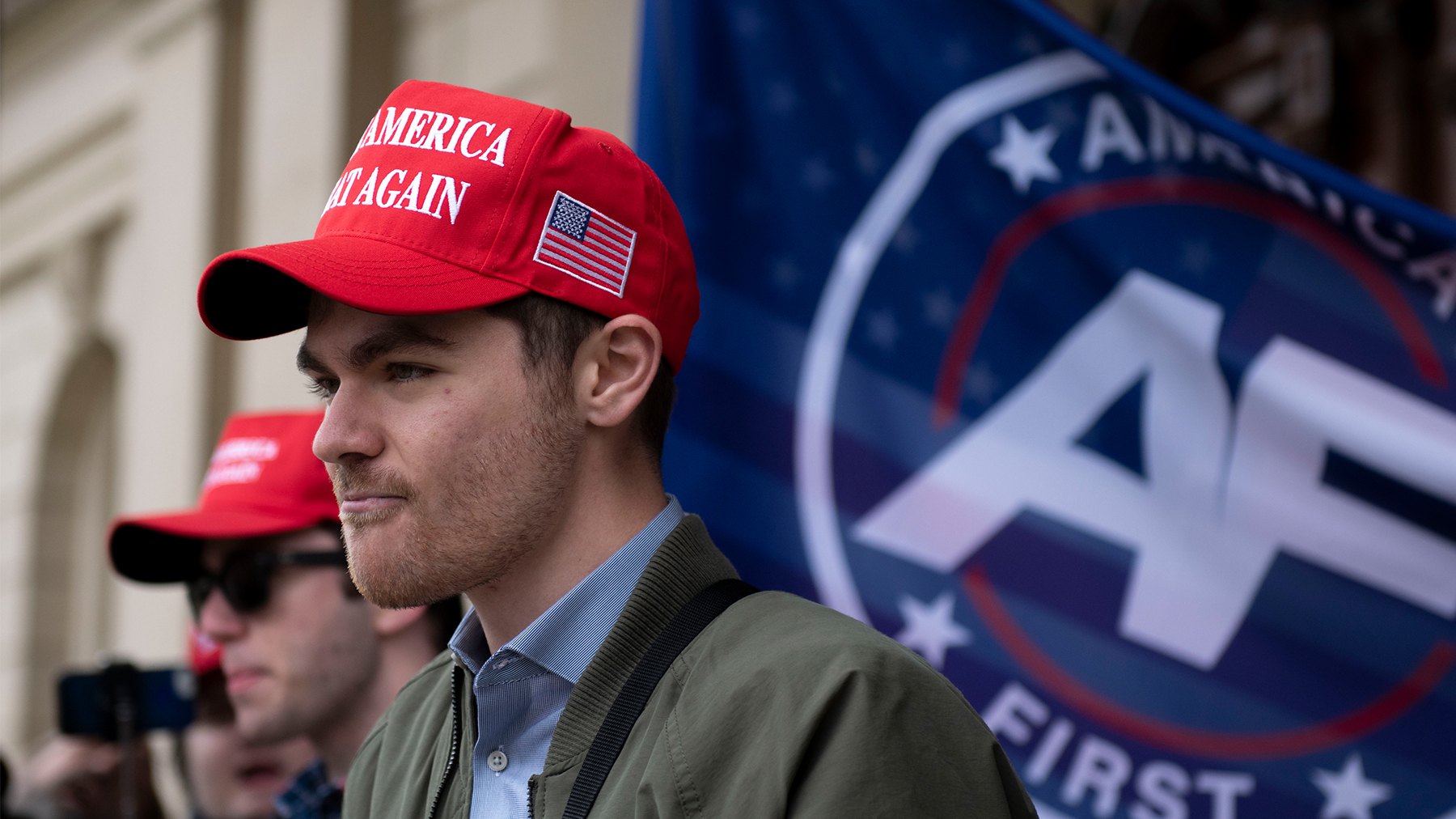
Every December 7th, we remember the 1941 attack on Japan by imperialist Japan. December 7th, 1941 is also the date that Hitler made his “Nacht und Nebel” (Night and Fog) decree, the order that instructed the Gestapo to round up all the enemies of Nazism in the lands controlled by Berlin, and send them to concentration camps. Sadly, many of those who supported Hitler’s anti-Semitic vision were political activists in the United States. That included aviation hero Charles Lindbergh, spokesperson of the America First Committee, founded in 1940. Four days after Pearl Harbor, Hitler declared war on the United States, declaring that Franklin Roosevelt was a spawn of the “eternal Jew.”
It’s important to remember that the Holocaust didn’t begin with gas chambers. It began with anti-Semitic hate speech. The fact that former president and current presidential candidate Donald Trump gleefully dines with anti-Semites like Kanye West and Nick Fuentes, tells Proud Boys to stand by, refers to the neo-Nazis of Charlottesville as “fine people,” and has routinely retweeted disinformation from white supremacist accounts should exclude him from any political credibility whatsoever. Instead, it places him in the center of right-wing politics that has always had its right foot in the mud of anti-Semitism. Blaming the Jews isn’t back. It never went away. It’s now just got a media platform so expansive it would make Father Coughlin drool on his frock.
First, let’s dispense with a crucial piece of bullcrap. Saying, “I can’t be anti-Semitic, I support Israel!” is like saying, “I can’t be racist, I support the Lakers!” Support for Israel is not the same as support for Jewish people (including Jews who are critical of the state of Israel). Evangelicals see Jews as “unsaved people,” who are just getting the Holy Land ready for the return of Jesus. MAGA support for Israel is inherently anti-Semitic. So it shouldn’t be surprising that the MAGA subculture has plenty of neo-Nazis, like Nick Fuentes, it its ranks.
This isn’t about Trump and “Ye.” There has been a dramatic increase in anti-Semitic hate crimes and incidents over the last few years. The ADL reported that 2021 was the highest year on record for anti-Semitic incidents and 2022 looks like it could end up worse. Oregon has already logged 257 bias crimes and incidents with Jewish victims this year. Just last month, New York City saw a 125% increase in hate attacks targeting Jews over the previous November. Trump and Kanye just make it more acceptable for those people to come out of the shadows.
While the Jewish people have a long history of oppression, the Adolph Hitler/Kanye West version of anti-Semitism has a fairly recent starting point. The 1789 French Revolution not only brought the promise of democracy to Europe, and the end of the divine right of kings, it emancipated French Jews, making them full French citizens. So when the defenders of church and monarchy needed a convenient scapegoat to blame the revolutionary chaos on, the “anti-Christian” Jews were an easy target. Aside from the fact that European Jews had a fairly good reason to not be fans of the Catholic Church, Jewish participation in the French Revolution was fairly minimal. And yet a new myth was born; the pro-democracy/anti-church rule movements around the globe were the work of secret cabal of Jewish rabbis. The puppet masters; controllers of banks, media outlet, competing political parties, and all things liberal.
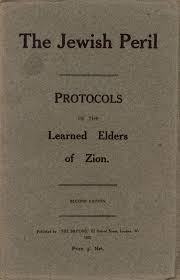
This new belief that Jews “control the world” spread like wildfire as the old empires began to crumble. By the beginning of the twentieth century, the bizarre conspiracy theory was codified in a supposedly real (but fully fabricated) document, The Protocols of the Elders of Zion. It was used to blame the Russian Revolution on Jews and used by Henry Ford to blame unionization efforts on the “international Jew” (the title of a series of booklets Ford wrote in the 1920s). The conspiracy theory became equally popular among jihadists and Neo-Nazis into the twenty-first century. We are almost a quarter of the way through the century and Trump acolyte Kanye West’s proclamation that “I like Hitler” on disgraced conspiracy theorist Alex Jones’ show barely sparks a response from the Learned Elders of the Republican Party. That should make the world say, collectively, we’ve seen this movie before.
Volumes have been written on how the authoritarian tendencies of Donald Trump map on to other nations’ slide into fascist rule. American democracy is not guaranteed and Trump’s recent claim that the U.S. Constitution should be “terminated” is straight-up Germany 1933. All we need is an economic collapse to send the “stable middle” into a panicked blame-game and a charismatic figure to convince them that all their problems are because of George Soros/drag queens/woke bankers/deep state agents and we’ve got pogroms in the streets of America; the Proud Boys and their ilk, who have been on “standby,” leading the charge to “make America great again.”
This might seem like a lot of hysteria but let me conclude with two thoughts. Every single Jewish person has a deep personal connection to the violence of anti-Semitism. Every news story about a synagogue covered in swastika graffiti, or about Jewish people attacked just walking down the street, or another “crazy” claim about Jews by an popstar who has 16 million followers on Instagram is a reminder of the long history in the belief that the complete annihilation of the Jewish people is a good thing that is both dreamed about and acted upon. The trauma of living in that world must be immense and yet the Jewish people continue to contribute to a world that imagines destroying them.
Finally, as I’ve written, earlier this year, I spent a snowy April day at the Auschwitz and Birkenau death camps in Poland. After walking though the gates that still read, “Arbeit Macht Frei” (Work sets you free), I suffered my first panic attack, realizing that it was all very real. A population, motivated by fear, was willing to commit mass genocide. Children, like my daughter, were ripped from their parents arms and thrown into the fire pits of Birkenau. Why? Because they were “dirty Jews.” I stood on that spot and wept. Because, unlike what certain guests at Mar-a-Lago believe, the Holocaust happened. And, like certain guests at Mar-a-Lago hope, it could happen again.
We must stand together against this insanity or it will be our children who will be thrown into the fire pits.
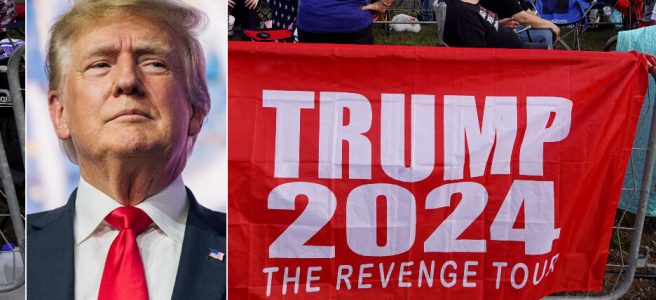
The good news is most Americans don’t want Donald Trump to run for president again. In a recent PBS NewsHour/NPR/Marist poll, 61 percent of Americans said they want the orange oaf off the ballot. Of course, another poll, from Harvard, found 67 percent of Americans don’t want Biden to run for re-election (citing his age, not his attempt to overthrow the government). But Trump has become the drunk uncle who won’t leave after the holidays. Based on the spotty attendance of Ultra MAGA weirdos at his recent rallies (“Huge!” pfft!), Trump’s cult of personality seems to be shrinking like his legal team.
But it only takes one Timothy McVeigh to ruin your whole day.
Just take one look at the people showing up at these MAGA rallies. On one hand, if you ever wondered were old white people go to die, it’s to a mostly empty arena dressed in red, white, and blue “Let’s Go Brandon” golf shirts. But on the other hand, these people are batshit crazy. That fascistic devotion to Trump is reflected in numerous polls that report the majority of Republicans still believe the Big Lie, that the Con Man from Queens won the 2020 election. As Joseph Goebbels is alleged to have said, “If you tell a lie big enough and keep repeating it, people will eventually come to believe it.”
Behind the wack-a-doo attendees at Trump rallies are numerous “patriot” militia members who are heavily armed and waiting for the go from their dear leader to kick off their “boogaloo” with the promise that the rednecks will win this civil war. A recent ADL report found scores of Oath Keepers in the ranks of the military, police, first responders, and among elected officials. Like a page out of the racist playbook, The Turner Diaries, these Timothy McVeigh-wannabees hope to make January 6 look like a Beach Boys concert on the DC Mall.
Which brings up to the conundrum of 2024 and Trump’s concerning attempt to force his way back into the White House. There are three possible scenarios, and none of them end well for this great nation.
Scenario 1: Trump runs in 2024 and a crushing recession, endless memes about “black crime,” the harassment of poll workers, and a well-timed news story about an undocumented immigrant from Latin America savaging a white woman (whether true or not), and 45 becomes 47. Trump takes it as a mandate to further deconstruct American democracy. Can you imagine what the federal courts will be capable of doing after another four years of Trump appointments? Suddenly The Handmaid’s Tale will look like a utopia instead of a dystopia. As forces loyal to the Constitution try to prevent America from sliding into an authoritarian state, civll war becomes eminent.
Scenario 2: Trump runs in ’24 and loses to Biden (or Kamala Harris because Joe fell off his bike). It will be seen as evidence of another “stolen election.” Nearly every MAGA candidate that lost a primary this year claimed to be a victim of “voter fraud.” As funny as it’s been they are sitting up the expectation that if Trump loses in ’24, it will be because the unseen evil forces. (Spend some time on Trump’s Truth Social or Gab and you know it’s the “Jews.”) Since peaceful means will be seen as no longer effective, violence will be called for – Civil War 2: The MAGA Boogaloo.
Scenario 3: Merrick Garland indicts Trump for his role in the January 6 insurrection or handing over classified documents to Putin, or throwing ketchup at the wall. Whatever. Section 3 of the Fourteenth Amendment prohibits ANY politician who has taken the oath of office from holding future public office if they have “engaged in insurrection or rebellion.” Engaged in, not caused. You better believe the DOJ is mulling this one over with sweating brows. While this is probably the best option that demonstrates that our Constitution and the rule of law actually fucking mean something in this country, the “defund the FBI” crowd is still going to be triggered and urged to drag themselves out of their troll holes and shoot SOMEBODY.
This really sucks. It sucks for America and for those of us that just want to live in peace and not have to have to defend ourselves from roving gangs of MAGA militias looking for liberals, Black Live Matter activists, and drag queens to hang. I have weapons training but I’d rather spend my gun budget on some shrubbery and taking my kid to Disney World (if the DeSantis Army hasn’t nuked it). Plus, I suck at that Big Buck Hunter game. I don’t know how good I would be at mowing down marauding Proud Boys on my street.
So America’s hope seems to lie in Scenario 4: The death of Donald J. Trump. And it can’t be from the most likely cause, a massive heart attack. The QAnon loons will see conspiracy all over that outcome. You thought bunker dwellers had a field day with JFK’s (and JFK Jr.’s) death. They will see the hand of Fauci and/or Antifa in Trump’s “natural causes” bucket kicking. And then we’re back to the armed rebellion of the sub-moronic legions. No, it has to be in public and as mundane as possible. He’s gotta trip over his feet and break his neck at a golf course, or fall off a stage at rally while doing that embarrassing white man dance. He could choke on an Egg McMuffin or maybe he could step out of a speeding limo after an argument with Eric. It’s gotta be Darwin Award-level stupid.
We know from research that cult-like movements tend to fade when the charismatic personality at the center expires. (Except for the Dead Head thing. That shit refuses to go away.) The MAGA faithful might rally around Junior, or the more frightening Ron DeSantis. But they can’t give them what Don gave them, the ability to be stupid but feel smart. And the Trump chapter closes, not with a bang, but with a briefly lingering oder.
This is where we are America. The threat of armed political violence is very real and the clock to 2024 is ticking. The great hope of America may just be Donald Trump driving his golf cart into a pool at Mar-a-Lago and getting his khakis caught in the pool drain or being hugged to death by Diamond and Silk and the My Pillow guy. But it’s gotta be spectacularly stupid, like the man himself.
PS. Scenario 5: Ukrainian victory drives Putin from power and the kompromat that Vladimir has on Trump falls into pro-democracy hands. Trump is told it will be released if he doesn’t permanently retire. Trump moves to Moscow where he spends his remaining days paying prostitutes to pee on pictures of Barack Obama.
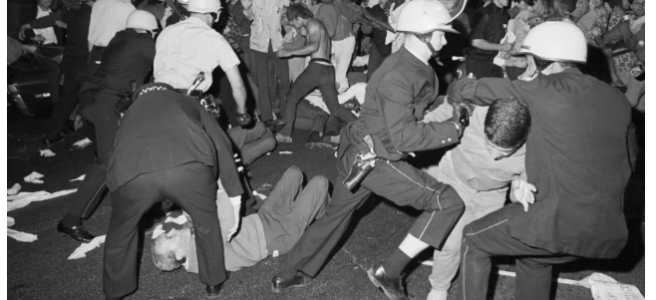
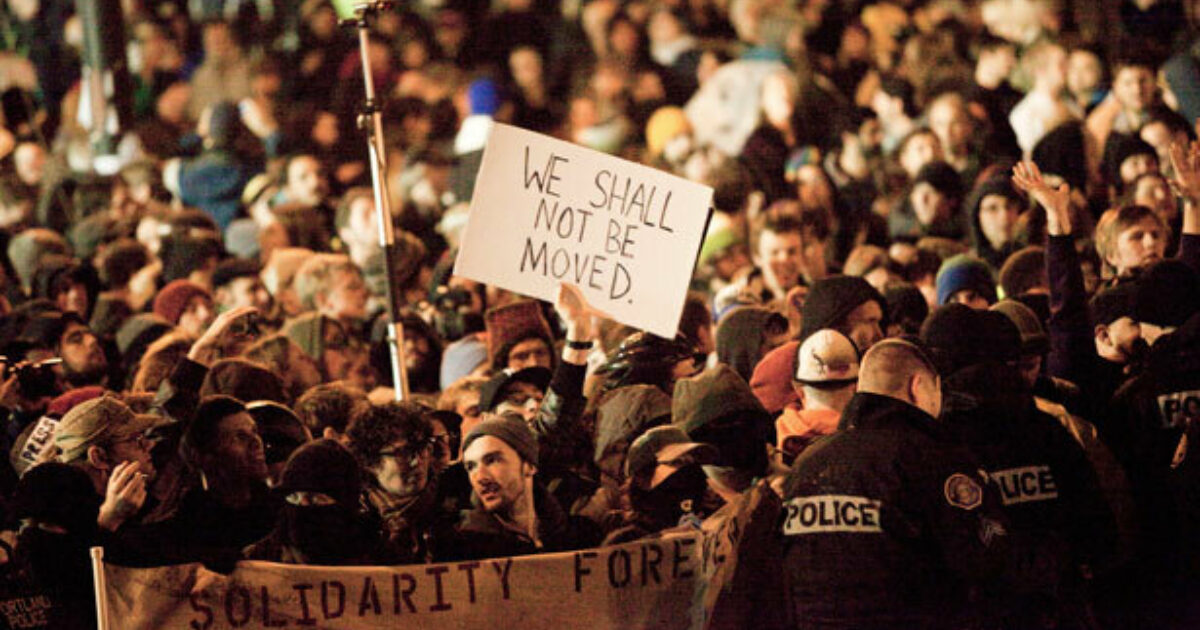
Fifty-four years ago this week, the dramatic violence outside the Democratic Convention in Chicago (August 23 to 28, 1968) defined an era of protest. It is now generally viewed as a “police riot.” The Chicago Police violently assaulted peaceful demonstrators, leading to numerous arrests and injuries, escalating the bloody street clashes. The mayhem was mostly broadcast on live TV, with the young protestors chanting, “The whole world is watching!”
In 2011, 43 years later those who studied the carnage from Chicago ’68 put those lessons to work. As the Occupy Wallstreet protests spread across the country, especially here in Portland, police utilized a new tactic – de-escalation. The old method of police knocking hippie heads tended to backfire and bring more civilians into the battle (and spurred increasingly costly lawsuits against police departments). In 2011, I spent many long nights in the three downtown squares claimed by Occupy protestors. The police kept their distance and let the people air their grievances. Eventually the protest ran its course and everyone went home. No teargas. No violence. The opposite was the case in 2020 when federal law enforcement arrived to quash the Black Lives Matter protests and turned downtown Portland into a war zone. I will never forget hiding behind concrete columns as feds, in heavily militarized gear, shot their weapons randomly down 5th Avenue.
Following the January 6th riot, we’ve re-entered the debate about de-escalating the violence. A 2022 University of California, Davis survey found that 1 in 4 Americans think violence against the government is sometimes OK and 1 in 10 feel political violence is justified right now. (Not surprisingly, these numbers are much higher among Republicans.) This call to violence has only escalated in the wake of the FBI’s warranted search (it wasn’t a “raid”) of Trump’s Mar-a-Lago compound to retrieve stolen classified documents. America suddenly seems close to falling into the tarpit of another civil war. Maybe the country needs to take a massive chill pill.
I’m privileged to be a part of a federally funded project to look at ways to interrupt extremist violence in America called Cure-PDX. The basic idea is that if there are individuals at risk of committing acts of political violence, whether they’re coming from the right or left or somewhere off the charts, there should be a way to get them to “de-escalate” and find a non-violent way to express their, perhaps legitimate, grievances. It’s not about de-radicalization. (As a sociology professor, I like to joke that I’m the radicalization field.) It’s about moving individuals back from the ledge of violence, before they go on a shooting spree, blow something up, or commit a hate crime.
The logic of de-escalation makes sense. Fewer victims of extremist violence seems like an easy sell. But our team ran to some push-back from some activists on both the right and left who argued, given the current state of affairs, this is the exact time TO escalate violence, before things tip over. Political scientists will tell you that extremists movements tend to have an apocalyptic element. The sky is always falling. But these days it’s hard not to share that sentiment. The left thinks democracy is one election away from disappearing and the right thinks the “Biden FBI” is coming to throw patriots into concentration camps. I will admit one thing, a part of me has considered arming up to protect my family from Proud Boys and the unorganized militias of the right.
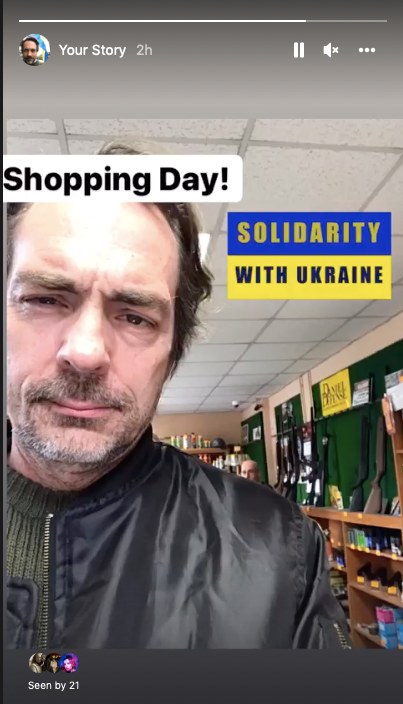
I reflected on my time this spring in Ukraine. I was not involved in de-escalation. I was helping the Ukrainian army escalate the you-know-what out of things. The stuff I brought in from Poland in the back of a van ended up in the hands of soldiers in Irpin and very likely helped them kill many Russian conscripts as they valiantly reclaimed the city. I may have Russian blood on my hands. How do I sleep at night? Like a baby. I wish there was a non-violent solution but if you had seen what I had, you wouldn’t want de-escalation in that moment either. While there, I kept remembering a Bruce Cockburn song that went, “If I had a rocket launcher…Some son of a bitch would die.”
So who am I to tell other people to de-escalate?
Well, we’re not Ukraine, occupied by a civilian-slaughtering invader. We still have a Constitution and free elections. Despite Trump’s attempt to dismantle our democracy, the house still stands. Everything the left and right want can be addressed without violence. There are political strategies that can build the middle while giving voice to those who feel marginalized, including 70-something straight white cis men who are scared shitless by “woke politics” (whatever that is).
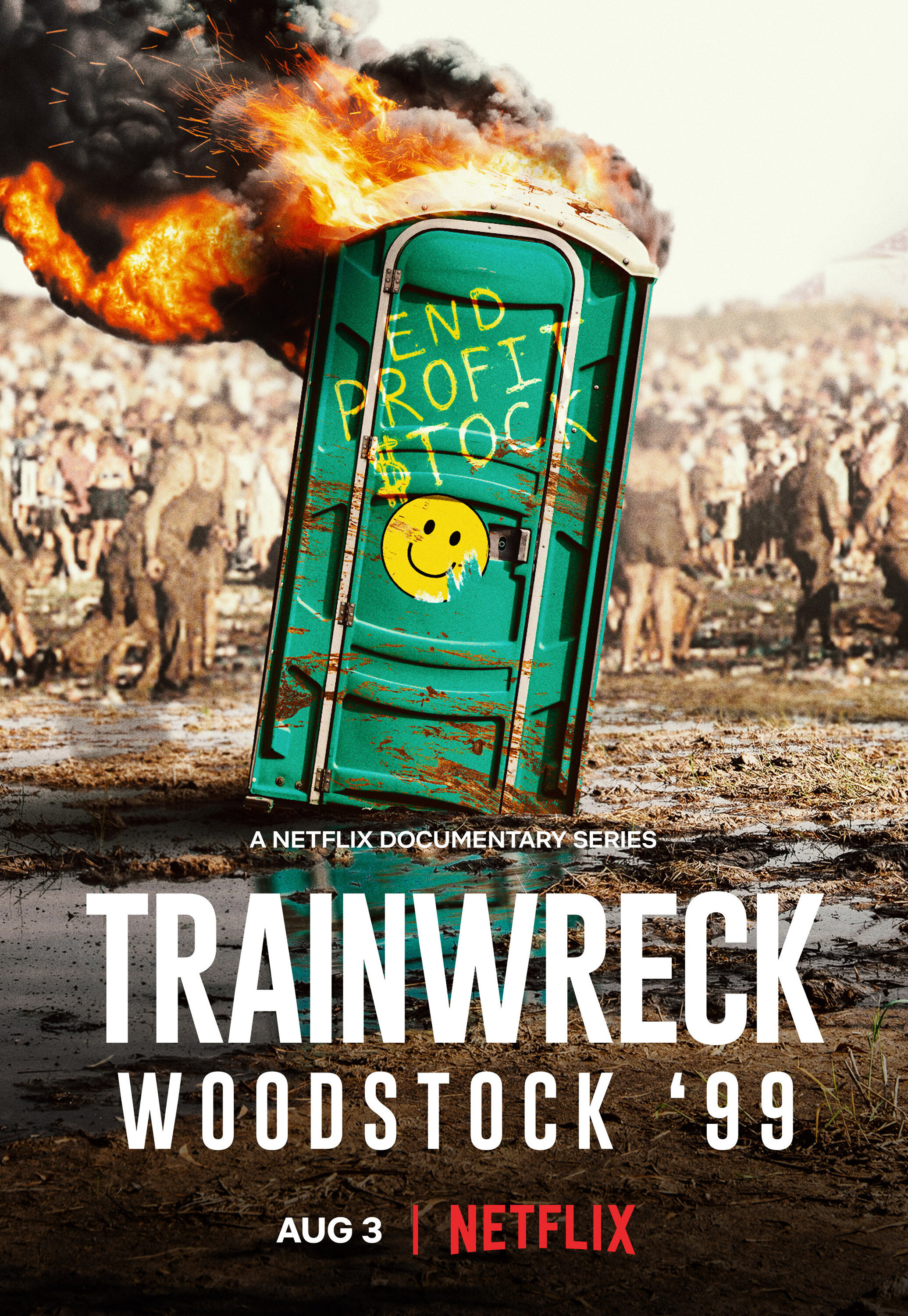
I just watched Netflix’s three-part documentary on Woodstock ’99. (I was briefly a Limp Bizkit fan, shhh.) The violent destruction at the 3-day festival, including the numerous sexual assaults, is a perfect example of the contagious nature of violence. Kids were suddenly burning down buildings. The madness of the moment consumed them. If I had been there (as I had planned to), I could have been one of them. America is at risk of “Woodstock ’22” becoming our descent into political violence as the mob mentality of us versus them sweeps the nation. Libtards versus Nazis. But, there is no us versus them, just us. And we have a brief window in history to de-escalate. If we miss it, it’s gonna make Woodstock ’99 look like Woodstock ’69.
Recent data shows that 80 percent of domestic terrorist plots that have been prevented were stopped because someone known to the potential offender came forward. We all can play the role of “credible messenger” to those at risk of escalating to violence. “Hey Frank, I now you want to storm the capitol, but can we just hang out and watch some cat videos?” Frank just got saved from a world of regret. It is worth pursuing this approach first and save the insanity (and body count) of escalation for another day. Non-violence is still the preferred path.
“The present moment began with fire. And still, it burns.” – Ben Okri, Nigerian poet
April 2, 2022
Once again, I find myself in a white van, crossing the, now snow-covered, fields of southern Poland. My very first record, Elvis Presley’s “Burning Love” is playing on the radio. The lyrics hit at an odd angle, “I just might turn to smoke.” Because we are headed to Auschwitz. Seeing the upside down world of April Fools Day, I try to make a joke with my fellow passengers, but my wartime dark humor is not received well. I was scolded earlier in the week for posting that the guy who was snoring in the bomb shelter we were sharing in Lviv, Ukraine made me pray for a bomb. I get it. But humor is also a way to cope with the endless trauma of this world. The DJ, sharing my skewed take on the day, next spins Ella Fitzgerald singing, “Let it Snow,” a Christmas classic in April.
Maybe the awkwardness was to prepare my brain for what was to come. How does one plan a day-trip to the Auschwitz-Birkenau Nazi death camps? How do you transition from this moment to that one? I’ve been a student of the Holocaust for as long as I can remember and lectured about the camps for 30 years. In my recent Research Methods class at the University of Oregon, I presented gut wrenching evidence of how Auschwitz doctor Josef Mengele perverted the values of science in a sadistic attempt to demonstrate Aryan superiority. My life’s work revolves around studying neo-Nazis who both pretend to believe the Holocaust never happened and fantasize about perpetuating similar acts of genocide. The previous day, I had wandered around Krakow’s old Jewish district that had been emptied of Jews by the Nazis, except for the lucky few who were rescued by Oskar Schindler. It was important for me to do this.
The van carried a varied lot, an English couple from Birmingham, a Norwegian couple, a young German woman who must have been filled with dread and her English friend who puked, on and off, during the hour drive from Krakow because she had had too many shots of vodka the night before. Our driver, who went by Mike, was wise enough to ease us into the arrival into hell. He took us to his “secret location,” which was an abandoned box car on a track between the Auschwitz and Birkenau camps that had been used to carry the doomed to their final destination. There, in the snow, I began to slip through time.
Auschwitz is where it is because Oświęcim, Poland was a railroad hub, and industrial town that could manage the importation of countless slave laborers and then the millions who were to be exterminated. It still feels like such a town, ringed with McDonalds and KFCs when you arrive. For better or worst, the area around the camps has been preserved in amber. When we arrived at the Auschwitz tour center, with the crematorium chimneys visible behind it, snow fell gently down, smelling cleaner than the ash that fell 80 years earlier. In the gift shop, I bought a copy of Ellie Wiesel’s Night and watched the other tourists. Some stared somberly, some teenagers laughed, as teenagers do, and a group of Israeli students, draped in their flag, did both. I held my breath.
My group got their headsets so we could better hear our tour guide, a Polish woman in her late sixties who had lost two uncles in the camp. We stepped back into the snow and walked under the “Arbeit macht frei” (“Work makes you free”) gate as she began to describe the buildings. For the first time, I had a 360 degree view of this thing. I could see the grey clouds above and the mud below my boots. This was not a fantasy, a conspiracy, or a scene from a film. This was real.
The tour had just started and I began to hyperventilate. Then I began to sob. I got light-headed and thought I was going to pass out. I had to lean against one of the barracks that had housed 500 prisoners at a time. Nothing like this had happened to me before. I think I was having a panic attack.
It was the realization that this was a real place and that horror had actually happened. Holocaust deniers be damned, the systematic annihilation of millions of men, women, children, and babies was carried out with methodical precision here from 1940 to 1945. I could feel the terror and it was too much to bear. All those books and lectures and movies and documentaries and sitting listening to Holocaust survivors, choking on the pain in my throat. It all happened in this spot and my body convulsed at the realization. The weight of what humanity was capable of in its darkest moment.
I sat down for a bit, half listening to our presenter, half trying to get my bearings. I flashed to a scene in Schindler’s List. The black and white film had one moment of color. A little Jewish girl in a red coat, her body later appears in a pile of corpses. It was 1993 and she reminded me of my then 5-year-old friend in Prague, Suzanka, who was living too close to the genocide in Yugoslavia. I burst out sobbing in the Phipps Plaza movie theater. The memory, as I sat on barrack steps in Auschwitz, caused me to burst out sobbing again.
Gradually, I wiped my eyes and rejoined the tour as we entered the slightly warmer barracks and viewed their displays. Our guide returned to the refrain, “You must remember,” and how the total count of those exterminated may never be known, because the Nazis burned the paperwork along with the bodies. Each display was more devastating than the last; children’s shoes, human hair removed from the gassed to make into fabric, luggage waiting to be claimed. The one that put me back in my panic was the massive collection of crutches, canes, and prosthetic limbs of the “invalids,” deemed too defective to work and put to immediate death. That specter of ablism did not fade with the Third Reich.
I soldiered on for the rest of the tour, through gas chambers, past the gallows, in front of the “wall of death,” where prisoners were shot, and down to the ovens, and finally to the spot where Auschwitz Commandant Rudolf Höss was finally hung on this day (April 2) in 1947. But this was only the first half of the trip. Auschwitz had a sequel, Auschwitz II-Birkenau, ordered built by Heinrich Himmler in 1941 to accelerate the extermination of the Jews. Mike ferried us over to the second, much larger camp, much of which was destroyed by the Nazis at the end of the war in a futile attempt to hide their crimes. Our guide walked us along the train tracks where prisoners were divided between those who would be forced into labor than those who were marched straight to the gas chambers. Babies and small children were thrown into open burning pits. I stood there, as a father, unable to move. Where was goodness? Where was God? Where was the empathy that should have been present among Hitler’s willing executioners?
On the ride home, we were all silent, including puking girl. I thought about what I had seen in Ukraine; the faces of frightened children forced out of their homes by an unprovoked war-monger. I thought about the concerns of my Polish friends, that nuclear weapons would turn them to ash like those who left Auschwitz and Birkenau through the chimneys. I thought about the new rise of authoritarianism in the form of Putin and Trump, that gleefully weaponizes hate and the threat of violence. I thought about the anti-trans laws and voter suppression acts that are slowly eroding democratic freedoms in my “beacon of liberty” home country.
The first chapter of Ellie Wiesel’s Night is a cautionary tale. The Jews who lived in his Hungarian village thought they were far enough from the war not to worry about the rumors of Nazi anti-Semitism. When they were pushed into a ghetto, many thought it was to protect them from the violence of the Allied invasion, and when they got to the platform at Birkenau, and Wiesel saw his mother and sister forced into the line for the gas chambers, many thought that no such horror would be allowed in the mid-twentieth century. The Holocaust was not a sudden tsunami of death. It was a slowly rising tide that drowned those who never realized they were so far from the shore.
That tide is rising again. I will not sit on my hands and hope things get better. I will use every tool at my disposal. This trip has taught me that I must.

















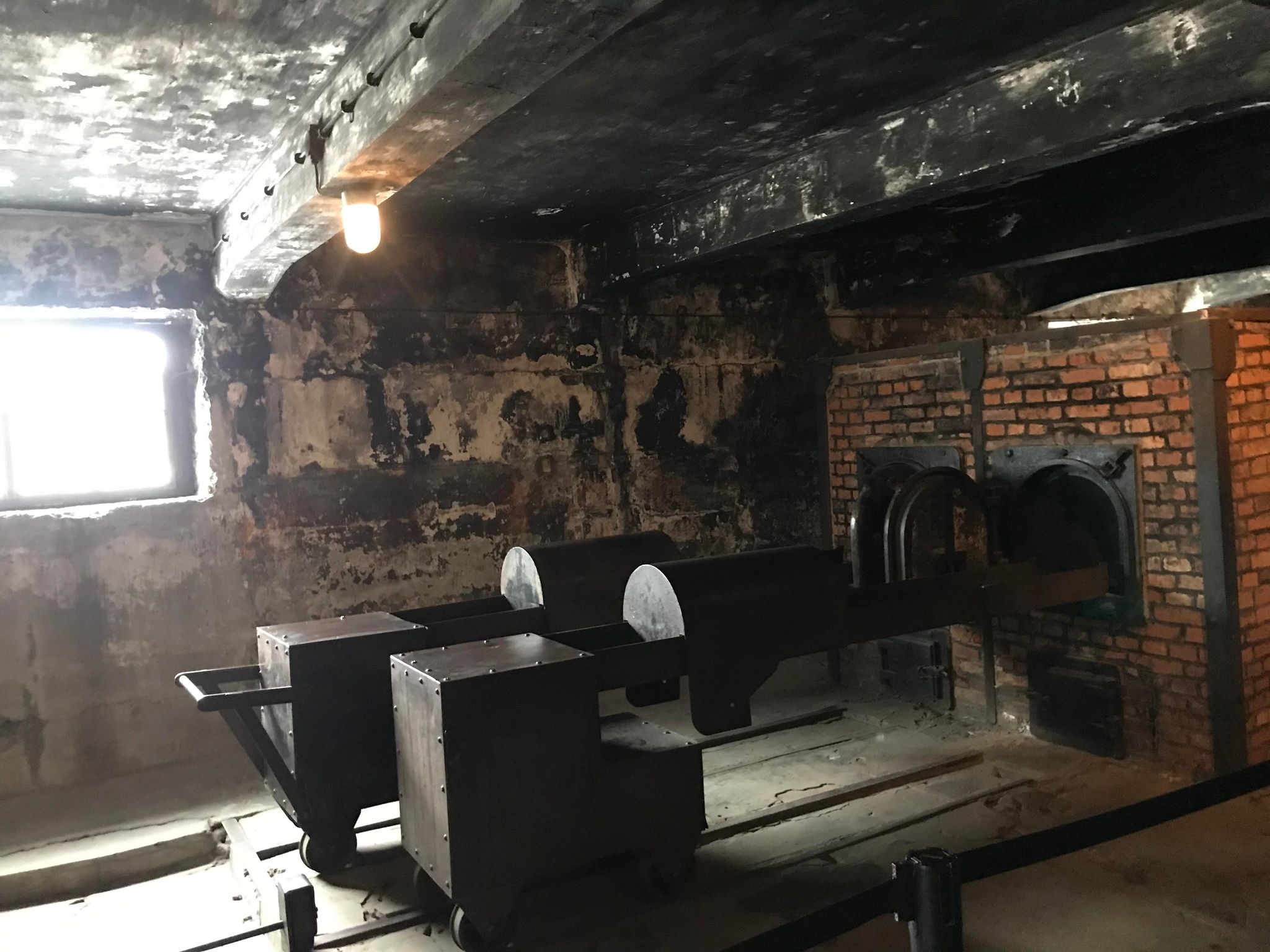
 Watching the Wheels