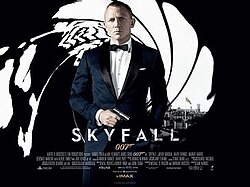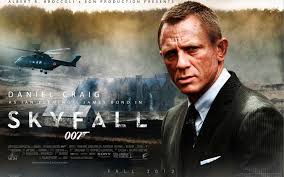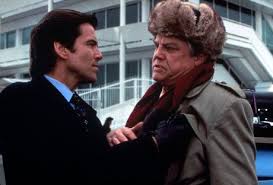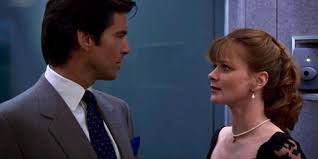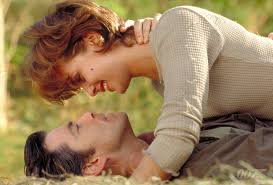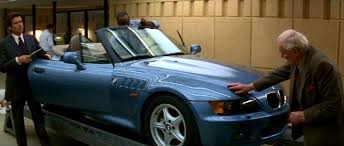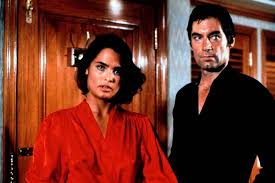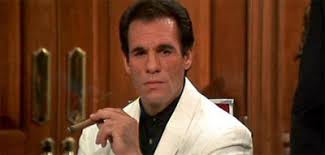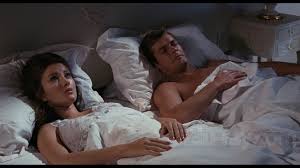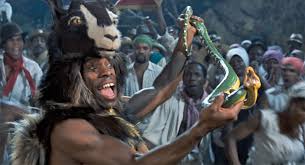
The James Bond Project #25: Skyfall (2012)

This series is intended to evaluate each product of the James Bond film franchise through a feminist lens, and the relevance of the Bond archetype to shifting ideas of masculinity in the 2020s.

Skyfall  (2012, directed by Sam Mendes)

July 31, 2025

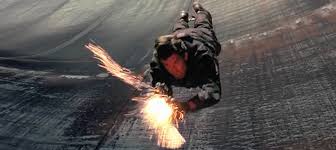
Daniel Craig is back for his third stint as Bond, a little older, a little more beat up in a film that further tweaks the 007 formula. There are some classic staples here, including James gambling in his tux, James under the ice, James fighting on top of a moving train, James in rooftop motorcycle chase, exotic locations, random hook ups, and the Aston Martin, but American Beauty (1999) director Sam Mendes brings enough innovation to Skyfall to bring a bolt of electricity to the franchise, marking its fiftieth anniversary.

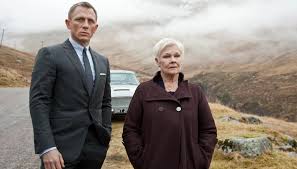
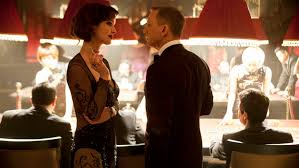
The most obvious shift from the formula here is that Skyfall is as much a Judi Dench movie as a Daniel Craig movie. M’s outsized role is fitting as it would be her last in the franchise. (She dies.) Also different is the strange twist that there really is no “Bond Girl” in this film. There’s not even a leggy woman on the movie posters! French actress Bérénice Marlohe’s character, Sévérine, almost plays the part, but she’s only briefly in the film. (She dies.) The most exciting addition is the return of Miss Moneypenny and this time she has a first name (“Eve”), she’s an action hero, and she’s black. We also get a Millennial Q, who has no time for gadgets.

The cast of Skyfall is robust, with 28 Days Later’s Naomie Harris as Moneypenny, Ralph Fiennes as head of intelligence Gareth Mallory, and Albert Finney as the housekeeper at Skyfall (a part Sean Connery was considered for as a nod to the fiftieth anniversary of Dr. No). The role of Bond Bad Guy went to No Country for Old Men break-out star Javier Bardem. Bardem dyed his hair blonde for the role, drawing comparisons with Julian Assange. Bardem also plays his character, Raoul Silva, as “gay” against James’ straight man role, although when Silva is sexually suggestive with James, Bond replies, “What makes you think this is my first time?” I remember the internet chat asking if 007 has been bi all these decades.

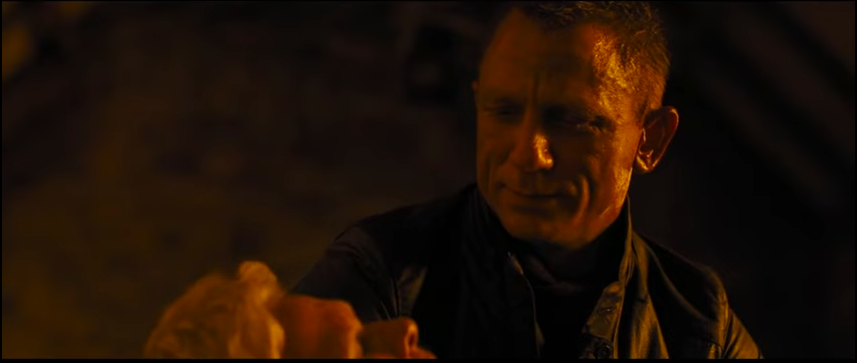
The flimsy plot follows a former MI-6 agent who is revealing the identity of fellow agents because M sold him out after Hong Kong was returned to China. Skyfall is the first Bond film to actually be partially filmed in China with segments in Shanghai and Macau. (Other locations include Instabul and Scotland). What the film lack in sense it make up for in bombast, including seeing our man James finally get shot, twice. (Although he does get winged by a speargun in 1965’s Thunderball.) But being shot clean through, and falling off a massive train bridge can’t kill Bond. He plays dead for a few months and then comes back to save the day.

Twenty-first century Bond has been described as “cool, not camp.” Let’s plug Skyfall’s 007 into our evaluation matrix.

Driver of ActionSkyfall is as much about M and her past choices as it is about James Bond. We do get some Bond backstory (and even see his parents’ grave), but this film is built on M’s career as spymaster in a changing global political landscape. We even get Judi Dench shooting at henchmen! Moneypenny also takes on a sidekick role often reserved for Bond girls. Is Eve Moneypenny Skyfall’s Bond girl?

The Role of Violence – An A.I. source says Bond kills 23 people in the film. It’s hard to tell because Bardem (as bad guy Silva) has so many henchmen. (Why, we don’t know.) Bond kills all of them. He also drops an assassin from a Hong Kong skyscraper. It’s interesting that everyone Bond shoots dies, but he bounces back from being shot like a Phoenix on coke.

Vulnerability – We do get a bit more of Bond’s soft white underbelly in Skyfall. Besides the backstory of James the orphaned child (not much emotion shared here but M quips, “orphans make the best recruits), we get a window into “dead 007,” as James lets the world think he’s dead as a means of retirement. He’s in some Black Sea coastal village, doing shots on the bar with the boys and a scorpion on his hand, having drunken sex, and letting his rock hard body atrophy with self indulgence. It’s not very believable but it sets up his comeback. When M asks him where he’s been, he replies, “Enjoying death.” Later, he states that his hobby is, “resurrection.” But there are plenty of allusions to spycraft being a “young man’s game,” and James being past his prime. (Craig had two more 007 films on his contract.)

Sexual Potency – Is the Bond “rule of 3 back”? Old Bond is still Horny Bond. While he’s “dead” we see drunk James having sex a local (or maybe she’s a contractor for Halliburton, we don’t know). Later, he climbs in the shower with sex-trafficking victim Sévérine, which seems just a tad misogynistic. I mean, c’mon James. Then he watches as she’s murdered by Silva. The big question is if 007 sleeps with Moneypenny after she shaves his face, while he’s clad only in a towel. It’s implied that, after 50 years of sexy banter, he seals the deal. There is an implication that Moneypenny with a gun is closer to his equal, even if she does shoot him on accident. But the message is consistent, that Bond is sexually irresistible to beautiful young women. (James sleeping with M would’ve made for a better film.)

Connection – The connection Bond has to M drives the film. Not only does he come back from the dead to help her, but he takes her to his childhood hiding place to keep his “mum” safe. The job of protecting and vindicating M is the framework of this episode. The connection with Moneypenny is noteworthy as is his lack of connection with the new, younger Q. Dench’s M dies in Bond’s arms, saying, “I did get one thing right.” Her trust and faith him were justified and now death has ended that bond.

Toxic Masculinity Scale: 3

Summary Bond’s interaction with Sévérine is highly problematic. Maybe we’re more sensitive in a post-Epstein era, but it should be clear that you don’t show up naked in the shower of a woman who is clearly a traumatized sex trafficking victim. Maybe it’s business as usual in a Bond film, but the scene was more anger-inducing, than “sexy.” However, the fact that Skyfall is really an M-centered film, with 007 in a supporting role, elevates the film as portraying a gender dynamic unique in the 007 canon.

For the 50th anniversary of Eon’s Bond franchises, there are familiar friends, like a title sequence featuring female bodies (and an Oscar-winning theme song by Adele), sharp dry quips from James (“Only a certain kind of woman wears a strapless dress with a Beretta 37 strapped to her thigh.”), and the return of the Aston Martin, along with the Bond theme music. (When Silva’s men blow up the car, 007 goes Rambo.) There’s even a glimpse of the vintage of the Macallan scotch Silva pours for Bond, 1962. Easter eggs aside, Bond’s emotions are still restrained but M (Dench) reveals the truth behind James masculine stoicism.

Skyfall premiered at Royal Albert Hall on October 23, 2012, while Hurricane Sandy was lashing America’s east coast. The film, as articulated by M, shares that the cold war world that produced Dr. No in 1962 now exists “in the shadows,” without clear enemies but with a new climate of danger. Mendes as director was an inspired choice to frame the action in service to M instead of Bond. Mendes would direct the next Bond as well as the Oscar/Golden Globe winning 1917 (2019). Medes is now directing four biopics on the members of the Beatles. For the kick-off of the next half-century of 007, Mendes would soon bring back a familiar foe to Bond’s universe.

Next: Spectre (2015)

The James Bond Project #24: Quantum of Solace (2008)

The James Bond Project #23: Casino Royale (2006)

The James Bond Project #22:  Die Another Day (2002)

The James Bond Project #21:  The World Is Not Enough (1999)

The James Bond Project #20:  Tomorrow Never Dies (1997)

The James Bond Project #19: GoldenEye (1995)

The James Bond Project #18: License to Kill (1989)

The James Bond Project #17: The Living Daylights (1987)

The James Bond Project #16: A View to a Kill (1985)

The James Bond Project #15: Never Say Never Again (1983)

The James Bond Project #14: Octopussy (1983)

The James Bond Project #13: For Your Eyes Only (1981)

The James Bond Project #12: Moonraker (1979)

The James Bond Project #11: The Spy Who Loved Me (1977)

The James Bond Project #10: The Man with the Golden Gun (1974)

The James Bond Project #9: Live and Let Die (1973)

The James Bond Project #8: Diamonds are Forever (1971)

The James Bond Project #7: On Her Majesty’s Secret Service (1969)

The James Bond Project #6: You Only Live Twice (1967)

The James Bond Project #5: Casino Royale (1967)

The James Bond Project #4: Thunderball (1965)

The James Bond Project #3: Goldfinger (1964)

The James Bond Project #2: From Russia With Love (1963)

The James Bond Project: #1: Dr. No (1962)

Cooling Off the Hot Air of the Manosphere

April 28, 2025

I’m trying to navigate my newfound celebrity. For whatever algorithmic reason, my Instagram account has exploded. At this writing I have over 62 thousand people following and over 3 million views in the last 30 days. That includes a certain star of Pretty in Pink and The Breakfast Club. I’ve gone viral! My 90-second takes on the state of political crisis are generating a vibrant dialogue from people around the world who are concerned about the fate of American democracy.

And it’s also brought out the trolls.

It’s shouldn’t be surprising that right-wing trolls target my masculinity. They call me “gay,” “beta,” and “cuck.” It’s the same language of the schoolyard bullies who called me “fag” and “pussy.” One troll said, “I bet he can’t even do 20 push ups.” (I immediately got on the floor to make sure that I could.) Somehow they associate caring about democracy with being feminine and they associate being feminine with being weak. These “alpha men” must not know any actual women. And their AI girlfriends don’t count.

I’ve written endless words in this blog about the ginned up “mansophere,” the booming world of performative masculinity that is there for boys and men who can’t navigate the social changes that include seeing girls and women as human beings. These are the fragile fellas that rally for Trump and rail against all things DEI, that think the man should be the king of his castle. They love MMA and rapists like Andrew Tate because they  mourn the loss of the myth of unrestrained male id, to fight and fuck whoever they want. Trump allowed them to escape 4chan and take over Washington. Pete Hegseth is the Incel god.

The fragile troll boys aren’t much of an issue for me. I learned how to deal with them in high school. Redan High had a notorious bully named Ted who one day during lunch, unprompted, said, “Blazak, you’re a pussy.” I shot back, “Well, Ted, I guess you are what you eat, you dick.” I escaped while he tried to figure out what I had just said. These guys are never too smart. They can’t argue policy. They only have ad hominem attacks on how much you’re not like their avatar on Grand Theft Auto V.

Where the danger is in how these “alpha men” treat women and how they vote. The gender gap among the youth is widening. According to a recent NBC poll, only 24% of young women approve of Trump’s performance, but 45% of young men approve of Trump’s shit show. I see this in my college students. There are young men, including men of color, who see the MAGA movement as “preserving” a world where men had status over others. The idea of sharing power cripples them with fear. Trump, the sexual assaulter, with the porn star wife, is their redemption.

So they come after me as a “soy boy libtard.” It would be funny if it wasn’t so sad. Their hollow macho fantasies of fascism will ultimately bite them in the ass. This isn’t their imagined Roman Empire and it was never meant to be. But trying to beat them down only triggers their fight response. We need to learn how to talk to these boys and men to bring them into the family of man and woman. Alpha Men might just need a hug.

The James Bond Project #19: GoldenEye (1995)

April 15, 2025

This series is intended to evaluate each product of the James Bond film franchise through a feminist lens, and the relevance of the Bond archetype to shifting ideas of masculinity in the 2020s.

GoldenEye (1995, directed by Martin Campbell)

The first Bond film in the fourth decade of the 007 franchise is something of a synthesis of all the previous EON Production films and a fair send-off for EON producer Cubby Broccoli, who died five months after its release. After a long six year gap, while Eon dragged Timothy Dalton into development hell, Bond was back with Pierce Brosnan as the new British MI-6 commander. GoldenEye fused License to Kill’s vengeful 007 with the smarmy, Casanova Bond of the past. The first Bond film not to be based on an Ian Fleming story is a sweeping tale that presents Bond with his first post-Cold War conflict and was tailor-made for 90s audiences who were getting used to the widescreen violence in films like Natural Born Killers.

Brosnan, who had been offered the role before Dalton, comes in a more upper crust English, but also more boyish, Bond who has parachuted into a third-wave feminist world. This disconnect is magnified by the new M, now played by Dame Judi Dench. The new M states a clear opinion on the archetype that is Bond, James Bond. “I think you’re a sexist, misogynist dinosaur, a relic of the Cold War, whose boyish charms are wasted on me,” she tells him. Welcome to the 90s, James. We still have Desmond Llewelyn as Q to link us to the Bond cannon. This installment’s Bond “girl” is Swedish model and actress Izabella Scorupco, who forces a rough Russian accent. Also trying to be Russian (or Georgian) is “sadistic lust murderer” Xenia Onatopp (There’s the names we love in these films), played by Famke Janssen (soon to be Jean Grey in the X-Men films).

GoldenEye starts with a flashback to the Cold War days with 007 and 006 on a mission in the Soviet Union where 006 (played by the great Sean Bean) is killed. Bond blames himself, setting up the revenge redux. After an epic scene where James dives into a falling plane (This is the first Bond film to use CGI), we flash forward to the present where new Russia is losing track of its shit and we’re off. The scene where James is chasing the rogue Russian general through the streets in St. Petersburg in a giant Russian tank was classic 007 thrills on the big screen. I remember watching it in the Lloyd Center Cinema and thinking it was the wildest thing filmmakers could cock up for a James Bond movie.

This installment gives us plenty of Bond staples fans crave. There’s Bond in a tux, playing baccarat, there’s Bond in the Caribbean, there’s the double entendre quips (none very clever), and thousands of bullets fired at our James with nary a scratch. The film also features some epic stunts, including a record setting bungee jump off a Russian (actually Swiss) dam that has to be seen to believed. Brosnan plays Bond closer to Moore than Connery and his bourgeois demeanor adds to the “Man out of place” element that makes this film kinda fun. Cubby Broccoli’s daughter, Barbara, took over the production as her father’s health failed, so some of the gender commentary may have been here doing.

Let’s see how GoldenEye fares in our feminist matrix.

Driver of Action – New Bond, new star. Q and his lab techs show up for comedic effect. There’s a new CIA agent, Jack Wade, to help out (Joe Don Baker is back!) because Felix is still legless from the shark. The new post-communist Russia really plays the support role. In the gap between Yeltsin and Putin, it presented a blank slate to the world, where the need for secret agents might be a thing of the past. But this film rests purely on the shoulders of Remington Steele star Pierce Brosnan.

Role of Violence – There’s a lot of slaughter in GoldenEye, largely due to Bond’s use of machine guns. I had to ask ChatGBT the body count because I lost track. AI reports James killed 47 people in the film, mostly Russian soldiers. (Wasn’t the Cold War over?) There’s also some weird violent sexual scenes with Xenia Onatopp (we’re to believe that violence is her kink) and a scene where 007 knocks her unconscious.

Vulnerability – For the first time in a Bond film, we learn that James’ parents were killed in a mountain climbing accident when he was a boy. But there’s no sense that this plays a role in his present psyche. It’s just presented as a factoid to contrast the story that 006’s parents were killed by Stalin.  There’s no James in love and only a mild sense of guilt that 006’s death might be his fault.

Sexual Potency – Here’s the James Bond rule of three. 1) Caroline – An MI-6 psychologist, sent to evaluate James, gets seduced by our agent who has a bottle of bubbly in the glovebox. He’s going to let her give him, “a very thorough evaluation.” Wink. 2) Xenia Onatopp – It’s more fighting than sex. James is taken aback by her biting his lip and drawing blood. Her death (pulled into a tree by a helicopter) is also played as sexual but in 2025 seems just weird. 3) Natalya Simonova (played by Izabella Scorupco), a Russian computer programmer, is Bond’s “love” interest/damsel in distress in the film. He forcibly kisses her and then suddenly they’re a romantic couple. (This quasi-rape trope seems all too common in 007 flicks.)

It should be mentioned that Bond’s relationship with Moneypenny (now played by Samantha Bond) is firmly located in 90s feminist positions. She’s not having any of James’ “charm” offensive. Bond: “What would I do without you?” Moneypenny : “As far as I can remember James, you’ve never had me.” Bond: “Hope springs eternal.” Moneypenny: “This sort of behavior could qualify as sexual harassment.” Finally.

Connection – Brosnan plays Bond detached, as we have come to expect. There’s a hint of a back story between 006 and 007 that might have been nice to know about. As is expected, he and Natalya end the film together, not in a boat but in a Cuban meadow. They think they’re alone, but there is some coitus interruptus from the United States Marines, so they’ll have to save their victory sex for another day, or never. There’s no real chemistry between these two so the door is open for Bond’s next “girl.”

Toxic Masculinity Scale: 5

Summary The opening title sequence of GoldenEye, with women smashing hammers and sickles to a song written by U2 (and sung by Tina Turner) locates the film in a new era. The Cold War was the golden era of the Flemming novels and the platform for Bond’s good vs. evil adventures. Now New Bond is forced (again?) to find his relevance. Is he a 90s-action hero, right up there with Arnold Schwarzenegger, or a washed-up antique who has lost his cultural relevance? His elevated violence and philandering may be intended as a middle finger to the politically correct shifts in cinema.

The tech in GoldenEye is a co-star along with lots of product placement. (Welcome to the new global market place.) IBM is featured front and center (and a great scene where a young Alan Cumming gets an “email”). The Aston Martin is replaced with a BMW, fully loaded with Q’s gadgets. “You have a license to kill, not to break the traffic laws,” Q tells an impish Bond. GoldenEye also gives us that most central staple of Bond Baddie accessories, the underground lair, hidden below a lake, from where a deadly satellite is controlled. Its explosive destruction is everything that Bond fans buy movie tickets to see.

GoldenEye premiered on November 13, 1995 at Radio City Music Hall, as the war in Yugoslavia, the largest hot war resulting from the end of the Cold War, was reaching its peak. The direction of Martin Campbell and the production of Barbara Broccoli (with Judi Dench’s M) represented a chance to reboot the franchise in a world without the Soviet Union. What issues would MI-6 confront as the 20th century closed? With the help of CGI, the promise of epic stunts and a horny agents would be a part of it.

Next: Tomorrow Never Dies (1997)

The James Bond Project #18: License to Kill (1989)

The James Bond Project #17: The Living Daylights (1987)

The James Bond Project #16: A View to a Kill (1985)

The James Bond Project #15: Never Say Never Again (1983)

The James Bond Project #14: Octopussy (1983)

The James Bond Project #13: For Your Eyes Only (1981)

The James Bond Project #12: Moonraker (1979)

The James Bond Project #11: The Spy Who Loved Me (1977)

The James Bond Project #10: The Man with the Golden Gun (1974)

The James Bond Project #9: Live and Let Die (1973)

The James Bond Project #8: Diamonds are Forever (1971)

The James Bond Project #7: On Her Majesty’s Secret Service (1969)

The James Bond Project #6: You Only Live Twice (1967)

The James Bond Project #5: Casino Royale (1967)

The James Bond Project #4: Thunderball (1965)

The James Bond Project #3: Goldfinger (1964)

The James Bond Project #2: From Russia With Love (1963)

The James Bond Project: #1: Dr. No (1962)

The James Bond Project #18: License to Kill (1989)

April 8, 2025

This series is intended to evaluate each product of the James Bond film franchise through a feminist lens, and the relevance of the Bond archetype to shifting ideas of masculinity in the 2020s.

License to Kill (1989, directed by John Glen)

Timothy Dalton’s Dark Bond is back for the second and final time in this revenge film that calls itself a James Bond movie. Maybe Eon Productions thought gangsta rap fans in 1989 wanted a 007 who was closer to Scarface than the guy in Goldfinger. License to Kill sees Bond go rogue from MI-6 as he goes after the guy who kidnapped his friend, CIA agent Felix Leiter, and fed him to a shark (after killing his wife). There’s no time for snarky quips here. James is out for blood.

License To Kill brings the action closer to home, primarily Key West, Florida, a bit of Bahamas, and a fictional country called the Republic of Isthmus (that’s actually Mexico). Even M and Moneypenny’s London scene was shot in Mexico to save money. David Hedison, who played Felix Leiter in Live and Let Die, is back in the role 16 years later. Carey Lowell, who went on to fame on TV’s Law & Order, was this installment’s Bond “girl.” The object of Bond’s obsession is drug lord Franz Sanchez, expertly played by Robert Davi, who will always be Jake Fratelli from The Goonies, to me. His sidekick is played by a very young Benicio del Toro. The score was by the brilliant Michael Kamen, who had just done the music for Die Hard.

The last of Bond film of the 1980s was also a fond farewell of sorts. It was the final film produced by Albert “Cubby” Broccoli, who had produced every Eon Bond film since Dr. No in 1962. It was the last Bond directed by John Glen, who had filmed all five 007 films of the eighties. It was the last Bond project of screenwriter Richard Maibaum, whose work goes back to Dr. No. It was also the last film appearance of Robert Brown (M since Octopussy) and the final film of Maurice Binder, who had designed the iconic opening title sequences of every Bond film since 1962.

Even though License to Kill may have been an end of era, there will still plenty of reminders of the staples of the franchise, primarily sharks and Q. Desmond Llewelyn’s Q gets more screen time than in any Bond film to date. Like James, Q goes rogue and arrives in Isthmus to help 007 with his revenge fantasy. Like Batman’s butler Albert, he’s not afraid to be right in the action. And because the action returns to America, we see more African-American actors, including DEA Agent Hawkins (played by Die Hard’s Grand L. Bush) and CIA aid Sharkey (played by pro football player Frank McRae).

The Dark Bond of License to Kill is a bit more unhinged than in The Living Daylights, so let’s do the analysis.

Driver of Action – While LTK is formed around Bond’s revenge plot, he does share the screen. Pam Bouvier (Carey Lowell), his femme fatale is less fem and more fatal. She’s a shotgun toting ex-Army pilot who never plays the damsel in distress. In fact, she saves James more than once. Bond even says, “Yes, sir!” to her at one point because she’s clearly in charge.

Role of ViolenceLicense to Kill takes the title literally. This film is a blood bath. Bond kills at least a dozen people, some in gruesome ways. He throws a renegade DEA agent into a shark tank and watches him get gobbled up by a Great White. He rigs a diving pressure chamber on boat and watches as a drug trafficker explodes inside it, his head inflating like a balloon. In the final act of revenge, he sets Sanchez on fire with the lighter Felix gave him at the wedding. It’s supposed to feel cathartic, but it just feels sadistic.

Vulnerability – We don’t get the “Is Bond in love?” question from the last installment. More like, “Has Bond lost his mind?” as he resigns from MI-6 to go after Sanchez. There is a scene at the wedding where Felix mentions to his bride that Bond was briefly married where we get a glimpse into James’ trauma, but this 007 is hard as nails.

Sexual Potency – Dalton’s Bond is still low key swinging through the AIDS epidemic, but he’s a bit more Id-drivien than The Living Daylights. First of all, there is no scene with 007 and Moneypenny in LTK, so that banter is left on the table. His relationship with Pam is more equal than previous films. (She demands to be called “Ms.” Kennedy, while playing his accomplice). They share there first kiss on a small boat (!) in the Bahamas and the scene fades as the go below deck, implying some seafaring hanky panky. He also has a fling with Sanchez’s girlfriend, Lupe Lamora (played by model Talisa Soto, who went to be Johnny Depp’s love interest in Don Juan DeMarco). Pam’s jealousy about the James-Lupe link is played for laughs, because, you know, he’s James Bond. (When Lupe tells Q, “I love James so much,” Q’s eye roll tells the whole 27-year story.)

Connection – The fact that 007 is attending Felix’s wedding as the best man is a solid implication that these men have formed a tight bond over the many years. And the fact that he throws his career out the window to go after Leiter’s attacker is evidence of his loyalty to his CIA friend (or maybe a reflection of the trauma Bond suffered when Blofeld killed his own wife shortly after their wedding). James’ connection to Pam seems more transactional (unlike his tie to Kara Milovy in the previous film). At the end of the film, he does choose her over Lupe and they end the film, fully clothed, in a pool, kissing (They’ve already checked boat sex off the Bond to-do list), but there is no sense this relationship is going anywhere.

Toxic Masculinity Scale: 5

Summary

While the hyper-violent vengeance theme doesn’t feel very “Bond,” there are plenty of 007 hallmarks here, including underwater battles with frogmen, Bond hanging off of planes, Bond gambling in his tux, and even a completely random attack by ninjas (in Mexico). We even get a nod to Blofeld when an obscured man is holding a cat at Hemingway’s house in Key West. (It’s just M.)  And there is a great theme song by the fabulous Gladys Knight. The stunts are epic with plenty of massive explosions, and a comedic appearance from Wayne Newton as a televangelist fronting for the cocaine traffickers. (You know this was a comment on the PTL scandal that dominated the media in the 1980s.)

Dark Bond pays lip service to the changing gender rolls. When Pam asks why she has to play the roll of James’ “administrative assistant” when the arrive in Isthmus, and not the other way around, James says, “We’re south of the border. It’s a man’s world.” Carey Lowell is certainly a more masculine Bond girl than we’ve seen in the past (still with plunging necklines), but this isn’t exactly a feminist film. And Bond’s sadistic use of violence erases any enlightenment our James may have experienced over the decades.

License to Kill premiered on June 13, 1989, a month after Panamanian President Manuel Noriega staged a coup to retain power in his banana republic. Similarities between Noriega and Robert Davi’s Franz Sanchez, with regard to both physical looks and cocaine connections, were commented on when the film was released. The film generated less income than previous films, perhaps reflecting its divergence from the Eon Productions formula. There was to be a third Dalton Bond film called Property of a Lady, to be released in 1991, but studio contract conflicts got in the way and we would not see a new Bond film, and a new Bond, until the mid-1990s.

Next: GoldenEye (1995)

The James Bond Project #17: The Living Daylights (1987)

The James Bond Project #16: A View to a Kill (1985)

The James Bond Project #15: Never Say Never Again (1983)

The James Bond Project #14: Octopussy (1983)

The James Bond Project #13: For Your Eyes Only (1981)

The James Bond Project #12: Moonraker (1979)

The James Bond Project #11: The Spy Who Loved Me (1977)

The James Bond Project #10: The Man with the Golden Gun (1974)

The James Bond Project #9: Live and Let Die (1973)

The James Bond Project #8: Diamonds are Forever (1971)

The James Bond Project #7: On Her Majesty’s Secret Service (1969)

The James Bond Project #6: You Only Live Twice (1967)

The James Bond Project #5: Casino Royale (1967)

The James Bond Project #4: Thunderball (1965)

The James Bond Project #3: Goldfinger (1964)

The James Bond Project #2: From Russia With Love (1963)

The James Bond Project: #1: Dr. No (1962)

The James Bond Project #9: Live and Let Die (1973)

January 24, 2025

This series is intended to evaluate each product of the James Bond film franchise through a feminist lens, and the relevance of the Bond archetype to shifting ideas of masculinity in the 2020s.

Live and Let Die (1973, directed by Guy Hamilton)

Now we’re into “my” Bond. The era of Roger Moore. And we’re still in America. Director Guy Hamilton and screenwriter Tom Mankiewicz are back to give us a Bond version of a seventies blaxploitation film. Producers couldn’t bribe Sean Connery (with $5.5 million) to put his white dinner jacket on one more time so the scramble for the next Bond began. Steve McQueen, Paul Newman, Anthony Hopkins, and (again) Burt Reynolds were considered but the license to kill went to Roger Moore (the first English actor to play the role), who had long been considered for the job. In the 1960s, Moore starred in The Saint, a British mystery thriller series, so he was 007 in training. Moore’s Bond comes off as more bourgeois than Connery’s, making his snarky quips much more funny. Maybe the comedic writing was just better in the seventies, but Live and Let Die has plenty of laugh out loud lines.

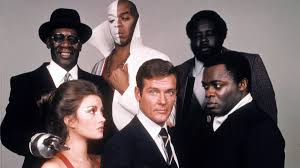
Live and Let Die is not a European film. The action takes place in New York (starting at the UN, then moving to Harlem), New Orleans, and the fictional island of San Monique. (Producers wanted to use Haiti, but the instability of Papa Doc Duvalier’s island forced filmmakers to move back to Jamaica and invent a tropical name.) There’s no Blofeld this time (but there is an underground lair!). Instead we get Mr. Big, a drug kingpin who has relationship with a Caribbean dictator named Kanaga (played by Yaphet Kotto, who had just played in the blaxploitation flick, Across 110th Street). The primary Bond “girl” this time is played by 21-year-old actress Jane Seymour. Since Pussy Galore (Goldfinger), the formula for the Bond girl has been a woman who is somehow in league with the bad guys who Bond peels away with his swarmy charm and Dudley Do-Right ethos. Here Solitaire (Seymour) is a psychic tarot card reader (as long as her virginity is intact) who belongs to the criminal Kanaga. Damsel in Distress Alert!!!

I didn’t see this movie when I came out the summer of 1973 (I was 9), but I knew all about it. The theme song was written and performed by Paul McCartney and Wings and was a radio staple that summer. I first saw it on TV a few years later and loved much of it, especially bayou boat chase that included a stunt that put the movie in the Guinness Book of World Records (which was like the Bible for kids in the 70s). As a boy in the Southern Klan town I was certainly challenged by the portrayals of black culture in the film that I found mostly frightening (especially the voodoo scenes). On its first TV screening the version that the Atlanta station showed removed the interracial kiss from the film. I missed out on that moment watching it age ll, but it was returned to the film by 1977 and, as a 13-year-old boy, I was already indoctrinated into the racist trope of black women as “sexual,” and was fixated on that scene. (The woman in question was CIA agent Rosie Carver, played by model Gloria Hendry.)

Live and Let Die was released at a time when “blaxploitation” films, made mostly by black filmmakers, started to find white audiences. Movies like Shaft (1971), Superfly (1972), and Cleopatra Jones (like Live and Let Die, in theaters the summer of ’73) were known for their gritty portrayals of black urban life, where black crime was often contrasted to the deeper crimes of racism. Live and Let Die contained many of these motifs and the images of James in Harlem capture a picture of urban decay that has long since gentrified. The film also finds great humor in the man out of place theme with Bond in his suit across 110th Street. “Can’t miss him. It’s like following a cue ball.” There’s a scene in a Harlem bar where Bond explains to a black waiter that ordering his whiskey “neat” means no ice, to which the waiter says, “Oh, we charge extra for that.” Brilliant.

Live and Let Die was hugely successful and worthy of our feminist analysis and probably a discussion about the portrayal of blackness as well.

Driver of Action – Maybe because there was (another) new Bond to introduce to the world, Roger Moore is the star of the show. We do get CIA agent Felix Leiter back in the fray (and a clever joke about a “Felix Lighter”). Felix (this time played by David Hedison) has, like in the last film, a team of unnamed CIA operatives, but this film is all about Bond in America, like a fish out of water. Everyone else is a  bit player.

Role of Violence – One might make the case that the violence in LALD is ramped up because it’s Bond vs. black gangsters (This time Mr. Big smacks the Bond girl instead of James), but it’s a pretty standard body count, including four MI-6 and CIA agents. As has become tradition, the carnage is saved for the end of the film, including 007 opening fire on a voodoo gathering. The climax of the film has James and Solitaire dangling over a pool of sharks (lordy) that end with 007 literally blowing up Mr. Big (his guts raining down into the shark pool). And after that, Bond battles Tee Hee, Mr. Big’s metal clawed henchman, tossing him out of the window of a moving train. Moore is less physical than Connery and Lazenby’s Bonds (at 45, Moore was 16 years older than Lazenby). He’s also more likely to rely on wit than weapons.

Vulnerability – This one is less clear. Moore is stepping into an established caricature that is forged on a popular formula. James shaving while sitting in the bathtub is about as “naked” as we are privy to witnessing. We do get to see James’ kitchen, complete with art deco tiles and espresso machine (Paging Martha Stewart!), but we still know little about James when he’s not 007-ing. Even his relationship with Rosie, the bumbling CIA agent posing as “Mrs. Bond” is more predatory than empathetic. Moore’s more bougie Bond is still walled off.

Sexual Potency – Bond is back. James quota of bedding three women is achieved in Live and Let Die. Bond’s first scene is him in the sack with a beautiful Italian agent, Miss Caruso, who has to hide in the closet when M and Moneypenny arrive at his apartment to give him his next mission. After they leave, he uses his cool magnet watch to unzip her dress for another round of “bonding.” In San Monique, he makes its with (double) agent Rosie in another interracial romp. When he calls her out for working for Mr. Big, looking for answers, he says, “And I’ll kill you if you don’t.” Having just had sex with him, she says, “But you couldn’t. You wouldn’t. Not after what we just done.” And his uber-creepy retort is, “Well, I certainly wouldn’t have killed you before.” Just a bit rapey. Finally, he beds the virginal Solitaire by tricking her with a tarot deck stacked with “Lover” cards so he can hit his quota. Even though her impropriety with Bond spells her death, she wants more 007 and begs him to come back to bed. “There’s no sense in going off half cocked,” he says in the best line of the film.

Connection – This new Bond is supremely detached, even from Moneypenny. When Rosie is killed, there’s not even a pause. There’s a reference to an MI-6 agent who was killed, and Bond says, “I rather liked him. We had the same hat maker.” That’s it. Even Felix is just a resource at the other end of a phone line. We do get the Bond/Bond girl end scene, this time not on a boat but a train to New York, headed for perhaps for some more cocking, somewhere south of Harlem.

Toxic Masculinity Scale: 5

Summary Live and Let Die has a racial subtext that is a bit rough in 2025. Let’s start with the good news. Producers hired a ton of black performers for this film. Scenes shot in Harlem, New Orleans, and Jamaica are populated with black bodies. Cabaret singer B. J. Arnau’s soulful version of McCartney’s theme song is a high point of the film. Having said that, the movie is rife with racial stereotypes, from “pimp mobiles” and black gangsters peddling heroin in hollowed-out Harlem, to “mystical blacks” dancing with snakes and chanting voodoo mumbo. As a dumb white kid in rural Georgia, the film didn’t make me want to advocate for black people, it made me afraid of them. It was a spin on that “mystical black” trope when Geoffrey Holder, who plays voodoo-practicing Baron Samedi, became the pitchman for 7-Up in the “Uncola” commercials a few years later.

Contemporary viewers are likely to pin LALD as both racist and sexist. You’ve got the southern white cop who calls black men “boy” and you’ve got Bond who calls every woman “darling.” You get the sense that all the movements toward equity that we starting to become institutionalized in society in the seventies are kept at arms length by the WASP male fantasy of Bond. It’s a fair start for Moore, who comes in as a more older “gentleman” than Connery, which might lead one to think we’d get a Bond with a little more introspection. (You learn things as you age!) Instead we get sardonic raised eyebrows and lies to get women’s underwear off. That’s not an evolved man.

The action scenes in this movie are absolutely spectacular. I could watch the boat chase a hundred times. The surprise appearance of an underground lair with sharks is a chef’s kiss gift to Bond fans. And the one liners, delivered like a Blofeld laser, are side splitting. (“Butterhook!”) The score by Beatles producer George Martin is epic. And the voodoo and alligator scenes are completely terrifying. There’s so much to love in this film, even if Bond is stuck in a world that has left him behind. As Sheriff J. W. Pepper says to Bond, “What are you? Some kinda doomsday machine, boy?” No, just a device to preserve the old order.

Next: The Man with the Golden Gun (1974)

The James Bond Project #8: Diamonds are Forever (1971)

The James Bond Project #7: On Her Majesty’s Secret Service (1969)

The James Bond Project #6: You Only Live Twice (1967)

The James Bond Project #5: Casino Royale (1967)

The James Bond Project #4: Thunderball (1965)

The James Bond Project #3: Goldfinger (1964)

The James Bond Project #2: From Russia With Love (1963)

The James Bond Project: #1: Dr. No (1962)

The James Bond Project #8: Diamonds are Forever (1971)

January 21, 2025

This series is intended to evaluate each product of the James Bond film franchise through a feminist lens, and the relevance of the Bond archetype to shifting ideas of masculinity in the 2020s.

Diamonds are Forever (1971, directed by Guy Hamilton)

Sean Connery is back! This is probably the Bond film I saw the most on the 4 O’clock Movie in the seventies. Watching it five decades later, it pretty much sucks. Eon Productions was Bond-less after George Lazenby agreed to only make one film, On Her Majesty’s Secret Service. Numerous actors were considered, including Americans Clint Eastwood, Burt Reynolds, Robert Wagner, and Batman’s Adam West. Ultimately, Connery was lured back with a promised $1.5 million payday. To recapture the glory, Goldfinger director Guy Hamilton was brought back, as was theme song singer Shirley Bassey. Early 70s 007 looked a lot like early 60s 007.

Diamonds are Forever begins with Bond hunting down Blofeld, presumably because he killed his wife in On Her Majesty’s Secret Service. However, his wife is never mentioned and James shows zero signs of grief or even vengeance. He’s been trying to kill Blofeld since 1963 in From Russia With Love. One could assume that Lazenby’s Bond may have been married but Connery’s never was. Diamonds are Forever is much more of an American film than any previous Bond movie, with most of the action taking place in Las Vegas. (One of the reasons American Tom Mankiewicz was hired to work on the script.) I loved the scenes in Circus, Circus and Bond racing cops on Freemont. That Vegas is long gone (although you can still shoot water into balloons at Circus, Circus). Diamonds also gives us our first American Bond girl, Tiffany Case (played by 70s-80s TV fixture Jill St. James).

The attempt to recreate the magic gives us Bond staples, including Blofeld (and his darn cat), CIA agent Felix Leiter, James gambling in a casino (craps, this time) and, of course, an underground lair. Also space lasers and an elephant that plays slot machines. Added to Blofeld’s bad guy team are Mr. Wint and Mr. Kidd, a pair of sociopathic gay assassins. This might have fit a “homosexuals are deviants” narrative in 1971, but now it’s just horribly offensive. (I thought it was creepy when I was a kid, but now it just seems really, really dumb.) We do get a bit of globe trotting with a stop in South African diamond mine (no mention of racial apartheid, just black miners smuggling diamonds) and Amsterdam, where James meets a scantily clad Tiffany and says he likes her change of hair color, “provided the collars and cuffs match.”

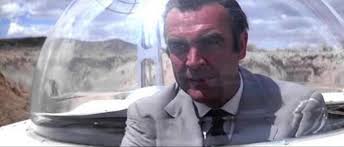
Diamonds are Forever premiered in Munich, West Germany on December 14, 1971, three days before East and West Germany signed a historic agreement allowing for more open travel across the Berlin Wall. The film was a box office blockbuster but reviewers saw it as more silly than sexy. Maybe that was due to the fact the the special effects budget was sacrificed to pay Connery’s salary. The scene of Bond driving a moon buggy through the Nevada desert, being chased by henchmen on dirt trikes, is particularly goofy. But you do get Bond in his white dinner jacket scaling the Las Vegas Hilton (the “Whyte House” in the film) and Jimmy Dean (the sausage guy) playing a character based on billionaire Howard Hughes, who was friends with Bond producer Cubby Broccoli.

Seventies Bond may fair better. Let’s drop Diamonds into our matrix.

Driver of ActionDiamonds are Forever is classic Bond. We get brief cameos from M, Q, and Miss Moneypenny. Felix and his CIA team play a minor support role, especially when 007 encounters Bambi and Thumper, Blofeld’s bathing suit-clad guardians of Willard Whyte. Part of the story drifts into heist film with James and Tiffany as a team, but, rarely fully clothed, she seems to be just brought along for added sex appeal. Producers had Connery back and were going to make sure he was in nearly every frame.

Role of Violence  – The film starts with Bond on a killing spree as he tries to find Blofeld. That includes finding a woman on a beach, ripping off her bikini top, and strangling her with it. Ultimately, after killing someone in Blofeld’s lab (with mud), Bond kills Blofeld. Or a Blofeld.(“Welcome to hell, Blofeld.”)  There’s a scene where Bond kills a diamond smuggler after a pretty intense fight in a Dutch elevator and the now routine scene where Bond slaps his Bond girl. Most “fun” is when Bond realizes that Blofeld is alive (THE GUY THAT KILLED HIS WIFE – BUT NOT MENTIONED). In fact, there are apparently multiple “cloned” Blofelds and cats. He’s faced with two Blofelds (this time played by Brit Charles Gray, who played an MI-6 agent in You Only Live Twice). With a 50-50 chance, Bond shoots and kills the wrong Blofeld. “Right idea, Mr. Bond,” says Blofeld. “But wrong pussy,” says Bond. Oh yeah, there’s a climatic shoot out on an oil rig between the CIA and the Henchmen that kills a grip of dudes.

Vulnerability – Nope. Zero mention of Bond’s dead wife. Not even a hint that that’s why he’s after Blofeld. Older Bond is all business.

Sexual Potency – James might be losing his touch. He hooks up with a casino trollop named (ready?) Plenty O’Toole (played by Natalie Wood’s little sister, Lana). He gets her dress off but before he can get his pants off, some mobsters throw her out of a hotel window, into a pool. He tells the gun-toting goons, “Well, I’m afraid you’ve caught me with more than my hands up,” which, I assume, is a reference to the Bond Boner. Of course, Bond does bed Tiffany Case. (Her smoking in his bed the next morning is the clue.) At one point, while his body on hers, she asks, “What’s going to happen to me?” “I’m on top of the situation,” James says. Snort. But the required three sexual conquests is not achieved in Diamonds are Forever. Gee, maybe he was thinking about Tracy.

Connection – Maybe Connery was just tired of playing Bond, but 007 doesn’t really seem to care about anybody in this film, including M, Felix, Moneypenny, or Plenty (who gets tossed out of a tenth story window). There is some connection with Tiffany, who seems to want to be a spy as much as a diamond smuggler. The film ends with James and Tiffany, wait for it it, in a boat! This time it’s an ocean liner. But we’re not quite done. Here come Mr. Wint and Mr. Kidd, the homicidal homosexuals, posing as waiters with bomb souffle to kill Bond. They end up on fire and blown up, over the side as James and Tiffany sail away to short-term happiness.

Toxic Masculinity Scale: 4

Summary Seventies Bond still has a problem with race. The primary cast is lily white and we’re still stuck with “the sun never sets on the British Empire” ethos. (Did Richard Nixon have anything to say about British agents running amok in Vegas?) There’s a scene in Circus, Circus where a black woman is transformed into a gorilla for the amusement of children. And the mobsters of Slumber, Inc are caricatures of Italian mafiosos. Some of this will be both fixed and made worse in the next installment, Live and Let Die.

Aside from slapping Bond “girls” or throwing them out of windows, you get the sense that the most misogynist elements of the franchise were running on fumes by 1971. Diamonds are Forever is a cartoon version of a 007 film that tries to balance sexy or sexist Bond quips with more over the top diabolical plans. (There’s a comment from Blofeld that if his space laser destroys Kansas, nobody will know about it for four years.) It’s all just dumb. They should have made Gloria Steinem a Bond girl and had her repurpose MI-6 and the CIA to raid the underground lair of patriarchy. Ms. Bond, we need you.

Next: Live and Let Die (1973)

The James Bond Project #7: On Her Majesty’s Secret Service (1969)

The James Bond Project #6: You Only Live Twice (1967)

The James Bond Project #5: Casino Royale (1967)

The James Bond Project #4: Thunderball (1965)

The James Bond Project #3: Goldfinger (1964)

The James Bond Project #2: From Russia With Love (1963)

The James Bond Project: #1: Dr. No (1962)

The James Bond Project #6: You Only Live Twice (1967)

January 12, 2025

This series is intended to evaluate each product of the James Bond film franchise through a feminist lens, and the relevance of the Bond archetype to shifting ideas of masculinity in the 2020s.

You Only Live Twice (1967, directed by Lewis Gilbert)

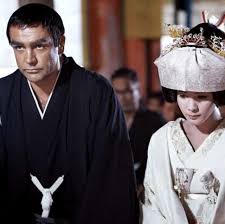
This might be the most Bondy Bond of all. Not only does it have the usual staples; underground lairs, evil global plots, white bikinis, and Blofeld’s pussy cat, but also a massive army of ninja warriors. I probably enjoyed it too much. Maybe it was the brilliant score by John Barry and dead volcanoes erupting. Maybe it’s because I watched it on a Saturday morning, hyped up on coffee and taking a break from the devastating news of the L.A. fires. Yeah, this was supposed to be Sean Connery’s last 007 film. The Scottish actor was worried he’d be forever typecast and announced that he’d be Bond no more before You Only Live Twice premiered. Maybe Connery’s weariness added to the “I could not give a damn” laconic attitude of 1967 Bond, making him that much more appealing to old school notions of rogue masculinity. It’s either Bond on auto-pilot or Bond fully realized. I can’t decide.

The screenplay for You Only Live Twice was written by acclaimed children’s book author Roald “Willie Wonka” Dahl. Dahl was a friend of Ian Flemming’s and (very) loosely adopted his novel for the screen. The original source paid mind to Japanese culture and Dahl retained the detailed Japanese wedding scene in the script. (Unlike other globe-hopping 007 films, the action here is primarily in Japan.) But Dahl had to create much of the plot himself. For example, producers told him Bond needed to make love to three women in the movie so he had to add two additional relationships in the screenplay.

The story is set in the 1960s space race between the US and USSR. We finally get to see Blofeld’s face and it’s great British actor Donald Pleasence. The British are trying to broker the peace between America and Russia as space capsules start disappearing from orbit. (Keep calm and don’t start World War 3.) They put Bond on the case who discovers that SPECTRE is helping an Asian country (presumably China) start a war between cold war adversaries so they can emerge from the ashes. (This plot seemed like it was as much 2025 as 1967. Because, you know, China.) After faking his own death, Bond ends up in Tokyo, after being shot out of a submarine torpedo tube without an air tank. (007 has very good lungs.) A welcomed sight is the large number of Japanese actors who were hired to make up a large percentage of the cast. Welcomed after the Hollywood tradition of making up white actors to look “Oriental.” (Breakfast at Tiffany’s, I’m looking at you.)

There are flushes of anti-Asian racism in You Only Live Twice. Connery’s first scene is in Hong Kong and Bond is in bed with an Asian woman. The first line of the film is, “Why do Chinese girls taste different from all other girls?” He then talks about how Peking duck is different from Russian caviar, but he loves them both. She replies, “Darling, I give you very best duck.” I laughed and I shouldn’t have. There’s a section where James has to be transformed into a Japanese villager that seems to mainly involve him putting on a Beatle wig. And so on. You Only Live Twice premiered in London on June 12 (with Queen Elizabeth in attendance), the same day the U.S. Supreme Court issued the Loving v. Virginia decision, legalizing interracial marriage, so maybe audiences were ready to see James in bed with non-white women. The film has plenty of that.

How doe Far East Bond fit in our analysis?

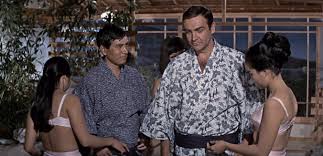
Driver of Action – After the ensemble romp of Casino Royale, we’re back to solo Bond. We don’t even get Felix Leiter on the scene. We do get Tiger Tanaka, head of the Japanese Secret Service (played by Tetsurō Tamba) to provide James with his ninja training and fix him up with his undercover Japanese wife, played by Mie Hama (who I remember from 1962’s King Kong vs. Godzilla). Tanaka also serves as something of a pimp for James. Taking Bond home, he says, ““Consider my house yours, including all of my possessions.” Then four young women in their underwear walk out. “In Japan, men always come first. Women come second,” he says as the women bathe Bond.

Role of Violence – 007 has a license to kill a ton of people in this movie. He shoots an assassin and then three or four dockworkers (while single-handedly fighting dozens), and countless henchmen in Blofeld’s under-volcano lair. There’s a SPECTRE agent who failed to kill Bond who Blofeld dumps in a pool of piranhas. (Bond also throws a henchman into the piranha pool.) The climatic battle between ninjas and henchmen probably has a body count above a hundred. There seems to be no remorse for anyone killed. It’s just entertainment.

Vulnerability – In the novel of You Only Live Twice, Bond’s mock Japanese bride is a woman named Kissy Susuki and the union produced a child. In the film she is not named. Before the wedding Bond asks Tiger Tanaka, “Is she pretty?” He replies, “She has a face like a pig,” and Bond grimaces. Of course she’s beautiful and later plays a role in James’ rescue. As has become rote, Connery’s Bond has zero moments of weakness, although the technology used is through the roof in this film. He needs his damn gadgets. Yet, Bond seems bulletproof. Literally. There are countless rounds fired at Bond, including from four attack helicopters and Jimmy doesn’t even suffer a scratch.

Sexual Potency – In 1967, I’m banking on the fact that part of the pitch of You Only Live Twice was that is was chocked full of “exotic” Asian women. From the first scene with Bond in bed with Aki (played by Akiko Wakabayashi)l, who throughout the film rescues 007 in her white sports car, to Tanaka’s House girls, there is plenty of “exotic” on display. (It’s worth noting that when Tanaka offers Bond one of his “girls” for Bond to take back to his room, Bond picks the one that’s most likely a white actress made up to look Japanese.) Then there’s Helga Brandt, a SPECTRE assassin who has James tied to chair and becomes sexual with him. (She’s a redhead. That’s what they do.) James talk her out of holding him and then uses her knife to cut the straps on her dress. “Oh, the things I do for England,” he mutters. (She later tries to again kill him by jumping out of the plane she’s flying.) James also tries to get busy with his mock wife, but she pushes him away and he then pushes away a plate of raw oysters. “Well, I won’t need these,” he says. Is JB suffering from ED?

Connection – Bond’s connection to his co-workers is minimal. M and Q make brief appearances. Q arrives in Tokyo to bring a cool mini-helicopter with heat seeking missiles! Even Bond’s usually flirtatious relationship with Moneypenny seems to have cooled off. He doesn’t even sexually harass her. When Aki, who saved Bond’s bacon more than once, is poisoned in bed next to him, he seems nonplussed. Connery’s weariness by the fifth film is reflected in Bond’s lack of effort with the women in the film and also in a stanza from the theme song, sung by Nancy Sinatra: “You drift through the years and life seems tame ‘til one dream appears and Love is its name.” As must now be required, the film ends with Bond and his mock wife (Kissy Suzuki is definitely a “Bond girl”) in a boat, another rescue raft in another sea. ”Now about that honeymoon,” he says to her. Then viewers are told that On Her Majesty’s Secret Service is on its way (along with the next batch of Bond girls).

Toxic Masculinity Score: 7

Summary It was Ian Fleming’s intent that readers of You Only Live Twice learn more about Japanese culture. When the book came out in 1964, we were only 19 years from the nuking of Japan and the end of WWII. Dahl devoted screen time to Sumo wrestling, the traditional wedding, and the rise of Japanese corporate power (there are a lot of Toyotas in this flick). But we also get nods to the Japanese version of patriarchy with Tiger Tanaka’s house girls as well as the standard English Bond jokes, like when Helga, referring to a warning about smoking, says, “Mr. Osato believes in a healthy chest” as her own chest fills the camera frame.

One wonders what You Only Live Twice would have been like if the James Bond-Kissy Suzuki marriage had been truer to the original novel. Instead we get tired James floating off be played by another actor, likely stepping into the well-established formula.

Next: On Her Majesty’s Secret Service (1969)

The James Bond Project #5: Casino Royale (1967)

The James Bond Project #4: Thunderball (1965)

The James Bond Project #3: Goldfinger (1964)

The James Bond Project #2: From Russia With Love (1963)

The James Bond Project: #1: Dr. No (1962)

The James Bond Project #4: Thunderball (1965)

January 8, 2025

This series is intended to evaluate each product of the James Bond film franchise through a feminist lens, and the relevance of the Bond archetype to shifting ideas of masculinity in the 2020s.

Thunderball (1965, directed by Terence Young)

Adjusted for inflation, Thunderball is the largest grossing of all Bond films. And it looked big, being the first Bond flick shot in widescreen Panavision. This was supposed to be the first Bond feature in 1962, but a legal dispute held it up in court. However, original director Terence Young was back at the helm so it had a very “classic Bond” feel. We end up back in the Caribbean (the Bahamas this time) so we see more black faces, including Bond team member Pinder, played by Earl Cameron (who some will remember from Dr. Who). And also sharks. Lots of sharks.

My initial thought watching this film was that all these “Bond Girls” look alike. Same cheek bones, same hair style, same dubbed in voice. Maybe it was just post-holiday malaise, but I found myself repeatedly confused as to which actress Sean Connery’s Bond was making the moves on. By film #4, they were virtually cookie cutter. The primary Bond girl in Thunderball is Domino. Producers originally considered Julie Christie, Raquel Welch, and Faye Dunaway for the part, but settled on beauty queen Claudine Auger (Miss France!). By film four you get the feeling that half the draw of a Bond film is just the cavalcade of beautiful women for James to plow through. However, there is a scene where SPECTRE assassin Fiona Volpe (played by Italian actress Luciana Paluzzi) blows up a car with rockets on her motorcycle and then takes off her helmet to reveal her flowing red hair that is pretty, um, empowering.

Thunderball premiered in Tokyo on December 9, 1965 at a time when the anti-Vietnam War movement was gaining steam in the U.S.. (On November 27, tens of thousands of protestors marched from the LBJ White House to the Washington Monument.) Thunderball skirts Cold War tensions by, again, making SPECTRE the bad guys. This time, #2, Emilio Largo (played by Italian actor Adolfo Celi), is ransoming NATO for £100 million in diamonds after stealing two nuclear bombs (a plot later spoofed in the first Austin Powers movie).

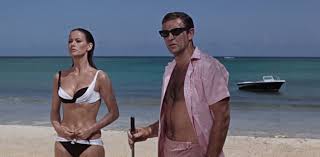
What this Bond film is most famous for is not the women or the evil plot (both a bit tired by 1965), but the extensive underwater filming. A quarter of this film takes place underwater, including shots of cool submersible vehicles and a massive speargun battle between the good guys and the bad guys. It must have been spectacular to see it on the widescreen in the mid-1960s. Apparently, the ocean shooting in Nassau had to be done at low tide because of the constant threat of sharks and the scene where Bond is in a salt water pool full of sharks almost ended with Connery getting chomped. The tropical locale means we get plenty of bikinis and bare-chested Bond as well as boats exploding (now a Bond film staple).

Let’s plug Thunderball into our feminist matrix.

Driver of Action – For the first time, we almost get Bond as a part of a team. Presumably assembled by MI-6, we get an on-the-ground team in Nassau put together to help James avert nuclear catastrophe, including familiar faces like CIA bro Felix Leiter (this time played by Rik Van Nutter) and MI-6 gadget guy Q, who, in Bermuda shorts, laments having to meet 007 “in the field.” He’s also joined by Pinder, another unnamed Afro-Caribbean dude, and CIA agent Paula Caplan, played by Martine Beswick (back from her role as “Gypsy Girl #2” in From Russia with Love). It’s mainly Felix who bales James out (in his handy CIA helicopter), but it should be noted that Paula is kidnapped by SPECTRE and commits suicide rather than rat on James. She’s the DDID. (Dead Damsel in Distress.) But it’s still Bond in the driver seat, whether he’s dodging sharks or ordering Beluga caviar.

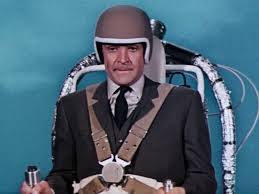
Role of ViolenceThunderball opens with Bond killing SPECTRE assassin Jacques Bouvar (who is dressed as a woman, so there’s that) and then escaping with a supercool (for 1965) jetpack. There’s a few henchmen (dressed in black, like an episode of Batman, which debuted the following year) that Bond kills, although they may just be stunned. Some henchmen throw another henchman into a pool of sharks. And whole bunch of frogmen, good, bad, and otherwise, get shot by spearguns in the Caribbean, some likely by 007. Other than the epic underwater battle, the body count is not giant and those scuba dudes who are killed are probably then eaten by sharks, so, the circle of life.

Vulnerability – It’s 007, so audiences don’t expect an inner window into Bond’s heart and it seems even more walled up than ever. He’s less dependent on technology than in Goldfinger, but James swallowing a radioactive pill so the CIA can track him seems like some kind of weird acknowledgement that maybe James can’t do everything by himself. There’s also a moment where James is trying to rescue Paula from Largo’s compound and he accidentally drops his gun off the roof he’s on. The look on his face seems to say, “Uh oh. My dick just fell off.”

Sexual Potency – Here’s where Thunderball goes off the rails. The first part of the movie, Bond is camped out at an English health spa called Shrublands, where he continually sexually harasses a masseuse (physiotherapist?) named Patricia (played by Molly Peters, featured in Playboy’s 1965 “James Bond’s Girls” spread). He forcefully kisses her and then when she thinks Bond’s bad experience on a, more Medieval than medicinal, stretching rack is her fault (it was a henchman) she frets that if her boss finds out, she could lose her spa job. “My silence could have a price,” James says then pulls her away for some quid pro quo sex. In the end, they’re in bed, with Bond doing the massaging.

Then there’s James’ relationship with SPECTRE agent Volpe. Her red hair is a classic signifier of a libidinous woman and when Bond walks uninvited into her bathroom to find her naked in her bathtub, he smirks with the recognition that he’s about to get another notch in his belt, “as if it was intended.” Because she’s a wicked redhead, she takes off Bond’s clothes and they end up in the sack where he tells her, “you should be locked up in a cage.” Rawr. Post coitus, she (and her henchmen) turn the tables on Bond, who seems shocked that he got caught with his pants down. In a moment for the Bond Girl demographic, she says, “But of course, I forgot your ego, Mr. Bond. James Bond, who only has to make love to a woman and she starts to hear heavenly choirs singing. She repents, and immediately returns to the side of right and virtue. But not this one.” Snap.

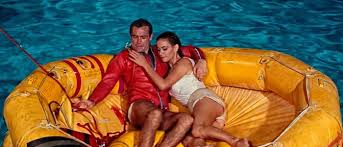
The final scenes are about rescuing Miss France/Domino from bad guy Largo. Bond sucks sea urchin poison from her foot and then they make love on the beach. When 007 says he needs her help catching Largo, she dejectedly says, “Of course. That’s why you make love to me.” Sex as transactional in Bond films. And also now cemented as a cliche, the film ends with Bond and Domino in a boat, this time a rescue raft floating in the Caribbean.

ConnectionThunderball begins and ends with Bond alone, acting or celebrating (with his prize) his actions. We do get to see a section of the Bond working with a team, but it’s sort of like Superman and his super-friends. Bond is in the lead. Again, as by Film 4, Bond is now the archetype of the man alone. He mocks love (including with Moneypenny), but he never actually has it. I wonder if writers ever considered developing a bromance between James and Felix. Maybe, at some point in this chronology, we’ll meet a James Bond who cares about somebody.

Toxic Masculinity Scale: 8

Summary By 1965, James Bond had officially become a franchise, produced by men to maximize 007 revenue. In the opening credits, the only females listed are “continuity girl” and “wardrobe mistress.” The fledgeling second wave feminist movement hadn’t yet turned its attention to Hollywood and the impact of this picture of gender. The normalization of sexual harassment in the 1960s (here, Bond’s treatment of spa worker Patricia) would later be unpacked by the brilliant AMC series Mad Men (2007 – 2015). But Bond is such a cad in Thunderball it makes watching his witty banter with the other characters in the film a lot less fun to watch. 

We do get tastes of gender subversions. There’s Volpe (Italian for “fox”) blowing stuff up, motorcycle between her legs, and later removing 007’s clothes and then sexually besting him. (“But not this one.”) Again, we get a female hotel concierge ogling Bond’s backside and Paula, the female CIA agent (who dies because, you know, lady CIA agents). But it all stands in the shadow of Bond’s hyper-masculinity. He even tries to feminize Largo by saying of his skeet shooting rifle, “That gun looks more fitting for a woman.” Huh?

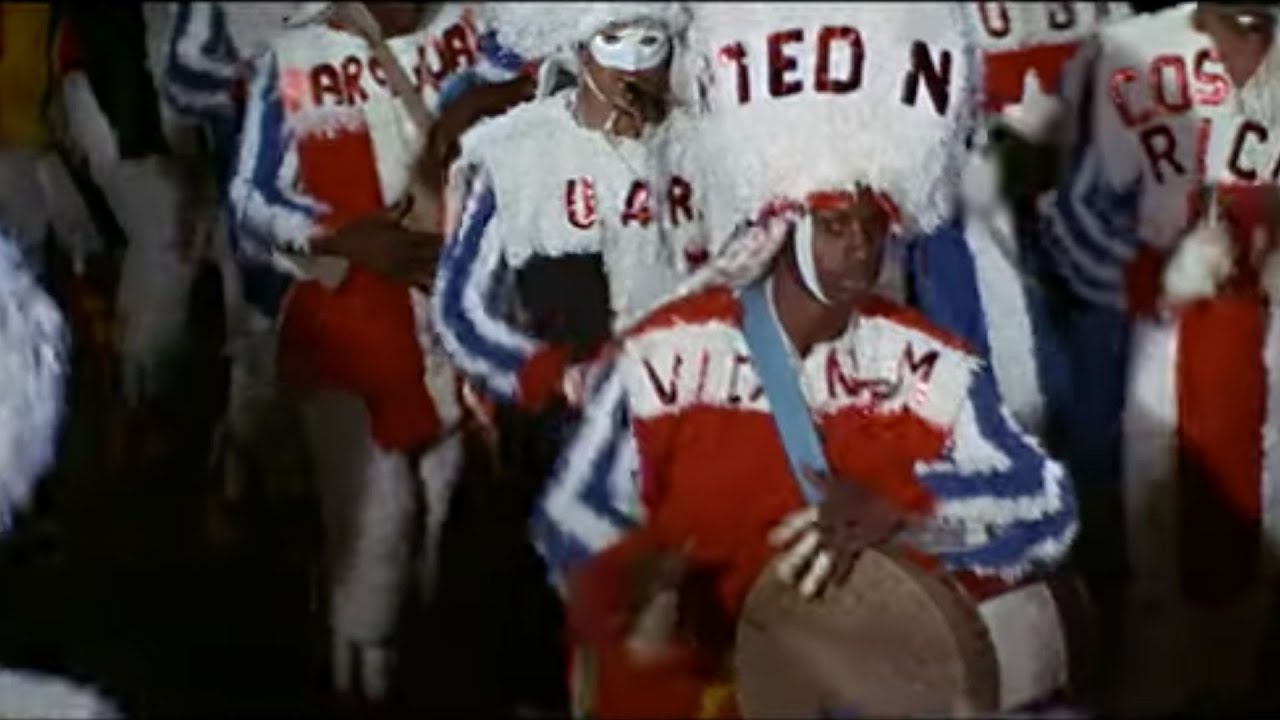
On a personal note, I appreciated the return to the Caribbean, especially Nassau where I experienced a particular “man making” experience as a 17-year-old boy. I loved the scenes shot during Junkanoo; Carnival in the Bahamas. It caught a glimpse of the decolonization that was happening in the black world in the 1960s and while there was no dreadlock rasta in Thunderball, behind the highly paid white actors in the camera’s focus there were a bunch of black faces who knew the world was changing. Those are the Bahamians I met when I was there as a teenager in the 1980s.

Next: Casino Royale (1967)

The James Bond Project #3: Goldfinger (1964)

The James Bond Project #2: From Russia With Love (1963)

The James Bond Project: #1: Dr. No (1962)

The James Bond Project #3: Goldfinger (1964)

December 30, 2024

Goldfinger (1964, directed by Guy Hamilton)

“That’s my James!” Welcome to the James Bond blockbuster. With the massive success of From Russia With Love came an even bigger budget (and a new director). Goldfinger gave us franchise staples, like the pre-credits action scene, the bouncy Bond quips, infinite gadgets (including the loaded Aston Martin), the epic theme song, and multiple exotic locations (including rural Kentucky). And of course there are multiple women who are branded as Bond “girls” in the film who find their way into 007’s beefy arms.

The box office smash surely benefited from the 1964 British Invasion and the American obsession with all things English. Bond even has a snarky line about the Fab Four after he beds Goldfinger’s girl Jill Masterson, chiding her not understanding his standards for chilled Champaign. “My dear girl, there are some things that just aren’t done, such as drinking Dom Pérignon ’53 above 38 degrees Fahrenheit. That’s as bad as listening to the Beatles without earmuffs.” (It should be noted that two of the actors in Goldfinger, Richard Vernon (Colonel Smithers) and Margaret Nolán (Dink), had just appeared in the Beatles’ film A Hard Days Night and the Beatles 1965 film, Help!, would be a send up of Goldfinger.)

Goldfinger cemented the formula for what a Bond film would be for decades to come. It was released in September of 1964, in a world that was increasingly surrendering to the ennui of the East-West Cold War, the same month as Lyndon Johnson’s apocalyptic “Daisy” campaign ad that ended with a mushroom cloud. I had been born 7 months earlier and would be socialized into a world that saw Bond as the modern model of masculinity. Let’s check Goldfinger with our five reference criteria.

Driver of Action – Goldfinger is the archetypical Bond film, the begins with him blowing some shit up in Mexico and ends with him making sweet love to Bond Girl #3 Pussy Galore on a desert island, telling her “This is no time to be rescued.” There is no “buddy,” as in the previous two films, just Bond, and his MI-6 and CIA supporters (who play minimal roles). Even the nefarious plotting by Goldfinger (played by former Nazi Gert Fröbe after Orson Welles proved to be too expensive) to irradiate all the gold in Fort Knox is a minor subplot. Goldfinger is all about watching Sean Connery as Bond move from scene to scene; Mexico, Miami, London, Switzerland, Kentucky. In the opening scene, he steps out of his wetsuit dressed in a white dinner jacket and you know this going to be 110 minutes of pure Connery.

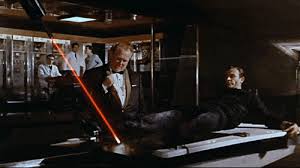
Role of Violence – Again, Bond has a relatively low bodycount in this film. People do die, especially women, including Jill Masterson. For her flirtation with Bond, she is painted gold and dies of “skin suffocation.” Her sister Tilly is killed by Oddjob, Goldfinger’s Korean henchman. But Mr. License-to-Kill is mostly restrained. A Mexican assassin gets an electric fan tossed into his bathtub. Some henchmen go over a cliff in a fiery crash after Bond shoots slick oil out of his Aston Martin. In the climatic scene in Fort Knox, Bond throws a henchman off a ledge and electrocutes Oddjob. (Apparently actor Harold Sakata was severely burned in the stunt.) Mostly Bond is the recipient of violence, including a laser beam aimed at his most manly parts while he is strapped to a table.

Vulnerability – Yeah, no. You wonder if we have to wait until the ‘90s to get new age sensitive James Bond. Whether strapped to a table with a laser heading toward his junk or locked in a Kentucky holding cell, or in a plane plummeting to the earth, we never see James break a sweat. 

Sexual PotencyGoldfinger is balls out on the message that Bond is the conquerer of women. In the opening sequence, he goes after a Mexican dancer and then uses her body to deflect an assassin. In Miami, he’s getting a poolside massage from his Florida fling, Dink (who’s cleavage was also featured in A Hard Days Night). Then there’s the romp with Jill who gets painted gold. In Switzerland, when a blonde passes him by in a ’64 Mustang convertible, he resists the urge to chase after her. “Discipline, 007, discipline,” he says to himself. She turns out to be Jill’s sister and they have a moment before Oddball kills her with his killer hat.

That brings us to Pussy Galore (the character, not the male fantasy). The Bond double entendres hit a new level here and Pussy’s name is mentioned constantly in the second half of the film. Galore is played by Honor Blackman, who was Diana Rigg’s predecessor on the highly popular British spy show, The Avengers. So she was coming in to Bondland a Judo-flipping badass, not a submissive DID (Damsel In Distress). In Goldfinger, she’s the leader of Goldfinger’s team of female pilots, playing a role in his grand slam plan. But there’s a scene in Goldfinger’s barn where James manhandles Pussy and the subsequent judo fight ends up with the two literally rolling in the hay. Galore tries to push Bond off her, but no woman can resist 007 and his assault ends in a passionate kiss. Woot, there it is.

Connection – Unbeknownst to the viewer, Pussy Galore’s Stockholm Syndrome turns her into an ally of Bond’s and Goldfinger’s evil plot is thwarted. As has already become an uber-cliche in Bond films, their end scene, making out under the parachute, casts no allusion that it’s the beginning of a beautiful relationship between James and Pussy. We know how this works. Women are transitory and co-workers are support players. Does Bond have any friends? A love that got away? He is supremely untethered. A man alone.

Toxic Masculinity Scale: 7

Summary –  Like an explosion of everything that was 1960s before LSD, Goldfinger is a magnum opus of a spy action film. The clever crime attempted (to irradiate the gold in Fort Knox to drive up the value of personal stocks of the metal) takes a back seat to watching Connery leap frog from woman to woman, often with his suped-up Bondmobile (Oh, to have stock in Aston Martin in 1964). Connery’s Bond is the Id unrestrained. One wonders what MI-6’s HR department would say about the workplace flirtations between Bond and Miss Moneypenny in the post #metoo era. But it’s the scene between Bond and Galore in the barn that reminds us that the debonair spy is not immune from the misogynistic value of male entitlement. A generation of boys learned women are to be taken by men, even if they resist. Pussy galore, indeed.

While contemporary audiences my get a bit of a creepy vibe from Goldfinger’s Bond, there’s a creeping trend that may be less noticed today. The third Bond film sees 007 more dependent on the technology provided by his employer. It may be a homing device in his shoe or an ejection seat in his car, but 1964 Bond is becoming less a man left to his own devices and more to the devices Q builds for him. Bond is the halfway point between the archetypical cowboy, fending for himself on the frontier, and Modern Man, juggling apps and monitoring social media, never not wired to the electronic collective. Where would Bond be without Q? Where would we be if the internet went down? One imagines that Bond would be better off, but not by much.

Next: Thunderball (1965)


The James Bond Project: #1 – Dr. No (1962)
The James Bond Project #2: From Russia With Love (1963)

The James Bond Project #2: From Russia With Love (1963)

December 28, 2024

From Russia With Love (1963, directed by Terence Young)

With the unexpected success of Dr. No, United Artists doubled the budget for the sequel and the bet paid off. (The $2 million film took in more than $78 million worldwide.) We are now firmly in a franchise of films made by men for men and their dates, starring manly man Sean Connery. Although it should be noted that Johanna Harwood, who had worked on the script for Dr. No, played a large role in the screenplay for From Russia With Love. Producers cast Italian beauty queen Daniela Bianchi as Bond Girl #2 Tatiana Romanova, after actress Elga Gimba Andersson refused to sleep with a United Artists executive. Bianchi, who could barely speak English, had her lines dubbed by a British actress.

The film starts the Bond tradition of the opening credits being projected on to the bodies of scantily clad or nude women, firmly establishing that these are stories for boys. Instead of Jamaica, most of the action takes place in Turkey, although there are obligatory scenes in London and wherever SPECTRE Island is. There we meet the Dr. Evil of the Bond cinematic universe, Blofeld (or at least his cute cat). Leaving the Caribbean means we leave any and all black actors, and the primary Turkish character, Ali Kerim Bey, is played by Mexican actor Pedro Armendáriz. (In a bizarre side note, Armendáriz contracted neck cancer after filming a Howard Hughes film near a nuclear test site in Utah, and before he finished shooting his parts for From Russia With Love, shot himself with a gun that he snuck into his hospital room.)

From Russia With Love was filmed as the Cold War intensified and SPECTRE agents replaced Russian agents (who were the villains in Ian Fleming’s original Bond novel) to not further inflame tensions. President Kennedy told Life Magazine that From Russia With Love was one of his favorite novels. The film version premiered on October 10, 1963, the same day U.S. Attorney General Robert Kennedy (crazy guy’s dad) approved J. Edgar Hoover’s wiretapping of Martin Luther King, Jr.. The film was screened at the White House for JFK before he left for Dallas, where he was assassinated. From Russia With Love received mixed reviews, some saying it was slower than Dr. No, but has gone on to be held up as one of the best of the Bond series.

Here’s how FRWL charts with our five evaluations.

Driver of Action – Director Terrence Young had established a formula and he’s not going to break it on the sophomore outing. This is Bond in all his glory, now supplied with cool gadgets by MI-6’s Agent Q (played by Desmond Llewelyn, who remained as Q to 1999’s The World is Not Enough). There is a great “buddy” feature between Bond and Bey (similar to Dr. No’s Quarrel role) and a fun subplot about SPECTRE operatives Rosa Klebb and Kronsteen, groveling before Blofeld as they attempt to kill Bond for offing Dr. No. (The “R” in SPECTRE is for “revenge”- Special Executive for Counter-intelligence, Terrorism, Revenge and Extortion. FYI.) But the story doesn’t happen without their dastardly plot to kill Bond and the delight of our man James foiling their fiendishness.

Role of Violence – There is considerably less violence in Dr. No’s sequel. There are some cool explosions after a helicopter attack and a boat chase, but 007 only kills one person, SPECTRE assassin Donald Grant (played by Robert Shaw, who will always be Captain Quint in Jaws to me). Grant’s death is the result of a beautifully choreographed fight scene in a train car on the Orient Express. (Fight scenes in train cars become something of a trope in the Bond franchise.) The most shocking violence in the film is Bond’s full-handed smack across Russian agent Tatiana’s face, after which she repeatedly tells him that she loves him. I bet that clip has showed up in a few “Sexism in Film” classes.

Vulnerability – Again, there’s no chink in James Bond’s armor. No glimpse inside. Even when Bond is literally on his knees prostrate before assassin Grant, we know he has a plan to quickly turn the tables.

Sexual Potency – The first shot of Bond in the film is him making out with Sylvia Trench (from Dr. No) in a floating punt, probably on the banks of the River Cam in Cambridge. He’s playing hooky from MI-6 to work his way around the bases with Trench. (Is there a cricket version of “third base”?). When Bond first meets Tatiana, she is naked in his Istanbul hotel bed. Later she asks him, “James, will you make love to me in London?” He answers, “Day and night.” There’s another strange segment where Bond must decide which of two young, attractive “gypsy” women will be awarded the man they both want. They arrive at his room to seductive music. “This might take some time,” he says. We see the women the next morning with broad smiles as James leaves. All these women are happy for a piece of 007’s sexual mojo, even when he slaps them.

Connection – The scenes with Pedro Armendáriz as Ali Kerim Bey sparkle. They have immense chemistry, enhanced by the knowledge of the great pain he was in from his cancer. Had he lived, one could see Armendáriz as Bond’s Morocco Mole sidekick in future Bond films. But both Armendáriz and his character are dead by the end of the film. His relationship with Tatiana is less mutual, even though they have to pretend to be a married couple while on the train, and she dreams of marrying him when they reach London. She even saves him from the venomous boots of Rosa Klebb in a hotel room in Venice and his heart is unmoved. Like the closing scene in Dr. No, we end with Bond and Bond Girl #2 romantically floating together in a boat, this time a gondola, with end credits urging viewers to get ready for Bond #3, Goldfinger, which will most certainly present us with Bond Girl #3.

Toxic Masculinity Scale: 7/10

Summary From Russia With Love really front loads the male gaze on women’s bodies thing. From the opening credits, to the (very) long shot of Ali Kerim Bey’s girlfriend’s cleavage, to a very oily masseuse on SPECTRE Island, to the camera endlessly hovering on a belly dancer’s torso, there’s plenty to ogle. Then there’s the weirdly placed “duel” between two scantily glad “gypsy girls” that has zip to do with the plot. If there’s any sense of balance, we do get Bond wrapped in a towel, which probably had some men wondering what they needed to do to grow crops of hair on their chests.

There’s also an odd lesbian subtext with Rosa Klebb. Props to having a female antagonist in the second Bond film. In 1963, there was a narrative that Russian (i.e. “communist”) women were more manly, so that tracks. But to make the point that women on the other side of the Iron Curtain are not bound by the same gender rules, they add a suggestion of sexual predation when Klebb is informing Tatiana of her mission to seduce Bond. And Romanova doesn’t seem to shirk as Klebb evaluates her body and places her hand on her leg. Russians, they not like us. (Or are they?)

From Russia With Love is rough film to place. It’s the most realistic of all the Bond films from the classic era. There’s a nice complexity to the plot but we know even less about the person of James Bond. It’s almost like Sean Connery is playing James Bond pretending to be a caricature of James Bond. A lot of people think this is one of the greatest British films ever made, but it felt flat to me. And the slapping scene seemed very un-Bond, even if it served as a reminder of how normalized violence against women is in film. Where is Wonder Woman when you need her?

Next: Goldfinger (1964)

The James Bond Project: #1: Dr. No