The James Bond Project #11: The Spy Who Loved Me (1977)

February 5, 2025

This series is intended to evaluate each product of the James Bond film franchise through a feminist lens, and the relevance of the Bond archetype to shifting ideas of masculinity in the 2020s.

The Spy Who Loved Me (1977, directed by Lewis Gilbert)

This was the first Bond film I saw in the theater. My dad took my little brother and I to see the PG-rated Spy Who Loved Me the summer of ’77. I was 13 and what I remember most was the brief glimpse of Barbara Bach’s (or her body double’s) right breast in the submarine shower scene. I was 13, OK? But The Spy Who Loved Me was a return to form after the limp Man with the Golden Gun in 1974. It had all your musts, including oodles of cool gadgets from Q, Bond in his tux and bad girls in bikinis, scores of henchmen willing to die for a megalomaniac, and sharks. My absolute favorite part of the film when I was a kid (besides the boob) was the Lotus Esprit that turned into a submarine, complete with missiles. I thought that was the coolest thing on earth and dreamed of a submarine car of my own. Ironically, in 2013 actual megalomaniac supervillain Elon Musk bought the film’s Lotus for £616,000 in hopes of turning it into a workable submarine. (Like most of his crazy ideas, he failed.)
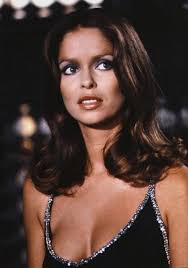
Roger Moore definitely is getting his mojo back in his third installment in the Bond franchise. While his lines still fall a bit flat, he’s got Bond “girls” dripping from his arms. On top of the TSWLM list is Barbara Bach as KGB agent Anya Amasova, AKA Agent XXX (get it?). Bach was a model and Spaghetti Western actor who would next star in Caveman (1980) with her future husband, Beatle Ringo Starr. (Rumors were that Moore wanted Brigitte Bardot for the role.) As a sort of seventies Blofeld, this installment’s villain is wealthy industrialist Karl Stromberg, who wants to destroy the world so he can build a new world under the ocean. Stromberg is played by Curt Jürgens, who starred with Bardot in And God Created Woman in 1956. Added to the cast is Richard Kiel, who stars as the indestructible steel toothed giant, Jaws. The return of You Only Live Twice director Lewis Gilbert helped to bring some of the Connery-era swagger back to 007’s mission.

As is expected, the exotic locales splash across the screen. Bond riding a camel across the Egyptian desert and then chasing the bad guys through the Giza ruins was not filmed on an English set. It was there on sight, as were the scenes filmed on the Italian island of Sardinia. We return to some classic Bond tropes, like assassins on skis (On Her Majesty’s Secret Service) and underwater battles (Thunderball). There’s sexy one-liners (Her: But James, I need you! Him: So does England.) And sexist one-liners (James commenting on a woman in a bikini in a boat, in front of Anya, posing as his wife – “What a handsome craft. Such lovely lines.”) And while we don’t get an underground lair, we get an under WATER lair that serves its purpose.

The Spy Who Loved Me premiered in the United States on August 3, 1977, the same day that the Tandy Corporation debuted the first mass produced microcomputer, the TRS-80, forever changing popular culture and gadgets in James Bond movies. The film received mixed reviews but fared better than its predecessor. Boosted by a great theme song, sung by Carly Simon (and constantly on the radio the summer of 1977), the film was United Artists biggest grossing movie to date, but competed in theaters with the box office sensation that was Star Wars, putting it at #8 for the year (between The Deep and Oh, God!)

Let’s put The Spy Who Loved Me in our feminist evaluation machine.
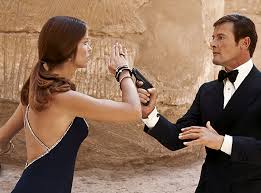
Driver of Action – I’m getting the feeling that the formula for Moore’s Bond films are it’s just him. Even though he’s paired up with a Soviet spy, Anya Amosova, this isn’t a buddy film. She’s primarily sexy arm candy whom 007 has to rescue. (Although there is one scene in Egypt where she throws up her arms in a Charlies Angels karate pose that I thought was going to give us some Russian aggression, but no such luck.) James does not even have a support team. We get brief cameos by Q and Moneypenny, but this is just James.

Role of Violence – 007 kills some people in TSWLM. At the start of the film he shoots a Soviet agent (who is Anya’s boyfriend) with a rocket ski poll while skiing backwards. He drops one of Stromberg’s henchmen off a roof in Cairo, and then kills a half dozen more in a crazy car chase in Sardinia, including killing a bikini-clad helicopter pilot with a missile from his submerged Lotus. When the action moves to Stromberg’s tanker, which is being used to capture nuclear submarines, 007 with a machine gun goes on a rampage. There are literally bloodless corpses everywhere. Where’s the blood? And James shoots Stromberg multiple times in his underwater HQ. 

Vulnerability – There is actually a mention of Bond being married in the film. Anya brings up that he was married and his wife was killed and he stops her from going any further. It was almost a moment of James the person. The break from James performing “007” was jarring but it only lasted for a split second and then it was back to Robot Bond.

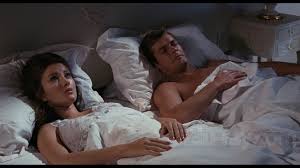
Sexual Potency – This version of Bond wants to be as horizontal as possible. Miss Moneypenny might be too old for him in the late 70s, but every other women on the screen is fair game for his jacked up libido. To be fair, the film starts with a twist on the familiar theme. A man that looks like James is in bed with a beautiful woman when the phone rings. We learn that the woman is actually a Soviet agent, Anya Amosava, and the man is just a lover. Never fear, the very next scene is James in bed with a Russian woman in Austria. It’s a clever trick perhaps meant to say that women can play this game. James in Egypt meets a very white sheik who has a harem of beautiful women. When Bond is offered one of the women for the night he says it would be rude to refuse the offer. In Cairo, he meets another woman who is linked to a connection. He tries to seduce her but ends up using her body to block an assassin’s bullet. Oh well.

The rest of the film is about James and Anya, cold war enemies who have teamed up for some “Anglo Soviet cooperation” to stop this dude who is stealing submarines and wants to blow up the world. Bond can’t keep his hands off her and she may just be playing him by letting his hands and lips wander. But there is a scene on a train (You know, the scene on the train!) where Jaws attacks James and Anya and Bond tosses him out of the train window (We’ve seen this movie before) and Anya says, “You saved my life.” The sexy sax version of theme song swells up as James takes her in his arms. Later, the film ends with 007 and XXX getting busy in a preview of Glasnost ten years down the road.
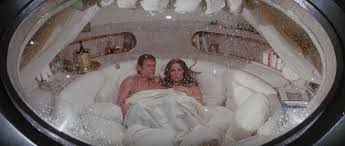
Connection – This is a weird one. (Surprise.) The film is called The Spy Who Loved Me and theme song is sung by a female so it’s reasonable it’s about Anya being loved by James. In the film Stromberg says Bond is “in love with a Russian agent.” But it doesn’t seem like either are in love with anyone. Anya seems to forgive him after finding out he killed her boyfriend, but it doesn’t seem the least bit romantic. This is the aloof Bond of the seventies. Even Q and Moneypenny are kept at arm’s length. Regardless, the film ends with James and Anya bobbing in the ocean in a luxury escape pod, complete with a bed and a chilled bottle of Dom Pérignon ’52. The pod floats into a cruising British destroyer where M and the British Ministers of Defense peer in through the window to see the two spies in flagrante delicto. “Bond! What do you think you’re doing?” asks the defense minister. “Keeping the British end up, sir.” And scene.

Toxic Masculinity Score: 6

Summary Watching this movie took me right back to the summer of ’77. The underwater submarine car battling frog men with their own subs was bliss for a 13-year-old boy. Catching a glimpse of Bach’s boob while sitting next to my dad was both terrifying and titillating. (See what I did there?) No part of me questioned the silly logic of the plot. Now I look at through the lens of 48 years of media. Stromberg has hundreds of henchmen all in red suits, like they were the henchmen of Squid Games. I wondered, who made these suits? Did Stromberg buy in bulk? Are they one size fits all? And do these henchmen get benefits? They all seem to be willing to die for him (and they all do). There should at least be life insurance in their benefits package. And dental.

The Spy Who Love Me, through that modern lens, has a pretty dim view of women. Bach, a few years after the film, said as much, telling People Magazine in 1983 that in the film Bond, “is a chauvinist pig who uses girls to shield him against bullets.” Moore himself said much the same in the 1970s. “Bond, like myself, is a male chauvinist pig. All my life I’ve been trying to get women out of brassieres and pants.” At least Bond doesn’t smack any women in this film on his way to thwart the accelerationist doomsday plot of this episode’s mad genius. While the mushroom clouds over the Atlantic might dampen the joie de vivre of the cold warriors warming things up the film’s climax, were left wondering will the aging Commander Bond will run out of notches on his belt before producers run of out of Ian Fleming novels to film.

Next: Moonraker (1979)

The James Bond Project #10: The Man with the Golden Gun (1974)

The James Bond Project #9: Live and Let Die (1973)

The James Bond Project #8: Diamonds are Forever (1971)

The James Bond Project #7: On Her Majesty’s Secret Service (1969)

The James Bond Project #6: You Only Live Twice (1967)

The James Bond Project #5: Casino Royale (1967)

The James Bond Project #4: Thunderball (1965)

The James Bond Project #3: Goldfinger (1964)

The James Bond Project #2: From Russia With Love (1963)

The James Bond Project: #1: Dr. No (1962)

The James Bond Project #9: Live and Let Die (1973)

January 24, 2025

This series is intended to evaluate each product of the James Bond film franchise through a feminist lens, and the relevance of the Bond archetype to shifting ideas of masculinity in the 2020s.

Live and Let Die (1973, directed by Guy Hamilton)

Now we’re into “my” Bond. The era of Roger Moore. And we’re still in America. Director Guy Hamilton and screenwriter Tom Mankiewicz are back to give us a Bond version of a seventies blaxploitation film. Producers couldn’t bribe Sean Connery (with $5.5 million) to put his white dinner jacket on one more time so the scramble for the next Bond began. Steve McQueen, Paul Newman, Anthony Hopkins, and (again) Burt Reynolds were considered but the license to kill went to Roger Moore (the first English actor to play the role), who had long been considered for the job. In the 1960s, Moore starred in The Saint, a British mystery thriller series, so he was 007 in training. Moore’s Bond comes off as more bourgeois than Connery’s, making his snarky quips much more funny. Maybe the comedic writing was just better in the seventies, but Live and Let Die has plenty of laugh out loud lines.

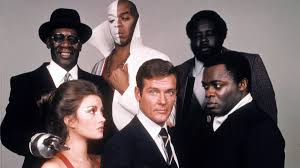
Live and Let Die is not a European film. The action takes place in New York (starting at the UN, then moving to Harlem), New Orleans, and the fictional island of San Monique. (Producers wanted to use Haiti, but the instability of Papa Doc Duvalier’s island forced filmmakers to move back to Jamaica and invent a tropical name.) There’s no Blofeld this time (but there is an underground lair!). Instead we get Mr. Big, a drug kingpin who has relationship with a Caribbean dictator named Kanaga (played by Yaphet Kotto, who had just played in the blaxploitation flick, Across 110th Street). The primary Bond “girl” this time is played by 21-year-old actress Jane Seymour. Since Pussy Galore (Goldfinger), the formula for the Bond girl has been a woman who is somehow in league with the bad guys who Bond peels away with his swarmy charm and Dudley Do-Right ethos. Here Solitaire (Seymour) is a psychic tarot card reader (as long as her virginity is intact) who belongs to the criminal Kanaga. Damsel in Distress Alert!!!

I didn’t see this movie when I came out the summer of 1973 (I was 9), but I knew all about it. The theme song was written and performed by Paul McCartney and Wings and was a radio staple that summer. I first saw it on TV a few years later and loved much of it, especially bayou boat chase that included a stunt that put the movie in the Guinness Book of World Records (which was like the Bible for kids in the 70s). As a boy in the Southern Klan town I was certainly challenged by the portrayals of black culture in the film that I found mostly frightening (especially the voodoo scenes). On its first TV screening the version that the Atlanta station showed removed the interracial kiss from the film. I missed out on that moment watching it age ll, but it was returned to the film by 1977 and, as a 13-year-old boy, I was already indoctrinated into the racist trope of black women as “sexual,” and was fixated on that scene. (The woman in question was CIA agent Rosie Carver, played by model Gloria Hendry.)

Live and Let Die was released at a time when “blaxploitation” films, made mostly by black filmmakers, started to find white audiences. Movies like Shaft (1971), Superfly (1972), and Cleopatra Jones (like Live and Let Die, in theaters the summer of ’73) were known for their gritty portrayals of black urban life, where black crime was often contrasted to the deeper crimes of racism. Live and Let Die contained many of these motifs and the images of James in Harlem capture a picture of urban decay that has long since gentrified. The film also finds great humor in the man out of place theme with Bond in his suit across 110th Street. “Can’t miss him. It’s like following a cue ball.” There’s a scene in a Harlem bar where Bond explains to a black waiter that ordering his whiskey “neat” means no ice, to which the waiter says, “Oh, we charge extra for that.” Brilliant.

Live and Let Die was hugely successful and worthy of our feminist analysis and probably a discussion about the portrayal of blackness as well.

Driver of Action – Maybe because there was (another) new Bond to introduce to the world, Roger Moore is the star of the show. We do get CIA agent Felix Leiter back in the fray (and a clever joke about a “Felix Lighter”). Felix (this time played by David Hedison) has, like in the last film, a team of unnamed CIA operatives, but this film is all about Bond in America, like a fish out of water. Everyone else is a  bit player.

Role of Violence – One might make the case that the violence in LALD is ramped up because it’s Bond vs. black gangsters (This time Mr. Big smacks the Bond girl instead of James), but it’s a pretty standard body count, including four MI-6 and CIA agents. As has become tradition, the carnage is saved for the end of the film, including 007 opening fire on a voodoo gathering. The climax of the film has James and Solitaire dangling over a pool of sharks (lordy) that end with 007 literally blowing up Mr. Big (his guts raining down into the shark pool). And after that, Bond battles Tee Hee, Mr. Big’s metal clawed henchman, tossing him out of the window of a moving train. Moore is less physical than Connery and Lazenby’s Bonds (at 45, Moore was 16 years older than Lazenby). He’s also more likely to rely on wit than weapons.

Vulnerability – This one is less clear. Moore is stepping into an established caricature that is forged on a popular formula. James shaving while sitting in the bathtub is about as “naked” as we are privy to witnessing. We do get to see James’ kitchen, complete with art deco tiles and espresso machine (Paging Martha Stewart!), but we still know little about James when he’s not 007-ing. Even his relationship with Rosie, the bumbling CIA agent posing as “Mrs. Bond” is more predatory than empathetic. Moore’s more bougie Bond is still walled off.

Sexual Potency – Bond is back. James quota of bedding three women is achieved in Live and Let Die. Bond’s first scene is him in the sack with a beautiful Italian agent, Miss Caruso, who has to hide in the closet when M and Moneypenny arrive at his apartment to give him his next mission. After they leave, he uses his cool magnet watch to unzip her dress for another round of “bonding.” In San Monique, he makes its with (double) agent Rosie in another interracial romp. When he calls her out for working for Mr. Big, looking for answers, he says, “And I’ll kill you if you don’t.” Having just had sex with him, she says, “But you couldn’t. You wouldn’t. Not after what we just done.” And his uber-creepy retort is, “Well, I certainly wouldn’t have killed you before.” Just a bit rapey. Finally, he beds the virginal Solitaire by tricking her with a tarot deck stacked with “Lover” cards so he can hit his quota. Even though her impropriety with Bond spells her death, she wants more 007 and begs him to come back to bed. “There’s no sense in going off half cocked,” he says in the best line of the film.

Connection – This new Bond is supremely detached, even from Moneypenny. When Rosie is killed, there’s not even a pause. There’s a reference to an MI-6 agent who was killed, and Bond says, “I rather liked him. We had the same hat maker.” That’s it. Even Felix is just a resource at the other end of a phone line. We do get the Bond/Bond girl end scene, this time not on a boat but a train to New York, headed for perhaps for some more cocking, somewhere south of Harlem.

Toxic Masculinity Scale: 5

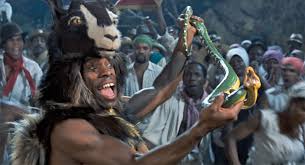
Summary Live and Let Die has a racial subtext that is a bit rough in 2025. Let’s start with the good news. Producers hired a ton of black performers for this film. Scenes shot in Harlem, New Orleans, and Jamaica are populated with black bodies. Cabaret singer B. J. Arnau’s soulful version of McCartney’s theme song is a high point of the film. Having said that, the movie is rife with racial stereotypes, from “pimp mobiles” and black gangsters peddling heroin in hollowed-out Harlem, to “mystical blacks” dancing with snakes and chanting voodoo mumbo. As a dumb white kid in rural Georgia, the film didn’t make me want to advocate for black people, it made me afraid of them. It was a spin on that “mystical black” trope when Geoffrey Holder, who plays voodoo-practicing Baron Samedi, became the pitchman for 7-Up in the “Uncola” commercials a few years later.

Contemporary viewers are likely to pin LALD as both racist and sexist. You’ve got the southern white cop who calls black men “boy” and you’ve got Bond who calls every woman “darling.” You get the sense that all the movements toward equity that we starting to become institutionalized in society in the seventies are kept at arms length by the WASP male fantasy of Bond. It’s a fair start for Moore, who comes in as a more older “gentleman” than Connery, which might lead one to think we’d get a Bond with a little more introspection. (You learn things as you age!) Instead we get sardonic raised eyebrows and lies to get women’s underwear off. That’s not an evolved man.

The action scenes in this movie are absolutely spectacular. I could watch the boat chase a hundred times. The surprise appearance of an underground lair with sharks is a chef’s kiss gift to Bond fans. And the one liners, delivered like a Blofeld laser, are side splitting. (“Butterhook!”) The score by Beatles producer George Martin is epic. And the voodoo and alligator scenes are completely terrifying. There’s so much to love in this film, even if Bond is stuck in a world that has left him behind. As Sheriff J. W. Pepper says to Bond, “What are you? Some kinda doomsday machine, boy?” No, just a device to preserve the old order.

Next: The Man with the Golden Gun (1974)

The James Bond Project #8: Diamonds are Forever (1971)

The James Bond Project #7: On Her Majesty’s Secret Service (1969)

The James Bond Project #6: You Only Live Twice (1967)

The James Bond Project #5: Casino Royale (1967)

The James Bond Project #4: Thunderball (1965)

The James Bond Project #3: Goldfinger (1964)

The James Bond Project #2: From Russia With Love (1963)

The James Bond Project: #1: Dr. No (1962)

The James Bond Project #7: On Her Majesty’s Secret Service (1969)

January 19, 2025

This series is intended to evaluate each product of the James Bond film franchise through a feminist lens, and the relevance of the Bond archetype to shifting ideas of masculinity in the 2020s.

On Her Majesty’s Secret Service (1969, directed by Peter Hunt)

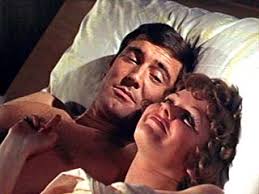
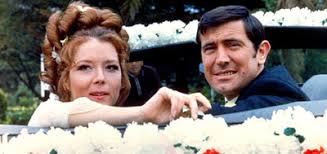
James Bond got married! Eon Productions had to scramble to find a new Bond after Sean Connery quit during the making of You Only Live Twice. Potential 007s included future Bond Timothy Dalton (too young) and Superman bad guy Terrence Stamp (too creepy?). Producer Albert Broccoli and first time director Peter Hunt settled on Australian model George Lazenby after seeing him in a chocolate bar commercial. Lazenby looked like a slightly younger Connery, but lacked the acting chops. He was offered a contract for seven Bond films but agreed to do only one, believing the 007 franchise would become passé in the 1970s. 

On Her Majesty’s Secret Service was the first Bond novel authored by Ian Fleming after his spy became a big screen feature and was written to leave out the heavy reliance on gadgets Hollywood Bond relied on. The primary Bond girl was Countess Tracy di Vincenzo, played by Diana Rigg. From 1965 to 1968, Rigg played Emma Peel on the popular British spy TV show, The Avengers. (Rigg joined The Avengers to replace Honor Blackman, who had left to play Pussy Galore in Goldfinger.) Emma Peel was often considered the “female James Bond,” so bringing Rigg in may have been meant to offer a new role for the Bond “girl” at the end of the decade.

The film was premiered in the United States on December 19, 1969 while the country was consumed with the details surrounding the Charles Manson murders. By January, it topped the box office on both sides of the Atlantic but received mixed reviews for veering from the blockbuster Bond formula. Overtime, the film has gained respect for remaining closer to the Fleming novel than other screen adaptations, and that was Hunt’s intent. The script even comments on previous Bond films, such as the opening scene were Lazenby’s Bond rescues Rigg from the ocean and fights some random henchmen. Lazenby breaks the fourth wall and says to the camera, “This never happened to the other fellow.” Or when Bond resigns from MI-6 and looks at some of his gadgets from previous films with a smirk of disdain while they remain in his shabby office desk.

We do get tried and true Bond tropes, including an underground lair filled with henchmen, Bond at the Baccarat table, his appetite of Beluga caviar and Dom Perignon, flirting with Moneypenny, and Blofeld (this time played by American Telly Savalas). But in one way, this is a very different Bond film, one that ends with a Mrs. James Bond.

Let’s plug it in to our feminist matrix and see where we come out.

Driver of Action – We are in full solo Bond mode in OHMSS. We have no “team” helping drive the story. (Q only makes a brief appearance at the end of the film.) There is an MI-6 agent, apparently named Shaun, who keeps an eye on James, from a distance, in Portugal and Switzerland but is killed off pretty early. And there’s Draco, the head of a Portuguese crime syndicate, who helps Bond take down Blofeld at the end of the film. But it’s pretty much just James, including when he goes rogue from MI-6 after being taken off the Blofeld case by M. We do see Blofeld (as a prequel to Kojak) leading more of the action, including slapping on a pair of skis to race down the Alps to catch Bond. There’s also a killer bobsled race between Bond and Blofeld. And, sadly, Blofeld’s cat only appears briefly.

Role of Violence – Lazenby’s Bond seemed a little more skilled in fake martial arts skills than Connery. There’s more chops and flips but the body count is reserved for the the end of the film (although, early in the film, he slaps Rigg’s character pretty hard). He sends a few henchmen on skis to their deaths as they plunge off a cliff and during the climatic assault on Blofeld’s mountaintop lair, he machine guns a bunch of henchmen and a scientist who throws a bottle of acid at him. This Bond punched harder, but used his gun a lot less. Does that make him less manly or more?

Vulnerability – OK, this is the big one. The set up is that mob boss Darco wants Bond to marry his troubled daughter, Tracy (AKA TV bad ass Emma Peel). Darco says, “What she needs is a man to dominate her” (puke) and offers James a million pounds in gold as a dowery. Bond says he doesn’t need the money and says, “I have a bachelor’s taste for freedom.” But something strange happens. It seems like Bond is falling in love with Tracy. There’s even a very 1969 montage of James and Tracy doing “falling in love” stuff, like walking on the beach and window shopping for rings, set to an original song written by Burt Bacharach and Hal David called “We Have All the Time in the World,” sung my Louis Armstrong! Is this a chick flick? Maybe it’s all part of a ruse to get Darco’s help going after Blofeld.

Nope. After Tracy rescues Bond in a Swiss town and escapes more henchmen in one of the craziest chase scenes on film, Tracy and James end up hiding in the hayloft of a barn. Instead of making his usual sex moves (like he did several times earlier in the film), he tells her, “I’m thinking about us. I love you. Will you marry me?” (I’ll take “Things I’d Never Expect to Hear in a James Bond Film” for $200, Alex.) She agrees to be “Mrs. James Bond” and we have a very different 007 flick. Instead of sealing the deal, James decides they should sleep separately. “The proper time for this is our wedding night. That’s my New Year’s resolution,” he says. “Whatever you say, my dear,” says Tracy. “And that is yours,” James quips. OK, maybe not that different.

The last Bond film of the 1960s ends like the dozens of Elvis Presley films of the 1960s, with a wedding. The proficient bedder of endless women is now wedded in holy matrimony, with M (and the rest of us) in shock that it happened and poor Miss Moneypenny in tears. But there is no happily ever after. A car driven by Blofeld pulls up next to the newlyweds and Irma Bunt, Blofeld’s henchwoman, fills Bond’s Aston Martin with machine gun fire. The final scene of On Her Majesty’s Secret Service is James Bond in tears, holding his dead wife.

Sexual Potency – Before we forget, this is a James Bond film. When Tracy appears at the casino, the camera lingers on her cleavage. She ends up in Bond’s bed as a business transaction (he payed her gambling debt). The encounter is so transactional it creates doubt in the legitimacy of the “romance” that follows (enhanced by a scene at a bullfighting ring where Darco is trying to pass his daughter off to Bond.) When Bond gets into Blofeld’s lair, pretending to be a gay genealogist (don’t ask), he’s met with a dozen beautiful women (Blofeld’s “Angles of Death”) that he goes to work on, sleeping with two in one night while scheduling a third. “Work is piling up,” he snorts. He may be in love with Tracy, but Bond’s gotta Bond.

Connection – This Bond does seem to have some genuine affection for M and Moneypenny, even kissing Moneypenny on the lips. But, again, this is solo Bond in action. His connection to Tracy seems to become genuine when she rescues him from Blofeld’s henchmen, repeatedly kissing her on the cheek as she frantically drives her getaway car from their gunfire. In the end, he is alone again and viewers are told to get ready for the next chapter of our man Bond.

Toxic Masculinity Scale: 5

Summary Hunt and Lazenby’s Bond may be closer to Ian Fleming’s 007 than the formula viewers had had become used to, but there’s still plenty of sexism in OHMSS. The most obvious proponent of misogyny is Darco (played by Italian actor Gabriele Ferzetti). He just goes on and on telling Bond how his daughter needs to be manhandled and smiles at that fact that Bond got her in the sack. He even punches his daughter in the face, knocking her out, so she doesn’t try to rescue James in the gunfight. At the wedding he says to her, “Obey your husband in all things.” We also get get Bond ogling a Playboy magazine (and stealing the centerfold) and working his way through Blofeld’s scantily clad angels of death. “Just a slight stiffness coming on,” he says, sitting among them in his kilt.

Don’t expect Bond to be mourning his dead wife in the next installment, 1971’s Diamonds Are Forever. James will be back to his old tricks. But the final scene of On Her Majesty’s Secret Service gives a glimpse of a more human man than in all the previous 007 films, left to reconcile the cost of vulnerability when your job requires you to carry a license to kill.

Next: Diamonds Are Forever (1971)

The James Bond Project #6: You Only Live Twice (1967)

The James Bond Project #5: Casino Royale (1967)

The James Bond Project #4: Thunderball (1965)

The James Bond Project #3: Goldfinger (1964)

The James Bond Project #2: From Russia With Love (1963)

The James Bond Project: #1: Dr. No (1962)

The James Bond Project #5: Casino Royale (1967)

January 11, 2025

This series is intended to evaluate each product of the James Bond film franchise through a feminist lens, and the relevance of the Bond archetype to shifting ideas of masculinity in the 2020s.

Casino Royale (1967, directed by John Huston and others)

After four hugely successful Bond films, it’s time for the first Bond spoof. Casino Royale was the first of Ian Fleming’s Bond books (published in 1953). The John Huston directed film brings back many faces from the first four films from the the United Artists Bond canon, including Ursula Andress (who, as MI-6 agent Vesper Lynd, sounds way too much like Melania Trump). Casino Royale is a comedy meant to mock many of the Bond conventions, so it’s going to score differently than the films produced by Eon Productions, the home to “official” 007 movie franchise.

Here we get an older Bond, played by David Niven, who is 20 years retired after a sad end of a relationship with his beloved Mata Hari. He stutters and is known for his celibacy. This ain’t Sean Connery’s Bond. He’s brought back to MI-6 by M (played by Huston himself) to deal with evil SMERSH. (We don’t know what SMERSH stands for but there was a counter-intelligence group in the Soviet Union with the same name). M is comically killed so Bond takes the helm of MI-6, where he is reunited with Miss Moneypenny, or at least her daughter. (Strangely, Moneypenny now has an American accent, played by Barbara Bouchet, who was born in Nazi Germany.) He orders all the “Double O” agents to change their names to “James Bond” to confuse and trap SMERSH baccarat player Le Chiffre, played with gusto by Orson Welles. Two of those agents include Peter Sellers and a very young Woody Allen.

Casino Royale is a madcap farce that lampoons the cool image of 007. There’s even a yakety sax soundtrack during chase and fight scenes (some played by Herb Albert). The funny Bond quips are turned up to 11, jumping from wry to hilarious. (“James Bond doesn’t wear glasses.” Bond: “Yes, it’s just because I like to see who I’m shooting.”) The film is fully located in the mid-sixties. The first shot is graffiti that says, “Les Beatles.” The scene where the Peter Sellers’ Bond is drugged is straight psychedelia. And the movie introduces the Burt Bacharach song, “The Look of Love,” sung by Dusty Springfield (and sung by Bacharach himself in 1997’s Austin Powers: International Man of Mystery). The film was released in April 1967 and Sgt. Peppers Lonely Hearts Club Band was released shortly after setting up the iconic “Summer of Love.”

This may be an anti-Bond Bond film, piercing some of the tried and true tropes of the previous four films, but it’s worth dropping it into our feminist matrix if just for point of comparison.

Driver of Action – There are multiple drivers of the story here, including multiple Bonds. Sir James Bond (Niven) plays almost a support role. The majority of the story centers around Evelyn Tremble (Peter Sellers as a Bond surrogate) and Vesper Lynd (Andress). A section of the film follows Bond’s daughter with Mata Hari, Mata Bond (played by Joanna Pettet) in an adventure in Berlin (which features A Hard Day’s Night’s Anna Quayle and a hilarious scene where a hole is blown in the Berlin Wall and a wave of East Germans run out). This is an ensemble cast.

Role of Violence – It’s a Bond film so there a guns and explosions. But much of the violence is done for laughs, aided by a comedic soundtrack. But, other than an army of fembots with machine guns, there is no overt violence. I don’t think Niven’s or Seller’s Bonds kill anybody.

Vulnerability – The premise of this story is that Bond experienced heartbreak from his true love, Mata Hari, and looks for a connection to his daughter Mata Bond (who is abducted into a SMERSH flying saucer). He’s developed a stammer that he’s self-conscious of and his fighting style as become what might be describes as “effeminate.”

Sexual Potency – The joke of the movie is that Bond is celibate and that 00 agents are being killed because they can’t resist women. Bond creates a program to train agents to resist females in a scene where Agent Cooper rebuffs seductive women by throwing them to the mat. There is one scene where Sir Bond forcibly kisses Moneypenny (or her daughter). Ursula Andress plays seductress to Peter Sellers’ Bond, as does Miss Goodthighs (played by a young Jacqueline Bisset). Additionally, Dr. Noah (not Dr. No), played by Woody Allen, has a fourth quarter evil plot. He has a biological weapon that will make all women beautiful and kill all men over 4 foot 6, making him the tallest (and most sexually attractive?) man on earth.

Connection – There are few autonomous men in this film. The last quarter of the movie features Sir James, Moneypenny, Mata, and Agent Cooper working together to bring down Le Chiffre at the Casino Royale. And the Calvary (literally!) arrives to help save the day. Bond’s connection to his daughter seems sincere as is his desire to shepherd MI-6 in the post-M era. The film ends with the cast, having been blown up, floating in heaven, while Woody Allen’s character drops down to hell.

Toxic Masculinity Scale: 2

Summary Casino Royale is not a feminist critique of Bond. It’s a mid-sixties comedy so there are plenty of jokes rooted in sexism. For example, after M dies, Bond is sequestered in his house with his eleven seductive daughters (actually SMERSH agents) and his equally seductive widow (played with great hilarity by Deborah Kerr). But the film also completely mocks Bond’s Lothario reputation. (Woody Allen as James Bond should make the point.) There are plenty of nods to the Bond franchise, including an underground lair and even women in gold paint, but the ensemble nature of Casino Royale stands in stark contrast to Bond 1 to 4.

Unlike the previous film, Thunderball, whose cast is entirely gone, many cast members from Casino Royale are still with is, including Ursula Andress, Woody Allen, Joanna Pettet, Barbara Bouchet, and Jacqueline Bisset. I’d love to know how they see the film’s depiction of Bond and of women from a contemporary lens. The film is both hilarious and, at times, a complete mess, but also provided a break from the Bond formula. Sometimes stepping out of something allows us a fresh perspective on it. Two months later there would be another Sean Connery Bond flick headed to theaters. I wonder if viewers saw it differently after watching Casino Royale.

Next: You Only Live Twice (1967)


The James Bond Project #4: Thunderball (1965)

The James Bond Project #3: Goldfinger (1964)

The James Bond Project #2: From Russia With Love (1963)

The James Bond Project: #1: Dr. No (1962)

I told you Donald Trump was a fascist!

December 9, 2015

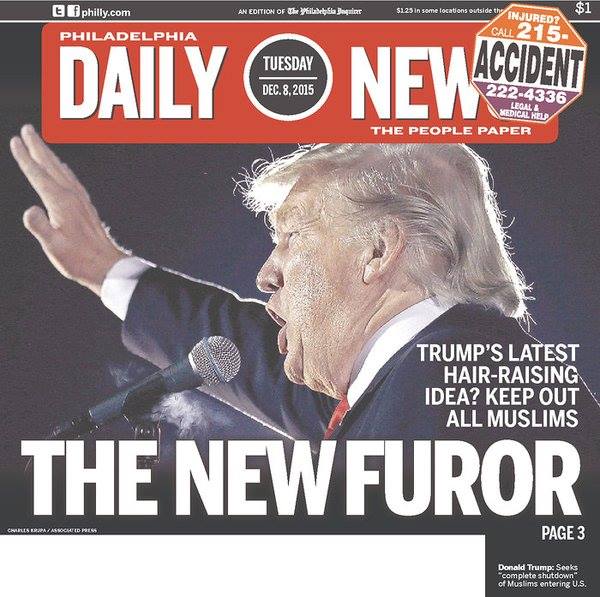
Well, I hate to be the one who said I told you so, but even mainstream Republicans are using the “F word” to describe Donald Trump. After his ridiculous fantasy about banning Muslims from America, I felt I should chime in, even though I’d rather write about Cozy’s first poop in her IKEA baby toilet. His use of the these emotional hot-button issues certainly is good at keeping this billionaire “man of the people” candidate in the headlines, but there is a frighteningly ugly side to his appeal.

leftright1

It’s clear that a lot of people don’t understand the basic political spectrum with fascism on the right side of the continuum and communism on the left. (Hint: We’re pretty much in the middle.) I’ve given up on explaining to people that Hitler’s “National socialism” is not actually socialism but a violently anti-socialist form of fascism. The right is characterized by the rule of the one and the left is characterized by the rule of the many, with lots of gradations between the extremes. (Bernie Sanders is to the left of Hillary Clinton and to the right of Fidel Castro. Similarly, Donald Trump is to the right of Marco Rubio and to the left of Benito Mussolini.)

controversy11n-2-web

So the memes comparing Trump to Hitler have been coming fast and furious. Godwin’s Law aside, I’m sure Trump is flattered by the comparison with a former Time Magazine Person of the Year. They do have much in common. But let’s stick to four hallmarks of fascism.

Conspiracy Theories: Trump is the king of the “Birther” movement. The theory is that Obama was born in Kenya instead of America and his college transcripts were forged. It’s all part of an elaborate conspiracy by foreign Muslims to instal a jihadist in the White House and institute Sharia Law in the United States. Since Obama will be leaving the office in January 2017, he better get his Jihadi ass in gear.

Then there is the fun one about the Mexican government is “sending its worst” to the U.S. (Remember, all those rapists and murderers?). They’re destroying us, he will tell you. “Believe me!”

Obviously, all these guys harp on the “liberal media” conspiracy that is out to get them.  (Hint: The media is only as liberal as the corporations that own it.)

The fact that these juvenile theories are disproven on a daily basis doesn’t really matter. Facts don’t matter to Trump and his minions. Conspiracy theories offer simplistic world views and explanations. Everything is very black and white. And the left has a few conspiracy theories of their own (9/11 was an inside job, Monsanto runs the world, etc.). But Trump’s are rooted in xenophobia and blaming “outsiders” for our problems and that puts him firmly on Adolf’s team.

Racism: I think Trumpies believe that you have to parade around in a Klan robe to be a racist. Trump does have a few black supporters and Hitler had a few Jewish supporters (before he gassed them). But let’s be clear, Trump is either a seething racist or he is an opportunist who uses racism to rally his sub-moronic drones.

A) He’s anti-black. Whether encouraging the man-handling of “disgusting” Black Lives Matters protesters or crowing that “All lives matter,” it’s clear that he has no interest in addressing the institutional racism that plagues the lives of millions of Americans. He’s tweeted “facts” from a white supremacist websites to reinforce his position that black people are a violent threat to his white followers.

B) He’s anti-Latino. His asinine comments about immigrants (he never mentions white immigrants) is based on the most extremist narrative and denies the reality of actual Latino immigrants, including members of my family.

C) He’s anti-Muslim. I know Islam is a religion and not a race, but it comes from the same dark place. He’s denied the role of Muslim Americans in the war on terrorism, in the armed forces, in government, in eduction, in science and even in sports (while  bragging about his “good friend” Muhammad Ali).

Trump whitey

Trump is not the traditional racist but brown is the new black so he can hope for a handful of black supporters by going after Latinos (“Mexicans”) and Arabs (“Muslims”) and his loyal flock is A-Okay with it. The assumption is that all non-whites are voting Democratic anyway so why not just recruit the highly motivated whites and make America great again, “again,” meaning back to early 1954 before America went all to shit.

Of course Trump’s plan to ban all Muslims from America is idiotic. According to what he told ABC’s George Stephanapoulos , customs agents would just ask people if they were Muslim and if they said “yes,” they wouldn’t be allowed into the country. You know, because actual terrorists are so honest. And would they be allowed into the country if they converted to Christianity? It seemed to work for the Spanish Inquisition.

In that interview he likened his plan to FDR’s WWII internment of American citizens of Japanese descent, one of the great American human rights abuses of the twentieth century and a massive violation of the due process constitutional rights of 110,000 Americans and thousands of Japanese immigrants whose only crime was being Japanese. In 1988, President Reagan apologized for the atrocity but here is Trump using it as his model. Even Jeb Bush described Trump as “unhinged.” He may be nuts or he may be secretly trying to help ISIS make the case that Americans hate all Muslims, but most likely he is  just be rallying his rabid jingoist base.

Aggressive Nationalism: All this is wrapped up in a flag and rhetoric about “making America great again,” taking us back to a time when straight white Christian males didn’t have to be bothered with the “politically correct” language that addressed all the others who thought they deserved a bit of equality at the American table. Trump hates political correctness. He doesn’t want to have to be sensitive to the issues of the needs of Americans other than his brat pack. “Believe me, they are doing horrible things.” He wants to kill the families of ISIS members, including their children. (“Pro-life!”) He wants to be a bigger terrorist than the terrorists. He wants to save America. He says, “We’re at war. We don’t have a choice.”

Donny, you always have a choice.

12321480_10153654929049543_6890780858567618541_n

Fearmongering: This is what Trump does best. The Mexicans are going to rape you, the Muslims hate you and are going to kill you, and anyone who disagrees is second rate and is a less valid human because they don’t get the ratings he does. He demagogues until his voice goes out. “Believe me, I saw thousands and thousands of Muslims celebrating in New Jersey after 9/11.” No you didn’t. Maybe you saw Muslims helping people and got confused.

“Believe me, there will be lots more 9/11’s if we don’t do something.” Remember when Rudy Giuliani tried this scare tactic in his 2008 presidential campaign? It’s only slightly historically removed from Father Coughlin who, in the 1930s, told his radio listeners that Jews were coming to kill Americans.

Trump is using the fear of terrorism and the general ignorance about Islam to whip his followers into a nationalist lynch mob. Listen to them carefully and then listen to people at a Klan rally and tell me how they differ. Scapegoating is an old tool but it is very effective.

Trumpcrowd

I’ve gotten some flack for referring to Trump’s followers as “sub-moronic” and it’s a fair criticism. It is not my intent to dehumanize them. I’ve been studying right-wing extremists and white supremacists for thirty years now. I know what connects them and the Trumpies is a desire for  simplified world view provided by a charismatic leader who can explain how to solve their problems, whether they be real or imagined. It’s how cults work and it’s how fascism works. But I also know many intelligent, compassionate, and progressive people who once subscribed to those ideologies and then walked away from them toward the light. There are plenty of former neo-Nazis and former jihadists who can testify that it’s entirely possible. And soon we will have some former Trumpies to add to the list.

This piece could be about the list of hate groups that have endorsed Trump or hate crimes that have been committed by his “very passionate” followers. It could be about how the Tea Party has dragged to the GOP into the ditch and how we should celebrate the death throws of an increasingly irrelevant political party that now only appeals to rednecks and fascists. But I just want to remind people, that America has been here before, in the 1930s. The specter of fascism was growing in America and the exact same bogus claims that Trump is now making were made by little Hitlers here. But America was better than them and America is better than Trump. We reminded ourselves of our core values and turned away from the fascist tide. It’s refreshing to hear this message from traditional Republicans, like Paul Ryan. We are so much better than Trump.

But for those who continue to follow this megalomaniac, here is a picture of my daughter’s first toilet turd. I’ll look forward to your brilliant comments.

12341309_10154373817144307_4237588355270571923_n


Explaining the world one tragedy at a time.

November 30, 2015

The world can seem so chaotic. Does it ever take a break?

Sometimes, in my line of work, things get a little busy. I’ve been getting a lot of media time lately. From local hate crimes to the global terror alert, from suspected Klan activity in Oregon to responses to the Black Lives Matter movement. Throw Paris into it and a few other issues in the news flow and I’ve been in overdrive lately. I’ve written about playing the role of “expert” in the media and hopefully I mentioned that I never get paid for any of it. But there’s a reason I’m on your TV.

9780465003365

The world can seem so chaotic. But a lot of it is our media-saturated culture. Sociologist (and now Lewis & Clark University president) Barry Glassner wrote about this in his 1999 book, The Culture of Fear. Just think about the local news. When I was a kid it was on for a half-hour at 6 and 11 pm. The local news in Portland starts at 4 am and then occupies at least 8 hours of daily broadcasting on each channel until 11:35 pm. That’s a lot of space to fill. And “if it bleeds it leads” can drive each one of those hours. Terrorism abroad, mass shootings at home, and a story about packages being stolen off porches for good measure. It’s enough to keep a person inside their house and watching TV. Suffice it to stay, research shows that the more TV people watch, the more fearful they are of the world.

12278739_10206559952291905_3728424953862913722_n

I can either try to ignore it or subvert it from the inside. So the reason I say yes to most local, national, and international media requests is that it provides an opportunity to slip a critical perspective into the shockingly uncritical news paradigm. And this is usually a feminist perspective. For example, the numerous mass shootings I’m called to comment on must include an analysis that this is male violence in a culture that promotes violence as an acceptable means for men to express themselves. Can you imagine if all these shootings were by females?

time-black-cover

So we hop from crisis to crisis trying to patiently explain things to people who are often resistant to anything other than the explanation that fits their picture of the world. A perfect example is the folks who blurt “All lives matter” in opposition to the Black Lives Matter movement. These people are either ignorant (which is something we all share about different things) or they are straight up racists. So here is the simplest explanation I can offer these folks: “Black lives matter,” means all lives matter, including black lives that have been devalued by the criminal justice system and racism in general. Got it? It does not mean your white life doesn’t matter. Now shut the fuck up.

Often I offer an analysis to try to explain a very complex social problem and what gets on the air is a three second sound byte that really doesn’t explain much. That’s why I prefer live TV and radio because you can go for the one point that really want to make. I learned this the hard way when I appeared on Fox News’ The O’Reilly Factor. Bill O’Reilly just talked over me the whole time. One of my conservative friends emailed me and said, “You just should have yelled over him.” I guess that’s how Fox rolls. Lesson learned.

Robert-L.-Dear-360x200

There is a root cause that links most of this together and it’s patriarchy. Friday’s shooting at the Colorado Planned Parenthood clinic is an obvious example. Conservatives wage a war on women’s advancement and rights. A Trump follower commented on this blog recently, “Does your wife bring home the bacon while you blog and change diapers or take of your children? Very manly there. Get a real life fool.” Trump, Fiorina and others spread lies about Planned Parenthood to their war-loving moronic minions who just want to bomb SOMETHING. So it shouldn’t be a surprise that this week’s domestic terrorist (aka, right-wing white male) attacks a women’s health center with an AK while ranting about Obama and “baby parts.” This is what patriarchy looks like.

There is also feminist perspective on the racial issue. The dehumanization of other people, including African Americans and Syrian refugees (who my cousin compared to snakes and Ben Carson likened to rabid dogs) starts with the dehumanization of women. Religions with male gods do this especially well. It’s easy to claim power over someone who you think is a child or an animal or a thing. Or a terrorist.

There’s just not a lot of places to get the macro analysis in the mainstream media. We just get little corners of the real issues that are at the core of the nightly news stories. Where is bell hooks or Noam Chomsky being interviewed on the news? Lord knows, there’s enough time to fit them in. But instead we get sound byte analysis for the short-attention span masses. Here’s a clip of Trump mocking a disabled person. Here’s a talking head saying his followers could care less and on to the next non-story.

I became a feminist in my head a long time ago because it helped to explain the big picture throughout human history. I became a feminist in my heart with the arrival of my daughter and the hope the world could finally make a great leap forward for her generation. That the trifles of Trump and travails of war would become artifacts of the past. (This optimism may come from watching too much Star Trek.)

12240101_10154338801679307_4900852557656292409_n

And I’m happy to take my show on the road. Last week I was in Washington, D.C., making a case for the re-evaluation of hate crime laws at a meeting of criminologists from around the world. This week I’m off to New York City where I’ll be discussing how plea bargains institutionalize racism at a university in Manhattan. You can’t shut me up. These issues are too important. And yeah, I’m going to continue to be pissed off at the people who choose not to get it. Their world is changing and they are becoming an obnoxious minority (not a “silent majority”). But that keeps me going and at some point we can talk about the big picture.

See ya in the funny papers.