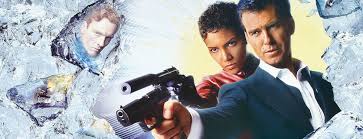
The James Bond Project #26: Spectre (2015)

This series is intended to evaluate each product of the James Bond film franchise through a feminist lens, and the relevance of the Bond archetype to shifting ideas of masculinity in the 2020s.

Spectre (2015, directed by Sam Mendes)

August 7, 2025

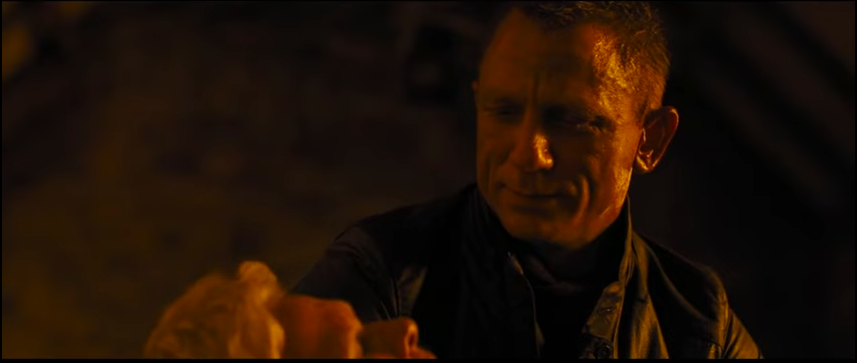
Yeah, it’s a formula, but when it works, you are in for a wild ride. There is not a scene or line in Spectre that one can not see coming from Sean Connery instead of Daniel Craig. The second half-century of Bond begins where we saw 007 50 years, locked in a death match with Ernst Stavro Blofeld. The long legal dispute between Eon Productions and screenwriter Kevin McClory finally resolved, we are gifted classic Bond that reunites these iconic arch rivals. Director Sam Mendes is back at the helm after Nicolas Winding Refn (Drive, 2011) backed out of the project. Here we go.

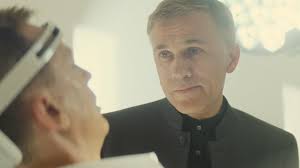
Ralph Fiennes (Lord Voldemort, himself) has replaced Judi Dench as M after Dench’s M was killed in Skyfall. Craig (46) is still doing his own stunts and tore his meniscus during filming. Brief love interest Lucia Sciarra, played by Italian actress Monica Bellucci, 50, would have been the first time a “Bond girl” was older than Bond himself. But the true “Bond girl” of the film is psychologist Madeleine Swann, played French actress Léa Seydoux, 30. The twenty-first century Blofeld is played by Christoph Waltz, the break-out star of Inglourious Basterds (2009), who completely owns the role.

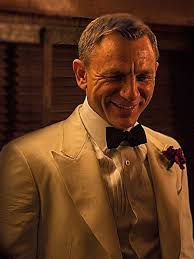
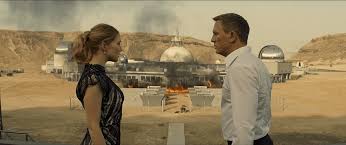
Spectre has all the staples you want in a Bond film; Bond in a white dinner jacket, Bond fighting inside a careening helicopter, Bond battling a mute assassin on a moving train, Bond going rogue, the classic Aston Martin, and Blofeld’s pussy cat. There are exotic locations that range from Mexico City’s Day of the Dead celebration (with 1500 extras) to a (not underground) lair in the Sahara desert. Shot on 35mm film but shown in IMAX theaters, Spectre makes the most of the Bond spy formula in a gift for 007 fans that also departs from the formula in some important ways.

The plot revolves around Blofeld’s SPECTRE (also back after legal wrangling) controlling the data flow from the first world’s intelligence agencies, making Blofeld the Big Brother for all intel on Earth. Ernst is watching you. Monneypenny is back behind the desk in M’s office but she and Q are secretly helping James. (We’ve seen this film before.) Bond has been left breadcrumb’s by Dench’s M and has bailed from MI-6 to find out about the conspiracy that threatens the global order. But on the way to beat Blofeld, something happens to Bond. Something we haven’t seen since 1969.

Let’s plug Spectre in to the matrix and see what happens.

Driver of Action – Unlike Skyfall that gave ample screen time to Dench, Spectre is back in the lone rogue spy narrative. M, Moneypenny, Q and MI-6’s Bill Tanner are the support team and Felix Leiter is mentioned but never shown. 007 has no female or male partner in this film. The center of the eye’s gaze.

The Role of Violence – Bond only kills a few dozen people in this film, including a bunch of Blofeld’s henchmen (it’s a dangerous job), assassin Marco Sciarra (by throwing him out of helicopter in Mexico City), and assassin Hinx (played by professional wrestler Dave Bautista), who he throws out of a train. Madeleine does press him on his chosen life as a killer, to which he replies, “It was that or the priesthood.”

Vulnerability – This is a tough one. We get the obligatory Bond being tortured scene and 007 keeps his wits. But we also get Blofeld claiming to have been behind the suffering of Bond’s losses, including M, Vesper Lynd, Bond’s love interest from Casino Royale (2006), and (unmentioned because Craig is leading a “reboot”), James’ wife Tracy, from On Her Majesty’s Secret Service (1969). “I am the author of all your pain, James.” Even so, Bond never breaks. It is not until he develops an emotional attachment to Madeleine, which magically creeps out at the end of the film, that we that 007 has a soft white underbelly.

Sexual Potency – Here’s our Lothario. The first scene of the film has a masked Bond ushering a beautiful woman into a hotel room in Mexico City, she removes her mask and we think Spectre is going to begin with a bang, but 007 escapes out the window to do some assassin work. Then, in Italy, he sleeps with the wife of the assassin he killed in Mexico. Finally, after an epic fight scene on a train, all juiced up on adrenaline, he beds Madeleine. It’s like the old song goes, “Fuckin’ and fightin’, it’s all the same.”

Connection – This is where the franchise takes a left turn. Bond, apparently, has fallen in love. It’s so slight, it’s barely noticeable until the final scene. When Blofeld is drilling into James’ skull Madeleine tells him that she loves him. That gives Bond the jolt to go apeshit and save the day (and the girl). Later, she says she doesn’t want any part of James’ action hero lifestyle (her father was an assassin, after all) and they calmly walk way from each other. But when Blofeld captures her and forces James to save one more damsel in distress, I guess he decides he loves her and, like James f’ing Bond, saves her and gets Blofeld. Instead of killing him, he says, “I’ve got something better to do.”  Then he throws away his gun and walks away with Madeline. The epilogue scene is not them in a boat, but James and Madeline driving away in the restored Aston Martin, presumably leaving MI-6 to be with the woman he loves.

Toxic Masculinity Scale: 2

Summary One does not expect James Bond to leave the life of a spy for love. Even when George Lazenby’s Bond got married in 1969, 007 was still 007-ing. But Madeline’s pressuring James’ being “always alone” created a crack in his iron wall, apparently. So we get Bond riding off into the sunset for a new life. No more killing and random hook ups, right? Right?

This installment has plenty of gifts for longtime 007 fans, including a modern Aston Martin DB10, Q’s exploding watch, finding out the Blofeld’s father raised an orphaned James, learning how Blofeld got the facial scar associated with Donald Pleasence’s performance of the character, and the return of Blofeld’s white Persian cat (“Hello, pussy,” says 007). While the plot is purely Bond by the numbers, the scope of Mendes production is as satisfying as it needs to be.

Spectre opened in London on October 26, 2015 the same day as a massive 7.5 earthquake struck the Himalayas. The film opened to mixed reviews but record-breaking box office receipts. The theme song, written and performed by Sam Smith, won both the Oscar and Golden Globe for best Theme song. The film’s ending had some asking if Spectre was the end of the 53-year-long 007 franchise, but Craig’s Bond had one more outing up his tuxedo sleeve.

Next: No Time to Die (2021)

The James Bond Project #25: Skyfall (2012)

The James Bond Project #24: Quantum of Solace (2008)

The James Bond Project #23: Casino Royale (2006)

The James Bond Project #22:  Die Another Day (2002)

The James Bond Project #21:  The World Is Not Enough (1999)

The James Bond Project #20:  Tomorrow Never Dies (1997)

The James Bond Project #19: GoldenEye (1995)

The James Bond Project #18: License to Kill (1989)

The James Bond Project #17: The Living Daylights (1987)

The James Bond Project #16: A View to a Kill (1985)

The James Bond Project #15: Never Say Never Again (1983)

The James Bond Project #14: Octopussy (1983)

The James Bond Project #13: For Your Eyes Only (1981)

The James Bond Project #12: Moonraker (1979)

The James Bond Project #11: The Spy Who Loved Me (1977)

The James Bond Project #10: The Man with the Golden Gun (1974)

The James Bond Project #9: Live and Let Die (1973)

The James Bond Project #8: Diamonds are Forever (1971)

The James Bond Project #7: On Her Majesty’s Secret Service (1969)

The James Bond Project #6: You Only Live Twice (1967)

The James Bond Project #5: Casino Royale (1967)

The James Bond Project #4: Thunderball (1965)

The James Bond Project #3: Goldfinger (1964)

The James Bond Project #2: From Russia With Love (1963)

The James Bond Project: #1: Dr. No (1962)

The James Bond Project #25: Skyfall (2012)

This series is intended to evaluate each product of the James Bond film franchise through a feminist lens, and the relevance of the Bond archetype to shifting ideas of masculinity in the 2020s.

Skyfall  (2012, directed by Sam Mendes)

July 31, 2025

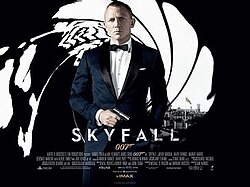
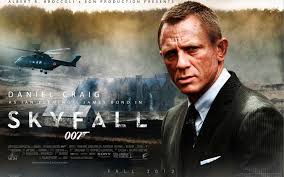
Daniel Craig is back for his third stint as Bond, a little older, a little more beat up in a film that further tweaks the 007 formula. There are some classic staples here, including James gambling in his tux, James under the ice, James fighting on top of a moving train, James in rooftop motorcycle chase, exotic locations, random hook ups, and the Aston Martin, but American Beauty (1999) director Sam Mendes brings enough innovation to Skyfall to bring a bolt of electricity to the franchise, marking its fiftieth anniversary.

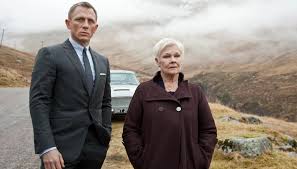
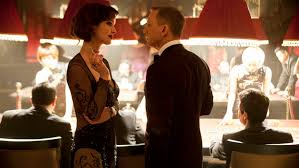
The most obvious shift from the formula here is that Skyfall is as much a Judi Dench movie as a Daniel Craig movie. M’s outsized role is fitting as it would be her last in the franchise. (She dies.) Also different is the strange twist that there really is no “Bond Girl” in this film. There’s not even a leggy woman on the movie posters! French actress Bérénice Marlohe’s character, Sévérine, almost plays the part, but she’s only briefly in the film. (She dies.) The most exciting addition is the return of Miss Moneypenny and this time she has a first name (“Eve”), she’s an action hero, and she’s black. We also get a Millennial Q, who has no time for gadgets.

The cast of Skyfall is robust, with 28 Days Later’s Naomie Harris as Moneypenny, Ralph Fiennes as head of intelligence Gareth Mallory, and Albert Finney as the housekeeper at Skyfall (a part Sean Connery was considered for as a nod to the fiftieth anniversary of Dr. No). The role of Bond Bad Guy went to No Country for Old Men break-out star Javier Bardem. Bardem dyed his hair blonde for the role, drawing comparisons with Julian Assange. Bardem also plays his character, Raoul Silva, as “gay” against James’ straight man role, although when Silva is sexually suggestive with James, Bond replies, “What makes you think this is my first time?” I remember the internet chat asking if 007 has been bi all these decades.

The flimsy plot follows a former MI-6 agent who is revealing the identity of fellow agents because M sold him out after Hong Kong was returned to China. Skyfall is the first Bond film to actually be partially filmed in China with segments in Shanghai and Macau. (Other locations include Instabul and Scotland). What the film lack in sense it make up for in bombast, including seeing our man James finally get shot, twice. (Although he does get winged by a speargun in 1965’s Thunderball.) But being shot clean through, and falling off a massive train bridge can’t kill Bond. He plays dead for a few months and then comes back to save the day.

Twenty-first century Bond has been described as “cool, not camp.” Let’s plug Skyfall’s 007 into our evaluation matrix.

Driver of ActionSkyfall is as much about M and her past choices as it is about James Bond. We do get some Bond backstory (and even see his parents’ grave), but this film is built on M’s career as spymaster in a changing global political landscape. We even get Judi Dench shooting at henchmen! Moneypenny also takes on a sidekick role often reserved for Bond girls. Is Eve Moneypenny Skyfall’s Bond girl?

The Role of Violence – An A.I. source says Bond kills 23 people in the film. It’s hard to tell because Bardem (as bad guy Silva) has so many henchmen. (Why, we don’t know.) Bond kills all of them. He also drops an assassin from a Hong Kong skyscraper. It’s interesting that everyone Bond shoots dies, but he bounces back from being shot like a Phoenix on coke.

Vulnerability – We do get a bit more of Bond’s soft white underbelly in Skyfall. Besides the backstory of James the orphaned child (not much emotion shared here but M quips, “orphans make the best recruits), we get a window into “dead 007,” as James lets the world think he’s dead as a means of retirement. He’s in some Black Sea coastal village, doing shots on the bar with the boys and a scorpion on his hand, having drunken sex, and letting his rock hard body atrophy with self indulgence. It’s not very believable but it sets up his comeback. When M asks him where he’s been, he replies, “Enjoying death.” Later, he states that his hobby is, “resurrection.” But there are plenty of allusions to spycraft being a “young man’s game,” and James being past his prime. (Craig had two more 007 films on his contract.)

Sexual Potency – Is the Bond “rule of 3 back”? Old Bond is still Horny Bond. While he’s “dead” we see drunk James having sex a local (or maybe she’s a contractor for Halliburton, we don’t know). Later, he climbs in the shower with sex-trafficking victim Sévérine, which seems just a tad misogynistic. I mean, c’mon James. Then he watches as she’s murdered by Silva. The big question is if 007 sleeps with Moneypenny after she shaves his face, while he’s clad only in a towel. It’s implied that, after 50 years of sexy banter, he seals the deal. There is an implication that Moneypenny with a gun is closer to his equal, even if she does shoot him on accident. But the message is consistent, that Bond is sexually irresistible to beautiful young women. (James sleeping with M would’ve made for a better film.)

Connection – The connection Bond has to M drives the film. Not only does he come back from the dead to help her, but he takes her to his childhood hiding place to keep his “mum” safe. The job of protecting and vindicating M is the framework of this episode. The connection with Moneypenny is noteworthy as is his lack of connection with the new, younger Q. Dench’s M dies in Bond’s arms, saying, “I did get one thing right.” Her trust and faith him were justified and now death has ended that bond.

Toxic Masculinity Scale: 3

Summary Bond’s interaction with Sévérine is highly problematic. Maybe we’re more sensitive in a post-Epstein era, but it should be clear that you don’t show up naked in the shower of a woman who is clearly a traumatized sex trafficking victim. Maybe it’s business as usual in a Bond film, but the scene was more anger-inducing, than “sexy.” However, the fact that Skyfall is really an M-centered film, with 007 in a supporting role, elevates the film as portraying a gender dynamic unique in the 007 canon.

For the 50th anniversary of Eon’s Bond franchises, there are familiar friends, like a title sequence featuring female bodies (and an Oscar-winning theme song by Adele), sharp dry quips from James (“Only a certain kind of woman wears a strapless dress with a Beretta 37 strapped to her thigh.”), and the return of the Aston Martin, along with the Bond theme music. (When Silva’s men blow up the car, 007 goes Rambo.) There’s even a glimpse of the vintage of the Macallan scotch Silva pours for Bond, 1962. Easter eggs aside, Bond’s emotions are still restrained but M (Dench) reveals the truth behind James masculine stoicism.

Skyfall premiered at Royal Albert Hall on October 23, 2012, while Hurricane Sandy was lashing America’s east coast. The film, as articulated by M, shares that the cold war world that produced Dr. No in 1962 now exists “in the shadows,” without clear enemies but with a new climate of danger. Mendes as director was an inspired choice to frame the action in service to M instead of Bond. Mendes would direct the next Bond as well as the Oscar/Golden Globe winning 1917 (2019). Medes is now directing four biopics on the members of the Beatles. For the kick-off of the next half-century of 007, Mendes would soon bring back a familiar foe to Bond’s universe.

Next: Spectre (2015)

The James Bond Project #24: Quantum of Solace (2008)

The James Bond Project #23: Casino Royale (2006)

The James Bond Project #22:  Die Another Day (2002)

The James Bond Project #21:  The World Is Not Enough (1999)

The James Bond Project #20:  Tomorrow Never Dies (1997)

The James Bond Project #19: GoldenEye (1995)

The James Bond Project #18: License to Kill (1989)

The James Bond Project #17: The Living Daylights (1987)

The James Bond Project #16: A View to a Kill (1985)

The James Bond Project #15: Never Say Never Again (1983)

The James Bond Project #14: Octopussy (1983)

The James Bond Project #13: For Your Eyes Only (1981)

The James Bond Project #12: Moonraker (1979)

The James Bond Project #11: The Spy Who Loved Me (1977)

The James Bond Project #10: The Man with the Golden Gun (1974)

The James Bond Project #9: Live and Let Die (1973)

The James Bond Project #8: Diamonds are Forever (1971)

The James Bond Project #7: On Her Majesty’s Secret Service (1969)

The James Bond Project #6: You Only Live Twice (1967)

The James Bond Project #5: Casino Royale (1967)

The James Bond Project #4: Thunderball (1965)

The James Bond Project #3: Goldfinger (1964)

The James Bond Project #2: From Russia With Love (1963)

The James Bond Project: #1: Dr. No (1962)

Are Third Places Democracy’s Last Hope?

From The Blazak Report (July 24, 2025)

July 24, 2025

My parents met in a bowling alley. A lot of my generational peers’ parents met in bowling alleys. Those days are long gone. As sociologist Robert Putnam detailed in his 2000 classic, Bowling Alone: The Collapse and Revival of American Community, nobody joins clubs anymore and our happiness has suffered for it. We are a nation of miserable loners. No wonder people identify with Trump.

A land of 340 million people staring at their phones does not make for a vibrant democracy. COVID was the nail in the coffin of civic engagement. We were locked down with Netflix and we liked it. Why build community when you can binge Love Island? Why prioritize democracy when you can doom scroll. And now you can share your alienation with your AI girlfriend.

All this loneliness is catnip to fascism. Where we got endorphins from meeting people at parties and pubs, we now get it from likes and algorithms. Fascism will walk in while we’re on TikTok, and be just another 60 second reel.

Let’s hope for a countertrend. And the countertrend is actually pretty cool.

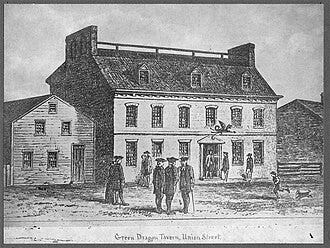
As a college student, I probably over-romanticized the mythology of revolutions and protests being born in cafés and coffeehouses, but there is some truth to those stories. Rejecting British tea, the political discussions in the American colonies moved to coffeehouses. The Green Dragon tavern and coffeehouse, built in 1701 in Boston, became known as the “headquarters of the revolution” after Paul Revere bought it 1764 to give the Sons of Liberty a meeting place.

Sociologist Ray Oldenburg, in his 1989 book, Coffee Shops, Bookstores, Bars, Hair Salons, and Other Hangouts at the Heart of a Community, refers to places like the The Green Dragon as “third spaces.” First place is home and second place is work. Third spaces are the community gathering spots where we have regular interactions with our neighbors. They include bars and barbershops, cafés and churches, local stores and hair salons. Anyplace people hang out. In the new 2025 edition, Oldenburg’s coauthor Karen Christensen argues that third places are the answer to political polarization and climate resilience. It’s like that Sesame Street song, who are the people in your neighborhood?

Third places are vital to democracy to several reasons. Putnam argues these places create social capital among community members, building trust which is key to democratic action. Taverns and barbershops encourage free expression and the exchange of ideas. Many a night in my youth I argued theory at cafés until the chairs were on the tables. Third places become places for building social movements. Yeah, Hitler did it in beer halls, but we can hijack Starbucks to fight fascism. Third places are a cure for isolation as we reconnect with fellow travelers. Finally, democracy requires a sense of shared ownership and salons and local shops can help people to care about public life and bond over shared struggles.

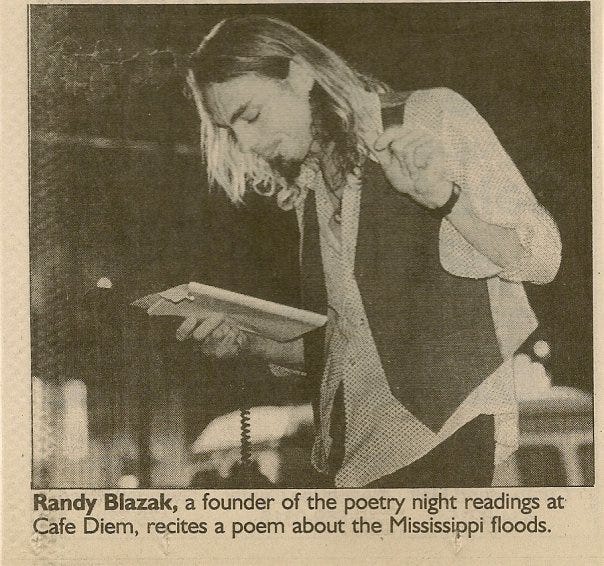
In the 1990s, I had a third place I virtually lived in in Atlanta called Café Diem. To say I held court there would be an understatement. But the realization that inhabiting that space and getting to know owners, employees, and regulars was more rewarding than sitting on a couch in front of a TV made it an easy lifestyle choice. Much bohemian joy came from what we lovingly referred to as “Diemland.” Social media has zapped that impulse in the 21st century. We’re zombies.

But the counter-trend is bubbling off screen. Two years ago a group of dads at my daughter’s elementary school started a poker club and it’s become medicine for my soul. Every other Thursday, cards, whiskey, and good conversation. People are re-discovering their local coffeehouses, not as alternative offices, but place just to talk and share the emotions of this insane moment. Churches, mosques, and temples aren’t just for religion anymore. I actually went to a great local church, called Riversgate, to hear people talk about political civility! It was awesome!

So let’s get out of our first place and find a third place. You don’t have to dive in like a crazy person. “Hi everyone! What the fuck are we gonna do about this fucking fascism?” Ease in like you’re a new kid at school. Third places are relaxed. Belly up to the bar and check the vibe. You might talk about a ball game or the history of the establishment long before you bridge political chat. Maybe you’ll just hang out reading a book until somebody asks you what you’re reading. But that’s your place and those are your people. It’s time to get to know them. Democracy might depend on it.

The American Revolution started in a coffee house. And it will again.

What Do We Do When the Violence Comes?

From The Blazak Report on Substack July 10, 2025

If we’re using history as our guide, we know it’s coming. The state sponsored violence against citizens. It’s already here at the hands of ICE and the violence against women’s body’s in the restriction of reproductive rights. But we can expect more waves of escalation. An ICE abduction that goes sideways when they try to kidnap an armed individual who does not want to be deported to some third country gulag. Protestors shot by National Guard who are unsure of their engagement orders, brains in fight or flight mode. The attempted arrest of Trump’s political prisoners who stand up to the weaponization of federal police. Critics of the regime who end up dead as is common in Putin’s Russia. We are a powder keg nation, one Kent State away from exploding. And that may be exactly what Trump wants.

Trump loves to cosplay strongman. He’s already sent the Marines to Los Angelos. He’s hellbent on turning America into one of those “shithole countries” he shit talks about. The slightest escalation could cause him to bring the hammer down so he can prove he’s an “alpha.” Then he has his pretext for suspending elections and cementing his police state rule. History has told this story before.

So how do we respond to the worst provocations of state violence?

The right has long argued for the need of a second American revolution against the multicultural liberal democracy that has sought to dethrone straight cis WASP men. (Can we start using SCWASPM, or is that too much?) The left is now quoting founding fathers like Thomas Jefferson. “The tree of liberty must be refreshed from time to time with the blood of patriots and tyrants.” Hidden among the peaceful protestors have been anarchists holstering side pieces. Is this the preamble to civil war?

I will admit the thought has crossed my mind. As someone who has had some weapons training, arming up for the coming shit show has been considered. But then I realize that’s a Hollywood fantasy of me protecting my family from Proud Boys and federal forces with an unlimited supply of ammo and slow mo John Rambo rage. It looks super cool in my head.

There will be blood. And there will be calls of retribution.

But, again, if history is our guide, we know that non-violence is the path. This isn’t the 18th century. For the last hundred years the model for the restoration of democracy has been built on mass uprisings that used peaceful means. They don’t always work. I’ll never forget watching the carnage in Tiananmen Square in 1989. But sometimes it has. (I also remember watching The Philippines and the People Power Revolution of 1986.) There will be casualties and it’s going to be heartbreaking. But the dictates of civil disobedience requires us to throw our bodies upon the wheel. Those deaths will be the seeds of a rebirth of democracy in the United States and their names will be cherished.

This moment, this terrifying moment in this terrifying history, could use a singular voice. We need an MLK or a Václav Havel to constantly remind us that the peaceful path is the most effective. To help us to channel our rage. An army of left-wing Timmothy McVeigh’s will not bring us the revolution we need. We can storm the ICE Bastille to liberate the prisoners of Trump’s race war. Or we can use our moral authority to transform those jailers to join us in the great experiment of democracy. In the absence of our Dr. King, we will have to be that singular voice.

We must hold the line and not become them. We’ve got the numbers and the moral arc.

The James Bond Project #24: Quantum of Solace (2008)

This series is intended to evaluate each product of the James Bond film franchise through a feminist lens, and the relevance of the Bond archetype to shifting ideas of masculinity in the 2020s.

Quantum of Solace  (2008, directed by Marc Foster)

July 1, 2025

I wonder if ChatGPT could tell me which 007 movie had the most bullets fired at James Bond. I’m guessing Quantum of Solace would be in the top three. Thousands of rounds. After two dozen films and millions of bullets, I’m convinced our James has a magical forcefield around him. Is it wrong to want to see Bond shot just once? I mean, he’s shot so many people since 1962. Where is the equity?

Quantum of Solace is framed as somewhat of a sequel to Daniel Craig’s first Bond film, Casino Royale, as he seeks revenge for the killing of Vesper, who M described as “someone you loved.” But, because of the writers’ strike, it gets folded into a different film about another Elon Musk-like billionaire trying to corner the market on fresh water in South America. Directed by Marc Foster (Monster’s Ball, The Kite Runner), who in 2013 would direct my favorite zombie film, World War Z, QoS is a non-stop action film. Craig trained for the role this time but still sustained multiple injuries during the film, including losing the tip of a finger.

Maybe because this film was set up as a revenge caper for the death of Vesper in the last film, the fast cracking Lothario Bond is dialed way back and replaced with the one speed demolition man.  This episode’s Bond “girl” is Ukrainian actress Olga Kurylenko, playing Bolivian agent Camille Montes. (Future Wonder Woman Gail Gadot also auditioned for the role.) Kurylenko, who did many of her own stunts, went on to a long action film career, most recently starring as Taskmaster in 2025’s Thunderbolts*. French actor Mathieu Amalric, who plays the villainous Dominic Greene, broke the Bond mold of bad guys having some weird distinguishing characteristic. He’s just a dude.

Besides the endless hail of bullets, there are some Bond staples in QoS; Bond in a suped-up Aston Martin, Bond in a tux, Bond falling out of an airplane without a parachute, and a wide variety of exotic locations, including Haiti (with no references to voodoo!). This film is somewhat of a departure in that M, still played by Judi Dench, takes almost a co-starring role as she both helps Bond and tries to reign him in. It has a different feel because of that so let’s plug it into our matrix.

Driver of Action – James Bond movies will always be “James Bond” movies but I started to wonder if the formula of the femme fatale who was good in a fight, Camille in this picture, was tweaked to have Bond teamed up with a male crime fighter, if the film would have a different feel. With the exception of Michelle Yeoh in Tomorrow Never Dies, Bond’s female accomplices always seem very subordinate. QoS see the return of CIA gadfly Felix Leiter, but he’s relegated to the shadows. What’s different here is the upsized role of Judi Dench’s M. It’s almost a movie about Mom/Mum/Mam trying to discipline her wild boy. Dench was not given co-billing but it feels as much her film as it does Craig’s.

Role of Violence – 007 maximizes his license to kill in this film. Over two dozen bodies stack up, including a traitorous MI-6 agent shot after an insane rooftop chase in Sienna, Italy, a hitman killed in a knife fight in Haiti, and the main bad guy left to die in the driest desert on earth in Bolivia. Bond even instructs Camille how to kill. “Have you ever killed someone? The training will tell you that when the adrenaline kicks in you should compensate. But part of you’s not going to believe the training because this kill is personal. Take a deep breath. You only need one shot. Make it count.”

Vulnerability – QoS Bond is zipped up tight. I don’t think he even smiles once in this film. It’s re-iterated throughout the film how little he cared about Vesper, the last scene not being Bond in a boat with a woman, a flagrante delicto, but Bond throwing Vesper’s neckless into the Russian snow. Even bloodied, he’s laser-focused on the mission, whatever it is.

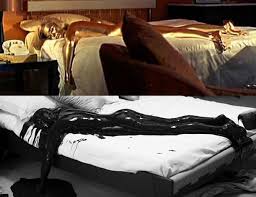
Sexual Potency – An hour into the film, James finally gets to unzip his pants. It’s with MI-6 underling Strawberry Fields (I’m not kidding). In an act of obligatory sexual harassment of company subordinates that’s become the most persistent cliche of the franchise, Bond gets his romp. There is no flirtation or chemistry. It seems purely contractual and you know that Ms. Fields will be dead before the end of the film. (Her naked body in a bed covered in oil, a nod to the famous scene in Goldfinger.) That’s it for the sex. He briefly kisses Camille, but it’s just sad all the way through for James.

Connection – There is one interesting bond in this Bond film, and that’s between James and M. She comes off as the strict mother, even applying face cream while she frets that her boy has gone off the rails. At the end of the film, she says, “Bond, I need you back.” To which he replies, “I never left.” Bond’s need to prove the threat of Quantum seems purely to prove the threat to M.

Toxic Masculinity Scale: 5

Summary

How can you be unhinged without appearing unhinged? QoS Bond is not a man. He’s a killing machine trying to prove a point that, ultimately, he doesn’t care about. But there’s a weird sense of balance in this film. On one side you have NONE-STOP action scenes, including classic Bond boat chases and airplane chases. On the other side, there’s the chunk of the film that is about M holding MI-6 and the entire geo-political order together. The brilliant theme song by Jack White and Alicia Keys hints at the promise of gender parity in the film, but it all goes off the rails amid the chaos. This includes the complete destruction of a hotel, that for some weird reason, is powered by hydrogen fuel cells. 

It should be mentioned there is an attempted rape scene. A woman working for exiled Bolivian General Medrano attacks her on a bed but is then killed by Camille, avenging the rape and murder of her family by the general.

Despite any real plot, Quantum of Solace was a box office smash, sailing on its over the top action sequences. You can literally hear Daniel Craig’s bones break in these scenes. The filming of this Bond coincided with the rise of the opioid painkiller epidemic so QoS doubles as a direct to consumer ad for OxyContin. The absence of Q and Moneypenny is made up for in the presented mythology of the indestructibility of the “good guy.”

Quantun of Solace premiered in London on October 29, 2008 as the American financial crisis, now known as the Great Recession, was just starting to drive Americans from their homes. QoS, Madagascar 2, and Twilight would give people brief escapes while the global economy crashed into a sinkhole. But steely-eyed assassins would not rescue their hope. It would be a man named Barack Obama.

Next: Skyall (2012)

The James Bond Project #23: Casino Royale (2006)

The James Bond Project #22:  Die Another Day (2002)

The James Bond Project #21:  The World Is Not Enough (1999)

The James Bond Project #20:  Tomorrow Never Dies (1997)

The James Bond Project #19: GoldenEye (1995)

The James Bond Project #18: License to Kill (1989)

The James Bond Project #17: The Living Daylights (1987)

The James Bond Project #16: A View to a Kill (1985)

The James Bond Project #15: Never Say Never Again (1983)

The James Bond Project #14: Octopussy (1983)

The James Bond Project #13: For Your Eyes Only (1981)

The James Bond Project #12: Moonraker (1979)

The James Bond Project #11: The Spy Who Loved Me (1977)

The James Bond Project #10: The Man with the Golden Gun (1974)

The James Bond Project #9: Live and Let Die (1973)

The James Bond Project #8: Diamonds are Forever (1971)

The James Bond Project #7: On Her Majesty’s Secret Service (1969)

The James Bond Project #6: You Only Live Twice (1967)

The James Bond Project #5: Casino Royale (1967)

The James Bond Project #4: Thunderball (1965)

The James Bond Project #3: Goldfinger (1964)

The James Bond Project #2: From Russia With Love (1963)

The James Bond Project: #1: Dr. No (1962)

On the question of violence

June 21, 2025 (Originally published in The Blazak Report)

There are times when I see the logic of violence. If an ICE agent was trying to abduct a loved one and I was armed, I can imagine my lizard brain telling me to do whatever it takes to save that person from being disappeared from view. This country was founded in violence. Violence was used to free us from tyranny 250 years ago. And violent protest has occasionally played a role in making America great. The role of riots after MLK’s assassination played in the passage of the Fair Housing Act of 1968 is an easy example.

But America is plagued by the dark side of political violence. The deadly shootings in Minnesota by a Trump supporter is only a recent example. And the death at the No Kings rally in Utah was the result of a protest “peacekeeper” trying to stop a man with a gun but shooting a fellow protestor by accident. The narrative of “civil war” has never felt closer

.

I’ve had many people ask if I have a gun or urge me to get a gun. I’ve comfortable with guns but I have a kid in the house, so that changes things. I want through the FBI Citizens Academy and got some good firearm training, but who exactly would I be shooting? When I see ICE agents brandishing weapons or heavily armed Marines in the streets of Los Angeles, I wonder who are they planning on killing. Every gunshot fired is fired with the intent to kill. Nobody shoots a gun just to scare people.

All this is to say, that while the pressure for violence seems to be ramping up, nonviolence is still our path. Even famous pacifist John Lennon said he would use violence to protect his family, but America is not there yet. We still have a clear ethic of doing this with non-violent civil disobedience. I’ve certainly had violent thoughts in this moment. Seeing the hell being levied on our communities by Gestapo-like ICE raids led me to wonder if we could protect those people by just burning all the ICE offices down to the ground. But ultimately people would be hurt or killed and then we’re worse off than we were before. We can do this without fire.

Growing up in the shadow of MLK in Atlanta led me to study Gandhi’s tactics more closely. We take the moral high ground when we throw our bodies against the wheel of death. And, as was the case in India, some of our bodies may be crushed. It seems inevitable that in the clash between protestors and Trump’s federalized goons there will be protestors killed. We could have Kent State on a weekly basis. And Trump will say they hated America and we will make them martyrs, but they will be dead either way. And then there will be those on our side to call for violence as a form of protection. It’s the old MLK vs. Malcolm X dynamic.

I’ve assigned Malcom X to my students for decades, because I want them to know where that “violence as self defense” impetus comes from. I get it. If Marine tanks roll into Portland, there’s going to be a cash course in Molotov cocktails in the Rose City, I’ve already posted the Doors lyric, “They got the guns, but we got the numbers.” You can feel the tension rising. But Mel Gibson fantasies aside, what does that actually get us?

It should be perfectly clear that Donald Trump is a madman. A senile, syphilitic madman. He’s willingness to jump into to the Israel-Iran war should be proof enough. Hundreds of protestors dead as Kristi Noem “liberates” the supposed “socialist” cities on the West Coast would be a trumpeted as a MAGA victory. And then we are in a civil war. We must maintain the moral high ground.

So there are two strategies here that must be kept up in the planning of all actions.

First is the value of peaceful resistance. Things are going to get ugly. Rumors of DHS deputizing Proud Boys and bounty hunters may turn out to be true. They will try to provoke a violent response so they can bring the hammer down, even employing agent provocateurs, so they can claim, “Antifa fired the first shot!” We must resist the impulse to hit back. Non-violent monkey wrenching can take many forms, from human barricades blocking ICE vans to (and this was a YIPPIE trick from the 1960s) loosening the lug nuts on the tires of said vans.

Secondly, these Marines, police, National Guard, and even ICE agents are Americans. They swore an oath to the Constitution, not to Stephen Miller or the Mango Mussolini. We have to encourage them to lay down their arms and walk away from this fascist abuse of the legitimate work they are bounded, by law not Trump, to do. We have to start diffusing the tools of authoritarianism by taking way their cudgel.

June 14 saw 5 to 13 million Americans in the street (depending on your sources). The people are sick of what this madman is doing. Yeah, they got the guns. But we got the numbers and that should be enough.

Note: I’m currently in LA to check on things. I was at the ICE detention center downtown where a half a dozen armed National Guardsmen stood watch, fingers on triggers.

The Gaza Question

I posted this piece on the paid part of The Blazak Report, my Substack, on May 24th. In wake of yesterday’s horrific attack in Boulder, Colorado, I thought it should be available to a wider audience.

May 24, 2025

Remember that song about the Vietnam War being the “big muddy”? (For you young ones, I’m referring to Pete Seeger’s 1967 “Waist Deep in the Big Muddy.”) Gaza feels the same way. The endless war where the locals are the casualties. It’s also the “big muddy” for the left. Since October 7, 2023, I’ve learned not to talk about Gaza, because if I do I will surely inflame somebody on my team. For example, does the word “Zionist” mean “a person who believes in the development and protection of a Jewish nation in what is now Israel” or a fascist who wants the genocide of Palestinians?

Even the basic facts are volatile. The October 7 Hamas attack killed 815 civilians, including 36 children, with another 251 Israelis taken hostage. The details are horrific. The worst attack on Jews since the Holocaust. But there are those who then argue that the attack was the penultimate response from Hamas after years of deadly violence against innocent civilians by Israel Defense Forces (IDF) and Jewish settlers in Gaza and the West Bank. Since IDF’s response to the attack, the Gaza Health Ministry has reported over 53,000 Palestinians have been killed, including over 17,000 children (as reported by Al Jazeera). And there are those who would argue that this is the cost of finally defeating Hamas and securing Israel’s safety.

Because I think it’s a bad idea to kill children in Ukraine or Yemen or Gaza, I attended some of the early protests to the attacks on Gaza. The local Palestinian/Arab/Muslim population were understandably outraged. Hospitals were being bombed. A year later Benjamin Netanyahu would be declared a war criminal by the International Criminal Court. But much of the protest was not about the Prime Minister of Israel, but Israel itself. When the chant turned to, “From the river to the sea, Palestine will be free!” I did some rudimentary geography in my head and figured out this was about more than stopping the bombing.

And I totally understand the need and the aching for a free Palestine. I also understand the need and the aching for a secure Israel. I have good friends and colleagues in both camps. What’s a human rights activist to do?

I was given some solace when I saw how many Jews, as well as Jews in Israel, were protesting Netanyahu’s war on civilians. I was also heartened to see Arabs and Muslims decry the October 7 attack. But then something weird happened.

The Trump administration started labeling the Gaza protestors as “antisemitic.” At the protests, I heard a lot of anger at Israel but I never once heard anything about “The Jews.” I have been studying anti-Semitism for a long time, including interviewing German neo-Nazis, so I think I have a pretty good handle on defining the term. Antisemitism sees a Jewish “race” as evil (some antisemites claim the Jews are the product of a union between Eve and Satan), and part of a global cabal to control banks, media, governments, and the world. There has been none of this in evidence at these protests. Trump’s Orwellian rewrite seemed more like performative “friend of Israel” strategizing.

It doesn’t mean that Jews haven’t felt unsafe or targeted by these protests. The murder of two Jewish employees of the Israeli embassy in DC this week, by a pro-Palestinian activist, certainly adds to that fear. However, antisemitism was on the rise before October 7 and has been a constant blight in American culture. But it is reasonable to believe that anger at Israel has morphed into anger at Jews as a group. It’s a rough time to be Jewish. Or Arab.

The pointless murder of Sarah Milgrim and Yaron Lischinsky this week reminded me of the pointless murder of six-year-old Wadea Al-Fayoume last year, killed by his landlord in Chicago because the landlord was angry about the October 7 attack. These names should be said together; Sarah Milgrim, Yaron Lischinsky, and Wadea Al-Fayoume, casualties of hate.

I have no solution to this conflict. It’s easy to say, “two state solution.” It’s easy to be angry at the rockets of Hezbollah and the Jewish settlers who drive Palestinians from their homes. I only have anger and the ability to alienate colleagues on both sides by not taking a side.

But I need to make two key points here.

I want to the right to stand in the discomfort of not taking a side while validating the hurt and anger that is felt on both sides. I believe in a free Palestine and a secure Israel. I believe that war is terrorism. And unlike Donald Trump, who one minute declares Qatar backers of Hamas, and the next minute is licking Qatari asses, I know this unwillingness to take a side is problematic. And I’m sorry to both causes.

The second thing is that I know in our struggle against the rise of authoritarianism in America we need all hands on deck. That means pro-Israel Americans and pro-Palestine Americans are going to have to lock arms. There’s going to be a lot of strange bedfellows in this fight. Wait until I tell you my plans for Reagan Republicans.

I don’t want to be afraid to talk about Israel/Gaza anymore. I want to acknowledge that it is hard and that I have faith in the people who are building bridges between the two people (and that included the two people who were murdered this week.) The violence must end. Shalom. Salam. Peace.

The James Bond Project #23: Casino Royale (2006)

May 30, 2025

This series is intended to evaluate each product of the James Bond film franchise through a feminist lens, and the relevance of the Bond archetype to shifting ideas of masculinity in the 2020s.

Casino Royale (2006, directed by Martin Campbell)

This is not your grandfather’s 007. Casino Royale was meant as Eon Production’s 21st century reboot of the Bond series.  Gone are Q, Moneypenny, endless sexual double entendres, laser watches, and the dumb CGI of Die Another Day. And gone is the brunette James as Daniel Craig steps into the role. The story starts with Bond earning his “00” license to kill, so we can frame it as a prequel, but the film still features Judi Dench as M, so it’s not clear where the story fits in the 007 timeline, if there is one.

Producers Barbara Broccoli and Michael G. Wilson brought GoldenEye director Martin Campbell back in for a bit of continuity (although Quentin Tarantino expressed interest in taking the gig). The hunt for a new James Bond was massive and included possible candidates such as Christian Bale, Hugh Jackman, Keith Urban, Ralph Fiennes, and Ewan McGregor. After initially rejecting the role, Craig took the job in 2005.  The casting of Bond “girl” Vesper Lynd also had long list, including Angelina Jolie, Charlize Theron, Audrey Tautou, Rachel McAdams, and Olivia Wilde. Finally producers cast French actress Eva Green (who I absolutely loved in 2003’s The Dreamers).

Casino Royale, while based on the same Ian Flemming novel as the 1967 spoof, starring Peter Sellers, is darker Bond that centers practical stunt work over impossible gadgets. The opening scene is shot in black and white and looks more like a scene from Dr. Strangelove than a sprawling action adventure flick. The opening credit montage features the iconic eye shot followed by a great theme song, sung by Soundgarden’s Chris Cornell. But instead of images of women’s bodies, it’s all Bond. We still have the prerequisite globe trotting, Aston Martins, and Bond gambling in a tux, but so much of this film shatters the Bond formula and that was the intent.

Let’s plug this Casino Royale into our evaluation criteria.

Driver of Action – Each time we get a new Bond, the story tends to revolve around him. There is a small MI-6 team that involves Vesper, and we get the return of Felix Leiter (played by Jeffrey Wright, who was so great in Basquiat). As we get in the final shot of the film, this movie belongs to Bond, James Bond.

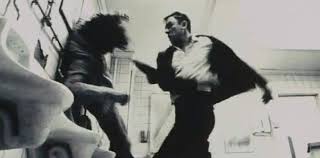
Role of Violence – Not only can Daniel Craig’s Bond run more than Tom Cruise in any Mission Impossible film, he can kill without remorse. He takes out 11 or 12 bad guys in the film, including drowning a guy in a bathroom sink in the first scene. He remarks that his second kill, a rogue MI-6 officer, is much easier. He shoots an unarmed bomb maker in Madagascar, which creates some bad press for MI-6. His ability to fight the bad guys to death, seems superhuman at time, but this is a James Bond film after all.

Vulnerability – Big shift here. While we get the strong silent bit out the wazoo (M says, “I would ask you if you could remain emotionally detached, but that’s not your problem, is it, Bond?”) We do see fear on Bond’s face when he is about to be tortured  by Le Chiffre (played by creepy Mads Mikkelsen). He should be. The torture is him being repeatedly hit in the scrotum, sending him to the hospital. He also shows great grief when Vesper dies, even though she double crossed him. The scene mirrors the final moment of On Her Majesty’s Secret Service (1967), with James Bond in tears, holding his dead wife.

Sexual Potency – Bond makes a quip about married women being his type, after he beds Solange Dimitrios, wife of a bad guy. MI-6 pairs him with Vespers Lynd, who keeps him at arms length for most of the film. Of course, they end up in bed together. But that’s it. This Bond ain’t a player.

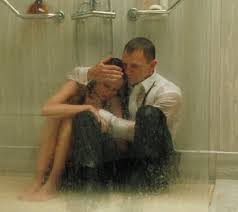
Connection – This is where 2006 Bond really departs from the formula. There’s a scene where a traumatized Vespers is sitting in a hotel room shower, and James steps in and holds her. There is a strong connection between the two. After they survive near death and torture stopping Le Chiffre, James is in the hospital and Vesper says, “You’re not going to let me in there, are you? You’ve got your armour back on. That’s that.” And he replies, “I have no armour left. You’ve stripped it from me. Whatever is left of me – whatever is left of me – whatever I am – I’m yours.” Who is this man who recognizes the “00” prevents him from being able to love? This scene was 44 years in the making. James resigns from MI-6 to run off with her. Of course, this is a James Bond movie so you know there will be no happily ever after.

Toxic Masculinity Scale: 2

Summary

Casino Royale has enough Bond tropes to connect it to the genre. As a poker player I absolutely loved the extended scenes of Bond, Leiter and Le Chiffre playing high stakes Tex Hold ‘em. Gripping. The film also turns some of those tropes upside down. We get Bond back in the Bahamas coming out of the water like Ursula Andress in Dr. No (1962), his body on full display. This James plays more the role of psychoanalyst than sexual conquerer. But he’s still portrayed as a man’s man. (Vesper: You know, James, I just want you to know that if all that was left of you was your smile and your little finger, you’d still be more of a man than anyone I’ve ever met. James: That’s because you know what I can do with my little finger.)

The high level of violence in the film led to Casino Royale being re-edited in numerous countries, including the United States, Britain, Germany and China. But the film is securely located in the 2000s, with the prevalence of cell phones, a parkour inspired chase scene in Madagascar, and the Body Worlds exhibit in Miami.

Casino Royale premiered in London’s Odeon in Leicester Square (where I saw the premiere of Pink Floyd’s The Wall in 1982) on November 16, 2006, with Queen Elizabeth and Prince Phillip in attendance. It’s the same week Nintendo’s Wii and Sony’s Playstation 3 hit the market, so there was a competition for young male eyeballs. The film received rave reviews with the Rotten Tomatoes website reporting,  “Casino Royale disposes of the silliness and gadgetry that plagued recent James Bond outings, and Daniel Craig delivers what fans and critics have been waiting for: a caustic, haunted, intense reinvention of 007.”

Maybe after four decades James learned the weight of his license to kill.

Next: Quantum of Solace (2008)

The James Bond Project #22:  Die Another Day (2002)

The James Bond Project #21:  The World Is Not Enough (1999)

The James Bond Project #20:  Tomorrow Never Dies (1997)

The James Bond Project #19: GoldenEye (1995)

The James Bond Project #18: License to Kill (1989)

The James Bond Project #17: The Living Daylights (1987)

The James Bond Project #16: A View to a Kill (1985)

The James Bond Project #15: Never Say Never Again (1983)

The James Bond Project #14: Octopussy (1983)

The James Bond Project #13: For Your Eyes Only (1981)

The James Bond Project #12: Moonraker (1979)

The James Bond Project #11: The Spy Who Loved Me (1977)

The James Bond Project #10: The Man with the Golden Gun (1974)

The James Bond Project #9: Live and Let Die (1973)

The James Bond Project #8: Diamonds are Forever (1971)

The James Bond Project #7: On Her Majesty’s Secret Service (1969)

The James Bond Project #6: You Only Live Twice (1967)

The James Bond Project #5: Casino Royale (1967)

The James Bond Project #4: Thunderball (1965)

The James Bond Project #3: Goldfinger (1964)

The James Bond Project #2: From Russia With Love (1963)

The James Bond Project: #1: Dr. No (1962)

The James Bond Project #22:  Die Another Day (2002)

May 26, 2025

This series is intended to evaluate each product of the James Bond film franchise through a feminist lens, and the relevance of the Bond archetype to shifting ideas of masculinity in the 2020s.

Die Another Day (2002, directed by Lee Tamahori)

The first Bond film of the 21st century and the last Pierce Brosnan 007 role was also intended to be a celebration of 40 years of James Bond movies. Several directors were considered, including Ang Lee and Martin Scorsese, but producer Barbara Broccoli settled on New Zealander Lee Tamahori, who directed the brilliant When We Were Warriors (1994). The result is a sweeping adventure that pulls together North Korean torture chambers, conflict diamonds, and Halle Berry into a film that is often placed at the bottom of Bond lists but is also surprisingly satisfying. Die Another Day would mark the end of 40 year run and take Bond into a new era with the arrival of Daniel Craig.

Die Another Day is meant to pay homage to all the previous Eon Bond films. Halle Berry walks out onto a Cuban beach as a doppelgänger of Ursula Andress in Dr. No (1962). John Cleese has been promoted to Q and his laboratory is a museum of past 007 gadgets, including the jet pack from Thunderball (1965). I’m sure there’s a website that goes through the film’s nods. (Live and Let Die’s interracial love scene?) There was even talk of having Sean Connery make a cameo.

As is expected, we get James underwater and on snow. James in a tux, making plenty of sexual double entendres (“ I have been known to keep my tip up”), and James in exotic locales; North Korea, Cuba, and Iceland. But there are also some departures. The opening title sequence features a theme song sung by Madonna (who also has a small role in the film) with usual female bodies, but also a montage of Bond being tortured in a North Korean prison. Weird. Also, the film relies heavily on CGI, including a really dumb invisible Aston Martin. So dated now.

There are actually a lot of dumb things in this film. We’re to believe that 007 was tortured for 14 straight months in North Korea, allowing his hair to grow a few feet. There’s also a Korean terrorist named Zao, played by Rick Yune, who has diamonds embedded in his face from a blast and I kept thinking, “With a pair of tweezers, I could take care of that for you.” There’s also the classic dumb Bond trope of using “science” to change somebody’s face to look like somebody’s else face. And then there’s the thing of James running around Iceland without a parka on. Not only does a single bullet not strike Bond, neither does a chill.

Let’s plug Bond at 40 into our matrix, shall we?

Driver of Action – We do get a little bit of Halle Berry previewing her 2004 Catwoman role, but this is a Jame Bond revenge movie. Although he doesn’t seem that angry that he was tortured in a North Korean jail for 14 months. In Brosnan’s final jaunt as 007, all plot lines are on him. Even M is sidelined.

Role of Violence – 007 takes out a few dozen guards and henchmen in the film, including during an over-the top hovercraft chase scene. There’s a pretty awesome sword fight scene between Bond and bad guy Gustave Graves (played by Toby Stephens) that smashes up a fancy fencing hall that’s so old school film violence that I didn’t want it to end. And the Bond kills Graves by opening his parachute on a plane so he gets sucked through the jet engine, which is pretty gross. If 40 years, there hasn’t been shred of remorse for this body count.

Vulnerability – After Bond has been traded for Zao to get him out of North Korea, M takes away his “00” status on the belief that James revealed state secrets under torture. He could have taken his cyanide pill but chose not to. (“Threw it away years ago…” he tells M.) There’s a brief moment where James is confronted with the realization, “If I’m not 007, what am I?” But it’s just a split second. Then he goes ape shit and busts out on his rogue (again) vengeance mission.

Sexual Potency – The sex scene with Halle Berry’s character, Jinx, is pretty hot, with her on top. Woman power! I remember seeing this in the theater and slinking into my seat. (Remind me to tell you the story of meeting Berry at a Braves game.) He also beds MI-6 operative Miranda Frost (played by Rosamund Pike), which seems completely unbelievable and dumb. Shockingly, there is a scene of Bond nailing Miss Moneypenny on her desk, but it turns out just be a fantasy she’s having on Q’s virtual reality contraption. So, we don’t get the “3 conquests” quota, and that’s probably a good thing.

Connection – Bond is so alone. More alone than in any previous film. M, Q, and all the other letters are annoyances. Jinx is an NSA agent so there is some connection there and they do end up flying a helicopter to a Korean island to role around in a pile of conflict diamonds, but it’s more obligatory than romantic. Poor James.

Toxic Masculinity Scale: 5

Summary This isn’t a great Bond film, but it is a romp. There’s cool stuff that are like a series of chef’s kisses for loyal Bond fans. The opening scene of Bond and South Korean soldiers surfing massive waves to land behind the DMZ is cool. Bond driving a 50s convertible in Havana is cool. Bond escaping the hospital bed by stopping his own heart is cool. Dumb, but cool. And the Clash’s “London Calling” playing as he flies back to HQ is super cool.

The 40th Anniversary Bond also suffers from the trap of toxic masculinity. The man alone who kills without consequence and beds women without care or kindness because that’s what men do is just sad decade after decade after decade after decade. He’s morphed into a robot. I suppose that’s functional for the MI-6 mandate, but it’s not human. Ten years earlier, the cost of this life was explored in Clint Eastwood’s brilliant film, The Unforgiven. But for James Bond, the cartoon character in a new millennium, it’s just a fading shell of what men were supposed to be.

Die Another Day premiered on November 18, 2002 at Royal Albert Hall with Queen Elizabeth and Prince Phillip in attendance. It was the week the SARS pandemic was causing panic and the week President Bush created the Department of Homeland Security. The world was changing and the relevance of a 007 was, again, in doubt. Or maybe needed more than ever. It would be up to Daniel Craig to tell us.

Next: Casino Royale (2006)

The James Bond Project #21:  The World Is Not Enough (1999)

The James Bond Project #20:  Tomorrow Never Dies (1997)

The James Bond Project #19: GoldenEye (1995)

The James Bond Project #18: License to Kill (1989)

The James Bond Project #17: The Living Daylights (1987)

The James Bond Project #16: A View to a Kill (1985)

The James Bond Project #15: Never Say Never Again (1983)

The James Bond Project #14: Octopussy (1983)

The James Bond Project #13: For Your Eyes Only (1981)

The James Bond Project #12: Moonraker (1979)

The James Bond Project #11: The Spy Who Loved Me (1977)

The James Bond Project #10: The Man with the Golden Gun (1974)

The James Bond Project #9: Live and Let Die (1973)

The James Bond Project #8: Diamonds are Forever (1971)

The James Bond Project #7: On Her Majesty’s Secret Service (1969)

The James Bond Project #6: You Only Live Twice (1967)

The James Bond Project #5: Casino Royale (1967)

The James Bond Project #4: Thunderball (1965)

The James Bond Project #3: Goldfinger (1964)

The James Bond Project #2: From Russia With Love (1963)

The James Bond Project: #1: Dr. No (1962)

Escaping Gilead – My experience crossing the border

May 21, 2025

Ever since January 20th, when Trump pretended to take the oath of office, things in America have felt really dark. From people being grabbed off the street by ICE and disappearing from public view without due process to the rise and fake fall of Trump’s top campaign donor, Elon Musk, it’s felt very end of a nation-ish. This includes rumors about changes at the border.

Here in Portland, it’s about a four-and-a-half our drive to the Canadian border. I’ve made the crossing many times. Last time was in December when Cozy and I drove up to Vancouver for the Taylor Swift concert. The crossing was a blast with carloads of Swifties shouting to each other and Canadian border guards the recipients of countless friendship bracelets. It’s so nice having another country just up the road a piece.

So I decided to make a run for the border.

After Andi picked up Cozy yesterday, I hopped on I-5 to make that long journey north; Olympia, Seattle, Bellingham, to the Peace Arch crossing about 10 pm last night. Late on a Tuesday, the usual border traffic jam was gone, but there was something new this time.

On the American side of the Peace Arch, there was a red traffic light and a barricade pushing cars into one lane. Up ahead I saw two armed men talking to a driver. When they finished, I was waved me forward. Two men in black military gear and long rifles stopped me. I searched for any identifying organization; border patrol, ICE, HSI, FBI. Nothing. I could have asked. I could have said, “Hey fellas, I’m on a DHS CP3 project. Who are you with?” But the rifles just shut me up.

It was a brief interaction. One of the men asked me to role down all my windows so he could look in the car. It was clear they were looking for people, not contraband. I have no idea who they were. To tall white guys straight out of central casting. I assumed that if I wasn’t a white male, the stop would have been longer, but they sent me forward where I showed my passport to the border guard and headed into our great neighbor to the north.

I didn’t go all the way to Vancouver. I booked a “pod” just south of the city in Richmond because I saw a program about Japanese pod hotels and it seemed like a fun way to crash for the night before turning around and heading back the U.S.A. in the morning. If you ever wondered what sleeping in a coffin would be like, this was it. But the coffin had wifi, so I got an Instagram post up about the experience. Actually, it reminded me of sleeping on the tour bus back in my road manager days, so I slept well.

This morning, after breakfast at IHOP (it truly IS international!), I headed south. There had been a lot of talk that entering the US would be the real problem. That I would be made to swear loyalty to the Mango Mussolini or would they search my phone and look at my social media footprint where I daily proclaim the emperor has no clothes. One wrong thoughtcrime and I would go from Canada to El Salvador.

There were only two lanes open at Peace Arch so I had time to watch and get nervous. It was obvious that the guards were taking their time, especially with Canadian cars. When is was my turn, I got the 20 questions, about what I did in Canada, who I met in Canada, what I bought in Canada. I know that most of these questions are meaningless and just meant to give the guard a chance to evaluate your demeanor. He took my keys and opened up the back of my car. He said, “Where are all your clothes? Your backpack’s empty.” I wanted to say, “That’s my brother’s backpack. He’s dead.” But, for some reason, I said, “I left them in Seattle.” Again, my white maleness played a role, I’m sure. I was allowed to enter my country and head home to pick up my kid.

The whole thing was weird. Why are there armed guards before you get to the Canadian border guards? What are they asking Canadians coming into the U.S.? Last night, it felt like they are trying to stop people from escaping  the United States, not escape into it, like a scene from The Handmaid’s Tale. I can’t change my skin tone to repeat the experiment, but the joy of international travel by car is now tense and scary. Part of me wonders if I should have just stayed in my pod.