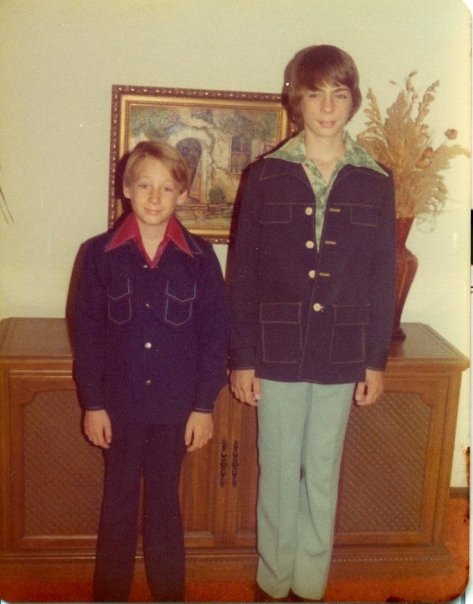
My little brother didn’t have the best life. I wasn’t the kindest sibling but we seemed to be destined to be on two very different paths from the start. Instead of playing the role of nurturing mentor, I was the perpetual antagonist. So when it came time to help him through his stage four rectal cancer, I was gifted a chance to make up for some bad childhood mojo. But ultimately, it was too little too late.
I was on a work trip to DC when I got a late night call from my mom. I knew what the news was. Ron had finally succumbed to his cancer.
He had asked me to send his body back to be buried in Cartersville, Georgia, where he had been “living off the grid” for ten years. I looked into it and it would have cost over ten thousand dollars that neither of us had. We hit on a reasonable compromise. That I would take his ashes back to the hill in Cartersville that he lived on and spread them at his camp. He found great peace there, living among the owls and squirrels, so it made sense to bring him home.
So on March 23, on what would have been his 58th birthday, Cozy and I hopped a flight to Atlanta, with Ron riding in my suitcase. The next day, with my dad, we drove up to Cartersville. While they waited in the car, I hiked up the hill and found Ron’s campsite that we had broke down two years ago. I could see another tent further up the hill so I didn’t want to linger too long. I spread half of his ashes around he camp, said a few words, and headed down the hill, feeling I had fulfilled Ron’s last request.
But there was another spot that I wanted to take my brother before I said goodbye. Growing up in Stone Mountain, Georgia meant we spent half our childhood at Stone Mountain Park. One of our favorite spots was the gristmill, a 19th century mill whose water wheel was fed by a small creek. Summers were spent at the millpond. We’d swim in the pond, find crawfish, and then slide down the long wooden flume with the rushing water. Right before the water went over the wheel, we’d jump out and do it all over again. Then my mother would buy cornmeal at the mill and we’d walk up the hill to have corn on the cob and boiled peanuts. Summer in Georgia in the 1970s.
I booked a few nights at the new hotel in Stone Mountain Park so I could share some of the fun I had as a kid with Cozy. We climbed the mountain and said rude things to the Confederate “heroes” carved on its face. But mostly we hung out at the mill pond. Ignoring the “Stay out the water” signs, we waded in. Our project was to rebuild the dam they had torn down when they stopped sending water to the mill. We moved boulders in an attempt to revive the pond to its old swimming hole status. With each rock well placed, the water level inched up.
Then, when it felt like the place Ronnie I would splash around in, I poured his ashes into the pond. Some formed a cloud and moved through the dam, down the creek, and to Stone Mountain lake, where our parents would take us canoeing. The rest spread across the pond floor, to forever be a part of our sacred little spot in the woods.
With that, it felt like my brother was finally back home. Ashes to ashes.
This series is intended to evaluate each product of the James Bond film franchise through a feminist lens, and the relevance of the Bond archetype to shifting ideas of masculinity in the 2020s.
A View to a Kill (1985, directed by John Glen)
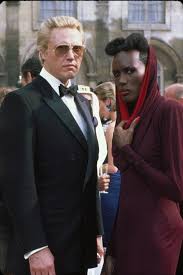
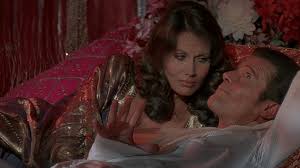
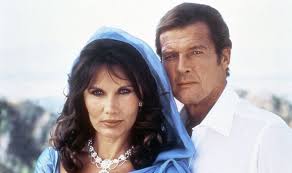
One last time into the breach, with Roger Moore. Probably the most famous thing about A View to a Kill was the theme song that shot Duran Duran to #1 and gave them a Golden Globe award. Eon coaxed Moore, 57, into doing “just one more” Bond film. He apparently was more than reluctant, especially when learning that he was older than his co-star Tanya Robert’s mother. Unlike Never Say Never Again (1983), the film makes zero references to Commander Bond’s age. Instead we get improbable fights on top of the Golden Gate Bridge with an ax wielding Christopher Walken. No sharks, but Walken and Grace Jones, both completely maniacal, are entertaining enough.
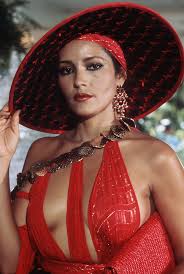
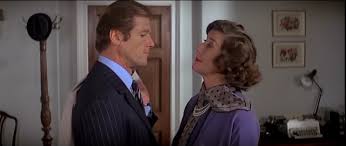
The casting of AVTAK is pretty eighties. Casting Christopher Walken as this episode’s evil capitalist is a delight (although the part was originally offered to David Bowie, and then Sting). There’s a part where Walken is trying to escape in his personal blimp where he screams, “More power!” and I just heard cowbell in my head. This episode’s Bond “girl” is former Charlie’s Angel Tanya Roberts, fast off her acting magnum opus, Beastmaster. The role was intended for Priscilla Presley, but Presley had a conflict due to her role on Dallas. (A pause here to imagine the scenes with David Bowie and Priscilla Presley. What could have been.) This was also the final time we would see Lois Maxwell, 58, in the perennial role of Miss Moneypenny, there from the very start in 1962.
The plot of A View to a Kill is pretty thin. Walker’s character, Max Zorin, wants to destroy Silicon Valley with a manmade earthquake so he can corner the microchip market. (These evil capitalists tend to spend massive amounts of capital on the plots to maybe make a little more capital. Maybe they should just invest in government bonds.) He’s the product of a Nazi genetic experiment, so he’s a bit kooky. He has a girlfriend, who is also assassin, played my great music star Grace Jones as May Day. Jones would release her brilliant album, Slave to the Rhythm, later that year. There’s the usual globe hopping. A ski-chase in Siberia where James skis on one ski (last time it was with one ski pole) and invents snowboarding. There’s a spectacular base jump off the Eiffel Tower that ends with 007 driving half a car along the Seine and then (literally) crashing a wedding party. And there’s James scuba diving in the dirty San Francisco Bay, almost getting sucked into an intake tube. The sexual double entendres are dialed back ( “A little restless but I got off eventually”), but director John Glen knows how to ramp up the Saturday matinee action. The chase scene through the streets of San Francisco with Roberts driving a hook and ladder fire truck and the senior Moore swinging from the ladder is one for the ages.
For Roger Moore’s final James Bond (1973 – 1985), lets put him through the wringer on more time.
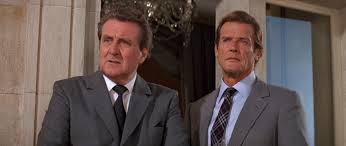
Driver of Action – The film really has two parts. The first involves Zorin’s horse selling business in France. Here, Bond shares the story with Sir Godfrey Tibbett, an MI-6 agent who is also a horse trainer (played by another Avengers alumni, Patrick Macnee). The second part of the story front-actions Stacey Sutton, Roberts’ character, who is a geologist whose father’s oil company was bought by Zorin. In both we get (very thin) backstories, but it does feel like Moore “shares” the story.
Role of Violence – Bond doesn’t really use his license to kill in 1985. He even winces and grabs his hand after punching a henchman in the face. Where the violence comes from is Walken’s character who laughs and smiles as he machine-guns hundreds of his own workers to death. It’s the first bloodbath in a Bond film and it’s jarring. But he IS the product of a Nazi experiment, so…
Vulnerability – Bond does seem genuinely bothered when Tibbett is murdered (by May Day), saying, “Killing Tibbett was mistake” to Zorin. He’s not as bothered when CIA ally Chuck Lee is murdered (also by May Day). Side note: You’d think that MI-6 and CIA agents would know to ALWAYS look in the backseat of the car before getting in. Moore’s Bond is always zipped up tight. He finishes the series as he started in Live and Let Die, stay calm and don’t give a damn.
Sexual Potency – Here’s where the formula comes through – The Eon promise of three + women bedded per film. The opening sequence ends with 007 in a submarine disguised as an iceberg driven by a beautiful blonde. We assume she’s MI-6, but she could be just a local submarine/iceberg driver. James tells her, “Be a good girl and put her on automatic.” Cue Duran Duran song. Bond also has some rough sex with Grace Jones character in France. Then, in SF, he hooks up with sexy KGB agent Pola Ivanova in a hot tub. (The part was written as Major Anya Amasova, but Barbara Bach declined to reprise her role from Live and Let Die.) “Would you like it harder?” He asks as he rubs her back. Then in the film’s closing scene that first zooms in on a bowl with the word “pussy” on it (the cat’s bowl), he bags Stacey in the shower of her house, with Creepy Q watching via his new robot, reporting to M that, “He’s just cleaning up a few details.” I guess since the film started with Bond boning on a boat, they’d let him finish (for once) on land.
Connection – One might hope that Bond approaching 60 would develop attachments to other human beings. He seems even less invested in his MI-6 colleagues, including Moneypenny and Q, than ever. They are just background scenery. You’d think that since Moore was leaving the series after a dozen years (as was Lois Maxwell after 23 years), the screenwriters would have added some sentimentality to the story. Nope. Moore plays Bond as unconnected as ever, fading into the sunset as a caricature of the lonely man.
Toxic Masculinity Scale: 3
Summary
A View to a Kill could have been grand send off for Sir Roger Moore, but Moore himself disliked the film. “I was horrified on the last Bond I did. Whole slews of sequences where Christopher Walken was machine-gunning hundreds of people. I said ‘That wasn’t Bond, those weren’t Bond films.’ It stopped being what they were all about. You didn’t dwell on the blood and the brains spewing all over the place.” We do get some Bond staples, like 007 in a tux and white dinner jacket. There’s not an underground lair, but there is a giant mine cave that’s basically an underground lair. (And I’d like to go back in time and inform Eon Productions that there are SHARKS in San Francisco Bay.)
There are some hints of progress. Women’s names start to pop up in the credits, including casting and unit manager. Producer Cubby Broccoli’s daughter, Barbara Broccoli, had been a Bond assistant director since Octopussy. Bond doesn’t immediately bed Stacey, even after two bottles of wine. He tucks her in and then sleeps in the chair with a shotgun in his lap. (That’s a good grandpa.) When a henchman spots Stacey’s heels on the mine sight, undercover James quips, “It’s women’s lib. They’re taking over the Teamsters.” While we are yet to get a lead female villain, Grace Jones as the bad guy’s #2 is pretty powerful (even if she’s played with a bit of a “black animal” trope).
Side Note 1: This the 16th Bond film I’ve watched in this series and I’ve seen hundreds of rounds of ammunition fired at our James. Maybe thousands. Never has a bullet come close to him. If MI-6 has the technology to make bullets go around their agents, they should tell us!
Side Note 2: I’ve long said that I ever win Powerball, I will first buy a personal blimp. A View to a Kill makes me believe that is possible.
A View to a Kill premiered in San Francisco on May 22, 1985, as cans of New Coke were hitting the shelves. Maybe the world was ready for a change but not sure what that change should be. Near the end of the film, Bond gets a meddle from the KGB for taking out Zorin, the joke being that the Soviets get their technology intel from Silicone Vally. The film was released a year before glasnost came to the USSR. Maybe 007 knew something we didn’t. I’ll leave Moore’s line as horny Bond to close this chapter. “On a mission I am expected to sacrifice myself.” Oh, James.
This series is intended to evaluate each product of the James Bond film franchise through a feminist lens, and the relevance of the Bond archetype to shifting ideas of masculinity in the 2020s.
Never Say Never Again (1983, directed by Irvin Kershner)
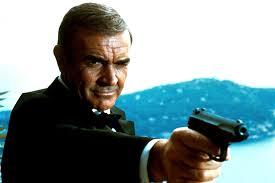
Never Say Never Again has everything you want in a James Bond film; exotic locations and women, Blofeld, cool gadgets, stolen nukes, double entendres, sharks, and Sean Connery. After completing Diamonds are Forever in 1971 and saying he would never play 007 again, Connery was lured back into the role by producers Kevin McClory and Jack Schwartzman. Connery, at 52, was still younger than his Eon Productions counterpart Roger Moore, but the non-canonical Bond film, Connery’s last, would poke fun at the aging agent while still delivering classic Bond tropes.
The return of Ernst Blofeld and his white cat, who were killed off in 1981’s For Your Eyes Only, serves to remind us that we are not in the official BCU (Bond Cinematic Universe). It does however bring back SPECTRE and the thrill of an evil global plot. Blofeld (played by Max von Sydow) directs billionaire businessman and SPECTRE Number 1 Maximillian Largo (played by Klaus Maria Brandauer, who seems to have greatly inspired Elon Musk) to hijack some Navy nukes to extort the world. Sexy assassin SPECTRE Number 12 Fatima Blush is played by Playboy model Barbara Carrera, who passed up a role in Octopussy to work in a Connery Bond film. NSNA’s Bond “girl” was played by Kim Basinger, in the role that launched her career. While NSNA has a less polished feel than the Eon catalog, Irvin Kershner, director of the 1980 blockbuster The Empire Strikes Back, gave the film a tight pace as 007 hops around the world.
The film gives us a younger, more bureaucracy-bound M, and a Q who complains about the bureaucracy. When Bond enters Q’s lab, Q says, “Good to see you, Mr. Bond. Things’ve been awfully dull ’round here. Bureaucrats running the whole place. Everything done by the book. Can’t make a decision unless the computer gives you the go-ahead. Now you’re on this. I hope we’re going to have some gratuitous sex and violence!” And we get that and more, including a return to the Bahamas and the film debut of Mr. Bean’s Rowan Atkinson as Nigel Small-Fawcett.
While not in the “official” 007 catalog, let’s analyze it for fun.
Driver of Action – If you’ve got Sir Sean Connery, you might as well let him drive the whole damn film. From the first jungle battle scene to the last underwater fight scene, this is a James Bond film. We do get the return of CIA agent Felix Leiter (this time played by former San Francisco 49er Bernie Casy) who shows up 57 minutes into the film, but he’s in the usual minor support role. There are no real storylines that compete with the spectacle of 007.
Role of Violence – In the opening scene Bond kills a bunch of dudes with varying means (including a blowdart), but it’s revealed to be a training exercise. He does kill a would-be assassin with his urine (don’t ask) and later blows up Fatima Blush, leaving her smoking high heels on the ground. Old Bond fights a lot but you get the feeling that he’s just not cut out for the fisticuffs anymore.
Vulnerability – Much is made in the start of the film about James advanced age. He laments that M doesn’t have much use for “double O’s” anymore and that he’s “teaching not doing.” M sends him to a health farm to get fit and get rid of his “free radicals,” accusing him of, “too many dry Martinis.” Bond being Bond dutifully goes but smuggles in Beluga caviar, quails eggs, vodka, and foie gras.
Sexual Potency – Sean Connery fans paid for Classic Bond, so the women needed be laid out like a buffet. While the banter with Ms. Moneypenny is tepid (James: Still here, Moneypenny? You should be in bed. Moneypenny: James, we both should be!), James does bed four women in the film. The first is the chiropractor at the health farm, Nurse Patricia Fearing. Then he gets busy with Fatima Blush, on a boat in Nassau. (James: You’re marvelously well equipped. Fatima: Thank you, James. So are you.) Then he’s in the sack with some unnamed woman he met on a fishing boat. Finally, he ends up making sweet love to Kim Basinger’s character, Domino, on a Navy Submarine. In 1983 the AIDS epidemic was still largely confined to gay and IV subcultures, so this was probably our James’ last hurrah.
Connection – In this film we see James Bond wrestling with his age, but still not willing to let his guard down and open up. There is a glimpse at the end. Since two “boat sex” encounters were ticked off in the film, Never Say Never Again ends with James and Domino back in the Bahamas. Domino brings him a fruity drink instead of his martini. He moans and she says, “You’ll never give up your old habits, James.” He replies, “No, you’re wrong. Those days are over.” Is he ready to settle down with the girl from Athens, GA? The film ends with Connery winking at the camera.
Toxic Masculinity Score: 5
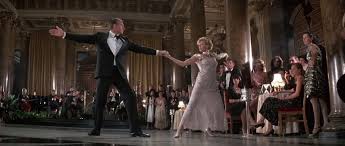
Never Say Never Again comes with plenty of Bond cliches, including watches with lasers, a pool full of bikini clad babes, James in a tux, and all his “Is that about sex? quips. (“Going down, one should always be relaxed.”) As a non-Eon film, the score and the theme song suck. But the rocket motorcycle chase in Nice, France and the scene with the sharks (Are those frickin’ lasers on their heads?) are pretty awesome. The film drags a bit with Connery’s lethargy and there is a really weird scene of Bond and Domino dancing a tango after he beats her boyfriend at a video game that seems way too eighties.
Bond as the sexual conquerer is also paired with his role of the rescuer of women. Domino is tied up on an auction block to be sold as a slave in North Africa. James literally rides in on a horse to save the damsel in distress. Fortunately, she saves him later in the film by shooting a speargun into her former lover as he’s about to kill Bond. There’s also the scene where he kills Fatima after commenting on her “hatred of men.” Seemed misogynistic to this viewer.
Never Say Never Again premiered in the U.S. on October 7, 1983, just four months after Octopussy and sold fewer tickets. There had been some talk about bringing Connery back in for a new series of Bond films to rival the Eon franchise, but you could tell that the Scotsman’s heart just wasn’t in it. Connery would go on to star in iconic eighties films like Highlander, The Name of the Rose, and The Untouchables, and leave 007 behind on some boat with some random damsel in distress.
Many of us watched the February 28th White House meeting with Ukrainian President Volodymyr Zelenskyy is abject horror. One of our most heralded allies was being attacked by Trump and Vance like a child being berated for breaking a window with a baseball. Then it became clear that it was the set up. An ambush for Trump’s Russian bosses. Vance badgering him to apologize. Marjorie Taylor Greene’s boyfriend chiding him about not wearing a suit (when few of Trump’s White House chums have). I wanted Zelenskyy to just say to Trump, “Mr. President, are you aligned with America’s ally, Ukraine, or Putin?”
We know what Trump would have said – “I’m not aligned with anybody.”
In that moment, it was clear that America was no longer the leader of the free world. That our allies could no longer rely on us and that we weren’t going to lift a finger to defend democracy. In that moment, Trump gave Putin the green light to obliterate Ukraine. At the United Nations, we voted with Russia (and North Korea) against the condemnation of Russia’s 2022 invasion. The following actions backed that position up, including halting support of military aid to Ukraine, ceasing cyber operations against Russia, mass firings at the CIA and FBI, and Trump asking to end U.S. sanctions against Russia. What more could Vladimir Putin ask for? (I’m sure we’ll find out.)
Trump’s capitulation to Russia and the falling in line of the MAGA cult rings familiar. In the years before the attack on Pearl Harbor, there were Americans, including in Congress, that thought the United States sending billions of dollars to our European allies to fight Nazi Germany was a big ol’ waste. Those nations weren’t sufficiently “grateful.” This included after Germany began their brutal blitzkrieg of Great Britain in 1940. They wanted England to at least give us some of their islands in the Caribbean for helping them. But FDR said, F that. We’re all in for freedom.
What launched the American century began in the first global conflict. During the “war to end all wars” (aka WW I), isolationist voices had the day, until it was clear that Britain and France REALLY need our help (and a ton of American merchant ships were being sunk by U-boats). On April 6, 1917, we declared war on Germany and shut that shit down. By November of the following year, the war was over. And the United States was the new hot shot defender of freedom, our perfect hair blowing in the wind. Ever since that moment in 1918, lovers of freedom and democracy knew we were their ride or die. Sure there were some ethical lapses, Central America, Vietnam, but for the most part we were the good guys on the planet.
That ended last Friday. The global realignment, long envisioned my MAGA architects, has jettisoned its long held alliance with Europe, viewed as decadent by Steve Bannon and white nationalists, in favor of an allegiance to authoritarian regimes like Russia. France is “socialist” and Moscow has clean subways. Sure, political dissidents are thrown into Siberian prisons, but Moscow has clean subways. We are now a part of the axis of evil and Trump and his handlers could not be happier.
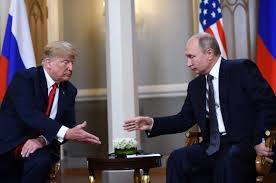
I often tell the story of the time I was at a meeting at the U.S. embassy in London in 2018. I was there as a part of a government-funded trip to study how the British respond to violent extremism. We just happened to be at the embassy the day President Trump was attending a summit in Helsinki, Finland with the Russian leader. We all watched the press conference where Trump famously said that he trusted Putin’s assertion that Russia didn’t interfere in the 2016 election, over the evidence presented by his own intelligence agencies. The shock among the career diplomats I was watching with was palpable. They immediately scrambled to craft a response to the fact that the U.S. President and had just publicly chosen loyalty to the biggest dictator on the planet over his own nation.
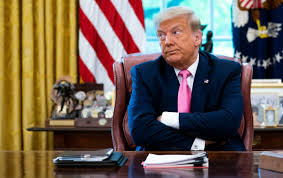
We don’t know if Putin has some serious kompromat on Trump (perhaps the pee pee tapes are in a vault in the Kremlin) or Trump just really wants to be an authoritarian (or both), but Trump’s mandate is clear. He’s out for himself. He’s never read the Constitution, or The Bible for that matter. I’d lay odds he’s never read a complete book. He’s the transactional president. If it serves him and the sycophants that kiss his ass, he will throw Americans and their security under the bus. He will wage war on our allies, like Canada and Mexico, and sing the praises of dictators like Turkey’s Erdoğan and Hungary’s Orbán. Whatever fluffs his fragile ego.
Trump is murdering America.
So, sorry Ukraine, and other nations fighting to be free and democratic, we now have our own fight to win.
This series is intended to evaluate each product of the James Bond film franchise through a feminist lens, and the relevance of the Bond archetype to shifting ideas of masculinity in the 2020s.
Octopussy (1983, directed by John Glen)
Fifteen years after the Beatles went to India, Britain’s second biggest export headed to the Asian subcontinent. It wasn’t to study meditation, but to fight the Cold War with an army of fembots. Octopussy sees our man Bond caught up in a conspiracy that includes fake Faberge eggs and loose nukes. Star Roger Moore had wanted to retire after For Your Eyes Only, feeling he was to old to play Bond, but word that Sean Connery was returning to play Bond in a non-Eon Productions film had worried producers that Bond-in-Waiting Timothy Dalton (and a few other potential contenders) would not be ready to compete with the O.G. 007.
The result is a film that tries to capture the Bond magic with a middle-age spy who has more lines on his face than stinging lines of dialogue. There are challenging scenes of Bond swinging from vine to vine with a dubbed in Tarzan yell, Bond fighting a henchman on top of a flying airplane, and Bond fighting two henchmen on top of a moving train (a scene that almost killed another stuntman). Watching this film made me wonder if they had Ibuprofen in the 1980s. Producers brought back Maud Adams, who had played Andrea Anders The Man with the Golden Gun. It made sense to have a slightly older Bond “girl” in the title role. This was Bond for aging Baby Boomers.
The film primarily takes place in India and East Germany, with a fun intro scene in some random Latin America country that has Bond flying a cool one-man plane out of the back of truck being chased by some banana republic types. We have a new M, played by Robert Brown. Desmond Llewelyn is back as Q and this time he’s got tons of gadgets for James to play with (including one Bond uses to zoom in on an MI-6 worker’s cleavage). James is back in his white dinner jacket and tux and there he is riding a horse through the jungle and crossing a river inside an alligator submarine. (Someone should have told filmmakers that India has crocodiles, not alligators.)
Octopussy is Bond in a holding pattern but let’s discuss it anyway.
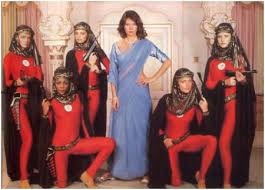
Driver of Action – Bond is back on his own. We do get a lot of Q. There’s a local agent named Vijay, but he’s not long for this world. There’s a real missed opportunity to tell the story of Octopussy (Maud Adams) who has created an island of misfit women in India who are also (how?) circus performers in East Germany. I’d love some Octopussy fan fiction because that would be a great story. But later in the film, James raids the bad guy’s compound with Octopussy’s all female army of circus warriors in their Electra Woman costumes and it’s glorious. Why did it take 21 years to get Bond to lead an army of fembots in an invasion of an evil-doers lair??? Oh, and Bond arrives in a Union Jack hot air balloon! I’m serious!
Role of Violence – Old Bond is pretty good at killing henchmen, including some rogue Soviet soldiers. That’s about it.
Vulnerability – Bond’s wall is way up with a few weird exceptions. There’s a moment that he laments that thousands of innocent people will be killed if the renegade Russian General Orlav detonates an A-bomb in Berlin. There’s a scene where James, desperate to save the world, can’t get a ride to the circus to defuse the bomb. Cars full of young people laugh at the old man desperately trying to hitchhike. 007 seems supremely uncool in his manic state. There’s also a bizarre sequence of James dressed as a clown trying to tell everyone there’s a nuclear bomb about to go off and they just laugh at him. Sad clown Bond must have been hard on 007’s ego.
Sexual Potency – It’s interesting watching this Bond age. There’s a scene in Moneypenny’s office where he perks up at seeing her new assistant, Miss Penelope Smallbone. (These names are such a crack.) There’s a great interchange where Moneypenny calls him on the carpet for his leering:
Bond: What can I say, Miss Moneypenny, except to say that she is – as attractive and, eh – as charming…
Moneypenny: As I used to be?
Bond: I didn’t say that.
Moneypenny: You’re such a flatterer, James.
Bond: Oh, Moneypenny, you know there never has been and, there never will be, anybody but you.
Moneypenny: So, you’ve told me.
The bedding three women per film quota is waning by 1983. James does sleep with Magda, who is kind of a double henchwoman to two bosses (played by Kristina Wayborn, Miss Sweden 1970). And, of course, he sleeps with Octopussy, after forcibly grabbing her. She resists and then relents as all women do. “Oh, James,” she says, falling into her bed in a scene that seems like a mirror of the same encounter between the two in The Man with the Golden Gun.
Connection – Bond’s connection to Octopussy is uber-flimsy. Even though the actors have a previous relationship, there is zero chemistry. Regardless, as is required by international law they end the film in a bed in a boat. (I literally laughed out loud.) This time the boat is a slave galley rowed by Octopussy’s army of circus ladies. Where they are rowing to, we don’t know. James is in her bed and has been injured in a crazy stunt (dem bones) and she says, “I wish you weren’t in such a weakened condition.” Then he breaks loose of his leg brace and amorously grabs her. “James!” The end and yawn.
Toxic Masculinity Scale: 3
Octopussy gets points for having an army of bad ass women fighting evil henchmen and having a Bond “girl” that’s only 18 years younger than our James. But there are some tired tropes. James sleeping with Magda seems pro forma. There’s a scene where Octopussy gets slapped by the bad guy that could be cut and pasted from a half dozen other Bond films. And there’s a hotel pool populated by bikini-clad babes that seems like a now required sequence. But we do get 007 in the casino, this time playing backgammon. (OK, grandpa.)
India looks great in this film. There’s an exciting Tuk Tuk chase scene in the streets of Udaipur and plenty of elephants, tigers, cobras, and spiders to let you know we’re not in London anymore. The Berlin scenes were shot in Britain and look it. It was great having John Barry back to do the film score after the super cheesy CHIPs music Bill Conti provided for For Your Eyes Only. But Octopussy never really gets off the ground with much peril or charm.
Octopussy premiered in London June 6, 1983, the week that the UK’s Conservative party, led by Maggie Thatcher, was re-elected in a landslide. At the time, I was living in a part of London called Brixton, famous for its riots against Thatcher and the very conservative world of Commander Bond. Prince Charles and Lady Diana were at the premiere while I was probably at some little punk rock club nearby. Moore’s Bond in this film seemed to be even more removed from the world he inhabited. Roger would have one more chance to make James Bond relevant. But first he’d have to contend with the return of a certain Scotsman to the role.
This series is intended to evaluate each product of the James Bond film franchise through a feminist lens, and the relevance of the Bond archetype to shifting ideas of masculinity in the 2020s.
For Your Eyes Only (1981, directed by John Glen)
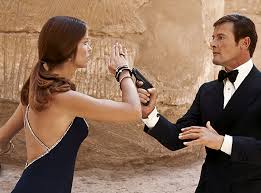
The third decade of Bond! After the silly sci-fi spectacle of Moonraker, producer Cubby Broccoli wanted to get 007 back to basics for the first Bond of the 1980s. While there is no underground lair, there’s plenty of other Bond staples, like assassins on skis, James in his tux at the baccarat table, underwater battles, and sharks. First time director John Glen, who had edited several Bond films before this, was brought in to bring James back to earth with a plot that was back to spy vs. spy and less reliant on tech (much to the chagrin of Q who seems at his limit with 007 snark).
A 54-year-old Roger Moore (who seems a bit out of breath in a few scenes) is paired with this round’s Bond “girl,” 25-year old French actress Carole Bouquet. Her character, Melina Havelock, is the daughter of marine archeologists who are killed because the KGB is trying to retrieve some British spy technology from the bottom of the Mediterranean. This launches her into the role of sidekick as she tells Bond, “I don’t expect you to understand, you’re English, but I’m half Greek, and Greek women like Elektra always avenge their loved ones!”
By 1981, we have established the tradition of the opening action scene being completely over the top. This one starts James at the grave of his wife, Tracy and ends with Bond captured in a remote controlled helicopter controlled by none other than Blofeld! (and his white pussy cat, presumably not the same one from Diamonds Are Forever). The scenes with the helicopter (with 007 hanging on for dear life) careening over London are eighties epic. The comic death of Blofeld was a long time coming and apparently meant as an FU to the producer of Thunderball, who claimed ownership of the Blofeld name.
For Your Eyes Only gives 007 fans the tropes they crave and, unlike Moonraker, has aged well. Moore’s Bond flirts with the problematic nature of his Lothario reputation while still throwing a solid punch. The quips are dialed back and much of the action is movie candy for the widescreen. For the first time the opening credits reveal females in roles like “production manager” and “continuity,” where previously women were relegated to costumes and make-up. Maybe some of these women whispered in filmmakers’ ears not to make Bond such a dick.
Let’s plug FYEO into our analysis.
Driver of Action – This is Moore’s Bond, but early in the film he is rescued by Melina and her crossbow, although in the mad escape car chase he does ask, “Mind if I drive?” Later in the film he is assisted by Milos Columbo, a pistachio-eating smuggler, and his band of thieves. No CIA help here, M (Bernard Lee) died of cancer before his scenes could be filmed, and Q was inserted merely for comic value. This James Bond is completely capable of solving all problems and escaping all sticky situations.
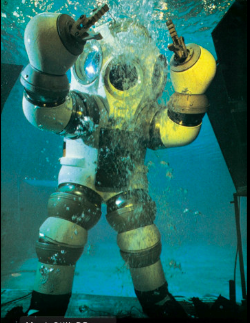
Role of Violence – There is a great relief of seeing 007 finally kill Blofeld, the man who had his wife killed, by dumping him and his electric wheelchair down an industrial smokestack on the Southside of the Thames. (We don’t know who got custody of the cat.) There are a bunch of henchmen killed, connected to various parts of the plot to get the spyware to the KGB. The most spectacular death is a henchmen in a deep diving suit, looking very robotic, who is blown up inside a sunken English trawler. Boom.
Vulnerability – Credit is given for reminding Bond fans that he was (briefly) married and she died in his arms. It was the only real glimpse we ever got into James the man. The epitaph on her tombstone is, “We have all the time in the world,” his last words to her in On Her Majesty’s Secret Service. Early in the film, Bond is captured by Cuban hitman Hector Gonzales and rescued by Melina. He seems a bit confused that he suddenly is the damsel in distress, but, like Jesus, he ultimately takes the wheel.
Sexual Potency – Here’s where we start to get a bit of a shift. Bond does not seem to be leering or sexually flirtatious with Melina, 29 years his junior. And between Bond and Moneypenny, the old spark is back, perhaps because they actors are now close in age (both were born in 1927!). Moneypenny, knowing Bond is about to arrive at MI-6 HQ, applies her makeup as James’ hat flies to the hatrack. “Moneypenny, a feast for my eyes,” James says, kissing her on the lips. “What about the rest of you?” she asks. “Well, I was going to get around to that.” There’s the old James Bond we love.
Another character is figure skater Bibi Dahl, played real life figure skater Lynn-Holly Johnson. She has a girl-like crush on Bond and climbs, naked, into his bed. In a shocking turn of events, he rejects her. “You get your clothes on and I’ll buy you an ice cream,” he says trying to kick her out of his room as she plants a kiss on him. Bond does sleep with the Countess Von Schlaf (played by Cassandra Harris, wife of future Bond Pierce Brosnan). The scene feels a bit like, “Oh, this is a Bond film, he needs to bed SOMEBODY.” But like a lot of James’ one night stands, she is killed by some bad guys shortly after bed with Bond. (Death by dune buggy.) And, as if a contractual obligation, James sleeps with Milena at the end of the film. (Can’t let the fans down.) But Bond ’81 seems noticeably less horny. Maybe he was worried about Blofeld’s cat.
Connection – Even though the the plot is pleasingly complex (for a Bond film), 007 is just here to get the job done. There is zero emotional connection. Even Q seems to get on his wick. Milena is strikingly beautiful but she seems to be just a pawn in his plan to stop the KGB from getting this thing (that looks like cheap lighting board). That’s why it’s a bit of a shock that the film ends with them in bed together (ON A BOAT!). Her neglige slides off and she tells James, “For your eyes only.” Roll credits.
Toxic Masculinity Scale: 2
FYEO has some boffo Bond moments. James and Milena in a mini-sub battling another mini-sub under the Mediterranean is pretty damn cool. The scene where 54-year-old Bond is scaling an Alpine cliff in Northern Italy while a henchmen is trying to dislodge the pitons holding his rope is pretty edge of the seat. And there’s a wild ski chase sequence in a bobsled track (that led to the actual death of a stuntman). There’s also some light comedy regarding Britain’s first female prime minister, Margaret Thatcher. “She’ll have our guts for garters,” the Minister of Defense says. The film ends with Thatcher (perfectly played by Scottish comedian Janet Brown) trying to congratulate Bond over the phone but actually talking to Milena’s parrot, who repeatedly says, “Give us a kiss.”
The misogyny in this 007 chapter seems to be dialed back a little. Bibi, the pigtailed ice skater, gets slapped by two men, but not by our hero. Gonzales’ Spanish villa is basically a swimming pool surrounded by bikini-clad women and KGB boss, General Gogal, has a secretary who appears to also be his young mistress. Posters for the movie featured Bond framed by woman’s bare legs, meant to attract male eyeballs. But for 1981, the year Porky’s came out, that all seems rather tame. It offers promise that 80s Bond can deliver the action that fans love with out the adjacent sexism.
For Your Eyes Only Premiered June 24, 1981 putting in direct competition with the Bill Murray film, Stripes. Aided by the popular theme song, sung by Sheena Easton, the film was second highest grossing Bond film (after Moonraker). Long, at 127 minutes, the film attempted to bring the grit back to 007 and find a place for the British spy in the new decade after 20 years of carving out the formula. Can Moore’s Bond age gracefully?
We love our myths. They bind our cultures together. Whether they are creation myths or heroic myths of the eternal return, they resonate with our collective senses of self, what Carl Jung called the archetypes of the collective unconsciousness. This is certainly true of the “exceptional” myths of America.
We’ve been hearing a lot about “merit” lately. Trump/Musk has tried to make the case that anybody in a job who is not a straight white man is a “DEI hire,” who got the position because of some imagined quota instead of their inherent qualifications for the job. After the DC air collision last month Trump railed on former Transportation Secretary Pete Buttigieg (who is gay), saying, “We can’t have regular people doing this job. They won’t be able to do it, but we’ll restore faith in American air travel.” Then he went on about how dwarves are being hired to be air traffic controllers.
The message was clear. Only straight white able-bodied cis-gendered men are qualified for the job. Everybody else is a diversity hire. White men have “merit.”
When I explain the value of meritocracy to my sociology students I describe it basically as the combination of talent and effort. Meritocracy is the belief that anyone in America can make it up the economic ladder and what you lack in talent can be made up for with extra effort. If you want to be an NBA star or a Shark Tank entrepreneur, just put the work in and you’ll get there. And if you’ve got lots of talent AND drive, the sky is the limit. I use the example of Taylor Swift as someone who has loads of talent and an insane work ethic.
But Taylor also has had the advantage of being an attractive white woman. Just look at how Beyoncé has had to work twice is hard for fewer accolades. It might not be the best example but race is a major factor in the merit calculation and it translates to the fact that white men have a much lower bar to be seen as having merit.
Just look at the range of completely unqualified nominations that Trump has put forward, like Matt Gaetz, Pete Hegseth, and Robert Kennedy, Jr., just to name a few of many. Their complete lack of merit makes Marco Rubio look like a supreme statesman in comparison. (Maybe that was the intent.) Perhaps Pam Bondi has the resume to be the U.S. Attorney General, but we know how attractive blondes are promoted by beauty pageant CEO Trump. The Trump administration has an Affirmative Action program for bootlickers. Merit matters less than loyalty. (Secretary of Defense Hegseth’s recent comments on Ukraine demonstrate how supremely unqualified he is for this job.)
The kleptocracy of the Trump regime is an illustration of the myth of merit in America, where women, people of color, and other marginalized populations have to work twice as hard for half as much and then see their accomplishments chided as the result of of some set-aside DEI program. It’s not surprising that many white men see valuing diversity, equity, and inclusion as a threat to their path of privilege, because it is. These men have always had an advantage and they are not about to relinquish it so easily.
But as Jim Morrison sang in 1968, “They got the guns but we got the numbers.” These men are a shrinking demographic and a unified effort will pry the keys out of their creaking fingers.
This series is intended to evaluate each product of the James Bond film franchise through a feminist lens, and the relevance of the Bond archetype to shifting ideas of masculinity in the 2020s.
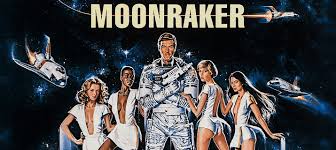
Moonraker (1979, directed by Lewis Gilbert)
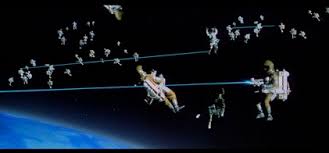
Bond in space! For Your Eyes Only was supposed to be the last 007 of the ‘70s, but due to the popularity of Star Wars, Close Encounters of the Third Kind, and the sci fi genre, Eon Productions decided to launch James into orbit. For the last time, Lewis Gilbert directed an expansive epic action adventure that starts with Bond falling through the sky without a parachute and ends with him floating in space with this episode’s Bond “girl.” The story is that Steven Spielberg offered to direct Moonraker after he wrapped up Close Encounters, but producer Cubby Broccoli wanted to stick with Gilbert. One can only imagine what THAT film would have looked like. Instead we get a camp romp that pleased Bond fans but looks pretty silly now.
Moonraker sees Roger Moore closing in on 50 but bringing some svelte bona fides to an older Bond. Hair and makeup prop him up nicely. Bond is up against another evil industrialist, this time its rocket designer Hugo Drax (played by Michael Lonsdale, who looks way too much like Peter Dinklage in this movie). Drax, like the megalomaniac in the last movie, wants to kill all the people on earth and then repopulate the planet with his master race of humans who are hanging out in his space ark. Bernard Lee makes his final appearance as M, the role he played since the first Bond film in 1962. Bond is aided by CIA agent/astronaut Dr. Holly Goodhead (Woot! There it is!). Goodhead is played by Lois Chiles, who delivers every line like she’s loaded on valium. Even when everyone on Earth is about to die, her voice remains in the “Gee, what should I wear to work?” range. Maybe Chiles was trying to play against the sexist “hysterical female” archetype, but women are allowed to have emotions. Oh, and Jaws (Richard Kiel) is back and he’s in love.
As we’ve come to expect, Bond does some globetrotting before he leaves the globe. Moonraker takes him to California, Venice, Italy, and Brazil. There’s a boat chase in the canals of Venice, that’s played for comedy (and is really dumb) and there’s a boat chase on the Amazon (that’s pretty cool). In the film, Drax has built a fleet of space shuttles to launch from his underground lair (Yes!) in the Amazon. The real space shuttle wouldn’t be launched by NASA for another two years, on April 12, 1981. That gave movie goers in 1979 a glimpse into what the 80s might look like.
Moonraker premiered in London on June 26, 1979, a week after President Jimmy Carter and Soviet Premier Leonid Brezhnev signed the SALT II agreement in Vienna, bringing cold war tensions down a few notches. The film was United Artists widest opening picture and highest grossing of the Bond franchise to that point. There was no hit theme song this time. Shirley Bassey was brought back in after Frank Sinatra, Johnny Mathis, and Kate Bush (!) passed. At the end of the seventies, Bond’s philandering was becoming tired, leaving audiences wondering if the franchise would survive into the 1980s.
Let’s drop Moonraker into our analysis matrix.
Driver of Action – As we’ve established, the Moore Bond films firmly place James in the driver seat, typically with the female spy sidekick who he can also sleep with. Dr. Goodhead doesn’t drive much of the story in Moonraker, and, like, the last film, needs to be rescued from the bad guy. Even though she’s a CIA agent AND an astronaut, James is still running the operation. We do get the team of M, Q, Moneypenny, and (now) the Defense Minister wedged in to help the ludicrous plot move along.
Role of Violence – 007 has a pretty low bodycount in this film. He shoots a would-be assassin out of a tree while pheasant hunting and, other than killing Drax at the end, that’s about it. There is a crazy climactic space battle with lasers when, somehow, a battalion of U.S. soldiers are crammed into the cargo bay of a space shuttle and then attack Drax’s space station. (I’m guessing this is where Trump got his idea for a U.S. Space Force.) Not sure where all the laser guns were in 1979, but Bond doesn’t really engage in any of the violence (like in the last film when he was mowing suckers down). Maybe older Bond has lost his taste for blood.
Vulnerability – Moore’s Bond is a robot. When he discovers Goodhead alive in Drax’s underground lair (beneath a shuttle that’s about to lift off), he says “Thank God you’re safe.” That’s it.
Sexual Potency – I could write a dissertation on this one. The FDA wouldn’t introduce Viagra until 1998 and one wonders if the mad scientists at Pfizer dreamed of a drug that would give men Bond boners. 007 is MI-6’s heat seeking missile. He’s rapacious. There isn’t a skirt he won’t chase, except for Miss Moneypenny, who is now matronly and completely off Bond’s radar. (How I miss their banter.) Speaking of Moneypenny, at the start of the film M asks her if 007 is back from his mission. “He’s on his last leg, sir,” she replies. The next shot is Bond’s hand on a flight attendants bare leg. “Any higher Mr. Bond and my ears will pop,” she says. (Of course she’s a double agent and Bond is sent flying out of the plane without a parachute, leading to one of the greatest action stunts in movie history.)
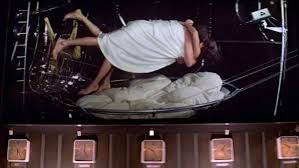
Bond may have failed at getting her knickers down, but you can’t keep a good Double O down. He makes passes at every woman under 40 that passes his field of vision. He would have made the moves on Drax’s hench-women, but he had to wrestle a giant anaconda. Shit happens. He does end up in bed with Corinne Dufour, Drax’s personal pilot, played by The Story of O’s Corinne Cléry. (She is killed by dogs for her transgression.) He also beds his MI-6 contact in Rio, Manuela. In his hotel room, she bares her leg and James asks, “How do you kill 5 hours in Rio if you don’t Samba?” Then he unties her frock. James meets Dr. Goodhead in California at Drax’s compound, but then again in Venice where he realizes she is CIA. He seduces her into bed and makes the case that she should team up, but she slips away in the morning. The film ends with Bond and Goodhead having sex in zero gravity onboard a Space Shuttle. As is the gag now, the MI-6 brass is watching and M asks what Bond is doing. Q replies, “I believe he is attempting re-entry, sir.” Thank you and goodnight.
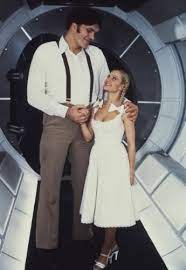
There also a side story worth commenting on. The monstrous Jaws is “redeemed” by falling in love in Rio. He’s a giant and she’s tiny with braided pigtails and glasses, dressed like a farm girl with heaving cleavage. Next to him, she looks like a child and I think that’s the point. She doesn’t speak, only stares lovingly her 7 foot 2 man. When Jaws realizes there’s no room for him and “Dolly” in Drax’s fascist utopia, he helps Bond to thwart the evil plot. The odd pair then open a bottle of champaign as the space lair is destroyed. The whole thing is icky.
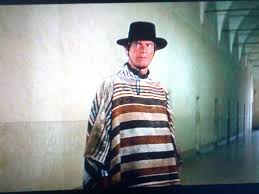
Connection – Again, Moore’s Bond is a man untethered to anyone. There’s a scene where he’s riding a horse in Brazil looking like a gaucho. It’s an obvious nod to Clint Eastwood, the penultimate seventies model of masculinity, the high plains drifter. His connection to Goodhead is wafer thin. In the obligatory coitus end scene, James and Holly are having space sex and she says, “Take me ’round the world one more time.” He drolly replies, “Why not?” Boring sex is boring.
SummaryMoonraker is so broad and silly it’s just a romp at this point. The countless henchmen scientists in their yellow jumpsuits, the martial arts attack by Drax’s Asian manservant in a glass museum that destroys dozens of priceless artifacts, escaping the bad guy in a Carnival celebration (Thunderball redux), pretending to be weightless by moving slowly, it’s all in good fun. But the fact that Moore and Chiles seem so completely bored by the script drags down the campiness of Bond ’79. And Jaws and his child bride may have delighted young fans in the Carter era, but it just seems kind of sad now.
These seventies 007 movies have consistently missed an easy opportunity to be a part of the decade where feminism went mainstream. Most of them attempted to pair James up with a female spy that could have been his equal or even taught him a few things. Instead they played the role to attract the male gaze and be yet another notch on James’ bedpost. Yawn. Will things be different in the third decade of our hero?
This series is intended to evaluate each product of the James Bond film franchise through a feminist lens, and the relevance of the Bond archetype to shifting ideas of masculinity in the 2020s.
The Spy Who Loved Me (1977, directed by Lewis Gilbert)
This was the first Bond film I saw in the theater. My dad took my little brother and I to see the PG-rated Spy Who Loved Me the summer of ’77. I was 13 and what I remember most was the brief glimpse of Barbara Bach’s (or her body double’s) right breast in the submarine shower scene. I was 13, OK? But The Spy Who Loved Me was a return to form after the limp Man with the Golden Gun in 1974. It had all your musts, including oodles of cool gadgets from Q, Bond in his tux and bad girls in bikinis, scores of henchmen willing to die for a megalomaniac, and sharks. My absolute favorite part of the film when I was a kid (besides the boob) was the Lotus Esprit that turned into a submarine, complete with missiles. I thought that was the coolest thing on earth and dreamed of a submarine car of my own. Ironically, in 2013 actual megalomaniac supervillain Elon Musk bought the film’s Lotus for £616,000 in hopes of turning it into a workable submarine. (Like most of his crazy ideas, he failed.)
Roger Moore definitely is getting his mojo back in his third installment in the Bond franchise. While his lines still fall a bit flat, he’s got Bond “girls” dripping from his arms. On top of the TSWLM list is Barbara Bach as KGB agent Anya Amasova, AKA Agent XXX (get it?). Bach was a model and Spaghetti Western actor who would next star in Caveman (1980) with her future husband, Beatle Ringo Starr. (Rumors were that Moore wanted Brigitte Bardot for the role.) As a sort of seventies Blofeld, this installment’s villain is wealthy industrialist Karl Stromberg, who wants to destroy the world so he can build a new world under the ocean. Stromberg is played by Curt Jürgens, who starred with Bardot in And God Created Woman in 1956. Added to the cast is Richard Kiel, who stars as the indestructible steel toothed giant, Jaws. The return of You Only Live Twice director Lewis Gilbert helped to bring some of the Connery-era swagger back to 007’s mission.
As is expected, the exotic locales splash across the screen. Bond riding a camel across the Egyptian desert and then chasing the bad guys through the Giza ruins was not filmed on an English set. It was there on sight, as were the scenes filmed on the Italian island of Sardinia. We return to some classic Bond tropes, like assassins on skis (On Her Majesty’s Secret Service) and underwater battles (Thunderball). There’s sexy one-liners (Her: But James, I need you! Him: So does England.) And sexist one-liners (James commenting on a woman in a bikini in a boat, in front of Anya, posing as his wife – “What a handsome craft. Such lovely lines.”) And while we don’t get an underground lair, we get an under WATER lair that serves its purpose.
The Spy Who Loved Me premiered in the United States on August 3, 1977, the same day that the Tandy Corporation debuted the first mass produced microcomputer, the TRS-80, forever changing popular culture and gadgets in James Bond movies. The film received mixed reviews but fared better than its predecessor. Boosted by a great theme song, sung by Carly Simon (and constantly on the radio the summer of 1977), the film was United Artists biggest grossing movie to date, but competed in theaters with the box office sensation that was Star Wars, putting it at #8 for the year (between The Deep and Oh, God!)
Let’s put The Spy Who Loved Me in our feminist evaluation machine.
Driver of Action – I’m getting the feeling that the formula for Moore’s Bond films are it’s just him. Even though he’s paired up with a Soviet spy, Anya Amosova, this isn’t a buddy film. She’s primarily sexy arm candy whom 007 has to rescue. (Although there is one scene in Egypt where she throws up her arms in a Charlies Angels karate pose that I thought was going to give us some Russian aggression, but no such luck.) James does not even have a support team. We get brief cameos by Q and Moneypenny, but this is just James.
Role of Violence – 007 kills some people in TSWLM. At the start of the film he shoots a Soviet agent (who is Anya’s boyfriend) with a rocket ski poll while skiing backwards. He drops one of Stromberg’s henchmen off a roof in Cairo, and then kills a half dozen more in a crazy car chase in Sardinia, including killing a bikini-clad helicopter pilot with a missile from his submerged Lotus. When the action moves to Stromberg’s tanker, which is being used to capture nuclear submarines, 007 with a machine gun goes on a rampage. There are literally bloodless corpses everywhere. Where’s the blood? And James shoots Stromberg multiple times in his underwater HQ.
Vulnerability – There is actually a mention of Bond being married in the film. Anya brings up that he was married and his wife was killed and he stops her from going any further. It was almost a moment of James the person. The break from James performing “007” was jarring but it only lasted for a split second and then it was back to Robot Bond.
Sexual Potency – This version of Bond wants to be as horizontal as possible. Miss Moneypenny might be too old for him in the late 70s, but every other women on the screen is fair game for his jacked up libido. To be fair, the film starts with a twist on the familiar theme. A man that looks like James is in bed with a beautiful woman when the phone rings. We learn that the woman is actually a Soviet agent, Anya Amosava, and the man is just a lover. Never fear, the very next scene is James in bed with a Russian woman in Austria. It’s a clever trick perhaps meant to say that women can play this game. James in Egypt meets a very white sheik who has a harem of beautiful women. When Bond is offered one of the women for the night he says it would be rude to refuse the offer. In Cairo, he meets another woman who is linked to a connection. He tries to seduce her but ends up using her body to block an assassin’s bullet. Oh well.
The rest of the film is about James and Anya, cold war enemies who have teamed up for some “Anglo Soviet cooperation” to stop this dude who is stealing submarines and wants to blow up the world. Bond can’t keep his hands off her and she may just be playing him by letting his hands and lips wander. But there is a scene on a train (You know, the scene on the train!) where Jaws attacks James and Anya and Bond tosses him out of the train window (We’ve seen this movie before) and Anya says, “You saved my life.” The sexy sax version of theme song swells up as James takes her in his arms. Later, the film ends with 007 and XXX getting busy in a preview of Glasnost ten years down the road.
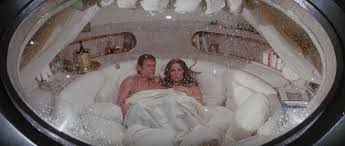
Connection – This is a weird one. (Surprise.) The film is called The Spy Who Loved Me and theme song is sung by a female so it’s reasonable it’s about Anya being loved by James. In the film Stromberg says Bond is “in love with a Russian agent.” But it doesn’t seem like either are in love with anyone. Anya seems to forgive him after finding out he killed her boyfriend, but it doesn’t seem the least bit romantic. This is the aloof Bond of the seventies. Even Q and Moneypenny are kept at arm’s length. Regardless, the film ends with James and Anya bobbing in the ocean in a luxury escape pod, complete with a bed and a chilled bottle of Dom Pérignon ’52. The pod floats into a cruising British destroyer where M and the British Ministers of Defense peer in through the window to see the two spies in flagrante delicto. “Bond! What do you think you’re doing?” asks the defense minister. “Keeping the British end up, sir.” And scene.
Toxic Masculinity Score: 6
Summary Watching this movie took me right back to the summer of ’77. The underwater submarine car battling frog men with their own subs was bliss for a 13-year-old boy. Catching a glimpse of Bach’s boob while sitting next to my dad was both terrifying and titillating. (See what I did there?) No part of me questioned the silly logic of the plot. Now I look at through the lens of 48 years of media. Stromberg has hundreds of henchmen all in red suits, like they were the henchmen of Squid Games. I wondered, who made these suits? Did Stromberg buy in bulk? Are they one size fits all? And do these henchmen get benefits? They all seem to be willing to die for him (and they all do). There should at least be life insurance in their benefits package. And dental.
The Spy Who Love Me, through that modern lens, has a pretty dim view of women. Bach, a few years after the film, said as much, telling People Magazine in 1983 that in the film Bond, “is a chauvinist pig who uses girls to shield him against bullets.” Moore himself said much the same in the 1970s. “Bond, like myself, is a male chauvinist pig. All my life I’ve been trying to get women out of brassieres and pants.” At least Bond doesn’t smack any women in this film on his way to thwart the accelerationist doomsday plot of this episode’s mad genius. While the mushroom clouds over the Atlantic might dampen the joie de vivre of the cold warriors warming things up the film’s climax, were left wondering will the aging Commander Bond will run out of notches on his belt before producers run of out of Ian Fleming novels to film.
These first two weeks have been dizzying. Trump and his billionaire bros have attacked multiple aspects of our democracy. They have ripped the guardrails off while Democrats have stood there, dazed and confused. The flurry of bias-motivated executive actions, appointments of merit-less droogs hell-bent on dismantling the imagined “deep state,” inflation driving tariffs, saber-rattling at our allies, and the pardoning of violent criminals who, in 2021, tried stop democracy in its tracks. It’s all too much.
The chaos of Trump, ripped from the pages of Project 2025, is the intent. In a normal world, each action would occupy a few weeks in the news cycle, but there’s a dozen actions a day. The chaos is the point. The opposition is playing Wack-a-Mole to each insane impulse from the orange madmen who is declaring war on our allies with one hand and canceling Black History Month celebrations with other. He’s throwing countless federal employees into economic crisis (as well as those, like me, who are employed by federal grants), while blaming the airline crashes on Obama and dwarves. It’s like being punched in the face over and over again with no chance to land a counterpunch.
Trump didn’t invent this strategy. Bush used it to destroy Iraq in 2003. Twenty-two years ago, they called it “Shock and Awe.” Use the military might of the United States to overwhelm Iraq and out of the chaos, create a machine that would profit post-war contractors. Just Google: Halliburton, Iraq, and Profit. This “shock doctrine” (as Naomi Klein called in her 2007 book) has a history of effectiveness. The disaster capitalism employed in nations like Chile was utilized to generate billions in profits for war contractors in Iraq. This week, as witnessed by the plunging of markets after Trump announced 25 percent tariffs on Mexico and Canada, Trump has brought disaster capitalism to the homeland and he and his billionaire bros stand to take home all the money.
The shock doctrine relies on chaos to shake up markets and political organization. Not only is the opposition stuck on the back foot trying to respond to each affront, economic destabilization paralyzes the working class who is more worried about inflation and holding on to their jobs than developing a strategy to fight back. Meanwhile, oligarchs are positioned to swoop in and calmly reassemble the pieces in a way that permanently protects their power and profit. This happened in Russia in the 1990s and it’s happening here now. It’s like that scene in It’s a Wonderful Life when there’s a run on the banks and George Bailey tries to calm the panic, saying, “Don’t you see what’s happening? Potter isn’t selling. Potter’s buying! And why? Because we’re panicky and he’s not.”
Trump, unregistered foreign agent Elon Musk, and their army of gangster capitalists are crashing the economy on purpose. Shipping migrant labor across the border, ludicrous tariffs, rampant deregulation, and appointing insanely unqualified loyalists are all meant to tank financial stability. Trump no longer needs his MAGA troops who were told he would lower the price of groceries on “Day 1.” They served their purpose of installing him back in the White House. They will suffer at the checkout line along with the rest of us. But at least they got to “own the libs.” Musk, now with the keys to the U.S. Treasury, can let the air out of America’s tires and jack up his global banking portfolio and Trump’s voters will have no idea what happened.
Like Mr. Potter, Trump’s billionaire bros will come in to “manage” the economic crisis. The German National Socialist Party did this when the Great Depression hit Germany. They consolidated power with the promise of affordable eggs. And now, when we look for the storied institutions of democracy to prevent an authoritarian takeover in the United States, including a free press, an independent judiciary, and a non-partisan Department of Justice, we will find they have been hollowed out during MAGA’s war of the “deep state.” Trump’s vow to purge the FBI of agents and analysts who investigated January 6th should be all the warning Americans need.
It’s easy to draw on the rise of Hitler as a historical parallel. And even though Melania has claimed that Trump kept Mein Kampf on his nightstand, Donald probably isn’t going back 90 years for a playbook. The rise of Putin and the rule of Russian oligarchs provide the formula. Just read Garry Kasparov’s 2015 book, Winter is Coming. Putin used economic calamity and the fear of Chechen terrorists to dismantle Russian democracy, making him President for Life. Dissidents get poisoned or sent to a Siberian gulag. Trump using the federal government to go after his political enemies is a page out of his comrade’s manifesto.
So what do we do?
We’ve have three weeks of the worst assault on American democracy in our lifetime. We’re all in shock that it’s really this bad. And it’s going to get worse. We can’t depend on Chuck Schumer and the corporate toadies of the Democratic Party save us. Many of them are in line to profit from the consolidation of power by the billionaire class. The Democrats who stand against them need to make themselves known now (or hang separately, as Ben Franklin said). But this is about us first. Us who are battered and defeated by the task at hand. Do we retreat into Netflix binges, or is there a path forward?
This is great opportunity to remember the practices of mindfulness. We’re all in reaction mode right now. Personally, I’ve had to resist the desire to punch someone, especially fellow working class people who think DEI is their enemy while their egg prices skyrocket. This is time to stop. Take a pause and breathe. Then we can start planning. There’s a great device popular in AA circles called “HALT.” Does this situation make me “Hungry Angry Lonely or Tired”? If so, just stop and take stock. So slowing the freakout roll is key.
Swiss sociologist Jennifer Walter offers a simple strategy to re-enage with solutions. First, focus on a few key issues you care about instead of being overwhelmed by the tsunami of fires that need to be put out (to mix metaphors). Second, find trusted sources of information who can do the work of providing needed facts and analysis. Third, if their goal is to overwhelm you, take mental health breaks. Meditation is a favorite “self gift” of mine. Next, Walter suggests taking 48 hours to respond to a news story to let your emotions subside and sort out what’s important. And lastly, build community to share the load. My faculty union president sent out an email last week, entitled, “What to Do in a Burning House,” asking faculty not disengage but step forward. I immediately joined a union committee.
Progressives, real patriots, and those who just care about the price of heat this winter, have been knocked to their knees by the Trump/Musk war on the buttresses of American democracy. But it’s time to stand back up. A lot of the heavy lifting is going to be done by lawyers who still have access to the courts to stop Trump’s actions, many of which are illegal and/or unconstitutional. The rest of us who are not the uber rich have a role, whether it’s monkey-wrenching the shock doctrine or building a viable alternative to Trump’s fear-fueled vision of America. Take a breath. We will do this.
































 Watching the Wheels