The James Bond Project #10: The Man with the Golden Gun (1974)

February 1, 2025

This series is intended to evaluate each product of the James Bond film franchise through a feminist lens, and the relevance of the Bond archetype to shifting ideas of masculinity in the 2020s.

The Man with the Golden Gun (1974, directed by Guy Hamilton)

This is the first “meh” of the Bond series. Guy Hamilton is back in the director seat, for the last time, and he seems to have run out steam. If Live and Let Die was meant to crib from blaxploitiation films, 1974’s entry is meant to riff on Kung Fu flicks popular at the time. (Bruce Lee’s Enter the Dragon grossed over $400 million in 1973 dollars.) Richard Maibaum turned in a flaccid script then bailed. The Man with the Golden Gun was the last Bond film to be joint produced by Cubby Broccoli and Harry Saltzman for Eon Productions and their falling out would end the “Bond film a year” schedule. That’s probably a good thing.

The good news is TMWTGG gets away from the Bond in America motif of the last two films. We’re back in the “exotic” far east. There’s no army of henchmen, no sharks, not even any Q designed gadgets, but there is (thank God) an underground lair. In the middle of the 70s Energy crisis, there’s a convoluted plot about how a former circus performer with three nipples named Francisco Scaramanga plots to control the solar energy market, as if that is not just called “capitalism.”.  Scaramanga is played wonderfully by Dracula icon Christopher Lee, who had just appeared on the cover of Band on the Run, the new album by Live and Let Die theme-singers Paul McCartney and Wings. The scenery in Hong Kong and Thailand is spectacular (even if the scene in Beirut was shot on a soundstage in London).

Roger Moore was back in his second 007 installment, already a bit weary. His quips fall flat (except for one at the end) and his mojo is dragging. TMWTGG was meant to be Moore’s entry into the Bond canon after You Only Live Twice. One wonders how 1967 Moore would have treated the role compared to 1974 Moore. As has become cliche, Scaramanga has a reluctant “lover,” played limply by Maud Adams (another Melania Trump clone). And, like the last film, there’s a bumbling but beautiful female MI-6 operative. This time it’s Mary Goodnight (Lord, these names) played by Swedish model/actress Britt Elkland, who was so great in 1971’s gangster classic, Get Carter. The great addition to the cast (and highlight of the film) is Hervé Villechaize as Scaramanga’s pint-sized right hand man, Nick Nack. Villechaize would go on to play Tattoo on TV’s Fantasy Island, cementing the words, “De plane!” into the English lexicon.

The Man with the Golden Gun was not well received upon its release in December 1974, the same week Nelson Rockefeller was sworn in as vice president, after Gerald Ford became president to replace “Tricky” Dick Nixon, who had resigned. A dozen years in, TMWTGG was seen as boilerplate Bond, dropped in for 1974’s chapter for fans of the franchise. There’s a super-70s car chase that ends with one car jumping over a river (with an Evel Knievel reference!) and a car literally flying away and a Swedish sex symbol in a bikini, but not much else to write home about.

Let’s plug it into our analysis.

Driver of Action – Again, this is all Bond all the time. We don’t even get Felix. There is a minor sidekick in Lieutenant Hip, the Hong Kong cop played by Soon-Taik Oh (who was a staple on 70s TV shows like MASH and Charlie’s Angels). In one scene, he and his teen nieces rescue James with some serious (and seriously dumb) Kill Bill Kung Fu action. But yeah, it’s the Live and Let Die formula with much less payoff. Maybe it’s Bond’s polyester suits.
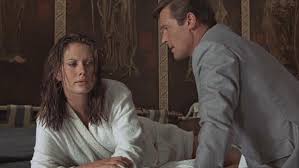
Role of Violence – Surprise, surprise, Bond smacks Maud Adams’ character, Andrea Anders, hard in the face and threatens to do it again. Was Bond striking women in the face required in all 007 scripts? Didn’t someone say something? I mean, Helen Reddy’s “I am Woman” was #1 on radio while they made this. Someone could have said SOMETHING. Bond pulls out his little pistol a lot in this movie but only shoots Scaramanga in the climatic end scene, posing as a wax figure of himself (don’t ask). Bond also takes out a kung fu master, manly man that he is. His violence is balanced by Miss Goodnight, who throws Kra, Scaramanga’s only henchman, into a vat of liquid oxygen.

Vulnerability – Yeah, no. James loses his gun at one point. He seems a little annoyed that Goodnight wants to reconnect. This is Stepford Bond on autopilot.

Sexual Potency – We get glimpses of the Bond of old when James tries to suck a golden bullet out of a belly dancer’s navel and when he encounters a nude woman swimming in a Chinese crime lord’s pool. She introduces herself as Chew Mee, to which Bond replies, “Really?” The main sexual conquest is Bond’s bedding of Scaramanga’s lover, Andrea. In an über creepy scene he sneaks into her hotel room and watches her shower and then man handles her only to learn that (shock) she is a damsel in distress. Later, he’s decided that, why not, he’s going to have sex with Agent Goodnight, but Andrea shows up so he throws Goodnight in the closet and has sex with Andrea Anders instead. It’s pretty messed up.  Bond can’t keep his work life and his sex life separate. He does end up back in bed with Goodnight at the end of the film, but it feels more obligatory than romantic. 

Connection – 007 is even more isolated in this film. Even Moneypenny gets the brush off. Q and James seem annoyed by each other. James knocks a kid who fixes his boat into the river. When Andrea Anders is shot, he’s not phased. There are zero fucks given by this Bond. The film ends, are you ready for it, with Bond and Bond girl Britt Ekland in a boat! (This time it’s a Chinese junk.) James and Agent Goodnight are finally back in bed on a slow boat from China. But, as is now tradition, it’s a false ending. Tick Tack is waiting (for some reason) to kill 007. In an unnecessarily funny scene, there is a Bond vs. little person battle to expedite before James can get Mary back in the sack. When he does, in another moment of coitus interruptus, Q calls and asks to speak to Agent Goodnight. “She’s just coming, sir,” says James. Ah, there’s our man Bond. Then he sets the phone down so Q can listen them making the MI-6 agent with two backs. Really creepy.

Toxic Masculinity Scale: 6

Summary The Man with the Golden Gun does a little bit better on the race issue than Live and Let Die. We do get some cool street-level views of Thai culture, including some great moments of Thai boxing. The contrast of free Hong Kong (with casinos) and Red China is flirted with. But the martial arts bit is weak. There’s no way 007 bests a Kung Fu master so easily, let alone an army of them. We get the comedic return of the racist Sheriff J. W. Pepper (from Live and Let Die), here on vacation in Thailand. (That’s a hard sell.) And a scene where Kra, Scaramanga’s black henchman, gets a little rapey with Goodnight. The hope is that mainstream audiences might have used TMWTGG as a gateway drug into the explosion of brilliant martial arts films that were coming out of Asia in the 1970s.

There are some great moments in this film. Bond flying a seaplane through island outcrops in the China Sea must have looked brilliant on the big screen. The ahead-of-its-time concept about the power of controlling renewable energy sources is noteworthy. Hervé Villechaize is an absolutely brilliant foil and steals every scene. And (recognizing that this might not be the most feminist bit of analysis) Britt Ekland is completely loved by the camera, which, of course, in Bond-land represents the male gaze. But there’s just a lot of silliness here. How did Scaramanga build an underground lair in an outcropping? And why did he include a funhouse, like some Disneyland attraction gone horribly wrong? James is going save his kept woman, but not really. James fancies Agent Goodnight, but not really. There is a car spinning 360 through the air and another flying off into the sunset. It’s like the writers just threw every leftover idea at the wall without the energy to see them through.

Roger Moore’s Bond smokes a ton of cigars in this film (calling Dr. Freud), drives a 1974 AMC Hornet through the streets of Bangkok like a madman, and kills guy who might have prevented global warming. It’s a mess and partly so because Bond is stuck in a tired model of manhood that had already become a caricature.

Next: The Spy Who Loved Me (1977)

The James Bond Project #9: Live and Let Die (1973)

The James Bond Project #8: Diamonds are Forever (1971)

The James Bond Project #7: On Her Majesty’s Secret Service (1969)

The James Bond Project #6: You Only Live Twice (1967)

The James Bond Project #5: Casino Royale (1967)

The James Bond Project #4: Thunderball (1965)

The James Bond Project #3: Goldfinger (1964)

The James Bond Project #2: From Russia With Love (1963)

The James Bond Project: #1: Dr. No (1962)

DEI Makes America Great, or How Trump Ended the American Century

January 28, 2025

Watching Trump dismantle the very fabric of America is soul crushing. This is the final nail in the coffin of the American Century. Every day another pillar of democracy is attacked by a petulant man with deep-seated inadequacy issues. I fear for the America my daughter will inherit. But if Trump has is way of striking down the 14th Amendment, she may not even be an American.

On day one, Trump ended federal spending on DEI programs, a favorite bogeyman of some straight white men who see efforts for equality as “reverse racism” and a bunch of other complete b.s. that is viewed as threatening their “God-given” right to sit in the privileged seat at the top of the heap. The federal government now has the right to discriminate. I’ve worked in the DEI field for over 15 years and I’ve seen these men whine and whine. As one of those very privileged men, I’ve tried to talk to them, bro to bro, about how embracing the values of diversity, equity, and inclusion makes their own lives better, even more profitable.

But then they got the most insecure bully in the land as their “defender.”

The Trump chaos hits me on a personal level. Besides the fact that all my federal DEI work was just cancelled (so much for affording groceries), much of my work to make workplaces safer spaces for others, including women and people with disabilities, is unraveling. The racist attack on DEI mirrors the racist attack on Affirmative Action in years past. White men fear their hold on power is slipping, and it is. (It should be pointed out that the primary beneficiaries of Affirmative Action have been white women and white men who are veterans.)

I could write a dissertation about how Donald Trump is taking a big steaming dump on the vision of Martin Luther King, Jr. but let me make just two important points about DEI.

DEI programs make workplaces safer and more productive. A famous study in the 2000s found that when employees felt respected for their identities, they were 4.4 times more productive. That means that instead of spending energy dealing with Racist Johnny, Sexist Carl, or Islamophobic Betty, they put that energy towards getting the task at hand done. DEI programs can educate around issues like implicit bias and micro-aggressions that suck the energy out of employees who are members of marginalized groups. Instead of spending time negotiating the minefield of co-worker bias, they can focus on the work, which increases profit.

And these workplaces are more safe. Not just emotionally but literally. I did some work in the local construction field after black construction workers were harassed (including a noose being hung on a construction site). If I was a black worker who had been hazed by fellow white workers, do you think I’m going to concerned about white workers’ safety? Hey, if Cleatus looks like he’s about to step off a third story girder, I might just think, “Oh, let’s just see what happens.” Workers who value inclusion look out for each other. As they say in the military, you’re only as strong as your weakest link. There is great benefit in creating safety by creating equity.

Secondly, DEI programs can help creating workforces and leadership that reflects the population being served. “Merit” is a myth. This fable that skill required should be the only criteria applied ignores the, not decades, but centuries of discrimination that have kept millions of Americans, including straight white men with disabilities, out of career paths that allow them to create intergenerational wealth. As much as it makes MAGA soil their Depends, America is no longer a country for old white men. The piece of the pie that looks like the father on Father Knows Best is rapidly shrinking. There are now more women in the workplace than men (so men better know how to see them as co-workers and not “girls.”). My incredibly diverse Gen Z students don’t even know what the acronym “WASP” stands for. No amount of ICE raids (starring Dr. Phil) will change the changing face of America. Trump can try to kick trans people out of the military, but the American rainbow genie is out of the lamp. DEI programs can help facilitate these welcome changes in a way that sees Americans for who they are, not force them to hide in the attic to allow fragile white men imagine they are in control.

On Inauguration Day, which was also MLK Day, Trump dared to mention Dr. King’s dream. If Trump was a scholar instead of a buffoon, he would know that King believed that his envisioned “symphony of brotherhood” would not be achieved until the institutional levers of oppression were dismantled. DEI programs are a vital tool in getting us there, as part of our broad civil rights goals. My great hope is that Trump, Musk, and the other white men of privilege who have decided to wage war on American diversity, the vital need for equity, and the great cultural and financial benefit of inclusion, are met by a much larger movement that burns their ideology of hate in the ash heap of history. If not, making America the 19th century again will end the promise of American greatness.

Read: A Study Finds That Diverse Companies Produce 19% More Revenue and How Diversity Increases Productivity

The James Bond Project #9: Live and Let Die (1973)

January 24, 2025

This series is intended to evaluate each product of the James Bond film franchise through a feminist lens, and the relevance of the Bond archetype to shifting ideas of masculinity in the 2020s.

Live and Let Die (1973, directed by Guy Hamilton)

Now we’re into “my” Bond. The era of Roger Moore. And we’re still in America. Director Guy Hamilton and screenwriter Tom Mankiewicz are back to give us a Bond version of a seventies blaxploitation film. Producers couldn’t bribe Sean Connery (with $5.5 million) to put his white dinner jacket on one more time so the scramble for the next Bond began. Steve McQueen, Paul Newman, Anthony Hopkins, and (again) Burt Reynolds were considered but the license to kill went to Roger Moore (the first English actor to play the role), who had long been considered for the job. In the 1960s, Moore starred in The Saint, a British mystery thriller series, so he was 007 in training. Moore’s Bond comes off as more bourgeois than Connery’s, making his snarky quips much more funny. Maybe the comedic writing was just better in the seventies, but Live and Let Die has plenty of laugh out loud lines.

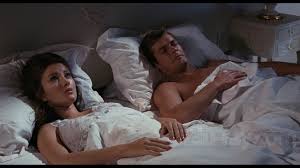
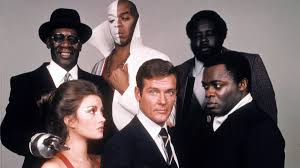
Live and Let Die is not a European film. The action takes place in New York (starting at the UN, then moving to Harlem), New Orleans, and the fictional island of San Monique. (Producers wanted to use Haiti, but the instability of Papa Doc Duvalier’s island forced filmmakers to move back to Jamaica and invent a tropical name.) There’s no Blofeld this time (but there is an underground lair!). Instead we get Mr. Big, a drug kingpin who has relationship with a Caribbean dictator named Kanaga (played by Yaphet Kotto, who had just played in the blaxploitation flick, Across 110th Street). The primary Bond “girl” this time is played by 21-year-old actress Jane Seymour. Since Pussy Galore (Goldfinger), the formula for the Bond girl has been a woman who is somehow in league with the bad guys who Bond peels away with his swarmy charm and Dudley Do-Right ethos. Here Solitaire (Seymour) is a psychic tarot card reader (as long as her virginity is intact) who belongs to the criminal Kanaga. Damsel in Distress Alert!!!

I didn’t see this movie when I came out the summer of 1973 (I was 9), but I knew all about it. The theme song was written and performed by Paul McCartney and Wings and was a radio staple that summer. I first saw it on TV a few years later and loved much of it, especially bayou boat chase that included a stunt that put the movie in the Guinness Book of World Records (which was like the Bible for kids in the 70s). As a boy in the Southern Klan town I was certainly challenged by the portrayals of black culture in the film that I found mostly frightening (especially the voodoo scenes). On its first TV screening the version that the Atlanta station showed removed the interracial kiss from the film. I missed out on that moment watching it age ll, but it was returned to the film by 1977 and, as a 13-year-old boy, I was already indoctrinated into the racist trope of black women as “sexual,” and was fixated on that scene. (The woman in question was CIA agent Rosie Carver, played by model Gloria Hendry.)

Live and Let Die was released at a time when “blaxploitation” films, made mostly by black filmmakers, started to find white audiences. Movies like Shaft (1971), Superfly (1972), and Cleopatra Jones (like Live and Let Die, in theaters the summer of ’73) were known for their gritty portrayals of black urban life, where black crime was often contrasted to the deeper crimes of racism. Live and Let Die contained many of these motifs and the images of James in Harlem capture a picture of urban decay that has long since gentrified. The film also finds great humor in the man out of place theme with Bond in his suit across 110th Street. “Can’t miss him. It’s like following a cue ball.” There’s a scene in a Harlem bar where Bond explains to a black waiter that ordering his whiskey “neat” means no ice, to which the waiter says, “Oh, we charge extra for that.” Brilliant.

Live and Let Die was hugely successful and worthy of our feminist analysis and probably a discussion about the portrayal of blackness as well.

Driver of Action – Maybe because there was (another) new Bond to introduce to the world, Roger Moore is the star of the show. We do get CIA agent Felix Leiter back in the fray (and a clever joke about a “Felix Lighter”). Felix (this time played by David Hedison) has, like in the last film, a team of unnamed CIA operatives, but this film is all about Bond in America, like a fish out of water. Everyone else is a  bit player.

Role of Violence – One might make the case that the violence in LALD is ramped up because it’s Bond vs. black gangsters (This time Mr. Big smacks the Bond girl instead of James), but it’s a pretty standard body count, including four MI-6 and CIA agents. As has become tradition, the carnage is saved for the end of the film, including 007 opening fire on a voodoo gathering. The climax of the film has James and Solitaire dangling over a pool of sharks (lordy) that end with 007 literally blowing up Mr. Big (his guts raining down into the shark pool). And after that, Bond battles Tee Hee, Mr. Big’s metal clawed henchman, tossing him out of the window of a moving train. Moore is less physical than Connery and Lazenby’s Bonds (at 45, Moore was 16 years older than Lazenby). He’s also more likely to rely on wit than weapons.

Vulnerability – This one is less clear. Moore is stepping into an established caricature that is forged on a popular formula. James shaving while sitting in the bathtub is about as “naked” as we are privy to witnessing. We do get to see James’ kitchen, complete with art deco tiles and espresso machine (Paging Martha Stewart!), but we still know little about James when he’s not 007-ing. Even his relationship with Rosie, the bumbling CIA agent posing as “Mrs. Bond” is more predatory than empathetic. Moore’s more bougie Bond is still walled off.

Sexual Potency – Bond is back. James quota of bedding three women is achieved in Live and Let Die. Bond’s first scene is him in the sack with a beautiful Italian agent, Miss Caruso, who has to hide in the closet when M and Moneypenny arrive at his apartment to give him his next mission. After they leave, he uses his cool magnet watch to unzip her dress for another round of “bonding.” In San Monique, he makes its with (double) agent Rosie in another interracial romp. When he calls her out for working for Mr. Big, looking for answers, he says, “And I’ll kill you if you don’t.” Having just had sex with him, she says, “But you couldn’t. You wouldn’t. Not after what we just done.” And his uber-creepy retort is, “Well, I certainly wouldn’t have killed you before.” Just a bit rapey. Finally, he beds the virginal Solitaire by tricking her with a tarot deck stacked with “Lover” cards so he can hit his quota. Even though her impropriety with Bond spells her death, she wants more 007 and begs him to come back to bed. “There’s no sense in going off half cocked,” he says in the best line of the film.

Connection – This new Bond is supremely detached, even from Moneypenny. When Rosie is killed, there’s not even a pause. There’s a reference to an MI-6 agent who was killed, and Bond says, “I rather liked him. We had the same hat maker.” That’s it. Even Felix is just a resource at the other end of a phone line. We do get the Bond/Bond girl end scene, this time not on a boat but a train to New York, headed for perhaps for some more cocking, somewhere south of Harlem.

Toxic Masculinity Scale: 5

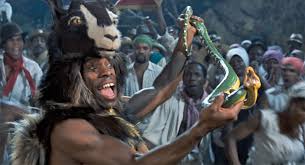
Summary Live and Let Die has a racial subtext that is a bit rough in 2025. Let’s start with the good news. Producers hired a ton of black performers for this film. Scenes shot in Harlem, New Orleans, and Jamaica are populated with black bodies. Cabaret singer B. J. Arnau’s soulful version of McCartney’s theme song is a high point of the film. Having said that, the movie is rife with racial stereotypes, from “pimp mobiles” and black gangsters peddling heroin in hollowed-out Harlem, to “mystical blacks” dancing with snakes and chanting voodoo mumbo. As a dumb white kid in rural Georgia, the film didn’t make me want to advocate for black people, it made me afraid of them. It was a spin on that “mystical black” trope when Geoffrey Holder, who plays voodoo-practicing Baron Samedi, became the pitchman for 7-Up in the “Uncola” commercials a few years later.

Contemporary viewers are likely to pin LALD as both racist and sexist. You’ve got the southern white cop who calls black men “boy” and you’ve got Bond who calls every woman “darling.” You get the sense that all the movements toward equity that we starting to become institutionalized in society in the seventies are kept at arms length by the WASP male fantasy of Bond. It’s a fair start for Moore, who comes in as a more older “gentleman” than Connery, which might lead one to think we’d get a Bond with a little more introspection. (You learn things as you age!) Instead we get sardonic raised eyebrows and lies to get women’s underwear off. That’s not an evolved man.

The action scenes in this movie are absolutely spectacular. I could watch the boat chase a hundred times. The surprise appearance of an underground lair with sharks is a chef’s kiss gift to Bond fans. And the one liners, delivered like a Blofeld laser, are side splitting. (“Butterhook!”) The score by Beatles producer George Martin is epic. And the voodoo and alligator scenes are completely terrifying. There’s so much to love in this film, even if Bond is stuck in a world that has left him behind. As Sheriff J. W. Pepper says to Bond, “What are you? Some kinda doomsday machine, boy?” No, just a device to preserve the old order.

Next: The Man with the Golden Gun (1974)

The James Bond Project #8: Diamonds are Forever (1971)

The James Bond Project #7: On Her Majesty’s Secret Service (1969)

The James Bond Project #6: You Only Live Twice (1967)

The James Bond Project #5: Casino Royale (1967)

The James Bond Project #4: Thunderball (1965)

The James Bond Project #3: Goldfinger (1964)

The James Bond Project #2: From Russia With Love (1963)

The James Bond Project: #1: Dr. No (1962)

With the J6 Pardons, President Trump Just Set Up His Coup

January 22, 2025

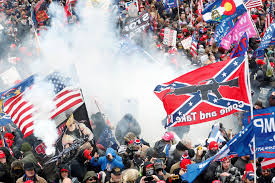
He said he was going to do it, so we shouldn’t be shocked. We hoped there would be some rhyme or reason, some forethought, some restraint. But there was none of that. President Trump blanket pardoned approximately 1500 of the terrorists who attacked the U.S. Capitol on January 6, 2021 in an attempt to overthrow our democratically elected government. This includes the most violent attackers who beat Capitol police, causing injury, trauma, and death. Today the leaders of violent extremist groups like the Oath Keepers and the Proud Boys walk free and our nation is much less safe. Trump did this in his first 24-hours as president.

Almost 30 years ago, I had just completed my PhD when Timothy McVeigh drove a Ryder Truck full of ammonium nitrate fertilizer up to the federal building in Oklahoma City, lit the fuse and ran. The explosion killed 168 people, including 19 children in the building’s daycare center. On that spring day in 1995, my research went from focusing on racist skinheads to the even darker corners of the far right. This included interviews with militia members in western Montana in 1998, who told me in very clear terms that the only salvation America would be born from a violent civil war.

The patriot militia movement that birthed McVeigh and his fellow anti-government extremists would die, not with a bang, but with a whimper at the turn of the century. Janet Reno’s Department of Justice broke up numerous plots, aided by many community members reporting bomb-making neighbors. The 2000 election of George W. Bush took the wind out of their sails as many of their core issues, like guns and land rights, had gone mainstream. On June 11, 2001, McVeigh was executed and exactly three months later, the nation would launch a new war on terror.

But the racist reaction to the 2008 election of Barrack Obama, the Tea Party, and the advent of social media, brought the militia movement back. The election of Donald Trump and the COVID pandemic took it from survivalist bunkers to the laptops of soccer moms. And the end result was the violent assault on our Capitol sparked by conspiracy theories that used to be the domain of tinfoil hat kooks, now spread by the President of the United States.

Many of those that attacked the Capitol were members of violent extremist groups, like the Oath Keepers, the 3 Percenters, and the Proud Boys. Over 75 of those arrested for entering the building were carrying weapons, including guns. They had been told by Trump to “fight like hell,” and they did. When the dust cleared the besieged members of Congress, both Democrat and Republican, called for the rioters to be arrested and charged to the fullest extent of the law. After encouraging them on January 6th, on January 7th, Trump said, “The demonstrators who infiltrated the Capitol have defiled the seat of American democracy. To those who engaged in the acts of violence and destruction, you do not represent our country. And to those who broke the law, you will pay.”

Thanks to vigilant work of community members, dubbed “sedition hunters,” and the diligence of the Department of Justice, over 1,500 rioters were arrested and charged with federal crimes and over a thousand plead guilty (with 64% receiving jail sentences). This included leaders of well-known extremists groups who were charged with sedition.  Enrique Tarrio, the leader of the Proud Boys, received a 22-year prison sentence. Oath Keepers leader Stewart Rhodes received 18 years.  The January 6th attack was the most violent assault on our Capital since the War of 1812.

And Donald Trump freed all of these terrorists. Every single one. They were not hostages, as he called them. Hostages are bound in the tunnels of Gaza. They were convicted criminals. But criminals who committed their crimes for Trump, so he let them loose, back into society.

Much of my work over the past four years has been in response to January 6. This includes my academic work as well as my ongoing work on a project, funded by the Department of Homeland Security, to reduce political violence. One of the things I can say for certain is the prosecution and sentencing of the J6 rioters has served to greatly suppress anti-government violence. Proud Boy-wannabes and militia members who missed the bus to DC saw the long sentences of Tarrio and Rhodes and hundreds of others and cooled their jets about the “boogaloo” and dreams of civil war.

Trump just erased that powerful deterrent with the stroke of a pen.

Where Timothy McVeigh’s story ended with a lethal ejection, the January 6 terrorists have been made into folk heroes by Trump and the far right. He has routinely sung their praises as lovers of the country. “These people have been destroyed,” Trump, said shortly after returning to the Oval Office. ”What they’ve done to these people is outrageous.” They are now living martyrs, rock stars of the anti-government movement, and will use their celebrity to bring more into the rabbit hole of paranoid conspiracy theories of the “deep state” and into the rhetoric of violent retribution for the agents of justice who dared imprison them. Tarrio has already promised revenge on those that jailed him. His Proud Boys marched in Washington DC, while Trump was being sworn in Monday. Rhodes and other militia members are free to reinvigorate the violent anti-government patriot movement that sees bloody revolution and a “Day of Ropes’ as required to wrestle America from the “deep state.”

Donald Trump, with the support of stiff armed ally Elon Musk, has opened Pandora’s Box. The core of the J6 terrorists see the Oklahoma City Bombing as the model for accelerating mass chaos to collapse society. Their anti-DEI policy ends with bodies hanging from lampposts. And don’t expect a Defense Department headed by fellow nationalist Pete Hegseth to get in their way. Where Reno shut plots down, Hegseth will enable a reign of terror.

We have seen versions of this in other countries. January 6, 2021 was the rehearsal for the coup. Trump and his corporate-fascist “patriots” have played the long game. In other countries, it has been the military that has quashed the coup. (It won’t be Hegseth’s military here, perhaps the rank and file.) We are heading towards that showdown and I wish I wasn’t so certain of that fact. What we do know is that with these pardons, Donald Trump has normalized political violence and ensured the loyalty of militia groups who will violently fight to keep him power. Welcome to the new Civil War.

The James Bond Project #8: Diamonds are Forever (1971)

January 21, 2025

This series is intended to evaluate each product of the James Bond film franchise through a feminist lens, and the relevance of the Bond archetype to shifting ideas of masculinity in the 2020s.

Diamonds are Forever (1971, directed by Guy Hamilton)

Sean Connery is back! This is probably the Bond film I saw the most on the 4 O’clock Movie in the seventies. Watching it five decades later, it pretty much sucks. Eon Productions was Bond-less after George Lazenby agreed to only make one film, On Her Majesty’s Secret Service. Numerous actors were considered, including Americans Clint Eastwood, Burt Reynolds, Robert Wagner, and Batman’s Adam West. Ultimately, Connery was lured back with a promised $1.5 million payday. To recapture the glory, Goldfinger director Guy Hamilton was brought back, as was theme song singer Shirley Bassey. Early 70s 007 looked a lot like early 60s 007.

Diamonds are Forever begins with Bond hunting down Blofeld, presumably because he killed his wife in On Her Majesty’s Secret Service. However, his wife is never mentioned and James shows zero signs of grief or even vengeance. He’s been trying to kill Blofeld since 1963 in From Russia With Love. One could assume that Lazenby’s Bond may have been married but Connery’s never was. Diamonds are Forever is much more of an American film than any previous Bond movie, with most of the action taking place in Las Vegas. (One of the reasons American Tom Mankiewicz was hired to work on the script.) I loved the scenes in Circus, Circus and Bond racing cops on Freemont. That Vegas is long gone (although you can still shoot water into balloons at Circus, Circus). Diamonds also gives us our first American Bond girl, Tiffany Case (played by 70s-80s TV fixture Jill St. James).

The attempt to recreate the magic gives us Bond staples, including Blofeld (and his darn cat), CIA agent Felix Leiter, James gambling in a casino (craps, this time) and, of course, an underground lair. Also space lasers and an elephant that plays slot machines. Added to Blofeld’s bad guy team are Mr. Wint and Mr. Kidd, a pair of sociopathic gay assassins. This might have fit a “homosexuals are deviants” narrative in 1971, but now it’s just horribly offensive. (I thought it was creepy when I was a kid, but now it just seems really, really dumb.) We do get a bit of globe trotting with a stop in South African diamond mine (no mention of racial apartheid, just black miners smuggling diamonds) and Amsterdam, where James meets a scantily clad Tiffany and says he likes her change of hair color, “provided the collars and cuffs match.”

Diamonds are Forever premiered in Munich, West Germany on December 14, 1971, three days before East and West Germany signed a historic agreement allowing for more open travel across the Berlin Wall. The film was a box office blockbuster but reviewers saw it as more silly than sexy. Maybe that was due to the fact the the special effects budget was sacrificed to pay Connery’s salary. The scene of Bond driving a moon buggy through the Nevada desert, being chased by henchmen on dirt trikes, is particularly goofy. But you do get Bond in his white dinner jacket scaling the Las Vegas Hilton (the “Whyte House” in the film) and Jimmy Dean (the sausage guy) playing a character based on billionaire Howard Hughes, who was friends with Bond producer Cubby Broccoli.

Seventies Bond may fair better. Let’s drop Diamonds into our matrix.

Driver of ActionDiamonds are Forever is classic Bond. We get brief cameos from M, Q, and Miss Moneypenny. Felix and his CIA team play a minor support role, especially when 007 encounters Bambi and Thumper, Blofeld’s bathing suit-clad guardians of Willard Whyte. Part of the story drifts into heist film with James and Tiffany as a team, but, rarely fully clothed, she seems to be just brought along for added sex appeal. Producers had Connery back and were going to make sure he was in nearly every frame.

Role of Violence  – The film starts with Bond on a killing spree as he tries to find Blofeld. That includes finding a woman on a beach, ripping off her bikini top, and strangling her with it. Ultimately, after killing someone in Blofeld’s lab (with mud), Bond kills Blofeld. Or a Blofeld.(“Welcome to hell, Blofeld.”)  There’s a scene where Bond kills a diamond smuggler after a pretty intense fight in a Dutch elevator and the now routine scene where Bond slaps his Bond girl. Most “fun” is when Bond realizes that Blofeld is alive (THE GUY THAT KILLED HIS WIFE – BUT NOT MENTIONED). In fact, there are apparently multiple “cloned” Blofelds and cats. He’s faced with two Blofelds (this time played by Brit Charles Gray, who played an MI-6 agent in You Only Live Twice). With a 50-50 chance, Bond shoots and kills the wrong Blofeld. “Right idea, Mr. Bond,” says Blofeld. “But wrong pussy,” says Bond. Oh yeah, there’s a climatic shoot out on an oil rig between the CIA and the Henchmen that kills a grip of dudes.

Vulnerability – Nope. Zero mention of Bond’s dead wife. Not even a hint that that’s why he’s after Blofeld. Older Bond is all business.

Sexual Potency – James might be losing his touch. He hooks up with a casino trollop named (ready?) Plenty O’Toole (played by Natalie Wood’s little sister, Lana). He gets her dress off but before he can get his pants off, some mobsters throw her out of a hotel window, into a pool. He tells the gun-toting goons, “Well, I’m afraid you’ve caught me with more than my hands up,” which, I assume, is a reference to the Bond Boner. Of course, Bond does bed Tiffany Case. (Her smoking in his bed the next morning is the clue.) At one point, while his body on hers, she asks, “What’s going to happen to me?” “I’m on top of the situation,” James says. Snort. But the required three sexual conquests is not achieved in Diamonds are Forever. Gee, maybe he was thinking about Tracy.

Connection – Maybe Connery was just tired of playing Bond, but 007 doesn’t really seem to care about anybody in this film, including M, Felix, Moneypenny, or Plenty (who gets tossed out of a tenth story window). There is some connection with Tiffany, who seems to want to be a spy as much as a diamond smuggler. The film ends with James and Tiffany, wait for it it, in a boat! This time it’s an ocean liner. But we’re not quite done. Here come Mr. Wint and Mr. Kidd, the homicidal homosexuals, posing as waiters with bomb souffle to kill Bond. They end up on fire and blown up, over the side as James and Tiffany sail away to short-term happiness.

Toxic Masculinity Scale: 4

Summary Seventies Bond still has a problem with race. The primary cast is lily white and we’re still stuck with “the sun never sets on the British Empire” ethos. (Did Richard Nixon have anything to say about British agents running amok in Vegas?) There’s a scene in Circus, Circus where a black woman is transformed into a gorilla for the amusement of children. And the mobsters of Slumber, Inc are caricatures of Italian mafiosos. Some of this will be both fixed and made worse in the next installment, Live and Let Die.

Aside from slapping Bond “girls” or throwing them out of windows, you get the sense that the most misogynist elements of the franchise were running on fumes by 1971. Diamonds are Forever is a cartoon version of a 007 film that tries to balance sexy or sexist Bond quips with more over the top diabolical plans. (There’s a comment from Blofeld that if his space laser destroys Kansas, nobody will know about it for four years.) It’s all just dumb. They should have made Gloria Steinem a Bond girl and had her repurpose MI-6 and the CIA to raid the underground lair of patriarchy. Ms. Bond, we need you.

Next: Live and Let Die (1973)

The James Bond Project #7: On Her Majesty’s Secret Service (1969)

The James Bond Project #6: You Only Live Twice (1967)

The James Bond Project #5: Casino Royale (1967)

The James Bond Project #4: Thunderball (1965)

The James Bond Project #3: Goldfinger (1964)

The James Bond Project #2: From Russia With Love (1963)

The James Bond Project: #1: Dr. No (1962)

Deep Breaths: Now the Work Ramps Up

January 20, 2025.

I’m trying to stay away from my lizard brain today, unlike the rage I surrendered to on Election Day. I’m trying to not focus on how Donald Trump used his first address as our 47th president to crap on Native Americans (Denali will not be renamed Mt. McKinley) and further marginalize trans Americans (although I did say a small prayer that Barron Trump is transgender). I’m not focusing on how the CBP One app, created so asylum seekers can enter this country legally, has already been shut down by Trump officials. I’m not going to talk about how Trump’s inauguration, surrounded by, not the red hat MAGA supporters but his Billionaire Bros, is the dawn of a new Dark Ages.

This is Martin Luther King Jr. Day so the focus is on the work. We are entering an age of disinformation that will require extra effort from us to do what we have done successfully in the past, organize. Trump’s ultra-wealthy handlers, Musk, Bezos, Zuckerberg, and the rest, will work to divide us and deflate our hope. Trump will give more tax breaks to the gilded class while the people who voted for him continue to suffer with lack of adequate health care coverage. They may be the newest recruits to the much chided “woke left.”

The work will require radical honesty about how Democrats have failed working class people, including new immigrants and queer people. The work will require radical honesty about how the “mainstream media” is the corporate media. The work will require radical honesty about how Neo-liberal economic policies have torn apart the safety and security of unionized labor in this country. And the work will require that the opposition party put up candidates in 2026 that will fight, without capitulation, for the issues real Americans face, including health care for all.

Most importantly, this work is going to require us to get off our phones and organize. And some of that organizing is going to be uncomfortable. Farm owners, who rely on undocumented workers, should be at the table. So should law enforcement officers and other first responders, who are as much a part of the service economy as baristas and vegan restaurant servers. Evangelicals, who recognize Christ’s attention to the poor and marginalized, can also be reached out to as well. Instead of falling into our little gangs of angry Americans, it’s time to build a massive coalition to save America from the broligarchy that Trump welcomed into our nation’s Capitol. We are a people who, at our core, value diversity, equity, and inclusion of our neighbors. We can control the narrative not him.

To date, Americans have spent 10 trillion dollars on the War on Terror, that replaced the Taliban in Afghanistan with the Taliban and enriched a lot of companies doing business with the Pentagon. We can debate if that price tag is required to keep the nation safe from 9/11-type attacks, but I’m betting that $10 trillion could have made our nation safe in other ways, including free health care and affordable housing for all Americans. These are things that affect all of us, including the millions of Americans who voted for Trump. Before Americans are completely overwhelmed by the chaos of the pathological liar in the White House and drugged with disinformation, coming from Chinese apps, Musk, Meta, and elsewhere, let’s reach out with reason. We have one last window. There are 650 days until the mid-term elections. Breathe today and work tomorrow.

The James Bond Project #7: On Her Majesty’s Secret Service (1969)

January 19, 2025

This series is intended to evaluate each product of the James Bond film franchise through a feminist lens, and the relevance of the Bond archetype to shifting ideas of masculinity in the 2020s.

On Her Majesty’s Secret Service (1969, directed by Peter Hunt)

James Bond got married! Eon Productions had to scramble to find a new Bond after Sean Connery quit during the making of You Only Live Twice. Potential 007s included future Bond Timothy Dalton (too young) and Superman bad guy Terrence Stamp (too creepy?). Producer Albert Broccoli and first time director Peter Hunt settled on Australian model George Lazenby after seeing him in a chocolate bar commercial. Lazenby looked like a slightly younger Connery, but lacked the acting chops. He was offered a contract for seven Bond films but agreed to do only one, believing the 007 franchise would become passé in the 1970s. 

On Her Majesty’s Secret Service was the first Bond novel authored by Ian Fleming after his spy became a big screen feature and was written to leave out the heavy reliance on gadgets Hollywood Bond relied on. The primary Bond girl was Countess Tracy di Vincenzo, played by Diana Rigg. From 1965 to 1968, Rigg played Emma Peel on the popular British spy TV show, The Avengers. (Rigg joined The Avengers to replace Honor Blackman, who had left to play Pussy Galore in Goldfinger.) Emma Peel was often considered the “female James Bond,” so bringing Rigg in may have been meant to offer a new role for the Bond “girl” at the end of the decade.

The film was premiered in the United States on December 19, 1969 while the country was consumed with the details surrounding the Charles Manson murders. By January, it topped the box office on both sides of the Atlantic but received mixed reviews for veering from the blockbuster Bond formula. Overtime, the film has gained respect for remaining closer to the Fleming novel than other screen adaptations, and that was Hunt’s intent. The script even comments on previous Bond films, such as the opening scene were Lazenby’s Bond rescues Rigg from the ocean and fights some random henchmen. Lazenby breaks the fourth wall and says to the camera, “This never happened to the other fellow.” Or when Bond resigns from MI-6 and looks at some of his gadgets from previous films with a smirk of disdain while they remain in his shabby office desk.

We do get tried and true Bond tropes, including an underground lair filled with henchmen, Bond at the Baccarat table, his appetite of Beluga caviar and Dom Perignon, flirting with Moneypenny, and Blofeld (this time played by American Telly Savalas). But in one way, this is a very different Bond film, one that ends with a Mrs. James Bond.

Let’s plug it in to our feminist matrix and see where we come out.

Driver of Action – We are in full solo Bond mode in OHMSS. We have no “team” helping drive the story. (Q only makes a brief appearance at the end of the film.) There is an MI-6 agent, apparently named Shaun, who keeps an eye on James, from a distance, in Portugal and Switzerland but is killed off pretty early. And there’s Draco, the head of a Portuguese crime syndicate, who helps Bond take down Blofeld at the end of the film. But it’s pretty much just James, including when he goes rogue from MI-6 after being taken off the Blofeld case by M. We do see Blofeld (as a prequel to Kojak) leading more of the action, including slapping on a pair of skis to race down the Alps to catch Bond. There’s also a killer bobsled race between Bond and Blofeld. And, sadly, Blofeld’s cat only appears briefly.

Role of Violence – Lazenby’s Bond seemed a little more skilled in fake martial arts skills than Connery. There’s more chops and flips but the body count is reserved for the the end of the film (although, early in the film, he slaps Rigg’s character pretty hard). He sends a few henchmen on skis to their deaths as they plunge off a cliff and during the climatic assault on Blofeld’s mountaintop lair, he machine guns a bunch of henchmen and a scientist who throws a bottle of acid at him. This Bond punched harder, but used his gun a lot less. Does that make him less manly or more?

Vulnerability – OK, this is the big one. The set up is that mob boss Darco wants Bond to marry his troubled daughter, Tracy (AKA TV bad ass Emma Peel). Darco says, “What she needs is a man to dominate her” (puke) and offers James a million pounds in gold as a dowery. Bond says he doesn’t need the money and says, “I have a bachelor’s taste for freedom.” But something strange happens. It seems like Bond is falling in love with Tracy. There’s even a very 1969 montage of James and Tracy doing “falling in love” stuff, like walking on the beach and window shopping for rings, set to an original song written by Burt Bacharach and Hal David called “We Have All the Time in the World,” sung my Louis Armstrong! Is this a chick flick? Maybe it’s all part of a ruse to get Darco’s help going after Blofeld.

Nope. After Tracy rescues Bond in a Swiss town and escapes more henchmen in one of the craziest chase scenes on film, Tracy and James end up hiding in the hayloft of a barn. Instead of making his usual sex moves (like he did several times earlier in the film), he tells her, “I’m thinking about us. I love you. Will you marry me?” (I’ll take “Things I’d Never Expect to Hear in a James Bond Film” for $200, Alex.) She agrees to be “Mrs. James Bond” and we have a very different 007 flick. Instead of sealing the deal, James decides they should sleep separately. “The proper time for this is our wedding night. That’s my New Year’s resolution,” he says. “Whatever you say, my dear,” says Tracy. “And that is yours,” James quips. OK, maybe not that different.

The last Bond film of the 1960s ends like the dozens of Elvis Presley films of the 1960s, with a wedding. The proficient bedder of endless women is now wedded in holy matrimony, with M (and the rest of us) in shock that it happened and poor Miss Moneypenny in tears. But there is no happily ever after. A car driven by Blofeld pulls up next to the newlyweds and Irma Bunt, Blofeld’s henchwoman, fills Bond’s Aston Martin with machine gun fire. The final scene of On Her Majesty’s Secret Service is James Bond in tears, holding his dead wife.

Sexual Potency – Before we forget, this is a James Bond film. When Tracy appears at the casino, the camera lingers on her cleavage. She ends up in Bond’s bed as a business transaction (he payed her gambling debt). The encounter is so transactional it creates doubt in the legitimacy of the “romance” that follows (enhanced by a scene at a bullfighting ring where Darco is trying to pass his daughter off to Bond.) When Bond gets into Blofeld’s lair, pretending to be a gay genealogist (don’t ask), he’s met with a dozen beautiful women (Blofeld’s “Angles of Death”) that he goes to work on, sleeping with two in one night while scheduling a third. “Work is piling up,” he snorts. He may be in love with Tracy, but Bond’s gotta Bond.

Connection – This Bond does seem to have some genuine affection for M and Moneypenny, even kissing Moneypenny on the lips. But, again, this is solo Bond in action. His connection to Tracy seems to become genuine when she rescues him from Blofeld’s henchmen, repeatedly kissing her on the cheek as she frantically drives her getaway car from their gunfire. In the end, he is alone again and viewers are told to get ready for the next chapter of our man Bond.

Toxic Masculinity Scale: 5

Summary Hunt and Lazenby’s Bond may be closer to Ian Fleming’s 007 than the formula viewers had had become used to, but there’s still plenty of sexism in OHMSS. The most obvious proponent of misogyny is Darco (played by Italian actor Gabriele Ferzetti). He just goes on and on telling Bond how his daughter needs to be manhandled and smiles at that fact that Bond got her in the sack. He even punches his daughter in the face, knocking her out, so she doesn’t try to rescue James in the gunfight. At the wedding he says to her, “Obey your husband in all things.” We also get get Bond ogling a Playboy magazine (and stealing the centerfold) and working his way through Blofeld’s scantily clad angels of death. “Just a slight stiffness coming on,” he says, sitting among them in his kilt.

Don’t expect Bond to be mourning his dead wife in the next installment, 1971’s Diamonds Are Forever. James will be back to his old tricks. But the final scene of On Her Majesty’s Secret Service gives a glimpse of a more human man than in all the previous 007 films, left to reconcile the cost of vulnerability when your job requires you to carry a license to kill.

Next: Diamonds Are Forever (1971)

The James Bond Project #6: You Only Live Twice (1967)

The James Bond Project #5: Casino Royale (1967)

The James Bond Project #4: Thunderball (1965)

The James Bond Project #3: Goldfinger (1964)

The James Bond Project #2: From Russia With Love (1963)

The James Bond Project: #1: Dr. No (1962)

The James Bond Project #6: You Only Live Twice (1967)

January 12, 2025

This series is intended to evaluate each product of the James Bond film franchise through a feminist lens, and the relevance of the Bond archetype to shifting ideas of masculinity in the 2020s.

You Only Live Twice (1967, directed by Lewis Gilbert)

This might be the most Bondy Bond of all. Not only does it have the usual staples; underground lairs, evil global plots, white bikinis, and Blofeld’s pussy cat, but also a massive army of ninja warriors. I probably enjoyed it too much. Maybe it was the brilliant score by John Barry and dead volcanoes erupting. Maybe it’s because I watched it on a Saturday morning, hyped up on coffee and taking a break from the devastating news of the L.A. fires. Yeah, this was supposed to be Sean Connery’s last 007 film. The Scottish actor was worried he’d be forever typecast and announced that he’d be Bond no more before You Only Live Twice premiered. Maybe Connery’s weariness added to the “I could not give a damn” laconic attitude of 1967 Bond, making him that much more appealing to old school notions of rogue masculinity. It’s either Bond on auto-pilot or Bond fully realized. I can’t decide.

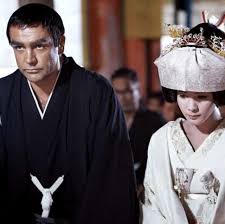
The screenplay for You Only Live Twice was written by acclaimed children’s book author Roald “Willie Wonka” Dahl. Dahl was a friend of Ian Flemming’s and (very) loosely adopted his novel for the screen. The original source paid mind to Japanese culture and Dahl retained the detailed Japanese wedding scene in the script. (Unlike other globe-hopping 007 films, the action here is primarily in Japan.) But Dahl had to create much of the plot himself. For example, producers told him Bond needed to make love to three women in the movie so he had to add two additional relationships in the screenplay.

The story is set in the 1960s space race between the US and USSR. We finally get to see Blofeld’s face and it’s great British actor Donald Pleasence. The British are trying to broker the peace between America and Russia as space capsules start disappearing from orbit. (Keep calm and don’t start World War 3.) They put Bond on the case who discovers that SPECTRE is helping an Asian country (presumably China) start a war between cold war adversaries so they can emerge from the ashes. (This plot seemed like it was as much 2025 as 1967. Because, you know, China.) After faking his own death, Bond ends up in Tokyo, after being shot out of a submarine torpedo tube without an air tank. (007 has very good lungs.) A welcomed sight is the large number of Japanese actors who were hired to make up a large percentage of the cast. Welcomed after the Hollywood tradition of making up white actors to look “Oriental.” (Breakfast at Tiffany’s, I’m looking at you.)

There are flushes of anti-Asian racism in You Only Live Twice. Connery’s first scene is in Hong Kong and Bond is in bed with an Asian woman. The first line of the film is, “Why do Chinese girls taste different from all other girls?” He then talks about how Peking duck is different from Russian caviar, but he loves them both. She replies, “Darling, I give you very best duck.” I laughed and I shouldn’t have. There’s a section where James has to be transformed into a Japanese villager that seems to mainly involve him putting on a Beatle wig. And so on. You Only Live Twice premiered in London on June 12 (with Queen Elizabeth in attendance), the same day the U.S. Supreme Court issued the Loving v. Virginia decision, legalizing interracial marriage, so maybe audiences were ready to see James in bed with non-white women. The film has plenty of that.

How doe Far East Bond fit in our analysis?

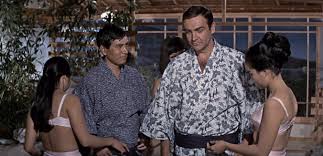
Driver of Action – After the ensemble romp of Casino Royale, we’re back to solo Bond. We don’t even get Felix Leiter on the scene. We do get Tiger Tanaka, head of the Japanese Secret Service (played by Tetsurō Tamba) to provide James with his ninja training and fix him up with his undercover Japanese wife, played by Mie Hama (who I remember from 1962’s King Kong vs. Godzilla). Tanaka also serves as something of a pimp for James. Taking Bond home, he says, ““Consider my house yours, including all of my possessions.” Then four young women in their underwear walk out. “In Japan, men always come first. Women come second,” he says as the women bathe Bond.

Role of Violence – 007 has a license to kill a ton of people in this movie. He shoots an assassin and then three or four dockworkers (while single-handedly fighting dozens), and countless henchmen in Blofeld’s under-volcano lair. There’s a SPECTRE agent who failed to kill Bond who Blofeld dumps in a pool of piranhas. (Bond also throws a henchman into the piranha pool.) The climatic battle between ninjas and henchmen probably has a body count above a hundred. There seems to be no remorse for anyone killed. It’s just entertainment.

Vulnerability – In the novel of You Only Live Twice, Bond’s mock Japanese bride is a woman named Kissy Susuki and the union produced a child. In the film she is not named. Before the wedding Bond asks Tiger Tanaka, “Is she pretty?” He replies, “She has a face like a pig,” and Bond grimaces. Of course she’s beautiful and later plays a role in James’ rescue. As has become rote, Connery’s Bond has zero moments of weakness, although the technology used is through the roof in this film. He needs his damn gadgets. Yet, Bond seems bulletproof. Literally. There are countless rounds fired at Bond, including from four attack helicopters and Jimmy doesn’t even suffer a scratch.

Sexual Potency – In 1967, I’m banking on the fact that part of the pitch of You Only Live Twice was that is was chocked full of “exotic” Asian women. From the first scene with Bond in bed with Aki (played by Akiko Wakabayashi)l, who throughout the film rescues 007 in her white sports car, to Tanaka’s House girls, there is plenty of “exotic” on display. (It’s worth noting that when Tanaka offers Bond one of his “girls” for Bond to take back to his room, Bond picks the one that’s most likely a white actress made up to look Japanese.) Then there’s Helga Brandt, a SPECTRE assassin who has James tied to chair and becomes sexual with him. (She’s a redhead. That’s what they do.) James talk her out of holding him and then uses her knife to cut the straps on her dress. “Oh, the things I do for England,” he mutters. (She later tries to again kill him by jumping out of the plane she’s flying.) James also tries to get busy with his mock wife, but she pushes him away and he then pushes away a plate of raw oysters. “Well, I won’t need these,” he says. Is JB suffering from ED?

Connection – Bond’s connection to his co-workers is minimal. M and Q make brief appearances. Q arrives in Tokyo to bring a cool mini-helicopter with heat seeking missiles! Even Bond’s usually flirtatious relationship with Moneypenny seems to have cooled off. He doesn’t even sexually harass her. When Aki, who saved Bond’s bacon more than once, is poisoned in bed next to him, he seems nonplussed. Connery’s weariness by the fifth film is reflected in Bond’s lack of effort with the women in the film and also in a stanza from the theme song, sung by Nancy Sinatra: “You drift through the years and life seems tame ‘til one dream appears and Love is its name.” As must now be required, the film ends with Bond and his mock wife (Kissy Suzuki is definitely a “Bond girl”) in a boat, another rescue raft in another sea. ”Now about that honeymoon,” he says to her. Then viewers are told that On Her Majesty’s Secret Service is on its way (along with the next batch of Bond girls).

Toxic Masculinity Score: 7

Summary It was Ian Fleming’s intent that readers of You Only Live Twice learn more about Japanese culture. When the book came out in 1964, we were only 19 years from the nuking of Japan and the end of WWII. Dahl devoted screen time to Sumo wrestling, the traditional wedding, and the rise of Japanese corporate power (there are a lot of Toyotas in this flick). But we also get nods to the Japanese version of patriarchy with Tiger Tanaka’s house girls as well as the standard English Bond jokes, like when Helga, referring to a warning about smoking, says, “Mr. Osato believes in a healthy chest” as her own chest fills the camera frame.

One wonders what You Only Live Twice would have been like if the James Bond-Kissy Suzuki marriage had been truer to the original novel. Instead we get tired James floating off be played by another actor, likely stepping into the well-established formula.

Next: On Her Majesty’s Secret Service (1969)

The James Bond Project #5: Casino Royale (1967)

The James Bond Project #4: Thunderball (1965)

The James Bond Project #3: Goldfinger (1964)

The James Bond Project #2: From Russia With Love (1963)

The James Bond Project: #1: Dr. No (1962)

The James Bond Project #5: Casino Royale (1967)

January 11, 2025

This series is intended to evaluate each product of the James Bond film franchise through a feminist lens, and the relevance of the Bond archetype to shifting ideas of masculinity in the 2020s.

Casino Royale (1967, directed by John Huston and others)

After four hugely successful Bond films, it’s time for the first Bond spoof. Casino Royale was the first of Ian Fleming’s Bond books (published in 1953). The John Huston directed film brings back many faces from the first four films from the the United Artists Bond canon, including Ursula Andress (who, as MI-6 agent Vesper Lynd, sounds way too much like Melania Trump). Casino Royale is a comedy meant to mock many of the Bond conventions, so it’s going to score differently than the films produced by Eon Productions, the home to “official” 007 movie franchise.

Here we get an older Bond, played by David Niven, who is 20 years retired after a sad end of a relationship with his beloved Mata Hari. He stutters and is known for his celibacy. This ain’t Sean Connery’s Bond. He’s brought back to MI-6 by M (played by Huston himself) to deal with evil SMERSH. (We don’t know what SMERSH stands for but there was a counter-intelligence group in the Soviet Union with the same name). M is comically killed so Bond takes the helm of MI-6, where he is reunited with Miss Moneypenny, or at least her daughter. (Strangely, Moneypenny now has an American accent, played by Barbara Bouchet, who was born in Nazi Germany.) He orders all the “Double O” agents to change their names to “James Bond” to confuse and trap SMERSH baccarat player Le Chiffre, played with gusto by Orson Welles. Two of those agents include Peter Sellers and a very young Woody Allen.

Casino Royale is a madcap farce that lampoons the cool image of 007. There’s even a yakety sax soundtrack during chase and fight scenes (some played by Herb Albert). The funny Bond quips are turned up to 11, jumping from wry to hilarious. (“James Bond doesn’t wear glasses.” Bond: “Yes, it’s just because I like to see who I’m shooting.”) The film is fully located in the mid-sixties. The first shot is graffiti that says, “Les Beatles.” The scene where the Peter Sellers’ Bond is drugged is straight psychedelia. And the movie introduces the Burt Bacharach song, “The Look of Love,” sung by Dusty Springfield (and sung by Bacharach himself in 1997’s Austin Powers: International Man of Mystery). The film was released in April 1967 and Sgt. Peppers Lonely Hearts Club Band was released shortly after setting up the iconic “Summer of Love.”

This may be an anti-Bond Bond film, piercing some of the tried and true tropes of the previous four films, but it’s worth dropping it into our feminist matrix if just for point of comparison.

Driver of Action – There are multiple drivers of the story here, including multiple Bonds. Sir James Bond (Niven) plays almost a support role. The majority of the story centers around Evelyn Tremble (Peter Sellers as a Bond surrogate) and Vesper Lynd (Andress). A section of the film follows Bond’s daughter with Mata Hari, Mata Bond (played by Joanna Pettet) in an adventure in Berlin (which features A Hard Day’s Night’s Anna Quayle and a hilarious scene where a hole is blown in the Berlin Wall and a wave of East Germans run out). This is an ensemble cast.

Role of Violence – It’s a Bond film so there a guns and explosions. But much of the violence is done for laughs, aided by a comedic soundtrack. But, other than an army of fembots with machine guns, there is no overt violence. I don’t think Niven’s or Seller’s Bonds kill anybody.

Vulnerability – The premise of this story is that Bond experienced heartbreak from his true love, Mata Hari, and looks for a connection to his daughter Mata Bond (who is abducted into a SMERSH flying saucer). He’s developed a stammer that he’s self-conscious of and his fighting style as become what might be describes as “effeminate.”

Sexual Potency – The joke of the movie is that Bond is celibate and that 00 agents are being killed because they can’t resist women. Bond creates a program to train agents to resist females in a scene where Agent Cooper rebuffs seductive women by throwing them to the mat. There is one scene where Sir Bond forcibly kisses Moneypenny (or her daughter). Ursula Andress plays seductress to Peter Sellers’ Bond, as does Miss Goodthighs (played by a young Jacqueline Bisset). Additionally, Dr. Noah (not Dr. No), played by Woody Allen, has a fourth quarter evil plot. He has a biological weapon that will make all women beautiful and kill all men over 4 foot 6, making him the tallest (and most sexually attractive?) man on earth.

Connection – There are few autonomous men in this film. The last quarter of the movie features Sir James, Moneypenny, Mata, and Agent Cooper working together to bring down Le Chiffre at the Casino Royale. And the Calvary (literally!) arrives to help save the day. Bond’s connection to his daughter seems sincere as is his desire to shepherd MI-6 in the post-M era. The film ends with the cast, having been blown up, floating in heaven, while Woody Allen’s character drops down to hell.

Toxic Masculinity Scale: 2

Summary Casino Royale is not a feminist critique of Bond. It’s a mid-sixties comedy so there are plenty of jokes rooted in sexism. For example, after M dies, Bond is sequestered in his house with his eleven seductive daughters (actually SMERSH agents) and his equally seductive widow (played with great hilarity by Deborah Kerr). But the film also completely mocks Bond’s Lothario reputation. (Woody Allen as James Bond should make the point.) There are plenty of nods to the Bond franchise, including an underground lair and even women in gold paint, but the ensemble nature of Casino Royale stands in stark contrast to Bond 1 to 4.

Unlike the previous film, Thunderball, whose cast is entirely gone, many cast members from Casino Royale are still with is, including Ursula Andress, Woody Allen, Joanna Pettet, Barbara Bouchet, and Jacqueline Bisset. I’d love to know how they see the film’s depiction of Bond and of women from a contemporary lens. The film is both hilarious and, at times, a complete mess, but also provided a break from the Bond formula. Sometimes stepping out of something allows us a fresh perspective on it. Two months later there would be another Sean Connery Bond flick headed to theaters. I wonder if viewers saw it differently after watching Casino Royale.

Next: You Only Live Twice (1967)


The James Bond Project #4: Thunderball (1965)

The James Bond Project #3: Goldfinger (1964)

The James Bond Project #2: From Russia With Love (1963)

The James Bond Project: #1: Dr. No (1962)

The James Bond Project #4: Thunderball (1965)

January 8, 2025

This series is intended to evaluate each product of the James Bond film franchise through a feminist lens, and the relevance of the Bond archetype to shifting ideas of masculinity in the 2020s.

Thunderball (1965, directed by Terence Young)

Adjusted for inflation, Thunderball is the largest grossing of all Bond films. And it looked big, being the first Bond flick shot in widescreen Panavision. This was supposed to be the first Bond feature in 1962, but a legal dispute held it up in court. However, original director Terence Young was back at the helm so it had a very “classic Bond” feel. We end up back in the Caribbean (the Bahamas this time) so we see more black faces, including Bond team member Pinder, played by Earl Cameron (who some will remember from Dr. Who). And also sharks. Lots of sharks.

My initial thought watching this film was that all these “Bond Girls” look alike. Same cheek bones, same hair style, same dubbed in voice. Maybe it was just post-holiday malaise, but I found myself repeatedly confused as to which actress Sean Connery’s Bond was making the moves on. By film #4, they were virtually cookie cutter. The primary Bond girl in Thunderball is Domino. Producers originally considered Julie Christie, Raquel Welch, and Faye Dunaway for the part, but settled on beauty queen Claudine Auger (Miss France!). By film four you get the feeling that half the draw of a Bond film is just the cavalcade of beautiful women for James to plow through. However, there is a scene where SPECTRE assassin Fiona Volpe (played by Italian actress Luciana Paluzzi) blows up a car with rockets on her motorcycle and then takes off her helmet to reveal her flowing red hair that is pretty, um, empowering.

Thunderball premiered in Tokyo on December 9, 1965 at a time when the anti-Vietnam War movement was gaining steam in the U.S.. (On November 27, tens of thousands of protestors marched from the LBJ White House to the Washington Monument.) Thunderball skirts Cold War tensions by, again, making SPECTRE the bad guys. This time, #2, Emilio Largo (played by Italian actor Adolfo Celi), is ransoming NATO for £100 million in diamonds after stealing two nuclear bombs (a plot later spoofed in the first Austin Powers movie).

What this Bond film is most famous for is not the women or the evil plot (both a bit tired by 1965), but the extensive underwater filming. A quarter of this film takes place underwater, including shots of cool submersible vehicles and a massive speargun battle between the good guys and the bad guys. It must have been spectacular to see it on the widescreen in the mid-1960s. Apparently, the ocean shooting in Nassau had to be done at low tide because of the constant threat of sharks and the scene where Bond is in a salt water pool full of sharks almost ended with Connery getting chomped. The tropical locale means we get plenty of bikinis and bare-chested Bond as well as boats exploding (now a Bond film staple).

Let’s plug Thunderball into our feminist matrix.

Driver of Action – For the first time, we almost get Bond as a part of a team. Presumably assembled by MI-6, we get an on-the-ground team in Nassau put together to help James avert nuclear catastrophe, including familiar faces like CIA bro Felix Leiter (this time played by Rik Van Nutter) and MI-6 gadget guy Q, who, in Bermuda shorts, laments having to meet 007 “in the field.” He’s also joined by Pinder, another unnamed Afro-Caribbean dude, and CIA agent Paula Caplan, played by Martine Beswick (back from her role as “Gypsy Girl #2” in From Russia with Love). It’s mainly Felix who bales James out (in his handy CIA helicopter), but it should be noted that Paula is kidnapped by SPECTRE and commits suicide rather than rat on James. She’s the DDID. (Dead Damsel in Distress.) But it’s still Bond in the driver seat, whether he’s dodging sharks or ordering Beluga caviar.

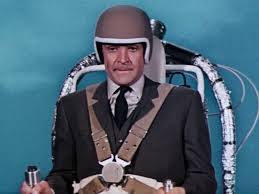
Role of ViolenceThunderball opens with Bond killing SPECTRE assassin Jacques Bouvar (who is dressed as a woman, so there’s that) and then escaping with a supercool (for 1965) jetpack. There’s a few henchmen (dressed in black, like an episode of Batman, which debuted the following year) that Bond kills, although they may just be stunned. Some henchmen throw another henchman into a pool of sharks. And whole bunch of frogmen, good, bad, and otherwise, get shot by spearguns in the Caribbean, some likely by 007. Other than the epic underwater battle, the body count is not giant and those scuba dudes who are killed are probably then eaten by sharks, so, the circle of life.

Vulnerability – It’s 007, so audiences don’t expect an inner window into Bond’s heart and it seems even more walled up than ever. He’s less dependent on technology than in Goldfinger, but James swallowing a radioactive pill so the CIA can track him seems like some kind of weird acknowledgement that maybe James can’t do everything by himself. There’s also a moment where James is trying to rescue Paula from Largo’s compound and he accidentally drops his gun off the roof he’s on. The look on his face seems to say, “Uh oh. My dick just fell off.”

Sexual Potency – Here’s where Thunderball goes off the rails. The first part of the movie, Bond is camped out at an English health spa called Shrublands, where he continually sexually harasses a masseuse (physiotherapist?) named Patricia (played by Molly Peters, featured in Playboy’s 1965 “James Bond’s Girls” spread). He forcefully kisses her and then when she thinks Bond’s bad experience on a, more Medieval than medicinal, stretching rack is her fault (it was a henchman) she frets that if her boss finds out, she could lose her spa job. “My silence could have a price,” James says then pulls her away for some quid pro quo sex. In the end, they’re in bed, with Bond doing the massaging.

Then there’s James’ relationship with SPECTRE agent Volpe. Her red hair is a classic signifier of a libidinous woman and when Bond walks uninvited into her bathroom to find her naked in her bathtub, he smirks with the recognition that he’s about to get another notch in his belt, “as if it was intended.” Because she’s a wicked redhead, she takes off Bond’s clothes and they end up in the sack where he tells her, “you should be locked up in a cage.” Rawr. Post coitus, she (and her henchmen) turn the tables on Bond, who seems shocked that he got caught with his pants down. In a moment for the Bond Girl demographic, she says, “But of course, I forgot your ego, Mr. Bond. James Bond, who only has to make love to a woman and she starts to hear heavenly choirs singing. She repents, and immediately returns to the side of right and virtue. But not this one.” Snap.

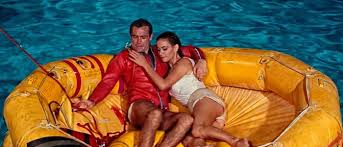
The final scenes are about rescuing Miss France/Domino from bad guy Largo. Bond sucks sea urchin poison from her foot and then they make love on the beach. When 007 says he needs her help catching Largo, she dejectedly says, “Of course. That’s why you make love to me.” Sex as transactional in Bond films. And also now cemented as a cliche, the film ends with Bond and Domino in a boat, this time a rescue raft floating in the Caribbean.

ConnectionThunderball begins and ends with Bond alone, acting or celebrating (with his prize) his actions. We do get to see a section of the Bond working with a team, but it’s sort of like Superman and his super-friends. Bond is in the lead. Again, as by Film 4, Bond is now the archetype of the man alone. He mocks love (including with Moneypenny), but he never actually has it. I wonder if writers ever considered developing a bromance between James and Felix. Maybe, at some point in this chronology, we’ll meet a James Bond who cares about somebody.

Toxic Masculinity Scale: 8

Summary By 1965, James Bond had officially become a franchise, produced by men to maximize 007 revenue. In the opening credits, the only females listed are “continuity girl” and “wardrobe mistress.” The fledgeling second wave feminist movement hadn’t yet turned its attention to Hollywood and the impact of this picture of gender. The normalization of sexual harassment in the 1960s (here, Bond’s treatment of spa worker Patricia) would later be unpacked by the brilliant AMC series Mad Men (2007 – 2015). But Bond is such a cad in Thunderball it makes watching his witty banter with the other characters in the film a lot less fun to watch. 

We do get tastes of gender subversions. There’s Volpe (Italian for “fox”) blowing stuff up, motorcycle between her legs, and later removing 007’s clothes and then sexually besting him. (“But not this one.”) Again, we get a female hotel concierge ogling Bond’s backside and Paula, the female CIA agent (who dies because, you know, lady CIA agents). But it all stands in the shadow of Bond’s hyper-masculinity. He even tries to feminize Largo by saying of his skeet shooting rifle, “That gun looks more fitting for a woman.” Huh?

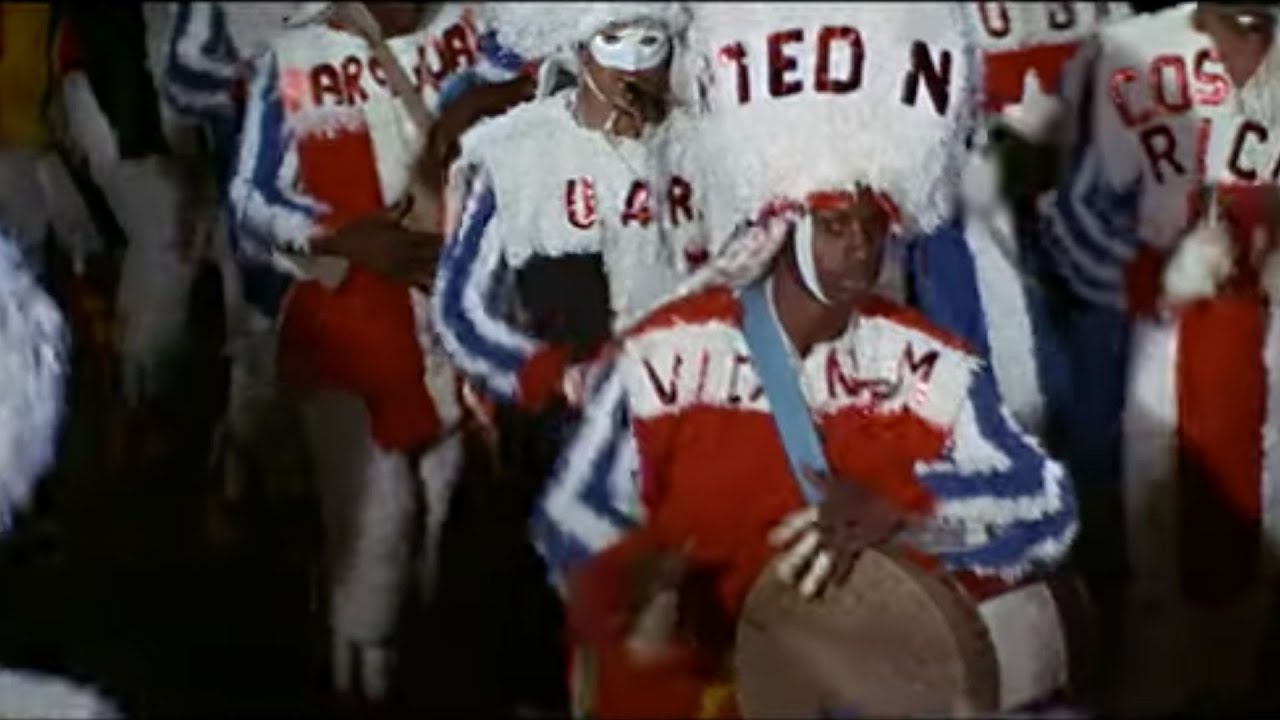
On a personal note, I appreciated the return to the Caribbean, especially Nassau where I experienced a particular “man making” experience as a 17-year-old boy. I loved the scenes shot during Junkanoo; Carnival in the Bahamas. It caught a glimpse of the decolonization that was happening in the black world in the 1960s and while there was no dreadlock rasta in Thunderball, behind the highly paid white actors in the camera’s focus there were a bunch of black faces who knew the world was changing. Those are the Bahamians I met when I was there as a teenager in the 1980s.

Next: Casino Royale (1967)

The James Bond Project #3: Goldfinger (1964)

The James Bond Project #2: From Russia With Love (1963)

The James Bond Project: #1: Dr. No (1962)