Foreshadowing Fascism: The Spike in Anti-Semitism is Bigger than Trump and Kanye

December 7, 2022

Every December 7th, we remember the 1941 attack on Japan by imperialist Japan. December 7th, 1941 is also the date that Hitler made his “Nacht und Nebel” (Night and Fog) decree, the order that instructed the Gestapo to round up all the enemies of Nazism in the lands controlled by Berlin, and send them to concentration camps. Sadly, many of those who supported Hitler’s anti-Semitic vision were political activists in the United States. That included aviation hero Charles Lindbergh, spokesperson of the America First Committee, founded in 1940. Four days after Pearl Harbor, Hitler declared war on the United States, declaring that Franklin Roosevelt was a spawn of the “eternal Jew.”
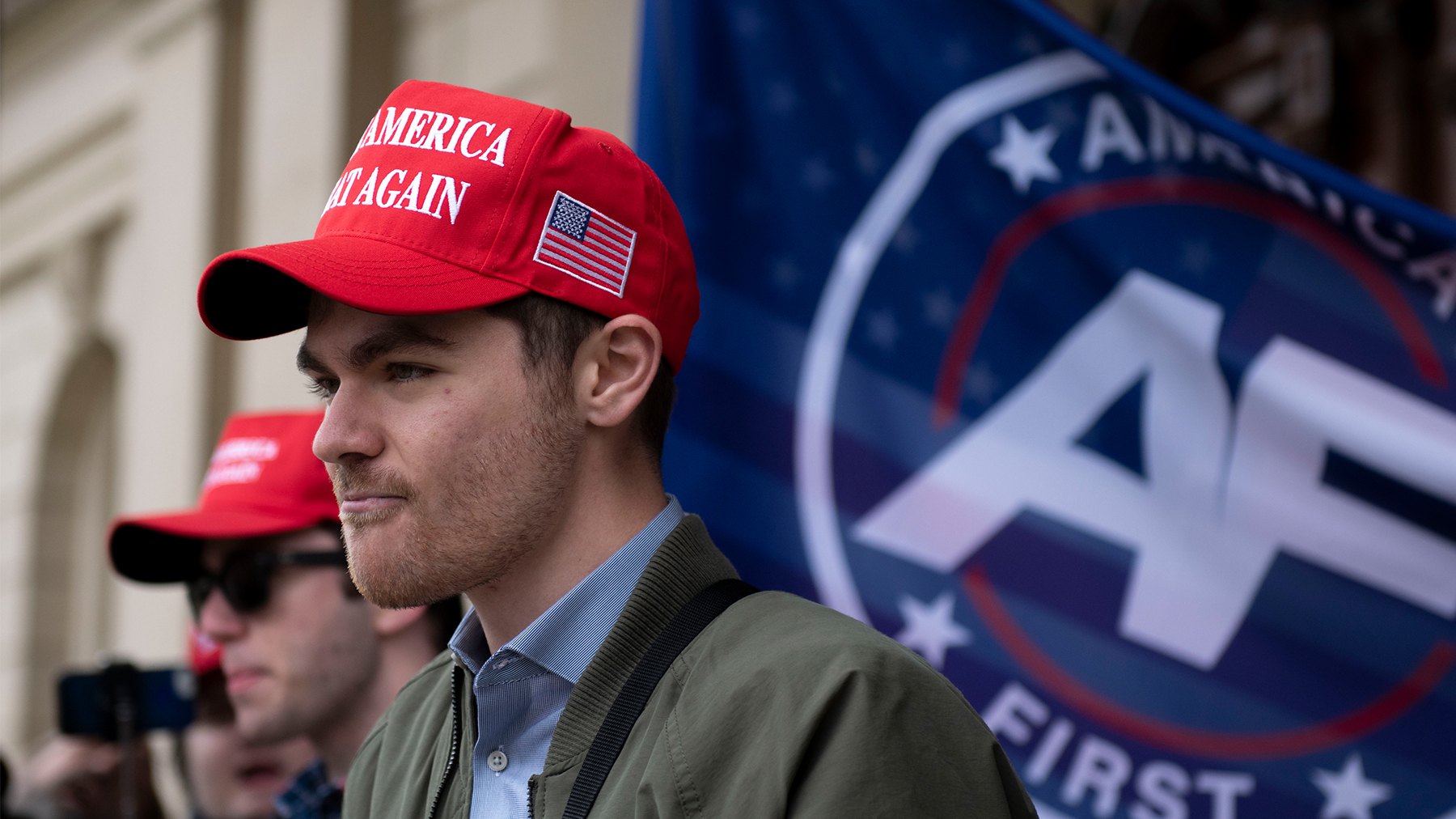
It’s important to remember that the Holocaust didn’t begin with gas chambers. It began with anti-Semitic hate speech. The fact that former president and current presidential candidate Donald Trump gleefully dines with anti-Semites like Kanye West and Nick Fuentes, tells Proud Boys to stand by, refers to the neo-Nazis of Charlottesville as “fine people,” and has routinely retweeted disinformation from white supremacist accounts should exclude him from any political credibility whatsoever. Instead, it places him in the center of right-wing politics that has always had its right foot in the mud of anti-Semitism. Blaming the Jews isn’t back. It never went away. It’s now just got a media platform so expansive it would make Father Coughlin drool on his frock.

First, let’s dispense with a crucial piece of bullcrap. Saying, “I can’t be anti-Semitic, I support Israel!” is like saying, “I can’t be racist, I support the Lakers!” Support for Israel is not the same as support for Jewish people (including Jews who are critical of the state of Israel). Evangelicals see Jews as “unsaved people,” who are just getting the Holy Land ready for the return of Jesus. MAGA support for Israel is inherently anti-Semitic. So it shouldn’t be surprising that the MAGA subculture has plenty of neo-Nazis, like Nick Fuentes, it its ranks.

This isn’t about Trump and “Ye.” There has been a dramatic increase in anti-Semitic hate crimes and incidents over the last few years. The ADL reported that 2021 was the highest year on record for anti-Semitic incidents and 2022 looks like it could end up worse. Oregon has already logged 257 bias crimes and incidents with Jewish victims this year. Just last month, New York City saw a 125% increase in hate attacks targeting Jews over the previous November. Trump and Kanye just make it more acceptable for those people to come out of the shadows.

While the Jewish people have a long history of oppression, the Adolph Hitler/Kanye West version of anti-Semitism has a fairly recent starting point. The 1789 French Revolution not only brought the promise of democracy to Europe, and the end of the divine right of kings, it emancipated French Jews, making them full French citizens. So when the defenders of church and monarchy needed a convenient scapegoat to blame the revolutionary chaos on, the “anti-Christian” Jews were an easy target. Aside from the fact that European Jews had a fairly good reason to not be fans of the Catholic Church, Jewish participation in the French Revolution was fairly minimal. And yet a new myth was born; the pro-democracy/anti-church rule movements around the globe were the work of secret cabal of Jewish rabbis. The puppet masters; controllers of banks, media outlet, competing political parties, and all things liberal.
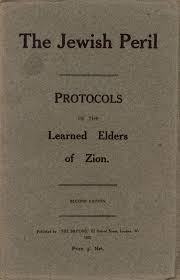
This new belief that Jews “control the world” spread like wildfire as the old empires began to crumble. By the beginning of the twentieth century, the bizarre conspiracy theory was codified in a supposedly real (but fully fabricated) document, The Protocols of the Elders of Zion. It was used to blame the Russian Revolution on Jews and used by Henry Ford to blame unionization efforts on the “international Jew” (the title of a series of booklets Ford wrote in the 1920s). The conspiracy theory became equally popular among jihadists and Neo-Nazis into the twenty-first century. We are almost a quarter of the way through the century and Trump acolyte Kanye West’s proclamation that “I like Hitler” on disgraced conspiracy theorist Alex Jones’ show barely sparks a response from the Learned Elders of the Republican Party. That should make the world say, collectively, we’ve seen this movie before.

Volumes have been written on how the authoritarian tendencies of Donald Trump map on to other nations’ slide into fascist rule. American democracy is not guaranteed and Trump’s recent claim that the U.S. Constitution should be “terminated” is straight-up Germany 1933. All we need is an economic collapse to send the “stable middle” into a panicked blame-game and a charismatic figure to convince them that all their problems are because of George Soros/drag queens/woke bankers/deep state agents and we’ve got pogroms in the streets of America; the Proud Boys and their ilk, who have been on “standby,” leading the charge to “make America great again.”

This might seem like a lot of hysteria but let me conclude with two thoughts. Every single Jewish person has a deep personal connection to the violence of anti-Semitism. Every news story about a synagogue covered in swastika graffiti, or about Jewish people attacked just walking down the street, or another “crazy” claim about Jews by an popstar who has 16 million followers on Instagram is a reminder of the long history in the belief that the complete annihilation of the Jewish people is a good thing that is both dreamed about and acted upon. The trauma of living in that world must be immense and yet the Jewish people continue to contribute to a world that imagines destroying them.

Finally, as I’ve written, earlier this year, I spent a snowy April day at the Auschwitz and Birkenau death camps in Poland. After walking though the gates that still read, “Arbeit Macht Frei” (Work sets you free), I suffered my first panic attack, realizing that it was all very real. A population, motivated by fear, was willing to commit mass genocide. Children, like my daughter, were ripped from their parents arms and thrown into the fire pits of Birkenau. Why? Because they were “dirty Jews.” I stood on that spot and wept. Because, unlike what certain guests at Mar-a-Lago believe, the Holocaust happened. And, like certain guests at Mar-a-Lago hope, it could happen again.

We must stand together against this insanity or it will be our children who will be thrown into the fire pits.

Panic in Auschwitz: Putting the Present Moment in Context

“The present moment began with fire. And still, it burns.” – Ben Okri, Nigerian poet

April 2, 2022

Once again, I find myself in a white van, crossing the, now snow-covered, fields of southern Poland. My very first record, Elvis Presley’s “Burning Love” is playing on the radio. The lyrics hit at an odd angle, “I just might turn to smoke.” Because we are headed to Auschwitz. Seeing the upside down world of April Fools Day, I try to make a joke with my fellow passengers, but my wartime dark humor is not received well. I was scolded earlier in the week for posting that the guy who was snoring in the bomb shelter we were sharing in Lviv, Ukraine made me pray for a bomb. I get it. But humor is also a way to cope with the endless trauma of this world. The DJ, sharing my skewed take on the day, next spins Ella Fitzgerald singing, “Let it Snow,” a Christmas classic in April.

Maybe the awkwardness was to prepare my brain for what was to come. How does one plan a day-trip to the Auschwitz-Birkenau Nazi death camps? How do you transition from this moment to that one? I’ve been a student of the Holocaust for as long as I can remember and lectured about the camps for 30 years. In my recent Research Methods class at the University of Oregon, I presented gut wrenching evidence of how Auschwitz doctor Josef Mengele perverted the values of science in a sadistic attempt to demonstrate Aryan superiority. My life’s work revolves around studying neo-Nazis who both pretend to believe the Holocaust never happened and fantasize about perpetuating similar acts of genocide. The previous day, I had wandered around Krakow’s old Jewish district that had been emptied of Jews by the Nazis, except for the lucky few who were rescued by Oskar Schindler. It was important for me to do this.

The van carried a varied lot, an English couple from Birmingham, a Norwegian couple, a young German woman who must have been filled with dread and her English friend who puked, on and off, during the hour drive from Krakow because she had had too many shots of vodka the night before. Our driver, who went by Mike, was wise enough to ease us into the arrival into hell. He took us to his “secret location,” which was an abandoned box car on a track between the Auschwitz and Birkenau camps that had been used to carry the doomed to their final destination. There, in the snow, I began to slip through time.

Auschwitz is where it is because Oświęcim, Poland was a railroad hub, and industrial town that could manage the importation of countless slave laborers and then the millions who were to be exterminated. It still feels like such a town, ringed with McDonalds and KFCs when you arrive. For better or worst, the area around the camps has been preserved in amber. When we arrived at the Auschwitz tour center, with the crematorium chimneys visible behind it, snow fell gently down, smelling cleaner than the ash that fell 80 years earlier. In the gift shop, I bought a copy of Ellie Wiesel’s Night and watched the other tourists. Some stared somberly, some teenagers laughed, as teenagers do, and a group of Israeli students, draped in their flag, did both. I held my breath.

My group got their headsets so we could better hear our tour guide, a Polish woman in her late sixties who had lost two uncles in the camp. We stepped back into the snow and walked under the “Arbeit macht frei” (“Work makes you free”) gate as she began to describe the buildings. For the first time, I had a 360 degree view of this thing. I could see the grey clouds above and the mud below my boots. This was not a fantasy, a conspiracy, or a scene from a film. This was real.

The tour had just started and I began to hyperventilate. Then I began to sob. I got light-headed and thought I was going to pass out. I had to lean against one of the barracks that had housed 500 prisoners at a time. Nothing like this had happened to me before. I think I was having a panic attack.

It was the realization that this was a real place and that horror had actually happened. Holocaust deniers be damned, the systematic annihilation of millions of men, women, children, and babies was carried out with methodical precision here from 1940 to 1945. I could feel the terror and it was too much to bear. All those books and lectures and movies and documentaries and sitting listening to Holocaust survivors, choking on the pain in my throat. It all happened in this spot and my body convulsed at the realization. The weight of what humanity was capable of in its darkest moment.

I sat down for a bit, half listening to our presenter, half trying to get my bearings. I flashed to a scene in Schindler’s List. The black and white film had one moment of color. A little Jewish girl in a red coat, her body later appears in a pile of corpses. It was 1993 and she reminded me of my then 5-year-old friend in Prague, Suzanka, who was living too close to the genocide in Yugoslavia. I burst out sobbing in the Phipps Plaza movie theater. The memory, as I sat on barrack steps in Auschwitz, caused me to burst out sobbing again.

Gradually, I wiped my eyes and rejoined the tour as we entered the slightly warmer barracks and viewed their displays. Our guide returned to the refrain, “You must remember,” and how the total count of those exterminated may never be known, because the Nazis burned the paperwork along with the bodies. Each display was more devastating than the last; children’s shoes, human hair removed from the gassed to make into fabric, luggage waiting to be claimed. The one that put me back in my panic was the massive collection of crutches, canes, and prosthetic limbs of the “invalids,” deemed too defective to work and put to immediate death. That specter of ablism did not fade with the Third Reich.

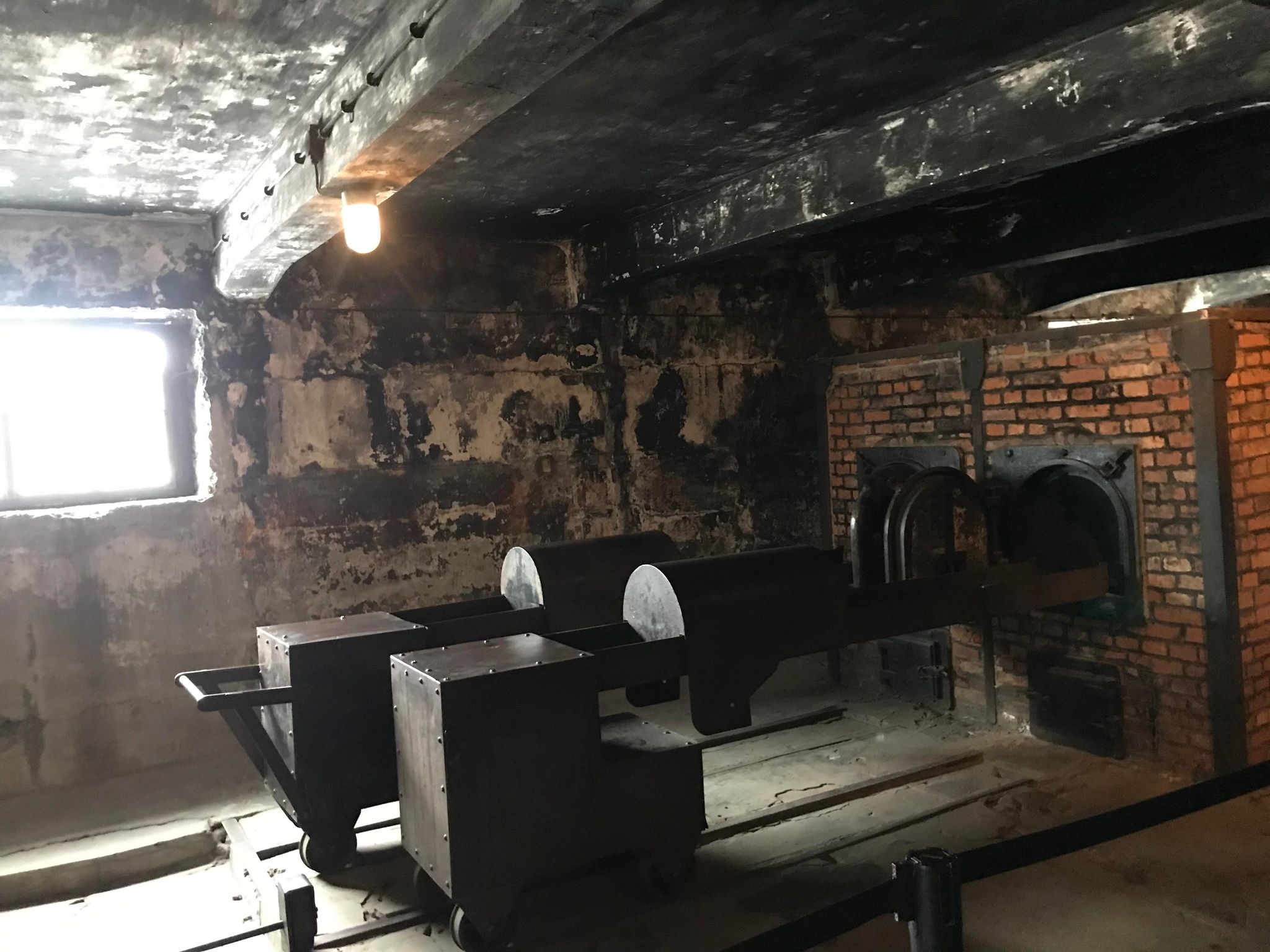
I soldiered on for the rest of the tour, through gas chambers, past the gallows, in front of the “wall of death,” where prisoners were shot, and down to the ovens, and finally to the spot where Auschwitz Commandant Rudolf Höss was finally hung on this day (April 2) in 1947. But this was only the first half of the trip. Auschwitz had a sequel, Auschwitz II-Birkenau, ordered built by Heinrich Himmler in 1941 to accelerate the extermination of the Jews. Mike ferried us over to the second, much larger camp, much of which was destroyed by the Nazis at the end of the war in a futile attempt to hide their crimes. Our guide walked us along the train tracks where prisoners were divided between those who would be forced into labor than those who were marched straight to the gas chambers. Babies and small children were thrown into open burning pits. I stood there, as a father, unable to move. Where was goodness? Where was God? Where was the empathy that should have been present among Hitler’s willing executioners?

On the ride home, we were all silent, including puking girl. I thought about what I had seen in Ukraine; the faces of frightened children forced out of their homes by an unprovoked war-monger. I thought about the concerns of my Polish friends, that nuclear weapons would turn them to ash like those who left Auschwitz and Birkenau through the chimneys. I thought about the new rise of authoritarianism in the form of Putin and Trump, that gleefully weaponizes hate and the threat of violence. I thought about the anti-trans laws and voter suppression acts that are slowly eroding democratic freedoms in my “beacon of liberty” home country.

The first chapter of Ellie Wiesel’s Night is a cautionary tale. The Jews who lived in his Hungarian village thought they were far enough from the war not to worry about the rumors of Nazi anti-Semitism. When they were pushed into a ghetto, many thought it was to protect them from the violence of the Allied invasion, and when they got to the platform at Birkenau, and Wiesel saw his mother and sister forced into the line for the gas chambers, many thought that no such horror would be allowed in the mid-twentieth century. The Holocaust was not a sudden tsunami of death. It was a slowly rising tide that drowned those who never realized they were so far from the shore.

That tide is rising again. I will not sit on my hands and hope things get better. I will use every tool at my disposal. This trip has taught me that I must.