Winding Down Elementary School: Gender Check-In

May 15, 2025

As fifth grade starts to wind down and the complex reality of middle school looms, I’m reminded of how this blog began. November 2014, I was a stay at home dad, spending my days with Baby Cozy, wondering how I was going to raise a girl in a culture that still devalued half the population. The idea of a blog charting the challenges of “feminist fatherhood” seemed like a good way to share the struggle. Over ten years later, while the the world burns, protecting her gendered journey is still the priority.

The experience of elementary schools has seen the predicted emergence of pre-teen gender rolls. As discussed in Carol Gilligan’s pioneering 1982 study, In a Different Voice, the primary grades, 1 – 3, saw boys and girls as a fairly homogenous blob of “kids.” Half of Cozy’s friends were made of snips, snails and puppy-dogs’ tails. But by 4th, each team peeled off. In fourth grade, Cozy found her tribe of Swifties and boys became the object of much gossip and wonder. “Does he like me?”

Gilligan wrote about how 13 was the age of the great gender divide in which girls start to realize their value is based on how boys view them and their self-esteem plummets. But 2025 is not 1982, for better or for worse. For worse, kids are hitting puberty earlier now. In the 1970s, the average of the first menstruation was 13 and it’s down to 12 now. The beauty industry is targeting younger and younger girls. Cozy has been experimenting with make up but tells me it’s just for fun. On the better side, Gen Alpha kids have been raised by parents who mostly accept the basic tenants of feminism that girls and women are human beings. Boys seem less creepy and girls seem less concerned with their opinion.

We’ll see if that holds up in sixth grade.

This week I got a little tour of the middle school Cozy will attending in the fall. Parents had fun sharing their fond memories of middle school. I don’t know if it’s a “Deep South” thing, but we didn’t have middle schools where I grew up. Elementary went to seventh grade and eighth grade was high school, where you were a “sub-freshman,” the dreaded “Subbie.” Being in seventh meant you were the very big fish in the pond, but the year was also spent full of horror stories about what awaited the little subbies, destined to be terrorized by giant (and practically adult) high school kids. “They’ll force you to do heroin in the bathroom!”

I’ve gathered that middle school is the crucible of adolescent drama. Take 300 kids going through puberty and lock them in a building together for 5 days a week and see what happens. I’m guessing the gendered game of attracting boys is part of that. I’m hoping Cozy’s internal compass is rooted in enough self-efficacy that she won’t be knocked off track by that monstrous norm. But I’ll be on the look out for anything that looks like the surrendering of self that happens to girls in that patriarchal zone, including eating disorders. I think her girl squad will provide a buffer to that traditional pull.

When this blog started, my primary rants were about gendered baby toys and the lack of TV commercials that show men doing housework. Now we’re getting into the real stuff, from body image to sexual safety. This is where the feminist fatherhood business either pays dividends or goes into crisis mode. I have faith in my daughter. The rest of the world, populated by MAGA incels and Carl’s Jr. ads, I’m on guard against. What will happen?

The Secret Life of Fourth Grade Girls

June 7, 2024

As Cozy approaches the end of her stint as a fourth grader, I’d like to take a moment to reflect on the evolution of peer culture for a 9-year-old. The difference between third grade (which is technically “primary school”) and fourth have been like night and day, and the primary shift is all about who she wants to hang out with. I’m still Daddy and get plenty of time and love, but her friend group is now her preferred time occupier. There’s a new sheriff in town and it’s a passel of pre-tween girls.

In her seminal 1982 piece of feminist scholarship, In a Different Voice: Psychological Theory and Women’s Development, Carol Gilligan charted how children generally play in mixed-sex groups through primary school. Cozy certainly had as many male friends as female friends. But then, as children begin to approach adolescence, they split up along gender lines; boys on one side of the playground and girls on the other. As a parent who is both at drop off and pick up, I’ve watched this phenomenon evolve over the school year. It’s like watching the formation of competing gangs.

We know that puberty is starting earlier for kids over recent decades. Every decade that passes, the average age of the onset of puberty moves up three months, according to recent research. This due to a number of factors including lack of exercise and changing diet. Researchers also think COVID accelerated precocious puberty, so there’s that. The bottom line is I was not ready for my child to be launched into adolescence quite yet, but here we are. Cozy has a bra.

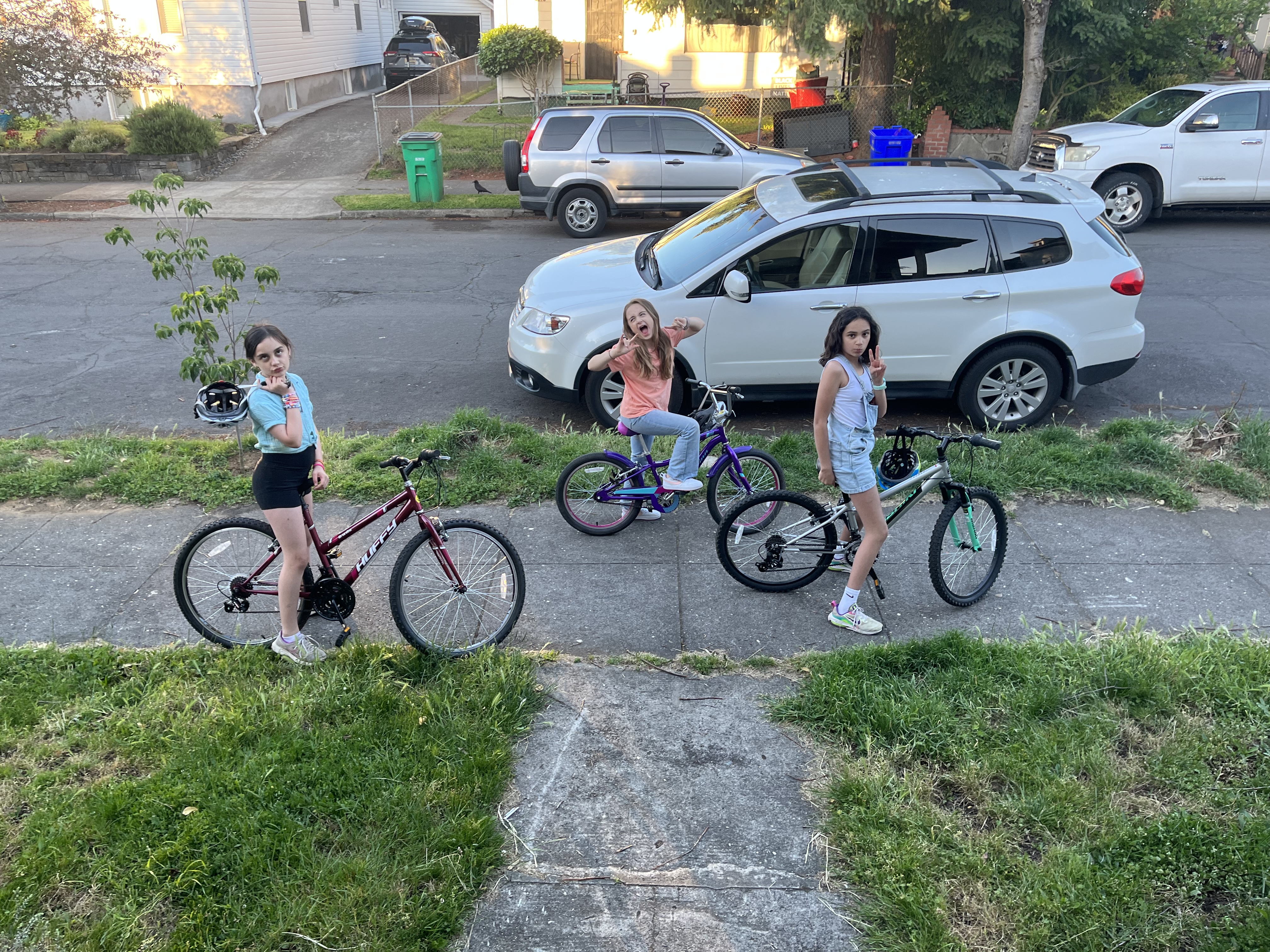
At the moment, the gender split has a decidedly childlike element. It’s not about dating or harassment. It’s about bikes. That’s right, Cozy is in a biker gang. It’s a regular occurrence now that three or four girls on bikes show up in front of our house and holler, “Hey, Cozy! Come out and ride with us!” I encourage her to watch out for cars and then advise her to do a good job terrorizing the neighborhood. While her male counterparts are playing video games, the girls of Sabin Elementary are owning the streets and it’s glorious.

I spent a large part of my fourth grade year riding bikes with my friends, so I trust her as she rides out of view. In my time, boys ruled the streets while girls stayed home and learned how to fold clothes. If there’s any “domestic apprenticeship” in this house, it’s me telling Cozy to pick up her clothes before she ding dong ditches the boys on the next block. The girl bike gang is a revolution on wheels. I can only imagine what they talk about when they ride to the park to lay on the fourth grade gossip and pop culture obsessions.

The dark side of the peer bonding has been some actions that drift into the bullying zone. Cozy’s both flirted with it and been the subject of it. We’ve taken away her phone twice because of reports of chats that tease and exclude. I can’t police her interactions, 24-7, but I can limit her access to screens where impulsive actions are a lot easier. But the bright side is seeing Cozy’s peer group engage in pop culture separate from their parents. Her squad is firmly in the Swiftie camp and they will sing Taylor’s songs at full volume (including in the back of my car). It must be like what was like 60 years ago when The Beatles took over America. I love it.

Gilligan’s 1982 book offered a darker picture of this period. Gilligan found that when girls and boys peel away from each other, girls start to evaluate themselves by how well they can attract boys’ attention, not by how smart or athletic they are. She discussed that girls’ self-esteem plummeted around age 13 as they are repeatedly told that their worth is in their looks, forcing them to compete with each for the middle school Prince Charming. “Boys don’t make passes at girls who wear glasses.”

I’m hoping none of this patriarchal hell lands on my daughter. I can’t change 8000 years of male dominated culture, but I can hope, a) things have changed a lot since 1982, and b) she’s a lesbian. For now, she’s rolling with her girlfriends, having sleepovers, and evaluating clues in Taylor Swift songs (mostly clues about a guy named Joe). Unlike Gilligan’s 13-year-olds, Cozy is bonding with her diverse pool of girl power classmates. (In 1998, I presented a paper on how the Spice Girls were positively impacting girls ability to bond.) As they ride off into the summer, I’m going to support their freedom and close friendships. They’re gonna need it.

Gender – Nature vs Nurture 8: The Looking Glass Self

August 7, 2022

There was a clear moment this past year when Dad picking out Cozy’s outfit for the day slammed into “societal expectations.” For the historical record, there is an event in the life of a second grader that sounds like this; “Dad, I don’t like how that makes me look!”

Legendary sociologist George Herbert Mead (1863 – 1931) often referred to Charles Cooley’s concept of the “looking glass self.” When “I” look in a mirror, I see “Me.” Me is society’s reflection and I evaluate myself by that reflection. It has nothing to do with who I am, only how they see “me.” I love mentioning to my students how they will never see their own face as it is. They will only see photos, videos, and reflections in mirrors, all versions of their face mediated by some external source. You don’t actually look like what you look like on Instagram. Sorry.

Even the most rugged individual’s sense of self is shaped by society. You’re a mountain man? Society says you have to have a beard, jeans, and flannel shirts. “But that’s just what I’m comfortable in,” says the rugged individual. “You know what’s even more comfortable?” asks George Herbert Mead. “Silk pajamas!” “But that will make me look like a cissy!” says the mountain man. Bam, society.

So me picking out my daughter’s clothes is starting to get filtered through the various mirrors of society. That’s not necessarily bad (“Pick out your own damn outfit,” Dad has screamed), but as we know, “society” is kinda messed up, like a funhouse full of distorted mirrors.

The first mirror is gender. This trip hits girls first. The boys in her second grade class seemed oblivious to what they should wear. Cozy has already been playing at wearing make-up with her friends. She has even said, “That outfit makes me look fat.” (Mom and Dad had a big “family time” conversation about that one.) And the way the fifth grade girls dress at her elementary school dress looks more college co-ed fashion than “kidswear.” According to feminist sociologists, like Carol Gilligan, all of this will be put in the service of attracting boys. 

Instead of being evaluated on her brains, her humor, or her ability to build a sustainable fairy house out of a bundle of sticks, society wants to primarily place her value in her “attractiveness.” Gilligan found that the self-esteem of 13-year-old girls plummeted as they began to realize that their worth was not based on what they had to offer the world but what they had to offer boys. The soccer player quits the team to become the cheerleader. Her research was first published in 1982. Forty years later, I fear the creeping insecurities of the 13-year-old girl who is told, “Boys don’t make passes at girls who wear glasses,” will arrive in the gender politics of 3rd grade.

The second mirror is race. Less visible to white girls, BIPOC girls know that white girls set the beauty standards, whether it’s the latest fashion, straight hair, or Instagram make-up tips. My brunette mixed-race daughter has commented, more than once, about wanting an outfit because the “blondies” will like it. Already in second grade, the Aryan girls are the mirror that the other girls are seeing themselves in (and never seeing a blondie looking back at them). This isn’t any critique of Cozy’s blonde classmates. We live in a white supremacists patriarchal culture that puts “blonde girls,” at the peak of the attractiveness scale, but that scale is changing rapidly.

The third mirror is class. Not only are these kids looking up to the wealthy, to keep up with the Kardashians, they (or their parents) are expected to shell out the money so they can “look cool.” The first day of school everyone gets evaluated in their new outfits and the poor kids are always shamed. “Your momma is so poor that when I asked her what’s for dinner tonight she lit her pocket on fire and said, hot pocket.” We can still find Cozy outfits at Goodwill but we are about 60 seconds away from that door closing and it’s gotta be the latest trend OR SHE WILL DIE. We’re trying to give her a bohemian ethic that rejects wealth in favor of a decidedly downwardly mobile artist esthetic. My credit card really needs her to be a beatnik.

All of this is tied to the process of “our baby” becoming her own person. But, as Mead explained, her sense of self is being formed by the culture she lives in and more than once I have been tempted to smash the mirror.

Here comes third grade.