
May 30, 2025
This series is intended to evaluate each product of the James Bond film franchise through a feminist lens, and the relevance of the Bond archetype to shifting ideas of masculinity in the 2020s.
Casino Royale (2006, directed by Martin Campbell)
This is not your grandfather’s 007. Casino Royale was meant as Eon Production’s 21st century reboot of the Bond series. Gone are Q, Moneypenny, endless sexual double entendres, laser watches, and the dumb CGI of Die Another Day. And gone is the brunette James as Daniel Craig steps into the role. The story starts with Bond earning his “00” license to kill, so we can frame it as a prequel, but the film still features Judi Dench as M, so it’s not clear where the story fits in the 007 timeline, if there is one.

Producers Barbara Broccoli and Michael G. Wilson brought GoldenEye director Martin Campbell back in for a bit of continuity (although Quentin Tarantino expressed interest in taking the gig). The hunt for a new James Bond was massive and included possible candidates such as Christian Bale, Hugh Jackman, Keith Urban, Ralph Fiennes, and Ewan McGregor. After initially rejecting the role, Craig took the job in 2005. The casting of Bond “girl” Vesper Lynd also had long list, including Angelina Jolie, Charlize Theron, Audrey Tautou, Rachel McAdams, and Olivia Wilde. Finally producers cast French actress Eva Green (who I absolutely loved in 2003’s The Dreamers).
Casino Royale, while based on the same Ian Flemming novel as the 1967 spoof, starring Peter Sellers, is darker Bond that centers practical stunt work over impossible gadgets. The opening scene is shot in black and white and looks more like a scene from Dr. Strangelove than a sprawling action adventure flick. The opening credit montage features the iconic eye shot followed by a great theme song, sung by Soundgarden’s Chris Cornell. But instead of images of women’s bodies, it’s all Bond. We still have the prerequisite globe trotting, Aston Martins, and Bond gambling in a tux, but so much of this film shatters the Bond formula and that was the intent.
Let’s plug this Casino Royale into our evaluation criteria.
Driver of Action – Each time we get a new Bond, the story tends to revolve around him. There is a small MI-6 team that involves Vesper, and we get the return of Felix Leiter (played by Jeffrey Wright, who was so great in Basquiat). As we get in the final shot of the film, this movie belongs to Bond, James Bond.
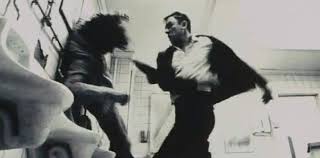
Role of Violence – Not only can Daniel Craig’s Bond run more than Tom Cruise in any Mission Impossible film, he can kill without remorse. He takes out 11 or 12 bad guys in the film, including drowning a guy in a bathroom sink in the first scene. He remarks that his second kill, a rogue MI-6 officer, is much easier. He shoots an unarmed bomb maker in Madagascar, which creates some bad press for MI-6. His ability to fight the bad guys to death, seems superhuman at time, but this is a James Bond film after all.
Vulnerability – Big shift here. While we get the strong silent bit out the wazoo (M says, “I would ask you if you could remain emotionally detached, but that’s not your problem, is it, Bond?”) We do see fear on Bond’s face when he is about to be tortured by Le Chiffre (played by creepy Mads Mikkelsen). He should be. The torture is him being repeatedly hit in the scrotum, sending him to the hospital. He also shows great grief when Vesper dies, even though she double crossed him. The scene mirrors the final moment of On Her Majesty’s Secret Service (1967), with James Bond in tears, holding his dead wife.
Sexual Potency – Bond makes a quip about married women being his type, after he beds Solange Dimitrios, wife of a bad guy. MI-6 pairs him with Vespers Lynd, who keeps him at arms length for most of the film. Of course, they end up in bed together. But that’s it. This Bond ain’t a player.

Connection – This is where 2006 Bond really departs from the formula. There’s a scene where a traumatized Vespers is sitting in a hotel room shower, and James steps in and holds her. There is a strong connection between the two. After they survive near death and torture stopping Le Chiffre, James is in the hospital and Vesper says, “You’re not going to let me in there, are you? You’ve got your armour back on. That’s that.” And he replies, “I have no armour left. You’ve stripped it from me. Whatever is left of me – whatever is left of me – whatever I am – I’m yours.” Who is this man who recognizes the “00” prevents him from being able to love? This scene was 44 years in the making. James resigns from MI-6 to run off with her. Of course, this is a James Bond movie so you know there will be no happily ever after.
Toxic Masculinity Scale: 2
Summary

Casino Royale has enough Bond tropes to connect it to the genre. As a poker player I absolutely loved the extended scenes of Bond, Leiter and Le Chiffre playing high stakes Tex Hold ‘em. Gripping. The film also turns some of those tropes upside down. We get Bond back in the Bahamas coming out of the water like Ursula Andress in Dr. No (1962), his body on full display. This James plays more the role of psychoanalyst than sexual conquerer. But he’s still portrayed as a man’s man. (Vesper: You know, James, I just want you to know that if all that was left of you was your smile and your little finger, you’d still be more of a man than anyone I’ve ever met. James: That’s because you know what I can do with my little finger.)
The high level of violence in the film led to Casino Royale being re-edited in numerous countries, including the United States, Britain, Germany and China. But the film is securely located in the 2000s, with the prevalence of cell phones, a parkour inspired chase scene in Madagascar, and the Body Worlds exhibit in Miami.
Casino Royale premiered in London’s Odeon in Leicester Square (where I saw the premiere of Pink Floyd’s The Wall in 1982) on November 16, 2006, with Queen Elizabeth and Prince Phillip in attendance. It’s the same week Nintendo’s Wii and Sony’s Playstation 3 hit the market, so there was a competition for young male eyeballs. The film received rave reviews with the Rotten Tomatoes website reporting, “Casino Royale disposes of the silliness and gadgetry that plagued recent James Bond outings, and Daniel Craig delivers what fans and critics have been waiting for: a caustic, haunted, intense reinvention of 007.”
Maybe after four decades James learned the weight of his license to kill.
Next: Quantum of Solace (2008)

The James Bond Project #22: Die Another Day (2002)
The James Bond Project #21: The World Is Not Enough (1999)
The James Bond Project #20: Tomorrow Never Dies (1997)
The James Bond Project #19: GoldenEye (1995)
The James Bond Project #18: License to Kill (1989)
The James Bond Project #17: The Living Daylights (1987)
The James Bond Project #16: A View to a Kill (1985)
The James Bond Project #15: Never Say Never Again (1983)
The James Bond Project #14: Octopussy (1983)
The James Bond Project #13: For Your Eyes Only (1981)
The James Bond Project #12: Moonraker (1979)
The James Bond Project #11: The Spy Who Loved Me (1977)
The James Bond Project #10: The Man with the Golden Gun (1974)
The James Bond Project #9: Live and Let Die (1973)
The James Bond Project #8: Diamonds are Forever (1971)
The James Bond Project #7: On Her Majesty’s Secret Service (1969)
The James Bond Project #6: You Only Live Twice (1967)
The James Bond Project #5: Casino Royale (1967)
The James Bond Project #4: Thunderball (1965)
The James Bond Project #3: Goldfinger (1964)


 Watching the Wheels