
February 1, 2025
This series is intended to evaluate each product of the James Bond film franchise through a feminist lens, and the relevance of the Bond archetype to shifting ideas of masculinity in the 2020s.
The Man with the Golden Gun (1974, directed by Guy Hamilton)
This is the first “meh” of the Bond series. Guy Hamilton is back in the director seat, for the last time, and he seems to have run out steam. If Live and Let Die was meant to crib from blaxploitiation films, 1974’s entry is meant to riff on Kung Fu flicks popular at the time. (Bruce Lee’s Enter the Dragon grossed over $400 million in 1973 dollars.) Richard Maibaum turned in a flaccid script then bailed. The Man with the Golden Gun was the last Bond film to be joint produced by Cubby Broccoli and Harry Saltzman for Eon Productions and their falling out would end the “Bond film a year” schedule. That’s probably a good thing.

The good news is TMWTGG gets away from the Bond in America motif of the last two films. We’re back in the “exotic” far east. There’s no army of henchmen, no sharks, not even any Q designed gadgets, but there is (thank God) an underground lair. In the middle of the 70s Energy crisis, there’s a convoluted plot about how a former circus performer with three nipples named Francisco Scaramanga plots to control the solar energy market, as if that is not just called “capitalism.”. Scaramanga is played wonderfully by Dracula icon Christopher Lee, who had just appeared on the cover of Band on the Run, the new album by Live and Let Die theme-singers Paul McCartney and Wings. The scenery in Hong Kong and Thailand is spectacular (even if the scene in Beirut was shot on a soundstage in London).

Roger Moore was back in his second 007 installment, already a bit weary. His quips fall flat (except for one at the end) and his mojo is dragging. TMWTGG was meant to be Moore’s entry into the Bond canon after You Only Live Twice. One wonders how 1967 Moore would have treated the role compared to 1974 Moore. As has become cliche, Scaramanga has a reluctant “lover,” played limply by Maud Adams (another Melania Trump clone). And, like the last film, there’s a bumbling but beautiful female MI-6 operative. This time it’s Mary Goodnight (Lord, these names) played by Swedish model/actress Britt Elkland, who was so great in 1971’s gangster classic, Get Carter. The great addition to the cast (and highlight of the film) is Hervé Villechaize as Scaramanga’s pint-sized right hand man, Nick Nack. Villechaize would go on to play Tattoo on TV’s Fantasy Island, cementing the words, “De plane!” into the English lexicon.
The Man with the Golden Gun was not well received upon its release in December 1974, the same week Nelson Rockefeller was sworn in as vice president, after Gerald Ford became president to replace “Tricky” Dick Nixon, who had resigned. A dozen years in, TMWTGG was seen as boilerplate Bond, dropped in for 1974’s chapter for fans of the franchise. There’s a super-70s car chase that ends with one car jumping over a river (with an Evel Knievel reference!) and a car literally flying away and a Swedish sex symbol in a bikini, but not much else to write home about.
Let’s plug it into our analysis.
Driver of Action – Again, this is all Bond all the time. We don’t even get Felix. There is a minor sidekick in Lieutenant Hip, the Hong Kong cop played by Soon-Taik Oh (who was a staple on 70s TV shows like MASH and Charlie’s Angels). In one scene, he and his teen nieces rescue James with some serious (and seriously dumb) Kill Bill Kung Fu action. But yeah, it’s the Live and Let Die formula with much less payoff. Maybe it’s Bond’s polyester suits.
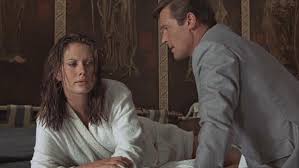
Role of Violence – Surprise, surprise, Bond smacks Maud Adams’ character, Andrea Anders, hard in the face and threatens to do it again. Was Bond striking women in the face required in all 007 scripts? Didn’t someone say something? I mean, Helen Reddy’s “I am Woman” was #1 on radio while they made this. Someone could have said SOMETHING. Bond pulls out his little pistol a lot in this movie but only shoots Scaramanga in the climatic end scene, posing as a wax figure of himself (don’t ask). Bond also takes out a kung fu master, manly man that he is. His violence is balanced by Miss Goodnight, who throws Kra, Scaramanga’s only henchman, into a vat of liquid oxygen.
Vulnerability – Yeah, no. James loses his gun at one point. He seems a little annoyed that Goodnight wants to reconnect. This is Stepford Bond on autopilot.
Sexual Potency – We get glimpses of the Bond of old when James tries to suck a golden bullet out of a belly dancer’s navel and when he encounters a nude woman swimming in a Chinese crime lord’s pool. She introduces herself as Chew Mee, to which Bond replies, “Really?” The main sexual conquest is Bond’s bedding of Scaramanga’s lover, Andrea. In an über creepy scene he sneaks into her hotel room and watches her shower and then man handles her only to learn that (shock) she is a damsel in distress. Later, he’s decided that, why not, he’s going to have sex with Agent Goodnight, but Andrea shows up so he throws Goodnight in the closet and has sex with Andrea Anders instead. It’s pretty messed up. Bond can’t keep his work life and his sex life separate. He does end up back in bed with Goodnight at the end of the film, but it feels more obligatory than romantic.

Connection – 007 is even more isolated in this film. Even Moneypenny gets the brush off. Q and James seem annoyed by each other. James knocks a kid who fixes his boat into the river. When Andrea Anders is shot, he’s not phased. There are zero fucks given by this Bond. The film ends, are you ready for it, with Bond and Bond girl Britt Ekland in a boat! (This time it’s a Chinese junk.) James and Agent Goodnight are finally back in bed on a slow boat from China. But, as is now tradition, it’s a false ending. Tick Tack is waiting (for some reason) to kill 007. In an unnecessarily funny scene, there is a Bond vs. little person battle to expedite before James can get Mary back in the sack. When he does, in another moment of coitus interruptus, Q calls and asks to speak to Agent Goodnight. “She’s just coming, sir,” says James. Ah, there’s our man Bond. Then he sets the phone down so Q can listen them making the MI-6 agent with two backs. Really creepy.
Toxic Masculinity Scale: 6
Summary The Man with the Golden Gun does a little bit better on the race issue than Live and Let Die. We do get some cool street-level views of Thai culture, including some great moments of Thai boxing. The contrast of free Hong Kong (with casinos) and Red China is flirted with. But the martial arts bit is weak. There’s no way 007 bests a Kung Fu master so easily, let alone an army of them. We get the comedic return of the racist Sheriff J. W. Pepper (from Live and Let Die), here on vacation in Thailand. (That’s a hard sell.) And a scene where Kra, Scaramanga’s black henchman, gets a little rapey with Goodnight. The hope is that mainstream audiences might have used TMWTGG as a gateway drug into the explosion of brilliant martial arts films that were coming out of Asia in the 1970s.

There are some great moments in this film. Bond flying a seaplane through island outcrops in the China Sea must have looked brilliant on the big screen. The ahead-of-its-time concept about the power of controlling renewable energy sources is noteworthy. Hervé Villechaize is an absolutely brilliant foil and steals every scene. And (recognizing that this might not be the most feminist bit of analysis) Britt Ekland is completely loved by the camera, which, of course, in Bond-land represents the male gaze. But there’s just a lot of silliness here. How did Scaramanga build an underground lair in an outcropping? And why did he include a funhouse, like some Disneyland attraction gone horribly wrong? James is going save his kept woman, but not really. James fancies Agent Goodnight, but not really. There is a car spinning 360 through the air and another flying off into the sunset. It’s like the writers just threw every leftover idea at the wall without the energy to see them through.
Roger Moore’s Bond smokes a ton of cigars in this film (calling Dr. Freud), drives a 1974 AMC Hornet through the streets of Bangkok like a madman, and kills guy who might have prevented global warming. It’s a mess and partly so because Bond is stuck in a tired model of manhood that had already become a caricature.
Next: The Spy Who Loved Me (1977)

The James Bond Project #9: Live and Let Die (1973)
The James Bond Project #8: Diamonds are Forever (1971)
The James Bond Project #7: On Her Majesty’s Secret Service (1969)
The James Bond Project #6: You Only Live Twice (1967)
The James Bond Project #5: Casino Royale (1967)
The James Bond Project #4: Thunderball (1965)
The James Bond Project #3: Goldfinger (1964)


 Watching the Wheels