The James Bond Project #19: GoldenEye (1995)

April 15, 2025

This series is intended to evaluate each product of the James Bond film franchise through a feminist lens, and the relevance of the Bond archetype to shifting ideas of masculinity in the 2020s.

GoldenEye (1995, directed by Martin Campbell)

The first Bond film in the fourth decade of the 007 franchise is something of a synthesis of all the previous EON Production films and a fair send-off for EON producer Cubby Broccoli, who died five months after its release. After a long six year gap, while Eon dragged Timothy Dalton into development hell, Bond was back with Pierce Brosnan as the new British MI-6 commander. GoldenEye fused License to Kill’s vengeful 007 with the smarmy, Casanova Bond of the past. The first Bond film not to be based on an Ian Fleming story is a sweeping tale that presents Bond with his first post-Cold War conflict and was tailor-made for 90s audiences who were getting used to the widescreen violence in films like Natural Born Killers.

Brosnan, who had been offered the role before Dalton, comes in a more upper crust English, but also more boyish, Bond who has parachuted into a third-wave feminist world. This disconnect is magnified by the new M, now played by Dame Judi Dench. The new M states a clear opinion on the archetype that is Bond, James Bond. “I think you’re a sexist, misogynist dinosaur, a relic of the Cold War, whose boyish charms are wasted on me,” she tells him. Welcome to the 90s, James. We still have Desmond Llewelyn as Q to link us to the Bond cannon. This installment’s Bond “girl” is Swedish model and actress Izabella Scorupco, who forces a rough Russian accent. Also trying to be Russian (or Georgian) is “sadistic lust murderer” Xenia Onatopp (There’s the names we love in these films), played by Famke Janssen (soon to be Jean Grey in the X-Men films).

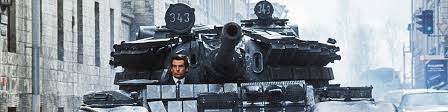
GoldenEye starts with a flashback to the Cold War days with 007 and 006 on a mission in the Soviet Union where 006 (played by the great Sean Bean) is killed. Bond blames himself, setting up the revenge redux. After an epic scene where James dives into a falling plane (This is the first Bond film to use CGI), we flash forward to the present where new Russia is losing track of its shit and we’re off. The scene where James is chasing the rogue Russian general through the streets in St. Petersburg in a giant Russian tank was classic 007 thrills on the big screen. I remember watching it in the Lloyd Center Cinema and thinking it was the wildest thing filmmakers could cock up for a James Bond movie.
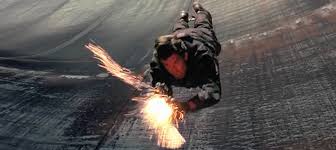
This installment gives us plenty of Bond staples fans crave. There’s Bond in a tux, playing baccarat, there’s Bond in the Caribbean, there’s the double entendre quips (none very clever), and thousands of bullets fired at our James with nary a scratch. The film also features some epic stunts, including a record setting bungee jump off a Russian (actually Swiss) dam that has to be seen to believed. Brosnan plays Bond closer to Moore than Connery and his bourgeois demeanor adds to the “Man out of place” element that makes this film kinda fun. Cubby Broccoli’s daughter, Barbara, took over the production as her father’s health failed, so some of the gender commentary may have been here doing.

Let’s see how GoldenEye fares in our feminist matrix.
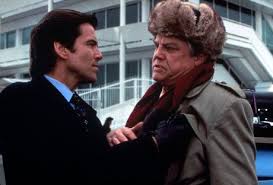
Driver of Action – New Bond, new star. Q and his lab techs show up for comedic effect. There’s a new CIA agent, Jack Wade, to help out (Joe Don Baker is back!) because Felix is still legless from the shark. The new post-communist Russia really plays the support role. In the gap between Yeltsin and Putin, it presented a blank slate to the world, where the need for secret agents might be a thing of the past. But this film rests purely on the shoulders of Remington Steele star Pierce Brosnan.

Role of Violence – There’s a lot of slaughter in GoldenEye, largely due to Bond’s use of machine guns. I had to ask ChatGBT the body count because I lost track. AI reports James killed 47 people in the film, mostly Russian soldiers. (Wasn’t the Cold War over?) There’s also some weird violent sexual scenes with Xenia Onatopp (we’re to believe that violence is her kink) and a scene where 007 knocks her unconscious.

Vulnerability – For the first time in a Bond film, we learn that James’ parents were killed in a mountain climbing accident when he was a boy. But there’s no sense that this plays a role in his present psyche. It’s just presented as a factoid to contrast the story that 006’s parents were killed by Stalin.  There’s no James in love and only a mild sense of guilt that 006’s death might be his fault.

Sexual Potency – Here’s the James Bond rule of three. 1) Caroline – An MI-6 psychologist, sent to evaluate James, gets seduced by our agent who has a bottle of bubbly in the glovebox. He’s going to let her give him, “a very thorough evaluation.” Wink. 2) Xenia Onatopp – It’s more fighting than sex. James is taken aback by her biting his lip and drawing blood. Her death (pulled into a tree by a helicopter) is also played as sexual but in 2025 seems just weird. 3) Natalya Simonova (played by Izabella Scorupco), a Russian computer programmer, is Bond’s “love” interest/damsel in distress in the film. He forcibly kisses her and then suddenly they’re a romantic couple. (This quasi-rape trope seems all too common in 007 flicks.)
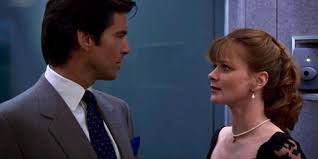
It should be mentioned that Bond’s relationship with Moneypenny (now played by Samantha Bond) is firmly located in 90s feminist positions. She’s not having any of James’ “charm” offensive. Bond: “What would I do without you?” Moneypenny : “As far as I can remember James, you’ve never had me.” Bond: “Hope springs eternal.” Moneypenny: “This sort of behavior could qualify as sexual harassment.” Finally.
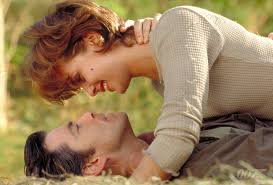
Connection – Brosnan plays Bond detached, as we have come to expect. There’s a hint of a back story between 006 and 007 that might have been nice to know about. As is expected, he and Natalya end the film together, not in a boat but in a Cuban meadow. They think they’re alone, but there is some coitus interruptus from the United States Marines, so they’ll have to save their victory sex for another day, or never. There’s no real chemistry between these two so the door is open for Bond’s next “girl.”

Toxic Masculinity Scale: 5

Summary The opening title sequence of GoldenEye, with women smashing hammers and sickles to a song written by U2 (and sung by Tina Turner) locates the film in a new era. The Cold War was the golden era of the Flemming novels and the platform for Bond’s good vs. evil adventures. Now New Bond is forced (again?) to find his relevance. Is he a 90s-action hero, right up there with Arnold Schwarzenegger, or a washed-up antique who has lost his cultural relevance? His elevated violence and philandering may be intended as a middle finger to the politically correct shifts in cinema.
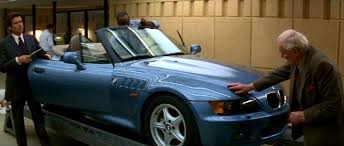
The tech in GoldenEye is a co-star along with lots of product placement. (Welcome to the new global market place.) IBM is featured front and center (and a great scene where a young Alan Cumming gets an “email”). The Aston Martin is replaced with a BMW, fully loaded with Q’s gadgets. “You have a license to kill, not to break the traffic laws,” Q tells an impish Bond. GoldenEye also gives us that most central staple of Bond Baddie accessories, the underground lair, hidden below a lake, from where a deadly satellite is controlled. Its explosive destruction is everything that Bond fans buy movie tickets to see.

GoldenEye premiered on November 13, 1995 at Radio City Music Hall, as the war in Yugoslavia, the largest hot war resulting from the end of the Cold War, was reaching its peak. The direction of Martin Campbell and the production of Barbara Broccoli (with Judi Dench’s M) represented a chance to reboot the franchise in a world without the Soviet Union. What issues would MI-6 confront as the 20th century closed? With the help of CGI, the promise of epic stunts and a horny agents would be a part of it.

Next: Tomorrow Never Dies (1997)
The James Bond Project #18: License to Kill (1989)

The James Bond Project #17: The Living Daylights (1987)

The James Bond Project #16: A View to a Kill (1985)

The James Bond Project #15: Never Say Never Again (1983)

The James Bond Project #14: Octopussy (1983)

The James Bond Project #13: For Your Eyes Only (1981)

The James Bond Project #12: Moonraker (1979)

The James Bond Project #11: The Spy Who Loved Me (1977)

The James Bond Project #10: The Man with the Golden Gun (1974)

The James Bond Project #9: Live and Let Die (1973)

The James Bond Project #8: Diamonds are Forever (1971)

The James Bond Project #7: On Her Majesty’s Secret Service (1969)

The James Bond Project #6: You Only Live Twice (1967)

The James Bond Project #5: Casino Royale (1967)

The James Bond Project #4: Thunderball (1965)

The James Bond Project #3: Goldfinger (1964)

The James Bond Project #2: From Russia With Love (1963)

The James Bond Project: #1: Dr. No (1962)

The James Bond Project #11: The Spy Who Loved Me (1977)

February 5, 2025

This series is intended to evaluate each product of the James Bond film franchise through a feminist lens, and the relevance of the Bond archetype to shifting ideas of masculinity in the 2020s.

The Spy Who Loved Me (1977, directed by Lewis Gilbert)

This was the first Bond film I saw in the theater. My dad took my little brother and I to see the PG-rated Spy Who Loved Me the summer of ’77. I was 13 and what I remember most was the brief glimpse of Barbara Bach’s (or her body double’s) right breast in the submarine shower scene. I was 13, OK? But The Spy Who Loved Me was a return to form after the limp Man with the Golden Gun in 1974. It had all your musts, including oodles of cool gadgets from Q, Bond in his tux and bad girls in bikinis, scores of henchmen willing to die for a megalomaniac, and sharks. My absolute favorite part of the film when I was a kid (besides the boob) was the Lotus Esprit that turned into a submarine, complete with missiles. I thought that was the coolest thing on earth and dreamed of a submarine car of my own. Ironically, in 2013 actual megalomaniac supervillain Elon Musk bought the film’s Lotus for £616,000 in hopes of turning it into a workable submarine. (Like most of his crazy ideas, he failed.)

Roger Moore definitely is getting his mojo back in his third installment in the Bond franchise. While his lines still fall a bit flat, he’s got Bond “girls” dripping from his arms. On top of the TSWLM list is Barbara Bach as KGB agent Anya Amasova, AKA Agent XXX (get it?). Bach was a model and Spaghetti Western actor who would next star in Caveman (1980) with her future husband, Beatle Ringo Starr. (Rumors were that Moore wanted Brigitte Bardot for the role.) As a sort of seventies Blofeld, this installment’s villain is wealthy industrialist Karl Stromberg, who wants to destroy the world so he can build a new world under the ocean. Stromberg is played by Curt Jürgens, who starred with Bardot in And God Created Woman in 1956. Added to the cast is Richard Kiel, who stars as the indestructible steel toothed giant, Jaws. The return of You Only Live Twice director Lewis Gilbert helped to bring some of the Connery-era swagger back to 007’s mission.

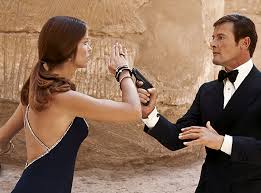
As is expected, the exotic locales splash across the screen. Bond riding a camel across the Egyptian desert and then chasing the bad guys through the Giza ruins was not filmed on an English set. It was there on sight, as were the scenes filmed on the Italian island of Sardinia. We return to some classic Bond tropes, like assassins on skis (On Her Majesty’s Secret Service) and underwater battles (Thunderball). There’s sexy one-liners (Her: But James, I need you! Him: So does England.) And sexist one-liners (James commenting on a woman in a bikini in a boat, in front of Anya, posing as his wife – “What a handsome craft. Such lovely lines.”) And while we don’t get an underground lair, we get an under WATER lair that serves its purpose.

The Spy Who Loved Me premiered in the United States on August 3, 1977, the same day that the Tandy Corporation debuted the first mass produced microcomputer, the TRS-80, forever changing popular culture and gadgets in James Bond movies. The film received mixed reviews but fared better than its predecessor. Boosted by a great theme song, sung by Carly Simon (and constantly on the radio the summer of 1977), the film was United Artists biggest grossing movie to date, but competed in theaters with the box office sensation that was Star Wars, putting it at #8 for the year (between The Deep and Oh, God!)

Let’s put The Spy Who Loved Me in our feminist evaluation machine.

Driver of Action – I’m getting the feeling that the formula for Moore’s Bond films are it’s just him. Even though he’s paired up with a Soviet spy, Anya Amosova, this isn’t a buddy film. She’s primarily sexy arm candy whom 007 has to rescue. (Although there is one scene in Egypt where she throws up her arms in a Charlies Angels karate pose that I thought was going to give us some Russian aggression, but no such luck.) James does not even have a support team. We get brief cameos by Q and Moneypenny, but this is just James.

Role of Violence – 007 kills some people in TSWLM. At the start of the film he shoots a Soviet agent (who is Anya’s boyfriend) with a rocket ski poll while skiing backwards. He drops one of Stromberg’s henchmen off a roof in Cairo, and then kills a half dozen more in a crazy car chase in Sardinia, including killing a bikini-clad helicopter pilot with a missile from his submerged Lotus. When the action moves to Stromberg’s tanker, which is being used to capture nuclear submarines, 007 with a machine gun goes on a rampage. There are literally bloodless corpses everywhere. Where’s the blood? And James shoots Stromberg multiple times in his underwater HQ. 

Vulnerability – There is actually a mention of Bond being married in the film. Anya brings up that he was married and his wife was killed and he stops her from going any further. It was almost a moment of James the person. The break from James performing “007” was jarring but it only lasted for a split second and then it was back to Robot Bond.

Sexual Potency – This version of Bond wants to be as horizontal as possible. Miss Moneypenny might be too old for him in the late 70s, but every other women on the screen is fair game for his jacked up libido. To be fair, the film starts with a twist on the familiar theme. A man that looks like James is in bed with a beautiful woman when the phone rings. We learn that the woman is actually a Soviet agent, Anya Amosava, and the man is just a lover. Never fear, the very next scene is James in bed with a Russian woman in Austria. It’s a clever trick perhaps meant to say that women can play this game. James in Egypt meets a very white sheik who has a harem of beautiful women. When Bond is offered one of the women for the night he says it would be rude to refuse the offer. In Cairo, he meets another woman who is linked to a connection. He tries to seduce her but ends up using her body to block an assassin’s bullet. Oh well.

The rest of the film is about James and Anya, cold war enemies who have teamed up for some “Anglo Soviet cooperation” to stop this dude who is stealing submarines and wants to blow up the world. Bond can’t keep his hands off her and she may just be playing him by letting his hands and lips wander. But there is a scene on a train (You know, the scene on the train!) where Jaws attacks James and Anya and Bond tosses him out of the train window (We’ve seen this movie before) and Anya says, “You saved my life.” The sexy sax version of theme song swells up as James takes her in his arms. Later, the film ends with 007 and XXX getting busy in a preview of Glasnost ten years down the road.

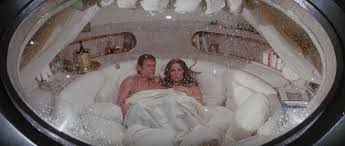
Connection – This is a weird one. (Surprise.) The film is called The Spy Who Loved Me and theme song is sung by a female so it’s reasonable it’s about Anya being loved by James. In the film Stromberg says Bond is “in love with a Russian agent.” But it doesn’t seem like either are in love with anyone. Anya seems to forgive him after finding out he killed her boyfriend, but it doesn’t seem the least bit romantic. This is the aloof Bond of the seventies. Even Q and Moneypenny are kept at arm’s length. Regardless, the film ends with James and Anya bobbing in the ocean in a luxury escape pod, complete with a bed and a chilled bottle of Dom Pérignon ’52. The pod floats into a cruising British destroyer where M and the British Ministers of Defense peer in through the window to see the two spies in flagrante delicto. “Bond! What do you think you’re doing?” asks the defense minister. “Keeping the British end up, sir.” And scene.

Toxic Masculinity Score: 6

Summary Watching this movie took me right back to the summer of ’77. The underwater submarine car battling frog men with their own subs was bliss for a 13-year-old boy. Catching a glimpse of Bach’s boob while sitting next to my dad was both terrifying and titillating. (See what I did there?) No part of me questioned the silly logic of the plot. Now I look at through the lens of 48 years of media. Stromberg has hundreds of henchmen all in red suits, like they were the henchmen of Squid Games. I wondered, who made these suits? Did Stromberg buy in bulk? Are they one size fits all? And do these henchmen get benefits? They all seem to be willing to die for him (and they all do). There should at least be life insurance in their benefits package. And dental.

The Spy Who Love Me, through that modern lens, has a pretty dim view of women. Bach, a few years after the film, said as much, telling People Magazine in 1983 that in the film Bond, “is a chauvinist pig who uses girls to shield him against bullets.” Moore himself said much the same in the 1970s. “Bond, like myself, is a male chauvinist pig. All my life I’ve been trying to get women out of brassieres and pants.” At least Bond doesn’t smack any women in this film on his way to thwart the accelerationist doomsday plot of this episode’s mad genius. While the mushroom clouds over the Atlantic might dampen the joie de vivre of the cold warriors warming things up the film’s climax, were left wondering will the aging Commander Bond will run out of notches on his belt before producers run of out of Ian Fleming novels to film.

Next: Moonraker (1979)

The James Bond Project #10: The Man with the Golden Gun (1974)

The James Bond Project #9: Live and Let Die (1973)

The James Bond Project #8: Diamonds are Forever (1971)

The James Bond Project #7: On Her Majesty’s Secret Service (1969)

The James Bond Project #6: You Only Live Twice (1967)

The James Bond Project #5: Casino Royale (1967)

The James Bond Project #4: Thunderball (1965)

The James Bond Project #3: Goldfinger (1964)

The James Bond Project #2: From Russia With Love (1963)

The James Bond Project: #1: Dr. No (1962)

The James Bond Project #6: You Only Live Twice (1967)

January 12, 2025

This series is intended to evaluate each product of the James Bond film franchise through a feminist lens, and the relevance of the Bond archetype to shifting ideas of masculinity in the 2020s.

You Only Live Twice (1967, directed by Lewis Gilbert)

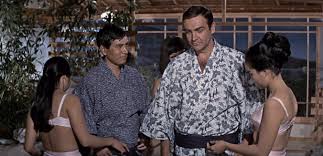
This might be the most Bondy Bond of all. Not only does it have the usual staples; underground lairs, evil global plots, white bikinis, and Blofeld’s pussy cat, but also a massive army of ninja warriors. I probably enjoyed it too much. Maybe it was the brilliant score by John Barry and dead volcanoes erupting. Maybe it’s because I watched it on a Saturday morning, hyped up on coffee and taking a break from the devastating news of the L.A. fires. Yeah, this was supposed to be Sean Connery’s last 007 film. The Scottish actor was worried he’d be forever typecast and announced that he’d be Bond no more before You Only Live Twice premiered. Maybe Connery’s weariness added to the “I could not give a damn” laconic attitude of 1967 Bond, making him that much more appealing to old school notions of rogue masculinity. It’s either Bond on auto-pilot or Bond fully realized. I can’t decide.

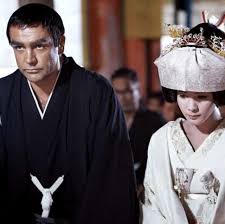
The screenplay for You Only Live Twice was written by acclaimed children’s book author Roald “Willie Wonka” Dahl. Dahl was a friend of Ian Flemming’s and (very) loosely adopted his novel for the screen. The original source paid mind to Japanese culture and Dahl retained the detailed Japanese wedding scene in the script. (Unlike other globe-hopping 007 films, the action here is primarily in Japan.) But Dahl had to create much of the plot himself. For example, producers told him Bond needed to make love to three women in the movie so he had to add two additional relationships in the screenplay.

The story is set in the 1960s space race between the US and USSR. We finally get to see Blofeld’s face and it’s great British actor Donald Pleasence. The British are trying to broker the peace between America and Russia as space capsules start disappearing from orbit. (Keep calm and don’t start World War 3.) They put Bond on the case who discovers that SPECTRE is helping an Asian country (presumably China) start a war between cold war adversaries so they can emerge from the ashes. (This plot seemed like it was as much 2025 as 1967. Because, you know, China.) After faking his own death, Bond ends up in Tokyo, after being shot out of a submarine torpedo tube without an air tank. (007 has very good lungs.) A welcomed sight is the large number of Japanese actors who were hired to make up a large percentage of the cast. Welcomed after the Hollywood tradition of making up white actors to look “Oriental.” (Breakfast at Tiffany’s, I’m looking at you.)

There are flushes of anti-Asian racism in You Only Live Twice. Connery’s first scene is in Hong Kong and Bond is in bed with an Asian woman. The first line of the film is, “Why do Chinese girls taste different from all other girls?” He then talks about how Peking duck is different from Russian caviar, but he loves them both. She replies, “Darling, I give you very best duck.” I laughed and I shouldn’t have. There’s a section where James has to be transformed into a Japanese villager that seems to mainly involve him putting on a Beatle wig. And so on. You Only Live Twice premiered in London on June 12 (with Queen Elizabeth in attendance), the same day the U.S. Supreme Court issued the Loving v. Virginia decision, legalizing interracial marriage, so maybe audiences were ready to see James in bed with non-white women. The film has plenty of that.

How doe Far East Bond fit in our analysis?

Driver of Action – After the ensemble romp of Casino Royale, we’re back to solo Bond. We don’t even get Felix Leiter on the scene. We do get Tiger Tanaka, head of the Japanese Secret Service (played by Tetsurō Tamba) to provide James with his ninja training and fix him up with his undercover Japanese wife, played by Mie Hama (who I remember from 1962’s King Kong vs. Godzilla). Tanaka also serves as something of a pimp for James. Taking Bond home, he says, ““Consider my house yours, including all of my possessions.” Then four young women in their underwear walk out. “In Japan, men always come first. Women come second,” he says as the women bathe Bond.

Role of Violence – 007 has a license to kill a ton of people in this movie. He shoots an assassin and then three or four dockworkers (while single-handedly fighting dozens), and countless henchmen in Blofeld’s under-volcano lair. There’s a SPECTRE agent who failed to kill Bond who Blofeld dumps in a pool of piranhas. (Bond also throws a henchman into the piranha pool.) The climatic battle between ninjas and henchmen probably has a body count above a hundred. There seems to be no remorse for anyone killed. It’s just entertainment.

Vulnerability – In the novel of You Only Live Twice, Bond’s mock Japanese bride is a woman named Kissy Susuki and the union produced a child. In the film she is not named. Before the wedding Bond asks Tiger Tanaka, “Is she pretty?” He replies, “She has a face like a pig,” and Bond grimaces. Of course she’s beautiful and later plays a role in James’ rescue. As has become rote, Connery’s Bond has zero moments of weakness, although the technology used is through the roof in this film. He needs his damn gadgets. Yet, Bond seems bulletproof. Literally. There are countless rounds fired at Bond, including from four attack helicopters and Jimmy doesn’t even suffer a scratch.

Sexual Potency – In 1967, I’m banking on the fact that part of the pitch of You Only Live Twice was that is was chocked full of “exotic” Asian women. From the first scene with Bond in bed with Aki (played by Akiko Wakabayashi)l, who throughout the film rescues 007 in her white sports car, to Tanaka’s House girls, there is plenty of “exotic” on display. (It’s worth noting that when Tanaka offers Bond one of his “girls” for Bond to take back to his room, Bond picks the one that’s most likely a white actress made up to look Japanese.) Then there’s Helga Brandt, a SPECTRE assassin who has James tied to chair and becomes sexual with him. (She’s a redhead. That’s what they do.) James talk her out of holding him and then uses her knife to cut the straps on her dress. “Oh, the things I do for England,” he mutters. (She later tries to again kill him by jumping out of the plane she’s flying.) James also tries to get busy with his mock wife, but she pushes him away and he then pushes away a plate of raw oysters. “Well, I won’t need these,” he says. Is JB suffering from ED?

Connection – Bond’s connection to his co-workers is minimal. M and Q make brief appearances. Q arrives in Tokyo to bring a cool mini-helicopter with heat seeking missiles! Even Bond’s usually flirtatious relationship with Moneypenny seems to have cooled off. He doesn’t even sexually harass her. When Aki, who saved Bond’s bacon more than once, is poisoned in bed next to him, he seems nonplussed. Connery’s weariness by the fifth film is reflected in Bond’s lack of effort with the women in the film and also in a stanza from the theme song, sung by Nancy Sinatra: “You drift through the years and life seems tame ‘til one dream appears and Love is its name.” As must now be required, the film ends with Bond and his mock wife (Kissy Suzuki is definitely a “Bond girl”) in a boat, another rescue raft in another sea. ”Now about that honeymoon,” he says to her. Then viewers are told that On Her Majesty’s Secret Service is on its way (along with the next batch of Bond girls).

Toxic Masculinity Score: 7

Summary It was Ian Fleming’s intent that readers of You Only Live Twice learn more about Japanese culture. When the book came out in 1964, we were only 19 years from the nuking of Japan and the end of WWII. Dahl devoted screen time to Sumo wrestling, the traditional wedding, and the rise of Japanese corporate power (there are a lot of Toyotas in this flick). But we also get nods to the Japanese version of patriarchy with Tiger Tanaka’s house girls as well as the standard English Bond jokes, like when Helga, referring to a warning about smoking, says, “Mr. Osato believes in a healthy chest” as her own chest fills the camera frame.

One wonders what You Only Live Twice would have been like if the James Bond-Kissy Suzuki marriage had been truer to the original novel. Instead we get tired James floating off be played by another actor, likely stepping into the well-established formula.

Next: On Her Majesty’s Secret Service (1969)

The James Bond Project #5: Casino Royale (1967)

The James Bond Project #4: Thunderball (1965)

The James Bond Project #3: Goldfinger (1964)
The James Bond Project #2: From Russia With Love (1963)

The James Bond Project: #1: Dr. No (1962)

Jukebox Hero 3: Right Here, Right Now Watching the World Wake Up

I’m occasionally posting some chapters from my “rock memoir,” Jukebox Hero. This seemed like a relevant piece in the wake of Generation Z’s moment in history. Here are some others:

Jukebox Hero 1: Queens of Noise

Jukebox Hero 2: I Will Follow

Jukebox Hero: Bridge Chapter A– “Right Here, Right Now”

I took a break from my trips to Europe after 1987 when I got the job managing the Atlanta band drivn’n’cryin’. The Europe I knew was on the frontline of the cold war between the U.S. and the Soviet Union. The Frankie Goes To Hollywood song, “Two Tribes” was more of a cautionary tale than a dance hit. “When two tribes go to war, one point is all that you can score.” I had marched in CND (Campaign for Nuclear Disarmament) parades in London and a cheered when 70,000 protestors blockaded the RAF Greenham Common nuclear missile base in Berkshire, England in 1983. The window of my squat in Brixton looked out at a massive mural of a nuclear holocaust. Western Europe was Ground Zero for the beginning of the end.

Brizton83

I met a Russian kid named Yuri in Denmark in 1986 who had recently defected to Finland and told me that the Soviet people were deathly afraid of the madman living in the American White House, Ronald Reagan. In 1984, I had tried to see George Harrison’s English house in Henlely-on-the-Thames only to be told that Beatle George had moved his family to Australia out of fear of nuclear war. I made it to West Germany twice, only to witness a heavy presence of the American military and anger that American and Soviet egos were pushing Europe towards nuclear annihilation.

The U.S. policy that was just a budget item or back page news story to most Americans was more than life and death to Europeans. It was mass extinction.

By 1989, I had a good 7-years in protesting the Reagan-Bush arms race under my belt. In 1983, at the tender age of 19, I became a lobbyist in Washington DC for the nuclear freeze movement. When Mikhail Gorbachev began the Soviet period of Glasnost in the late 1980s, it seemed like World War III might be avoided and, more, importantly, that I could finally get into the Soviet Union with a duffle bag full of Levis.

images

So it was with intense excitement that I watched the Iron Curtain begin to crack in the last minutes of the 1980s. I watched East and West Germans take sledgehammers to the Berlin Wall from a TV in my apartment in Atlanta with tears streaming down my face. People were escaping the oppressive regimes in Romania and Hungary and by 1991 the Soviet Union was collapsing.

I had to get back to Europe to be a part of this moment in history. Just like I had to be in London in 1985  for Live Aid, I had to be back at the frontline for the end of the Cold War. The door to Eastern Europe was finally open and their was a blank slate for the new decade. When I was offered a teaching assistantship in London for an Emory study abroad course, I packed my bags.

MikeM91

In 1991, I was 27-years-old and fully invested in the rock-and-roll lifestyle. I had been teaching undergrads at Emory but spent most of my time on the road or in the studio with drivin’ n’ cryin’. With my long bleached hair and black stretch jeans, I probably didn’t look like the typical university TA.

Once in London, I tried to turn on the American students to the city I knew and loved; shopping in Camden Market, seeing bands at the Marquee Club, and endless pub crawls. While there, I got hooked on going to the theater in the West End, seeing Les Miserables four times. I sent a postcard to my girlfriend, back in Atlanta, that said, “I’m still straight but I LIVE for the musical theater!” And it wasn’t just American university kids in those seats. I started to notice a new subculture in the West End, Russian tourists.

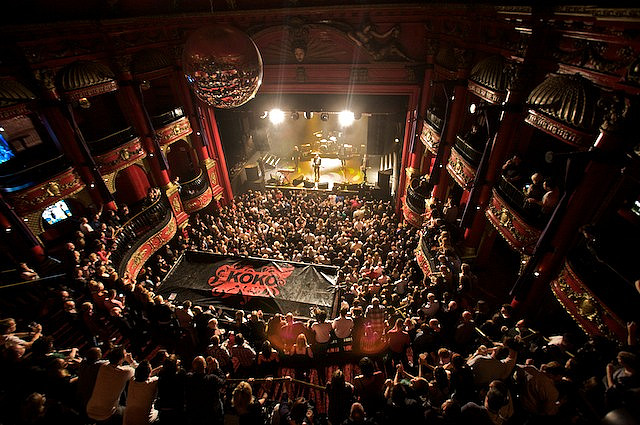
One of the places I loved to take the students was my favorite dance club, the Camden Palace.  The hall opened in 1900 as the Camden Theater but had been the Palace since 1982. It was at the Palace in 1983 I had met a nice German girl at the bar. I was trying to chat her up when she realized the guy at the bar next to me was Limhal. Limhal was the poofy-haired singer of Kajagoogoo who were topping the pops that summer with the airy hit, “Too Shy.” Despite the rumors that he liked boys, Limhal scooped in and purloined my fraulein. Damn you, Limhal!

648878a2076d17af0a37b7aecbd7e3f7

In the summer of 1991, Thursdays were “guitar rock” nights at the Palace. Kids from around the globe met to dance to R.E.M., Happy Mondays, and Ned’s Atomic Dustbin. There was a song by The Wonder Stuff, “The Size of the Cow” that always filled the dance floor; Americans, French kids, Italians, and the ever-trendy London scenesters. I loved Thursday nights at the Palace because the music kicked ass and you didn’t need a partner to dance with. It was like being at a rock concert. You just hit the floor of the old theater and felt the energy of the crowd.

One particular night in late July, I dragged a few students to the ornate club. I wanted to share the fun of dancing to the new music of the decade with the youth of the world. London always felt like the center of the hipster planet. In London, you can find the best African music, the coolest Middle Eastern late night cafés, and the most over-the-top South American dancers. Going to London, was never like going to “Merry Old England.” It was always like being present in all that was important to the world.

990226f008f654cbcbe93a78f8866e68--culture-shock-fence

On that night, the floor was particularly rocking. There was a new wave of kids making it to London from the newly free Eastern European countries. You could identify the “Easterners” because they grew up completely removed from any black culture and danced like it. It didn’t matter. For the first time since before Hitler fucked everything up, Europe felt truly united. The next song was Jesus Jones, “Right Here, Right Now,” which was inspired by the fall of communism. The Russian kids and the Czech kids crammed on to the dance floor. Taking their lead, the German kids and the Swedish kids followed.

There were so many people on the dance floor for this song, no one could move. Instead, everyone hugged and jumped up and down and wept. This is what freedom felt like. We weren’t East and West anymore. We were kids who wanted to dance and not get nuked. I had danced at the Palace in 1982 amid fear of atomic bombs. In 1991, I danced in love with the world. We had all survived the long war. You know it feels good to be alive.

I was alive and I waited for this

Right here, right now, there is no other place I want to be

Right here, right now, watching the world wake up from history.

I still get chills every time I hear that song. I’m sure there are Baby Boomers who have one song that crystallizes what it meant to be a part of that generation, but for me it’s that Jesus Jones song that finally plugged me in to my time on Earth; a song that would later become a K-Mart ad and a Ford commercial.

Later that summer, while traveling through Eastern Europe, I was on a train pulling into a station in East Berlin. It was 3:30 in the morning and there was one East German kid on the platform with a beat up boombox. He was playing a tape of the Scorpions’ new song “Winds of Change” over and over. I just listened to the lyrics about the new Europe bounce around the crumbling old regime. Music had the power to ferry us through massive historical shifts. For the rest of our human existence, historians would muse about this massive global right turn, but, in the moment it occurred, it all came down to a song.

1053780268.2416173149

In 2003, Vladimir Putin told Paul McCartney that it wasn’t Ronald Reagan that ended the Cold War, it was The Beatles – that once Russian kids heard that sound, they stopped caring about the Communist Party and just wanted to join the world party. When they grew up, they pulled the plug on the USSR and came out to dance.