
February 5, 2025
This series is intended to evaluate each product of the James Bond film franchise through a feminist lens, and the relevance of the Bond archetype to shifting ideas of masculinity in the 2020s.
The Spy Who Loved Me (1977, directed by Lewis Gilbert)

This was the first Bond film I saw in the theater. My dad took my little brother and I to see the PG-rated Spy Who Loved Me the summer of ’77. I was 13 and what I remember most was the brief glimpse of Barbara Bach’s (or her body double’s) right breast in the submarine shower scene. I was 13, OK? But The Spy Who Loved Me was a return to form after the limp Man with the Golden Gun in 1974. It had all your musts, including oodles of cool gadgets from Q, Bond in his tux and bad girls in bikinis, scores of henchmen willing to die for a megalomaniac, and sharks. My absolute favorite part of the film when I was a kid (besides the boob) was the Lotus Esprit that turned into a submarine, complete with missiles. I thought that was the coolest thing on earth and dreamed of a submarine car of my own. Ironically, in 2013 actual megalomaniac supervillain Elon Musk bought the film’s Lotus for £616,000 in hopes of turning it into a workable submarine. (Like most of his crazy ideas, he failed.)

Roger Moore definitely is getting his mojo back in his third installment in the Bond franchise. While his lines still fall a bit flat, he’s got Bond “girls” dripping from his arms. On top of the TSWLM list is Barbara Bach as KGB agent Anya Amasova, AKA Agent XXX (get it?). Bach was a model and Spaghetti Western actor who would next star in Caveman (1980) with her future husband, Beatle Ringo Starr. (Rumors were that Moore wanted Brigitte Bardot for the role.) As a sort of seventies Blofeld, this installment’s villain is wealthy industrialist Karl Stromberg, who wants to destroy the world so he can build a new world under the ocean. Stromberg is played by Curt Jürgens, who starred with Bardot in And God Created Woman in 1956. Added to the cast is Richard Kiel, who stars as the indestructible steel toothed giant, Jaws. The return of You Only Live Twice director Lewis Gilbert helped to bring some of the Connery-era swagger back to 007’s mission.
As is expected, the exotic locales splash across the screen. Bond riding a camel across the Egyptian desert and then chasing the bad guys through the Giza ruins was not filmed on an English set. It was there on sight, as were the scenes filmed on the Italian island of Sardinia. We return to some classic Bond tropes, like assassins on skis (On Her Majesty’s Secret Service) and underwater battles (Thunderball). There’s sexy one-liners (Her: But James, I need you! Him: So does England.) And sexist one-liners (James commenting on a woman in a bikini in a boat, in front of Anya, posing as his wife – “What a handsome craft. Such lovely lines.”) And while we don’t get an underground lair, we get an under WATER lair that serves its purpose.
The Spy Who Loved Me premiered in the United States on August 3, 1977, the same day that the Tandy Corporation debuted the first mass produced microcomputer, the TRS-80, forever changing popular culture and gadgets in James Bond movies. The film received mixed reviews but fared better than its predecessor. Boosted by a great theme song, sung by Carly Simon (and constantly on the radio the summer of 1977), the film was United Artists biggest grossing movie to date, but competed in theaters with the box office sensation that was Star Wars, putting it at #8 for the year (between The Deep and Oh, God!)
Let’s put The Spy Who Loved Me in our feminist evaluation machine.
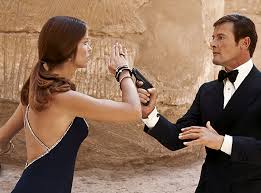
Driver of Action – I’m getting the feeling that the formula for Moore’s Bond films are it’s just him. Even though he’s paired up with a Soviet spy, Anya Amosova, this isn’t a buddy film. She’s primarily sexy arm candy whom 007 has to rescue. (Although there is one scene in Egypt where she throws up her arms in a Charlies Angels karate pose that I thought was going to give us some Russian aggression, but no such luck.) James does not even have a support team. We get brief cameos by Q and Moneypenny, but this is just James.
Role of Violence – 007 kills some people in TSWLM. At the start of the film he shoots a Soviet agent (who is Anya’s boyfriend) with a rocket ski poll while skiing backwards. He drops one of Stromberg’s henchmen off a roof in Cairo, and then kills a half dozen more in a crazy car chase in Sardinia, including killing a bikini-clad helicopter pilot with a missile from his submerged Lotus. When the action moves to Stromberg’s tanker, which is being used to capture nuclear submarines, 007 with a machine gun goes on a rampage. There are literally bloodless corpses everywhere. Where’s the blood? And James shoots Stromberg multiple times in his underwater HQ.
Vulnerability – There is actually a mention of Bond being married in the film. Anya brings up that he was married and his wife was killed and he stops her from going any further. It was almost a moment of James the person. The break from James performing “007” was jarring but it only lasted for a split second and then it was back to Robot Bond.

Sexual Potency – This version of Bond wants to be as horizontal as possible. Miss Moneypenny might be too old for him in the late 70s, but every other women on the screen is fair game for his jacked up libido. To be fair, the film starts with a twist on the familiar theme. A man that looks like James is in bed with a beautiful woman when the phone rings. We learn that the woman is actually a Soviet agent, Anya Amosava, and the man is just a lover. Never fear, the very next scene is James in bed with a Russian woman in Austria. It’s a clever trick perhaps meant to say that women can play this game. James in Egypt meets a very white sheik who has a harem of beautiful women. When Bond is offered one of the women for the night he says it would be rude to refuse the offer. In Cairo, he meets another woman who is linked to a connection. He tries to seduce her but ends up using her body to block an assassin’s bullet. Oh well.
The rest of the film is about James and Anya, cold war enemies who have teamed up for some “Anglo Soviet cooperation” to stop this dude who is stealing submarines and wants to blow up the world. Bond can’t keep his hands off her and she may just be playing him by letting his hands and lips wander. But there is a scene on a train (You know, the scene on the train!) where Jaws attacks James and Anya and Bond tosses him out of the train window (We’ve seen this movie before) and Anya says, “You saved my life.” The sexy sax version of theme song swells up as James takes her in his arms. Later, the film ends with 007 and XXX getting busy in a preview of Glasnost ten years down the road.
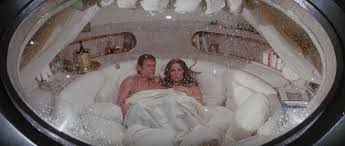
Connection – This is a weird one. (Surprise.) The film is called The Spy Who Loved Me and theme song is sung by a female so it’s reasonable it’s about Anya being loved by James. In the film Stromberg says Bond is “in love with a Russian agent.” But it doesn’t seem like either are in love with anyone. Anya seems to forgive him after finding out he killed her boyfriend, but it doesn’t seem the least bit romantic. This is the aloof Bond of the seventies. Even Q and Moneypenny are kept at arm’s length. Regardless, the film ends with James and Anya bobbing in the ocean in a luxury escape pod, complete with a bed and a chilled bottle of Dom Pérignon ’52. The pod floats into a cruising British destroyer where M and the British Ministers of Defense peer in through the window to see the two spies in flagrante delicto. “Bond! What do you think you’re doing?” asks the defense minister. “Keeping the British end up, sir.” And scene.
Toxic Masculinity Score: 6
Summary Watching this movie took me right back to the summer of ’77. The underwater submarine car battling frog men with their own subs was bliss for a 13-year-old boy. Catching a glimpse of Bach’s boob while sitting next to my dad was both terrifying and titillating. (See what I did there?) No part of me questioned the silly logic of the plot. Now I look at through the lens of 48 years of media. Stromberg has hundreds of henchmen all in red suits, like they were the henchmen of Squid Games. I wondered, who made these suits? Did Stromberg buy in bulk? Are they one size fits all? And do these henchmen get benefits? They all seem to be willing to die for him (and they all do). There should at least be life insurance in their benefits package. And dental.
The Spy Who Love Me, through that modern lens, has a pretty dim view of women. Bach, a few years after the film, said as much, telling People Magazine in 1983 that in the film Bond, “is a chauvinist pig who uses girls to shield him against bullets.” Moore himself said much the same in the 1970s. “Bond, like myself, is a male chauvinist pig. All my life I’ve been trying to get women out of brassieres and pants.” At least Bond doesn’t smack any women in this film on his way to thwart the accelerationist doomsday plot of this episode’s mad genius. While the mushroom clouds over the Atlantic might dampen the joie de vivre of the cold warriors warming things up the film’s climax, were left wondering will the aging Commander Bond will run out of notches on his belt before producers run of out of Ian Fleming novels to film.
Next: Moonraker (1979)

The James Bond Project #10: The Man with the Golden Gun (1974)
The James Bond Project #9: Live and Let Die (1973)
The James Bond Project #8: Diamonds are Forever (1971)
The James Bond Project #7: On Her Majesty’s Secret Service (1969)
The James Bond Project #6: You Only Live Twice (1967)
The James Bond Project #5: Casino Royale (1967)
The James Bond Project #4: Thunderball (1965)
The James Bond Project #3: Goldfinger (1964)




 Watching the Wheels