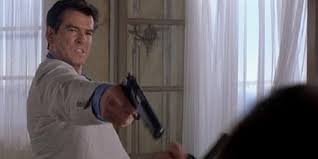
The James Bond Project #27: No Time to Die (2021)

This series is intended to evaluate each product of the James Bond film franchise through a feminist lens, and the relevance of the Bond archetype to shifting ideas of masculinity in the 2020s.

No Time to Die (2021, directed by Cary Joji Fukunaga)

August 27, 2025

And in the end. Here we are at the final (for now) review. The final Daniel Craig performance as James Bond. The final 007 in the 59 year history to be produced by Eon Productions and anyone named Broccoli. And perhaps the last Bond film ever. Spoiler: James dies but rumors of another reboot abound. Last February, Amazon/MGM bought the franchise from Eon, so we may get another generation of 007, perhaps AI generated.

No Time to Die,  the 25th Eon Bond film, wraps up the Bond story in some interesting ways. Danny Boyle was to direct but backed out at the last minute so True Detective director Cary Joji Fukunaga took on the job. Daniel Craig, 51 at the time, who’s body had been battered by the role, reportedly said he’d rather slash his wrists than play Bond again. MGM reportedly offered him $100 for two more Bond films, which he turned down. He utilmateiy accepted a payday of $25 million for a film that would tie up the Bond story’s loose ends. We’d see some familiar faces for the last time, including Jeffrey Wright as Felix Leiter, Ralph Fiennes as M, Naomie Harris as Moneypenny, and Christoph Waltz as Blofeld.

NTTD doesn’t really have a Bond girl in the traditional franchise sense. For the first time, a female lead returns in a film. Léa Seydoux, who played James’ love interest, Dr. Madeleine Swann in Spectre, returns in NTTD and she has a surprise for 007. Ana de Armas, who racked up the awards as Marilyn Monroe in 2022’s Blonde, is CIA agent Paloma and she out-La Femme Nikita’s Nikita. Her action scenes are the highlight of the film.

The final installment gives us the expected Bond tropes, including our final underground lair, Bond in a tux, cool gadgets (including a glider submarine), exotic locations (Bond’s back in Jamaica!), and more than one Aston Martin. But this Bond is not the walled-off Lothario of the past six decades. Craig still plays him with smirky panache, but NTTD 007 is a family man.

For one last time, let’s plug the film into our evaluation matrix and see how the final Bond film ranks in our toxic masculinity scale.

Driver of Action – It makes sense that the final film centers on Bond himself. As Spectre ended, we have James leaving MI-6 to be with Madeline. The MI-6 crew, including Q, play small roles. There’s even a new 007, who, fittingly, is a black female, played by Lashana Lynch. Bond is reunited with CIA agent Felix Leiter, who is killed by a bad DOJ agent. The diversion from solo Bond is the scene with Ana de Armas in Cuba where they make an excellent team opening an epic can of whoop ass on Spectre.

The Role of Violence – Rogue Bond doesn’t need a license to kill, but when he’s reinstated to MI-6, his body count is off the charts. The Cuba scene with the Paloma has the highest kill rate in Bond history and in the Norway chase scene and the underground island lair of the assassin Safin (played by future Freddie Mercury Rami Malek) we see countless henchmen mowed down. Fan count is 27 killed but it felt like twice that. As usual, Bond dodges an endless hail of bullets, but one fired by Safin, finds him, leading to his death as British missiles destroy the island base.

Vulnerability – James Bond has never been more vulnerable in a James Bond film. The first part of the film, Bond is plagued by thoughts of Vesper Lynn, his previous love interest who died. Then he’s plagued by thoughts that Madeleine has betrayed him. Then he learns that that was a mind trick by Blofeld. Reunited with Madeleine, he learns that he has a child named named Mathilde. In the end he sacrifices himself to save Mathilde and Madeleine.

Sexual Potency – That’s not really the vibe in this film. The films opens with James and Madeleine, in love in Italy, including a scene in bed. He tries to make the moves on a woman in his room in Jamaica until he learns she is an MI-6 agent, the new 007 (in a scene that felt like an homage to Live and Let Die). He briefly flirts with Paloma until they get busy killing Spectre baddies. NTTD is a Dad Bond film.

Connection – Jame is fully connected to Madeline in this movie. Even in the scene where he puts her on the train after he believes she tried to kill him is full of pathos. Later in the film, he tells her, “I have loved you and I will love you.” Once he learns Mathilde is his daughter, the parent protection gene is unleashed and he is focused on saving his people. NTTD has no cute epilogue where we see he’s survived the missile strike and on a boat, drinking martinis with Madeleine. We see him blown up real good and the film ends with Madeleine telling their daughter about her heroic father.

Toxic Masculinity Scale: 1

Summary: NTTD might score higher because of the constant explosion of gun violence, but paternal Bond levels all that out. Even the title sequence steps back. Over a great Oscar-winning theme song by Billie Eilish, instead of the titles being projected on the bodies of nude women, it’s over Bond and his weapons. It should also mentioned that the credits included the names of many women, not just hair and make-up and casting. For reasons that might be sad (the end of Eon Bond films), we finally get a more human model of masculinity from Ian Flemming’s iconic character.

No Time to Die’s release was held up by the COVID pandemic. Principle photography wrapped in October 2019, but post-production was shuttered during the lockdown. The final Eon Bond film had its world premiere on September 28, 2021 at London’s Royal Albert Hall and landed in a market where most theaters were still closed. A month later, the global deaths from COVID-19 topped 5 million.

Because of the nature of corporate ownership of film franchises, nobody really lamented No Time to Die as the LAST JAMES BOND MOVIE EVER. In fact, “Bond 26” is currently being written by Peaky Blinders creator Steven Knight and Dune director Denis Villeneuve is tapped to direct. Who will play the new Bond? Rumors are floating about Kick Ass star, Aaron Taylor-Johnson. I’ve been routing for Idris Elba, but he might be a little old. Could it be a person of color? Or even a woman? I mean, why not? We can only hope the new Bond is a healthier versions of masculinity that is both vulnerable and lethal. He (or she) still has a license to kill, after all.

The James Bond Project #26: Spectre (2015)

The James Bond Project #25: Skyfall (2012)

The James Bond Project #24: Quantum of Solace (2008)

The James Bond Project #23: Casino Royale (2006)

The James Bond Project #22:  Die Another Day (2002)

The James Bond Project #21:  The World Is Not Enough (1999)

The James Bond Project #20:  Tomorrow Never Dies (1997)

The James Bond Project #19: GoldenEye (1995)

The James Bond Project #18: License to Kill (1989)

The James Bond Project #17: The Living Daylights (1987)

The James Bond Project #16: A View to a Kill (1985)

The James Bond Project #15: Never Say Never Again (1983)

The James Bond Project #14: Octopussy (1983)

The James Bond Project #13: For Your Eyes Only (1981)

The James Bond Project #12: Moonraker (1979)

The James Bond Project #11: The Spy Who Loved Me (1977)

The James Bond Project #10: The Man with the Golden Gun (1974)

The James Bond Project #9: Live and Let Die (1973)

The James Bond Project #8: Diamonds are Forever (1971)

The James Bond Project #7: On Her Majesty’s Secret Service (1969)

The James Bond Project #6: You Only Live Twice (1967)

The James Bond Project #5: Casino Royale (1967)

The James Bond Project #4: Thunderball (1965)

The James Bond Project #3: Goldfinger (1964)

The James Bond Project #2: From Russia With Love (1963)

The James Bond Project: #1: Dr. No (1962)

The James Bond Project #23: Casino Royale (2006)

May 30, 2025

This series is intended to evaluate each product of the James Bond film franchise through a feminist lens, and the relevance of the Bond archetype to shifting ideas of masculinity in the 2020s.

Casino Royale (2006, directed by Martin Campbell)

This is not your grandfather’s 007. Casino Royale was meant as Eon Production’s 21st century reboot of the Bond series.  Gone are Q, Moneypenny, endless sexual double entendres, laser watches, and the dumb CGI of Die Another Day. And gone is the brunette James as Daniel Craig steps into the role. The story starts with Bond earning his “00” license to kill, so we can frame it as a prequel, but the film still features Judi Dench as M, so it’s not clear where the story fits in the 007 timeline, if there is one.

Producers Barbara Broccoli and Michael G. Wilson brought GoldenEye director Martin Campbell back in for a bit of continuity (although Quentin Tarantino expressed interest in taking the gig). The hunt for a new James Bond was massive and included possible candidates such as Christian Bale, Hugh Jackman, Keith Urban, Ralph Fiennes, and Ewan McGregor. After initially rejecting the role, Craig took the job in 2005.  The casting of Bond “girl” Vesper Lynd also had long list, including Angelina Jolie, Charlize Theron, Audrey Tautou, Rachel McAdams, and Olivia Wilde. Finally producers cast French actress Eva Green (who I absolutely loved in 2003’s The Dreamers).

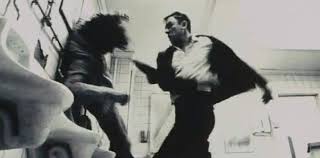
Casino Royale, while based on the same Ian Flemming novel as the 1967 spoof, starring Peter Sellers, is darker Bond that centers practical stunt work over impossible gadgets. The opening scene is shot in black and white and looks more like a scene from Dr. Strangelove than a sprawling action adventure flick. The opening credit montage features the iconic eye shot followed by a great theme song, sung by Soundgarden’s Chris Cornell. But instead of images of women’s bodies, it’s all Bond. We still have the prerequisite globe trotting, Aston Martins, and Bond gambling in a tux, but so much of this film shatters the Bond formula and that was the intent.

Let’s plug this Casino Royale into our evaluation criteria.

Driver of Action – Each time we get a new Bond, the story tends to revolve around him. There is a small MI-6 team that involves Vesper, and we get the return of Felix Leiter (played by Jeffrey Wright, who was so great in Basquiat). As we get in the final shot of the film, this movie belongs to Bond, James Bond.

Role of Violence – Not only can Daniel Craig’s Bond run more than Tom Cruise in any Mission Impossible film, he can kill without remorse. He takes out 11 or 12 bad guys in the film, including drowning a guy in a bathroom sink in the first scene. He remarks that his second kill, a rogue MI-6 officer, is much easier. He shoots an unarmed bomb maker in Madagascar, which creates some bad press for MI-6. His ability to fight the bad guys to death, seems superhuman at time, but this is a James Bond film after all.

Vulnerability – Big shift here. While we get the strong silent bit out the wazoo (M says, “I would ask you if you could remain emotionally detached, but that’s not your problem, is it, Bond?”) We do see fear on Bond’s face when he is about to be tortured  by Le Chiffre (played by creepy Mads Mikkelsen). He should be. The torture is him being repeatedly hit in the scrotum, sending him to the hospital. He also shows great grief when Vesper dies, even though she double crossed him. The scene mirrors the final moment of On Her Majesty’s Secret Service (1967), with James Bond in tears, holding his dead wife.

Sexual Potency – Bond makes a quip about married women being his type, after he beds Solange Dimitrios, wife of a bad guy. MI-6 pairs him with Vespers Lynd, who keeps him at arms length for most of the film. Of course, they end up in bed together. But that’s it. This Bond ain’t a player.

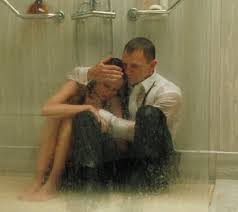
Connection – This is where 2006 Bond really departs from the formula. There’s a scene where a traumatized Vespers is sitting in a hotel room shower, and James steps in and holds her. There is a strong connection between the two. After they survive near death and torture stopping Le Chiffre, James is in the hospital and Vesper says, “You’re not going to let me in there, are you? You’ve got your armour back on. That’s that.” And he replies, “I have no armour left. You’ve stripped it from me. Whatever is left of me – whatever is left of me – whatever I am – I’m yours.” Who is this man who recognizes the “00” prevents him from being able to love? This scene was 44 years in the making. James resigns from MI-6 to run off with her. Of course, this is a James Bond movie so you know there will be no happily ever after.

Toxic Masculinity Scale: 2

Summary

Casino Royale has enough Bond tropes to connect it to the genre. As a poker player I absolutely loved the extended scenes of Bond, Leiter and Le Chiffre playing high stakes Tex Hold ‘em. Gripping. The film also turns some of those tropes upside down. We get Bond back in the Bahamas coming out of the water like Ursula Andress in Dr. No (1962), his body on full display. This James plays more the role of psychoanalyst than sexual conquerer. But he’s still portrayed as a man’s man. (Vesper: You know, James, I just want you to know that if all that was left of you was your smile and your little finger, you’d still be more of a man than anyone I’ve ever met. James: That’s because you know what I can do with my little finger.)

The high level of violence in the film led to Casino Royale being re-edited in numerous countries, including the United States, Britain, Germany and China. But the film is securely located in the 2000s, with the prevalence of cell phones, a parkour inspired chase scene in Madagascar, and the Body Worlds exhibit in Miami.

Casino Royale premiered in London’s Odeon in Leicester Square (where I saw the premiere of Pink Floyd’s The Wall in 1982) on November 16, 2006, with Queen Elizabeth and Prince Phillip in attendance. It’s the same week Nintendo’s Wii and Sony’s Playstation 3 hit the market, so there was a competition for young male eyeballs. The film received rave reviews with the Rotten Tomatoes website reporting,  “Casino Royale disposes of the silliness and gadgetry that plagued recent James Bond outings, and Daniel Craig delivers what fans and critics have been waiting for: a caustic, haunted, intense reinvention of 007.”

Maybe after four decades James learned the weight of his license to kill.

Next: Quantum of Solace (2008)

The James Bond Project #22:  Die Another Day (2002)

The James Bond Project #21:  The World Is Not Enough (1999)

The James Bond Project #20:  Tomorrow Never Dies (1997)

The James Bond Project #19: GoldenEye (1995)

The James Bond Project #18: License to Kill (1989)

The James Bond Project #17: The Living Daylights (1987)

The James Bond Project #16: A View to a Kill (1985)

The James Bond Project #15: Never Say Never Again (1983)

The James Bond Project #14: Octopussy (1983)

The James Bond Project #13: For Your Eyes Only (1981)

The James Bond Project #12: Moonraker (1979)

The James Bond Project #11: The Spy Who Loved Me (1977)

The James Bond Project #10: The Man with the Golden Gun (1974)

The James Bond Project #9: Live and Let Die (1973)

The James Bond Project #8: Diamonds are Forever (1971)

The James Bond Project #7: On Her Majesty’s Secret Service (1969)

The James Bond Project #6: You Only Live Twice (1967)

The James Bond Project #5: Casino Royale (1967)

The James Bond Project #4: Thunderball (1965)

The James Bond Project #3: Goldfinger (1964)

The James Bond Project #2: From Russia With Love (1963)

The James Bond Project: #1: Dr. No (1962)

The James Bond Project #21:  The World Is Not Enough (1999)

May 1, 2025

This series is intended to evaluate each product of the James Bond film franchise through a feminist lens, and the relevance of the Bond archetype to shifting ideas of masculinity in the 2020s.

The World Is Not Enough (1999, directed by Michael Apted)

Four decades of 007 movies and so many bullets fired at Bond. Not that I want to see James get shot, but couldn’t one bullet at least graze his perfect temple? The World Is Not Enough, Pierce Brosnan’s third go at 007, finds Brosnan comfortably coasting as Bond in a film with epic stunts but not much else. Eon Productions still seems unsure of Bond’s role in a post-Cold War world, so they rely on the time-tested (over 37 years! That’s 4 years older than Jesus Christ!!) conventions. James in a tux in a casino. James wrestling a nuclear submarine. James and his obligatory three sexual conquests. Yawn.

Barbara Broccoli wanted to find a director who could bring out strong female performances. (Peter Jackson, pre-LOTR, had been considered.) She settled on Michael Apted because of his work with Sigourney Weaver (Gorillas in the Mist), Jodie Foster (Nell) and Sissy Spacek (Coal Miner’s Daughter). All three women were nominated for Oscars (with Spacek winning). One would think that would lead to a more woman-centered film, especially after the heavy reliance on Michelle Yeoh in Tomorrow Never Dies. Nope. TWINE is about as boilerplate Bond as we get.

Side note, as a viewer who has been keeping an eye on the credits of these films, the one filmmaking role that is most constantly populated by women (besides costumes, and hair & makeup) is the casting director. According to 2025 data, 74% of casting directors in the United States are women. So one wonders what casting director Debbie McWilliams was thinking when she cast Denise Richards as nuclear physicist Dr. Christmas Jones. Richards was an “it” girl in the late 90s, starring in two of my favorite fluff films of the era, Starship Troopers and Wild Things. She might be believable cast as a substitute high school science teacher (maybe), but as a nuclear physicist dressed as Lara Croft, completely laughable. Maybe Barbara Broccoli was trying to hold on to the horny teenage boy demographic (who, in 1999, were heavily breaking for Natalie Portman in Star Wars: Episode I – The Phantom Menace).

There were some casting coups in TWINE. Robert Carlylem, who had been so great in Trainspotting, was cast as the psychotic terrorist, Renard. And Sophie Marceau, the French actress who stared in Braveheart and Anna Karenina, played the erotically complex role of Electra. But most notable was the final performance of Desmond Llewelyn as Q. The one consistent thread through the Bond franchise was Llewelyn’s Q, starting with From Russia with Love in 1963, through 17 films. TWINE had Q training his replacement, R (played by Monty Python’s John Cleese) and joking about retirement, but his fate in the series was sealed. Three weeks after the premiere of TWINE, Llewelyn, 85, was driving home in his Renault Mégane, when he was hit head on by 35-year-old man in a Fiat. To die a young man’s death.

The World Is Not Enough, as expected, has plenty of exotic locations, including Spain, Azerbaijan, and an UNDERGROUND LAIR in Kazakhstan. We even get the Bond staple of 007 on skis being chased by Russian assassins. (Don’t fix it if it ain’t broke.) But this film finally gives us an action sequence in London with an epic boat chase on the Thames that climaxes with Bond flying off his rocket boat and grabbing a dangling rope of hot air balloon that the beautiful assassin is getting away in. (Assassin played by Maria Grazia Cucinotta. I had to look her up.) Cinema!

The 20th century of Bond ended, not with a bang, but with a meh. Let’s analyze it.

Driver of Action – Unlike the previous film, TWINE is a Bond solo vehicle. There’s a subplot about a relationship between Renard and Electra but it’s barely dealt with. M has more of a role but she’s mostly another damsel in distress for 007 to rescue. The world is not enough for the black hole that is James Bond.

Role of Violence – The body count is significantly less than the last two Brosnan films. About 19, if you don’t count all the henchmen that drown in the nuclear submarine. He kills Renard with a nuclear fuel rod to the chest. More dramatic is when he confronts Elektra for planning mass murder. “You wouldn’t kill me. You’d miss me,” she says. “I never miss,” he says then shoots her in the chest. She dies in her bed and Bond lays on top of her in one of the creepiest moments in the franchise.

Vulnerability – Early in the film we see James wearing glasses, but they may be a disguise, not a sign of aging. Later, when the beautiful assassin blows up her hot air ballon, he falls, crashing on a roof and dislocating his shoulder. It’s not getting shot, but it’s something. Later, Elektra talks about the death of her mother and asks James, “Have you ever lost someone?” but the scene moves on before we can get a glimpse of James recalling the death of his wife. That inference is left for longtime Bond fans.

Sexual Potency – The formula is in play. First Bond sleeps an MI-6 doctor, Dr. Molly Warmflash (I shit you not) so he can get her to forge a doctors note so James can get back to work. Then he sleeps with Elektra, who turns out to be a bad girl. At the end of the film, he sleeps with Dr. Christmas Jones as M, R, and the rest of the MI-6 brass watch their humping heat signatures. Bond quips, “And I thought Christmas only came once a year.” Check, please!  And, just to check it off the list, there is the prerequisite sex banter between James and Moneypenny. “Close, but no cigar.”

Connection – Yeah, no. Brosnan has mastered Moore’s detached Bond. There’s no sense of connection, not even with the fading Q or captured M. There are no CIA friends to lean on. We’re not sure why he sleeps with Elektra. It’s just expected. And his relationship with Denise Richards’ nuclear-physicist-damsel-in-distress-in-wet-clothes is more than flimsy. They don’t end up in a screwing in a boat. They do it on a rooftop in Istanbul while fireworks explode overhead. But for a Bond climax, it’s pretty flaccid.

Toxic Masculinity Scale – 6

Summary Bond 1999 is a disappointment. The previous film, Tomorrow Never Dies, offered so much promise. TWINE feels like a big back slide. Brosnan is playing a cartoon character version of James Bond, swimming up from the floor of the Black Sea, with his damsel in distress, holding his breath. (If ever a scene needed a man-eating shark.) We expect the sexy one-liners. When future beautiful assassin is just the beautiful cigar girl, she asks James, “Would you like to check my figures? Bond replies, “Oh, I’m sure they’re perfectly rounded.” Low hanging fruit. The action scenes redeem somewhat but, otherwise, this is 007 the two-dimensional prick.

The film was originally going to be called James Bond 2000, but they moved up the release to cash in on the holiday season and the film did quite well. (It was the first film I saw as a new homeowner on Thanksgiving night 1999.) The World Is Not Enough premiered in LA on November 8, 1999, as a MGM film (not United Artists). Four days later a massive earthquake struck Turkey, destroying some of the locations used in the film. The theme  song, performed by Garbage, attempted to make the film contemporary, but the TWINE made Bond feel like an artifact of the 20th century. Brosnan would have one more chance to update Bond for the new millennium.

Next: Die Another Day (2002)

The James Bond Project #20:  Tomorrow Never Dies (1997)

The James Bond Project #19: GoldenEye (1995)

The James Bond Project #18: License to Kill (1989)

The James Bond Project #17: The Living Daylights (1987)

The James Bond Project #16: A View to a Kill (1985)

The James Bond Project #15: Never Say Never Again (1983)

The James Bond Project #14: Octopussy (1983)

The James Bond Project #13: For Your Eyes Only (1981)

The James Bond Project #12: Moonraker (1979)

The James Bond Project #11: The Spy Who Loved Me (1977)

The James Bond Project #10: The Man with the Golden Gun (1974)

The James Bond Project #9: Live and Let Die (1973)

The James Bond Project #8: Diamonds are Forever (1971)

The James Bond Project #7: On Her Majesty’s Secret Service (1969)

The James Bond Project #6: You Only Live Twice (1967)

The James Bond Project #5: Casino Royale (1967)

The James Bond Project #4: Thunderball (1965)

The James Bond Project #3: Goldfinger (1964)
The James Bond Project #2: From Russia With Love (1963)

The James Bond Project: #1: Dr. No (1962)

The James Bond Project #18: License to Kill (1989)

April 8, 2025

This series is intended to evaluate each product of the James Bond film franchise through a feminist lens, and the relevance of the Bond archetype to shifting ideas of masculinity in the 2020s.

License to Kill (1989, directed by John Glen)

Timothy Dalton’s Dark Bond is back for the second and final time in this revenge film that calls itself a James Bond movie. Maybe Eon Productions thought gangsta rap fans in 1989 wanted a 007 who was closer to Scarface than the guy in Goldfinger. License to Kill sees Bond go rogue from MI-6 as he goes after the guy who kidnapped his friend, CIA agent Felix Leiter, and fed him to a shark (after killing his wife). There’s no time for snarky quips here. James is out for blood.

License To Kill brings the action closer to home, primarily Key West, Florida, a bit of Bahamas, and a fictional country called the Republic of Isthmus (that’s actually Mexico). Even M and Moneypenny’s London scene was shot in Mexico to save money. David Hedison, who played Felix Leiter in Live and Let Die, is back in the role 16 years later. Carey Lowell, who went on to fame on TV’s Law & Order, was this installment’s Bond “girl.” The object of Bond’s obsession is drug lord Franz Sanchez, expertly played by Robert Davi, who will always be Jake Fratelli from The Goonies, to me. His sidekick is played by a very young Benicio del Toro. The score was by the brilliant Michael Kamen, who had just done the music for Die Hard.

The last of Bond film of the 1980s was also a fond farewell of sorts. It was the final film produced by Albert “Cubby” Broccoli, who had produced every Eon Bond film since Dr. No in 1962. It was the last Bond directed by John Glen, who had filmed all five 007 films of the eighties. It was the last Bond project of screenwriter Richard Maibaum, whose work goes back to Dr. No. It was also the last film appearance of Robert Brown (M since Octopussy) and the final film of Maurice Binder, who had designed the iconic opening title sequences of every Bond film since 1962.

Even though License to Kill may have been an end of era, there will still plenty of reminders of the staples of the franchise, primarily sharks and Q. Desmond Llewelyn’s Q gets more screen time than in any Bond film to date. Like James, Q goes rogue and arrives in Isthmus to help 007 with his revenge fantasy. Like Batman’s butler Albert, he’s not afraid to be right in the action. And because the action returns to America, we see more African-American actors, including DEA Agent Hawkins (played by Die Hard’s Grand L. Bush) and CIA aid Sharkey (played by pro football player Frank McRae).

The Dark Bond of License to Kill is a bit more unhinged than in The Living Daylights, so let’s do the analysis.

Driver of Action – While LTK is formed around Bond’s revenge plot, he does share the screen. Pam Bouvier (Carey Lowell), his femme fatale is less fem and more fatal. She’s a shotgun toting ex-Army pilot who never plays the damsel in distress. In fact, she saves James more than once. Bond even says, “Yes, sir!” to her at one point because she’s clearly in charge.

Role of ViolenceLicense to Kill takes the title literally. This film is a blood bath. Bond kills at least a dozen people, some in gruesome ways. He throws a renegade DEA agent into a shark tank and watches him get gobbled up by a Great White. He rigs a diving pressure chamber on boat and watches as a drug trafficker explodes inside it, his head inflating like a balloon. In the final act of revenge, he sets Sanchez on fire with the lighter Felix gave him at the wedding. It’s supposed to feel cathartic, but it just feels sadistic.

Vulnerability – We don’t get the “Is Bond in love?” question from the last installment. More like, “Has Bond lost his mind?” as he resigns from MI-6 to go after Sanchez. There is a scene at the wedding where Felix mentions to his bride that Bond was briefly married where we get a glimpse into James’ trauma, but this 007 is hard as nails.

Sexual Potency – Dalton’s Bond is still low key swinging through the AIDS epidemic, but he’s a bit more Id-drivien than The Living Daylights. First of all, there is no scene with 007 and Moneypenny in LTK, so that banter is left on the table. His relationship with Pam is more equal than previous films. (She demands to be called “Ms.” Kennedy, while playing his accomplice). They share there first kiss on a small boat (!) in the Bahamas and the scene fades as the go below deck, implying some seafaring hanky panky. He also has a fling with Sanchez’s girlfriend, Lupe Lamora (played by model Talisa Soto, who went to be Johnny Depp’s love interest in Don Juan DeMarco). Pam’s jealousy about the James-Lupe link is played for laughs, because, you know, he’s James Bond. (When Lupe tells Q, “I love James so much,” Q’s eye roll tells the whole 27-year story.)

Connection – The fact that 007 is attending Felix’s wedding as the best man is a solid implication that these men have formed a tight bond over the many years. And the fact that he throws his career out the window to go after Leiter’s attacker is evidence of his loyalty to his CIA friend (or maybe a reflection of the trauma Bond suffered when Blofeld killed his own wife shortly after their wedding). James’ connection to Pam seems more transactional (unlike his tie to Kara Milovy in the previous film). At the end of the film, he does choose her over Lupe and they end the film, fully clothed, in a pool, kissing (They’ve already checked boat sex off the Bond to-do list), but there is no sense this relationship is going anywhere.

Toxic Masculinity Scale: 5

Summary

While the hyper-violent vengeance theme doesn’t feel very “Bond,” there are plenty of 007 hallmarks here, including underwater battles with frogmen, Bond hanging off of planes, Bond gambling in his tux, and even a completely random attack by ninjas (in Mexico). We even get a nod to Blofeld when an obscured man is holding a cat at Hemingway’s house in Key West. (It’s just M.)  And there is a great theme song by the fabulous Gladys Knight. The stunts are epic with plenty of massive explosions, and a comedic appearance from Wayne Newton as a televangelist fronting for the cocaine traffickers. (You know this was a comment on the PTL scandal that dominated the media in the 1980s.)

Dark Bond pays lip service to the changing gender rolls. When Pam asks why she has to play the roll of James’ “administrative assistant” when the arrive in Isthmus, and not the other way around, James says, “We’re south of the border. It’s a man’s world.” Carey Lowell is certainly a more masculine Bond girl than we’ve seen in the past (still with plunging necklines), but this isn’t exactly a feminist film. And Bond’s sadistic use of violence erases any enlightenment our James may have experienced over the decades.

License to Kill premiered on June 13, 1989, a month after Panamanian President Manuel Noriega staged a coup to retain power in his banana republic. Similarities between Noriega and Robert Davi’s Franz Sanchez, with regard to both physical looks and cocaine connections, were commented on when the film was released. The film generated less income than previous films, perhaps reflecting its divergence from the Eon Productions formula. There was to be a third Dalton Bond film called Property of a Lady, to be released in 1991, but studio contract conflicts got in the way and we would not see a new Bond film, and a new Bond, until the mid-1990s.

Next: GoldenEye (1995)

The James Bond Project #17: The Living Daylights (1987)

The James Bond Project #16: A View to a Kill (1985)

The James Bond Project #15: Never Say Never Again (1983)

The James Bond Project #14: Octopussy (1983)

The James Bond Project #13: For Your Eyes Only (1981)

The James Bond Project #12: Moonraker (1979)

The James Bond Project #11: The Spy Who Loved Me (1977)

The James Bond Project #10: The Man with the Golden Gun (1974)

The James Bond Project #9: Live and Let Die (1973)

The James Bond Project #8: Diamonds are Forever (1971)

The James Bond Project #7: On Her Majesty’s Secret Service (1969)

The James Bond Project #6: You Only Live Twice (1967)

The James Bond Project #5: Casino Royale (1967)

The James Bond Project #4: Thunderball (1965)

The James Bond Project #3: Goldfinger (1964)
The James Bond Project #2: From Russia With Love (1963)

The James Bond Project: #1: Dr. No (1962)

The James Bond Project #16: A View to a Kill (1985)

March 18, 2025

This series is intended to evaluate each product of the James Bond film franchise through a feminist lens, and the relevance of the Bond archetype to shifting ideas of masculinity in the 2020s.

A View to a Kill (1985, directed by John Glen)

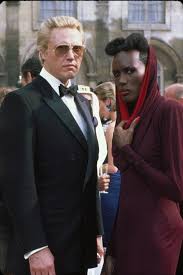
One last time into the breach, with Roger Moore. Probably the most famous thing about A View to a Kill was the theme song that shot Duran Duran to #1 and gave them a Golden Globe award. Eon coaxed Moore, 57, into doing “just one more” Bond film. He apparently was more than reluctant, especially when learning that he was older than his co-star Tanya Robert’s mother. Unlike Never Say Never Again (1983), the film makes zero references to Commander Bond’s age. Instead we get improbable fights on top of the Golden Gate Bridge with an ax wielding Christopher Walken. No sharks, but Walken and Grace Jones, both completely maniacal, are entertaining enough.

The casting of AVTAK is pretty eighties. Casting Christopher Walken as this episode’s evil capitalist is a delight (although the part was originally offered to David Bowie, and then Sting). There’s a part where Walken is trying to escape in his personal blimp where he screams, “More power!” and I just heard cowbell in my head. This episode’s Bond “girl” is former Charlie’s Angel Tanya Roberts, fast off her acting magnum opus, Beastmaster. The role was intended for Priscilla Presley, but Presley had a conflict due to her role on Dallas. (A pause here to imagine the scenes with David Bowie and Priscilla Presley. What could have been.) This was also the final time we would see Lois Maxwell, 58, in the perennial role of Miss Moneypenny, there from the very start in 1962.

The plot of A View to a Kill is pretty thin. Walker’s character, Max Zorin, wants to destroy Silicon Valley with a manmade earthquake so he can corner the microchip market. (These evil capitalists tend to spend massive amounts of capital on the plots to maybe make a little more capital. Maybe they should just invest in government bonds.) He’s the product of a Nazi genetic experiment, so he’s a bit kooky. He has a girlfriend, who is also assassin, played my great music star Grace Jones as May Day. Jones would release her brilliant album, Slave to the Rhythm, later that year. There’s the usual globe hopping. A ski-chase in Siberia where James skis on one ski (last time it was with one ski pole) and invents snowboarding. There’s a spectacular base jump off the Eiffel Tower that ends with 007 driving half a car along the Seine and then (literally) crashing a wedding party. And there’s James scuba diving in the dirty San Francisco Bay, almost getting sucked into an intake tube. The sexual double entendres are dialed back ( “A little restless but I got off eventually”), but director John Glen knows how to ramp up the Saturday matinee action. The chase scene through the streets of San Francisco with Roberts driving a hook and ladder fire truck and the senior Moore swinging from the ladder is one for the ages.

For Roger Moore’s final James Bond (1973 – 1985), lets put him through the wringer on more time.

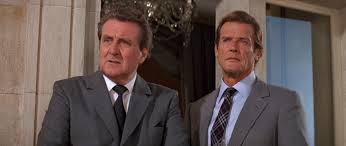
Driver of Action – The film really has two parts. The first involves Zorin’s horse selling business in France. Here, Bond shares the story with Sir Godfrey Tibbett, an MI-6 agent who is also a horse trainer (played by another Avengers alumni, Patrick Macnee). The second part of the story front-actions Stacey Sutton, Roberts’ character, who is a geologist whose father’s oil company was bought by Zorin. In both we get (very thin) backstories, but it does feel like Moore “shares” the story.

Role of Violence – Bond doesn’t really use his license to kill in 1985. He even winces and grabs his hand after punching a henchman in the face. Where the violence comes from is Walken’s character who laughs and smiles as he machine-guns hundreds of his own workers to death. It’s the first bloodbath in a Bond film and it’s jarring. But he IS the product of a Nazi experiment, so…

Vulnerability – Bond does seem genuinely bothered when Tibbett is murdered (by May Day), saying, “Killing Tibbett was mistake” to Zorin. He’s not as bothered when CIA ally Chuck Lee is murdered (also by May Day). Side note: You’d think that MI-6 and CIA agents would know to ALWAYS look in the backseat of the car before getting in. Moore’s Bond is always zipped up tight. He finishes the series as he started in Live and Let Die, stay calm and don’t give a damn.

Sexual Potency – Here’s where the formula comes through – The Eon promise of three + women bedded per film. The opening sequence ends with 007 in a submarine disguised as an iceberg driven by a beautiful blonde. We assume she’s MI-6, but she could be just a local submarine/iceberg driver. James tells her, “Be a good girl and put her on automatic.” Cue Duran Duran song. Bond also has some rough sex with Grace Jones character in France. Then, in SF, he hooks up with sexy KGB agent Pola Ivanova in a hot tub. (The part was written as Major Anya Amasova, but Barbara Bach declined to reprise her role from Live and Let Die.) “Would you like it harder?” He asks as he rubs her back. Then in the film’s closing scene that first zooms in on a bowl with the word “pussy” on it (the cat’s bowl), he bags Stacey in the shower of her house, with Creepy Q watching via his new robot, reporting to M that, “He’s just cleaning up a few details.” I guess since the film started with Bond boning on a boat, they’d let him finish (for once) on land.

Connection – One might hope that Bond approaching 60 would develop attachments to other human beings. He seems even less invested in his MI-6 colleagues, including Moneypenny and Q, than ever. They are just background scenery. You’d think that since Moore was leaving the series after a dozen years (as was Lois Maxwell after 23 years), the screenwriters would have added some sentimentality to the story. Nope. Moore plays Bond as unconnected as ever, fading into the sunset as a caricature of the lonely man.

Toxic Masculinity Scale: 3

Summary

A View to a Kill could have been grand send off for Sir Roger Moore, but Moore himself disliked the film. “I was horrified on the last Bond I did. Whole slews of sequences where Christopher Walken was machine-gunning hundreds of people. I said ‘That wasn’t Bond, those weren’t Bond films.’ It stopped being what they were all about. You didn’t dwell on the blood and the brains spewing all over the place.” We do get some Bond staples, like 007 in a tux and white dinner jacket. There’s not an underground lair, but there is a giant mine cave that’s basically an underground lair. (And I’d like to go back in time and inform Eon Productions that there are SHARKS in San Francisco Bay.)

There are some hints of progress. Women’s names start to pop up in the credits, including casting and unit manager. Producer Cubby Broccoli’s daughter, Barbara Broccoli, had been a Bond assistant director since Octopussy. Bond doesn’t immediately bed Stacey, even after two bottles of wine. He tucks her in and then sleeps in the chair with a shotgun in his lap. (That’s a good grandpa.) When a henchman spots Stacey’s heels on the mine sight, undercover James quips, “It’s women’s lib. They’re taking over the Teamsters.” While we are yet to get a lead female villain, Grace Jones as the bad guy’s #2 is pretty powerful (even if she’s played with a bit of a “black animal” trope).

Side Note 1: This the 16th Bond film I’ve watched in this series and I’ve seen hundreds of rounds of ammunition fired at our James. Maybe thousands. Never has a bullet come close to him. If MI-6 has the technology to make bullets go around their agents, they should tell us!

Side Note 2: I’ve long said that I ever win Powerball, I will first buy a personal blimp. A View to a Kill makes me believe that is possible.

A View to a Kill premiered in San Francisco on May 22, 1985, as cans of New Coke were hitting the shelves. Maybe the world was ready for a change but not sure what that change should be. Near the end of the film, Bond gets a meddle from the KGB for taking out Zorin, the joke being that the Soviets get their technology intel from Silicone Vally. The film was released a year before glasnost came to the USSR. Maybe 007 knew something we didn’t. I’ll leave Moore’s line as horny Bond to close this chapter. “On a mission I am expected to sacrifice myself.” Oh, James.

Next: The Living Daylights (1987)

The James Bond Project #15: Never Say Never Again (1983)

The James Bond Project #14: Octopussy (1983)

The James Bond Project #13: For Your Eyes Only (1981)

The James Bond Project #12: Moonraker (1979)

The James Bond Project #11: The Spy Who Loved Me (1977)

The James Bond Project #10: The Man with the Golden Gun (1974)

The James Bond Project #9: Live and Let Die (1973)

The James Bond Project #8: Diamonds are Forever (1971)

The James Bond Project #7: On Her Majesty’s Secret Service (1969)

The James Bond Project #6: You Only Live Twice (1967)

The James Bond Project #5: Casino Royale (1967)

The James Bond Project #4: Thunderball (1965)

The James Bond Project #3: Goldfinger (1964)

The James Bond Project #2: From Russia With Love (1963)

The James Bond Project: #1: Dr. No (1962)

The James Bond Project #8: Diamonds are Forever (1971)

January 21, 2025

This series is intended to evaluate each product of the James Bond film franchise through a feminist lens, and the relevance of the Bond archetype to shifting ideas of masculinity in the 2020s.

Diamonds are Forever (1971, directed by Guy Hamilton)

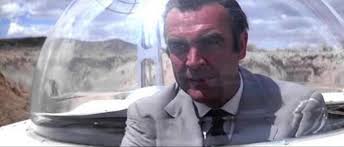
Sean Connery is back! This is probably the Bond film I saw the most on the 4 O’clock Movie in the seventies. Watching it five decades later, it pretty much sucks. Eon Productions was Bond-less after George Lazenby agreed to only make one film, On Her Majesty’s Secret Service. Numerous actors were considered, including Americans Clint Eastwood, Burt Reynolds, Robert Wagner, and Batman’s Adam West. Ultimately, Connery was lured back with a promised $1.5 million payday. To recapture the glory, Goldfinger director Guy Hamilton was brought back, as was theme song singer Shirley Bassey. Early 70s 007 looked a lot like early 60s 007.

Diamonds are Forever begins with Bond hunting down Blofeld, presumably because he killed his wife in On Her Majesty’s Secret Service. However, his wife is never mentioned and James shows zero signs of grief or even vengeance. He’s been trying to kill Blofeld since 1963 in From Russia With Love. One could assume that Lazenby’s Bond may have been married but Connery’s never was. Diamonds are Forever is much more of an American film than any previous Bond movie, with most of the action taking place in Las Vegas. (One of the reasons American Tom Mankiewicz was hired to work on the script.) I loved the scenes in Circus, Circus and Bond racing cops on Freemont. That Vegas is long gone (although you can still shoot water into balloons at Circus, Circus). Diamonds also gives us our first American Bond girl, Tiffany Case (played by 70s-80s TV fixture Jill St. James).

The attempt to recreate the magic gives us Bond staples, including Blofeld (and his darn cat), CIA agent Felix Leiter, James gambling in a casino (craps, this time) and, of course, an underground lair. Also space lasers and an elephant that plays slot machines. Added to Blofeld’s bad guy team are Mr. Wint and Mr. Kidd, a pair of sociopathic gay assassins. This might have fit a “homosexuals are deviants” narrative in 1971, but now it’s just horribly offensive. (I thought it was creepy when I was a kid, but now it just seems really, really dumb.) We do get a bit of globe trotting with a stop in South African diamond mine (no mention of racial apartheid, just black miners smuggling diamonds) and Amsterdam, where James meets a scantily clad Tiffany and says he likes her change of hair color, “provided the collars and cuffs match.”

Diamonds are Forever premiered in Munich, West Germany on December 14, 1971, three days before East and West Germany signed a historic agreement allowing for more open travel across the Berlin Wall. The film was a box office blockbuster but reviewers saw it as more silly than sexy. Maybe that was due to the fact the the special effects budget was sacrificed to pay Connery’s salary. The scene of Bond driving a moon buggy through the Nevada desert, being chased by henchmen on dirt trikes, is particularly goofy. But you do get Bond in his white dinner jacket scaling the Las Vegas Hilton (the “Whyte House” in the film) and Jimmy Dean (the sausage guy) playing a character based on billionaire Howard Hughes, who was friends with Bond producer Cubby Broccoli.

Seventies Bond may fair better. Let’s drop Diamonds into our matrix.

Driver of ActionDiamonds are Forever is classic Bond. We get brief cameos from M, Q, and Miss Moneypenny. Felix and his CIA team play a minor support role, especially when 007 encounters Bambi and Thumper, Blofeld’s bathing suit-clad guardians of Willard Whyte. Part of the story drifts into heist film with James and Tiffany as a team, but, rarely fully clothed, she seems to be just brought along for added sex appeal. Producers had Connery back and were going to make sure he was in nearly every frame.

Role of Violence  – The film starts with Bond on a killing spree as he tries to find Blofeld. That includes finding a woman on a beach, ripping off her bikini top, and strangling her with it. Ultimately, after killing someone in Blofeld’s lab (with mud), Bond kills Blofeld. Or a Blofeld.(“Welcome to hell, Blofeld.”)  There’s a scene where Bond kills a diamond smuggler after a pretty intense fight in a Dutch elevator and the now routine scene where Bond slaps his Bond girl. Most “fun” is when Bond realizes that Blofeld is alive (THE GUY THAT KILLED HIS WIFE – BUT NOT MENTIONED). In fact, there are apparently multiple “cloned” Blofelds and cats. He’s faced with two Blofelds (this time played by Brit Charles Gray, who played an MI-6 agent in You Only Live Twice). With a 50-50 chance, Bond shoots and kills the wrong Blofeld. “Right idea, Mr. Bond,” says Blofeld. “But wrong pussy,” says Bond. Oh yeah, there’s a climatic shoot out on an oil rig between the CIA and the Henchmen that kills a grip of dudes.

Vulnerability – Nope. Zero mention of Bond’s dead wife. Not even a hint that that’s why he’s after Blofeld. Older Bond is all business.

Sexual Potency – James might be losing his touch. He hooks up with a casino trollop named (ready?) Plenty O’Toole (played by Natalie Wood’s little sister, Lana). He gets her dress off but before he can get his pants off, some mobsters throw her out of a hotel window, into a pool. He tells the gun-toting goons, “Well, I’m afraid you’ve caught me with more than my hands up,” which, I assume, is a reference to the Bond Boner. Of course, Bond does bed Tiffany Case. (Her smoking in his bed the next morning is the clue.) At one point, while his body on hers, she asks, “What’s going to happen to me?” “I’m on top of the situation,” James says. Snort. But the required three sexual conquests is not achieved in Diamonds are Forever. Gee, maybe he was thinking about Tracy.

Connection – Maybe Connery was just tired of playing Bond, but 007 doesn’t really seem to care about anybody in this film, including M, Felix, Moneypenny, or Plenty (who gets tossed out of a tenth story window). There is some connection with Tiffany, who seems to want to be a spy as much as a diamond smuggler. The film ends with James and Tiffany, wait for it it, in a boat! This time it’s an ocean liner. But we’re not quite done. Here come Mr. Wint and Mr. Kidd, the homicidal homosexuals, posing as waiters with bomb souffle to kill Bond. They end up on fire and blown up, over the side as James and Tiffany sail away to short-term happiness.

Toxic Masculinity Scale: 4

Summary Seventies Bond still has a problem with race. The primary cast is lily white and we’re still stuck with “the sun never sets on the British Empire” ethos. (Did Richard Nixon have anything to say about British agents running amok in Vegas?) There’s a scene in Circus, Circus where a black woman is transformed into a gorilla for the amusement of children. And the mobsters of Slumber, Inc are caricatures of Italian mafiosos. Some of this will be both fixed and made worse in the next installment, Live and Let Die.

Aside from slapping Bond “girls” or throwing them out of windows, you get the sense that the most misogynist elements of the franchise were running on fumes by 1971. Diamonds are Forever is a cartoon version of a 007 film that tries to balance sexy or sexist Bond quips with more over the top diabolical plans. (There’s a comment from Blofeld that if his space laser destroys Kansas, nobody will know about it for four years.) It’s all just dumb. They should have made Gloria Steinem a Bond girl and had her repurpose MI-6 and the CIA to raid the underground lair of patriarchy. Ms. Bond, we need you.

Next: Live and Let Die (1973)

The James Bond Project #7: On Her Majesty’s Secret Service (1969)

The James Bond Project #6: You Only Live Twice (1967)

The James Bond Project #5: Casino Royale (1967)

The James Bond Project #4: Thunderball (1965)

The James Bond Project #3: Goldfinger (1964)

The James Bond Project #2: From Russia With Love (1963)

The James Bond Project: #1: Dr. No (1962)

The James Bond Project #5: Casino Royale (1967)

January 11, 2025

This series is intended to evaluate each product of the James Bond film franchise through a feminist lens, and the relevance of the Bond archetype to shifting ideas of masculinity in the 2020s.

Casino Royale (1967, directed by John Huston and others)

After four hugely successful Bond films, it’s time for the first Bond spoof. Casino Royale was the first of Ian Fleming’s Bond books (published in 1953). The John Huston directed film brings back many faces from the first four films from the the United Artists Bond canon, including Ursula Andress (who, as MI-6 agent Vesper Lynd, sounds way too much like Melania Trump). Casino Royale is a comedy meant to mock many of the Bond conventions, so it’s going to score differently than the films produced by Eon Productions, the home to “official” 007 movie franchise.

Here we get an older Bond, played by David Niven, who is 20 years retired after a sad end of a relationship with his beloved Mata Hari. He stutters and is known for his celibacy. This ain’t Sean Connery’s Bond. He’s brought back to MI-6 by M (played by Huston himself) to deal with evil SMERSH. (We don’t know what SMERSH stands for but there was a counter-intelligence group in the Soviet Union with the same name). M is comically killed so Bond takes the helm of MI-6, where he is reunited with Miss Moneypenny, or at least her daughter. (Strangely, Moneypenny now has an American accent, played by Barbara Bouchet, who was born in Nazi Germany.) He orders all the “Double O” agents to change their names to “James Bond” to confuse and trap SMERSH baccarat player Le Chiffre, played with gusto by Orson Welles. Two of those agents include Peter Sellers and a very young Woody Allen.

Casino Royale is a madcap farce that lampoons the cool image of 007. There’s even a yakety sax soundtrack during chase and fight scenes (some played by Herb Albert). The funny Bond quips are turned up to 11, jumping from wry to hilarious. (“James Bond doesn’t wear glasses.” Bond: “Yes, it’s just because I like to see who I’m shooting.”) The film is fully located in the mid-sixties. The first shot is graffiti that says, “Les Beatles.” The scene where the Peter Sellers’ Bond is drugged is straight psychedelia. And the movie introduces the Burt Bacharach song, “The Look of Love,” sung by Dusty Springfield (and sung by Bacharach himself in 1997’s Austin Powers: International Man of Mystery). The film was released in April 1967 and Sgt. Peppers Lonely Hearts Club Band was released shortly after setting up the iconic “Summer of Love.”

This may be an anti-Bond Bond film, piercing some of the tried and true tropes of the previous four films, but it’s worth dropping it into our feminist matrix if just for point of comparison.

Driver of Action – There are multiple drivers of the story here, including multiple Bonds. Sir James Bond (Niven) plays almost a support role. The majority of the story centers around Evelyn Tremble (Peter Sellers as a Bond surrogate) and Vesper Lynd (Andress). A section of the film follows Bond’s daughter with Mata Hari, Mata Bond (played by Joanna Pettet) in an adventure in Berlin (which features A Hard Day’s Night’s Anna Quayle and a hilarious scene where a hole is blown in the Berlin Wall and a wave of East Germans run out). This is an ensemble cast.

Role of Violence – It’s a Bond film so there a guns and explosions. But much of the violence is done for laughs, aided by a comedic soundtrack. But, other than an army of fembots with machine guns, there is no overt violence. I don’t think Niven’s or Seller’s Bonds kill anybody.

Vulnerability – The premise of this story is that Bond experienced heartbreak from his true love, Mata Hari, and looks for a connection to his daughter Mata Bond (who is abducted into a SMERSH flying saucer). He’s developed a stammer that he’s self-conscious of and his fighting style as become what might be describes as “effeminate.”

Sexual Potency – The joke of the movie is that Bond is celibate and that 00 agents are being killed because they can’t resist women. Bond creates a program to train agents to resist females in a scene where Agent Cooper rebuffs seductive women by throwing them to the mat. There is one scene where Sir Bond forcibly kisses Moneypenny (or her daughter). Ursula Andress plays seductress to Peter Sellers’ Bond, as does Miss Goodthighs (played by a young Jacqueline Bisset). Additionally, Dr. Noah (not Dr. No), played by Woody Allen, has a fourth quarter evil plot. He has a biological weapon that will make all women beautiful and kill all men over 4 foot 6, making him the tallest (and most sexually attractive?) man on earth.

Connection – There are few autonomous men in this film. The last quarter of the movie features Sir James, Moneypenny, Mata, and Agent Cooper working together to bring down Le Chiffre at the Casino Royale. And the Calvary (literally!) arrives to help save the day. Bond’s connection to his daughter seems sincere as is his desire to shepherd MI-6 in the post-M era. The film ends with the cast, having been blown up, floating in heaven, while Woody Allen’s character drops down to hell.

Toxic Masculinity Scale: 2

Summary Casino Royale is not a feminist critique of Bond. It’s a mid-sixties comedy so there are plenty of jokes rooted in sexism. For example, after M dies, Bond is sequestered in his house with his eleven seductive daughters (actually SMERSH agents) and his equally seductive widow (played with great hilarity by Deborah Kerr). But the film also completely mocks Bond’s Lothario reputation. (Woody Allen as James Bond should make the point.) There are plenty of nods to the Bond franchise, including an underground lair and even women in gold paint, but the ensemble nature of Casino Royale stands in stark contrast to Bond 1 to 4.

Unlike the previous film, Thunderball, whose cast is entirely gone, many cast members from Casino Royale are still with is, including Ursula Andress, Woody Allen, Joanna Pettet, Barbara Bouchet, and Jacqueline Bisset. I’d love to know how they see the film’s depiction of Bond and of women from a contemporary lens. The film is both hilarious and, at times, a complete mess, but also provided a break from the Bond formula. Sometimes stepping out of something allows us a fresh perspective on it. Two months later there would be another Sean Connery Bond flick headed to theaters. I wonder if viewers saw it differently after watching Casino Royale.

Next: You Only Live Twice (1967)


The James Bond Project #4: Thunderball (1965)

The James Bond Project #3: Goldfinger (1964)

The James Bond Project #2: From Russia With Love (1963)

The James Bond Project: #1: Dr. No (1962)