The James Bond Project #22:  Die Another Day (2002)

May 26, 2025

This series is intended to evaluate each product of the James Bond film franchise through a feminist lens, and the relevance of the Bond archetype to shifting ideas of masculinity in the 2020s.

Die Another Day (2002, directed by Lee Tamahori)

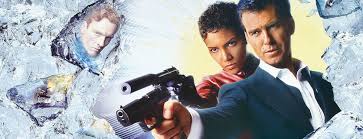
The first Bond film of the 21st century and the last Pierce Brosnan 007 role was also intended to be a celebration of 40 years of James Bond movies. Several directors were considered, including Ang Lee and Martin Scorsese, but producer Barbara Broccoli settled on New Zealander Lee Tamahori, who directed the brilliant When We Were Warriors (1994). The result is a sweeping adventure that pulls together North Korean torture chambers, conflict diamonds, and Halle Berry into a film that is often placed at the bottom of Bond lists but is also surprisingly satisfying. Die Another Day would mark the end of 40 year run and take Bond into a new era with the arrival of Daniel Craig.

Die Another Day is meant to pay homage to all the previous Eon Bond films. Halle Berry walks out onto a Cuban beach as a doppelgänger of Ursula Andress in Dr. No (1962). John Cleese has been promoted to Q and his laboratory is a museum of past 007 gadgets, including the jet pack from Thunderball (1965). I’m sure there’s a website that goes through the film’s nods. (Live and Let Die’s interracial love scene?) There was even talk of having Sean Connery make a cameo.

As is expected, we get James underwater and on snow. James in a tux, making plenty of sexual double entendres (“ I have been known to keep my tip up”), and James in exotic locales; North Korea, Cuba, and Iceland. But there are also some departures. The opening title sequence features a theme song sung by Madonna (who also has a small role in the film) with usual female bodies, but also a montage of Bond being tortured in a North Korean prison. Weird. Also, the film relies heavily on CGI, including a really dumb invisible Aston Martin. So dated now.

There are actually a lot of dumb things in this film. We’re to believe that 007 was tortured for 14 straight months in North Korea, allowing his hair to grow a few feet. There’s also a Korean terrorist named Zao, played by Rick Yune, who has diamonds embedded in his face from a blast and I kept thinking, “With a pair of tweezers, I could take care of that for you.” There’s also the classic dumb Bond trope of using “science” to change somebody’s face to look like somebody’s else face. And then there’s the thing of James running around Iceland without a parka on. Not only does a single bullet not strike Bond, neither does a chill.

Let’s plug Bond at 40 into our matrix, shall we?

Driver of Action – We do get a little bit of Halle Berry previewing her 2004 Catwoman role, but this is a Jame Bond revenge movie. Although he doesn’t seem that angry that he was tortured in a North Korean jail for 14 months. In Brosnan’s final jaunt as 007, all plot lines are on him. Even M is sidelined.

Role of Violence – 007 takes out a few dozen guards and henchmen in the film, including during an over-the top hovercraft chase scene. There’s a pretty awesome sword fight scene between Bond and bad guy Gustave Graves (played by Toby Stephens) that smashes up a fancy fencing hall that’s so old school film violence that I didn’t want it to end. And the Bond kills Graves by opening his parachute on a plane so he gets sucked through the jet engine, which is pretty gross. If 40 years, there hasn’t been shred of remorse for this body count.

Vulnerability – After Bond has been traded for Zao to get him out of North Korea, M takes away his “00” status on the belief that James revealed state secrets under torture. He could have taken his cyanide pill but chose not to. (“Threw it away years ago…” he tells M.) There’s a brief moment where James is confronted with the realization, “If I’m not 007, what am I?” But it’s just a split second. Then he goes ape shit and busts out on his rogue (again) vengeance mission.

Sexual Potency – The sex scene with Halle Berry’s character, Jinx, is pretty hot, with her on top. Woman power! I remember seeing this in the theater and slinking into my seat. (Remind me to tell you the story of meeting Berry at a Braves game.) He also beds MI-6 operative Miranda Frost (played by Rosamund Pike), which seems completely unbelievable and dumb. Shockingly, there is a scene of Bond nailing Miss Moneypenny on her desk, but it turns out just be a fantasy she’s having on Q’s virtual reality contraption. So, we don’t get the “3 conquests” quota, and that’s probably a good thing.

Connection – Bond is so alone. More alone than in any previous film. M, Q, and all the other letters are annoyances. Jinx is an NSA agent so there is some connection there and they do end up flying a helicopter to a Korean island to role around in a pile of conflict diamonds, but it’s more obligatory than romantic. Poor James.

Toxic Masculinity Scale: 5

Summary This isn’t a great Bond film, but it is a romp. There’s cool stuff that are like a series of chef’s kisses for loyal Bond fans. The opening scene of Bond and South Korean soldiers surfing massive waves to land behind the DMZ is cool. Bond driving a 50s convertible in Havana is cool. Bond escaping the hospital bed by stopping his own heart is cool. Dumb, but cool. And the Clash’s “London Calling” playing as he flies back to HQ is super cool.

The 40th Anniversary Bond also suffers from the trap of toxic masculinity. The man alone who kills without consequence and beds women without care or kindness because that’s what men do is just sad decade after decade after decade after decade. He’s morphed into a robot. I suppose that’s functional for the MI-6 mandate, but it’s not human. Ten years earlier, the cost of this life was explored in Clint Eastwood’s brilliant film, The Unforgiven. But for James Bond, the cartoon character in a new millennium, it’s just a fading shell of what men were supposed to be.

Die Another Day premiered on November 18, 2002 at Royal Albert Hall with Queen Elizabeth and Prince Phillip in attendance. It was the week the SARS pandemic was causing panic and the week President Bush created the Department of Homeland Security. The world was changing and the relevance of a 007 was, again, in doubt. Or maybe needed more than ever. It would be up to Daniel Craig to tell us.

Next: Casino Royale (2006)
The James Bond Project #21:  The World Is Not Enough (1999)

The James Bond Project #20:  Tomorrow Never Dies (1997)

The James Bond Project #19: GoldenEye (1995)

The James Bond Project #18: License to Kill (1989)

The James Bond Project #17: The Living Daylights (1987)

The James Bond Project #16: A View to a Kill (1985)

The James Bond Project #15: Never Say Never Again (1983)

The James Bond Project #14: Octopussy (1983)

The James Bond Project #13: For Your Eyes Only (1981)

The James Bond Project #12: Moonraker (1979)

The James Bond Project #11: The Spy Who Loved Me (1977)

The James Bond Project #10: The Man with the Golden Gun (1974)

The James Bond Project #9: Live and Let Die (1973)

The James Bond Project #8: Diamonds are Forever (1971)

The James Bond Project #7: On Her Majesty’s Secret Service (1969)

The James Bond Project #6: You Only Live Twice (1967)

The James Bond Project #5: Casino Royale (1967)

The James Bond Project #4: Thunderball (1965)

The James Bond Project #3: Goldfinger (1964)

The James Bond Project #2: From Russia With Love (1963)

The James Bond Project: #1: Dr. No (1962)

The James Bond Project #18: License to Kill (1989)

April 8, 2025

This series is intended to evaluate each product of the James Bond film franchise through a feminist lens, and the relevance of the Bond archetype to shifting ideas of masculinity in the 2020s.

License to Kill (1989, directed by John Glen)

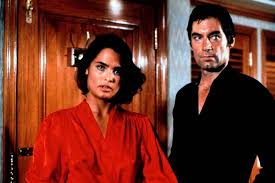
Timothy Dalton’s Dark Bond is back for the second and final time in this revenge film that calls itself a James Bond movie. Maybe Eon Productions thought gangsta rap fans in 1989 wanted a 007 who was closer to Scarface than the guy in Goldfinger. License to Kill sees Bond go rogue from MI-6 as he goes after the guy who kidnapped his friend, CIA agent Felix Leiter, and fed him to a shark (after killing his wife). There’s no time for snarky quips here. James is out for blood.

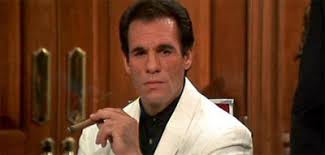
License To Kill brings the action closer to home, primarily Key West, Florida, a bit of Bahamas, and a fictional country called the Republic of Isthmus (that’s actually Mexico). Even M and Moneypenny’s London scene was shot in Mexico to save money. David Hedison, who played Felix Leiter in Live and Let Die, is back in the role 16 years later. Carey Lowell, who went on to fame on TV’s Law & Order, was this installment’s Bond “girl.” The object of Bond’s obsession is drug lord Franz Sanchez, expertly played by Robert Davi, who will always be Jake Fratelli from The Goonies, to me. His sidekick is played by a very young Benicio del Toro. The score was by the brilliant Michael Kamen, who had just done the music for Die Hard.

The last of Bond film of the 1980s was also a fond farewell of sorts. It was the final film produced by Albert “Cubby” Broccoli, who had produced every Eon Bond film since Dr. No in 1962. It was the last Bond directed by John Glen, who had filmed all five 007 films of the eighties. It was the last Bond project of screenwriter Richard Maibaum, whose work goes back to Dr. No. It was also the last film appearance of Robert Brown (M since Octopussy) and the final film of Maurice Binder, who had designed the iconic opening title sequences of every Bond film since 1962.

Even though License to Kill may have been an end of era, there will still plenty of reminders of the staples of the franchise, primarily sharks and Q. Desmond Llewelyn’s Q gets more screen time than in any Bond film to date. Like James, Q goes rogue and arrives in Isthmus to help 007 with his revenge fantasy. Like Batman’s butler Albert, he’s not afraid to be right in the action. And because the action returns to America, we see more African-American actors, including DEA Agent Hawkins (played by Die Hard’s Grand L. Bush) and CIA aid Sharkey (played by pro football player Frank McRae).

The Dark Bond of License to Kill is a bit more unhinged than in The Living Daylights, so let’s do the analysis.

Driver of Action – While LTK is formed around Bond’s revenge plot, he does share the screen. Pam Bouvier (Carey Lowell), his femme fatale is less fem and more fatal. She’s a shotgun toting ex-Army pilot who never plays the damsel in distress. In fact, she saves James more than once. Bond even says, “Yes, sir!” to her at one point because she’s clearly in charge.

Role of ViolenceLicense to Kill takes the title literally. This film is a blood bath. Bond kills at least a dozen people, some in gruesome ways. He throws a renegade DEA agent into a shark tank and watches him get gobbled up by a Great White. He rigs a diving pressure chamber on boat and watches as a drug trafficker explodes inside it, his head inflating like a balloon. In the final act of revenge, he sets Sanchez on fire with the lighter Felix gave him at the wedding. It’s supposed to feel cathartic, but it just feels sadistic.

Vulnerability – We don’t get the “Is Bond in love?” question from the last installment. More like, “Has Bond lost his mind?” as he resigns from MI-6 to go after Sanchez. There is a scene at the wedding where Felix mentions to his bride that Bond was briefly married where we get a glimpse into James’ trauma, but this 007 is hard as nails.

Sexual Potency – Dalton’s Bond is still low key swinging through the AIDS epidemic, but he’s a bit more Id-drivien than The Living Daylights. First of all, there is no scene with 007 and Moneypenny in LTK, so that banter is left on the table. His relationship with Pam is more equal than previous films. (She demands to be called “Ms.” Kennedy, while playing his accomplice). They share there first kiss on a small boat (!) in the Bahamas and the scene fades as the go below deck, implying some seafaring hanky panky. He also has a fling with Sanchez’s girlfriend, Lupe Lamora (played by model Talisa Soto, who went to be Johnny Depp’s love interest in Don Juan DeMarco). Pam’s jealousy about the James-Lupe link is played for laughs, because, you know, he’s James Bond. (When Lupe tells Q, “I love James so much,” Q’s eye roll tells the whole 27-year story.)

Connection – The fact that 007 is attending Felix’s wedding as the best man is a solid implication that these men have formed a tight bond over the many years. And the fact that he throws his career out the window to go after Leiter’s attacker is evidence of his loyalty to his CIA friend (or maybe a reflection of the trauma Bond suffered when Blofeld killed his own wife shortly after their wedding). James’ connection to Pam seems more transactional (unlike his tie to Kara Milovy in the previous film). At the end of the film, he does choose her over Lupe and they end the film, fully clothed, in a pool, kissing (They’ve already checked boat sex off the Bond to-do list), but there is no sense this relationship is going anywhere.

Toxic Masculinity Scale: 5

Summary

While the hyper-violent vengeance theme doesn’t feel very “Bond,” there are plenty of 007 hallmarks here, including underwater battles with frogmen, Bond hanging off of planes, Bond gambling in his tux, and even a completely random attack by ninjas (in Mexico). We even get a nod to Blofeld when an obscured man is holding a cat at Hemingway’s house in Key West. (It’s just M.)  And there is a great theme song by the fabulous Gladys Knight. The stunts are epic with plenty of massive explosions, and a comedic appearance from Wayne Newton as a televangelist fronting for the cocaine traffickers. (You know this was a comment on the PTL scandal that dominated the media in the 1980s.)

Dark Bond pays lip service to the changing gender rolls. When Pam asks why she has to play the roll of James’ “administrative assistant” when the arrive in Isthmus, and not the other way around, James says, “We’re south of the border. It’s a man’s world.” Carey Lowell is certainly a more masculine Bond girl than we’ve seen in the past (still with plunging necklines), but this isn’t exactly a feminist film. And Bond’s sadistic use of violence erases any enlightenment our James may have experienced over the decades.

License to Kill premiered on June 13, 1989, a month after Panamanian President Manuel Noriega staged a coup to retain power in his banana republic. Similarities between Noriega and Robert Davi’s Franz Sanchez, with regard to both physical looks and cocaine connections, were commented on when the film was released. The film generated less income than previous films, perhaps reflecting its divergence from the Eon Productions formula. There was to be a third Dalton Bond film called Property of a Lady, to be released in 1991, but studio contract conflicts got in the way and we would not see a new Bond film, and a new Bond, until the mid-1990s.

Next: GoldenEye (1995)

The James Bond Project #17: The Living Daylights (1987)

The James Bond Project #16: A View to a Kill (1985)

The James Bond Project #15: Never Say Never Again (1983)

The James Bond Project #14: Octopussy (1983)

The James Bond Project #13: For Your Eyes Only (1981)

The James Bond Project #12: Moonraker (1979)

The James Bond Project #11: The Spy Who Loved Me (1977)

The James Bond Project #10: The Man with the Golden Gun (1974)

The James Bond Project #9: Live and Let Die (1973)

The James Bond Project #8: Diamonds are Forever (1971)

The James Bond Project #7: On Her Majesty’s Secret Service (1969)

The James Bond Project #6: You Only Live Twice (1967)

The James Bond Project #5: Casino Royale (1967)

The James Bond Project #4: Thunderball (1965)

The James Bond Project #3: Goldfinger (1964)

The James Bond Project #2: From Russia With Love (1963)

The James Bond Project: #1: Dr. No (1962)