
March 18, 2025
This series is intended to evaluate each product of the James Bond film franchise through a feminist lens, and the relevance of the Bond archetype to shifting ideas of masculinity in the 2020s.
A View to a Kill (1985, directed by John Glen)
One last time into the breach, with Roger Moore. Probably the most famous thing about A View to a Kill was the theme song that shot Duran Duran to #1 and gave them a Golden Globe award. Eon coaxed Moore, 57, into doing “just one more” Bond film. He apparently was more than reluctant, especially when learning that he was older than his co-star Tanya Robert’s mother. Unlike Never Say Never Again (1983), the film makes zero references to Commander Bond’s age. Instead we get improbable fights on top of the Golden Gate Bridge with an ax wielding Christopher Walken. No sharks, but Walken and Grace Jones, both completely maniacal, are entertaining enough.
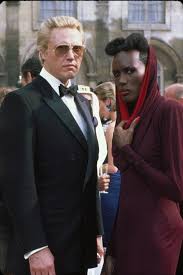
The casting of AVTAK is pretty eighties. Casting Christopher Walken as this episode’s evil capitalist is a delight (although the part was originally offered to David Bowie, and then Sting). There’s a part where Walken is trying to escape in his personal blimp where he screams, “More power!” and I just heard cowbell in my head. This episode’s Bond “girl” is former Charlie’s Angel Tanya Roberts, fast off her acting magnum opus, Beastmaster. The role was intended for Priscilla Presley, but Presley had a conflict due to her role on Dallas. (A pause here to imagine the scenes with David Bowie and Priscilla Presley. What could have been.) This was also the final time we would see Lois Maxwell, 58, in the perennial role of Miss Moneypenny, there from the very start in 1962.

The plot of A View to a Kill is pretty thin. Walker’s character, Max Zorin, wants to destroy Silicon Valley with a manmade earthquake so he can corner the microchip market. (These evil capitalists tend to spend massive amounts of capital on the plots to maybe make a little more capital. Maybe they should just invest in government bonds.) He’s the product of a Nazi genetic experiment, so he’s a bit kooky. He has a girlfriend, who is also assassin, played my great music star Grace Jones as May Day. Jones would release her brilliant album, Slave to the Rhythm, later that year. There’s the usual globe hopping. A ski-chase in Siberia where James skis on one ski (last time it was with one ski pole) and invents snowboarding. There’s a spectacular base jump off the Eiffel Tower that ends with 007 driving half a car along the Seine and then (literally) crashing a wedding party. And there’s James scuba diving in the dirty San Francisco Bay, almost getting sucked into an intake tube. The sexual double entendres are dialed back ( “A little restless but I got off eventually”), but director John Glen knows how to ramp up the Saturday matinee action. The chase scene through the streets of San Francisco with Roberts driving a hook and ladder fire truck and the senior Moore swinging from the ladder is one for the ages.
For Roger Moore’s final James Bond (1973 – 1985), lets put him through the wringer on more time.

Driver of Action – The film really has two parts. The first involves Zorin’s horse selling business in France. Here, Bond shares the story with Sir Godfrey Tibbett, an MI-6 agent who is also a horse trainer (played by another Avengers alumni, Patrick Macnee). The second part of the story front-actions Stacey Sutton, Roberts’ character, who is a geologist whose father’s oil company was bought by Zorin. In both we get (very thin) backstories, but it does feel like Moore “shares” the story.
Role of Violence – Bond doesn’t really use his license to kill in 1985. He even winces and grabs his hand after punching a henchman in the face. Where the violence comes from is Walken’s character who laughs and smiles as he machine-guns hundreds of his own workers to death. It’s the first bloodbath in a Bond film and it’s jarring. But he IS the product of a Nazi experiment, so…
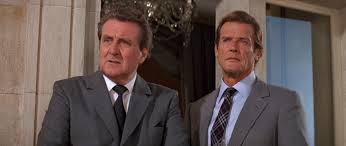
Vulnerability – Bond does seem genuinely bothered when Tibbett is murdered (by May Day), saying, “Killing Tibbett was mistake” to Zorin. He’s not as bothered when CIA ally Chuck Lee is murdered (also by May Day). Side note: You’d think that MI-6 and CIA agents would know to ALWAYS look in the backseat of the car before getting in. Moore’s Bond is always zipped up tight. He finishes the series as he started in Live and Let Die, stay calm and don’t give a damn.
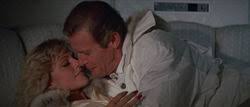
Sexual Potency – Here’s where the formula comes through – The Eon promise of three + women bedded per film. The opening sequence ends with 007 in a submarine disguised as an iceberg driven by a beautiful blonde. We assume she’s MI-6, but she could be just a local submarine/iceberg driver. James tells her, “Be a good girl and put her on automatic.” Cue Duran Duran song. Bond also has some rough sex with Grace Jones character in France. Then, in SF, he hooks up with sexy KGB agent Pola Ivanova in a hot tub. (The part was written as Major Anya Amasova, but Barbara Bach declined to reprise her role from Live and Let Die.) “Would you like it harder?” He asks as he rubs her back. Then in the film’s closing scene that first zooms in on a bowl with the word “pussy” on it (the cat’s bowl), he bags Stacey in the shower of her house, with Creepy Q watching via his new robot, reporting to M that, “He’s just cleaning up a few details.” I guess since the film started with Bond boning on a boat, they’d let him finish (for once) on land.

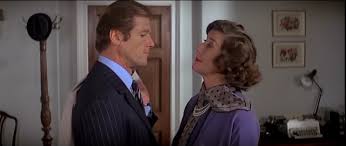
Connection – One might hope that Bond approaching 60 would develop attachments to other human beings. He seems even less invested in his MI-6 colleagues, including Moneypenny and Q, than ever. They are just background scenery. You’d think that since Moore was leaving the series after a dozen years (as was Lois Maxwell after 23 years), the screenwriters would have added some sentimentality to the story. Nope. Moore plays Bond as unconnected as ever, fading into the sunset as a caricature of the lonely man.
Toxic Masculinity Scale: 3
Summary
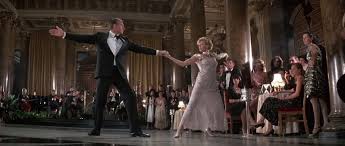
A View to a Kill could have been grand send off for Sir Roger Moore, but Moore himself disliked the film. “I was horrified on the last Bond I did. Whole slews of sequences where Christopher Walken was machine-gunning hundreds of people. I said ‘That wasn’t Bond, those weren’t Bond films.’ It stopped being what they were all about. You didn’t dwell on the blood and the brains spewing all over the place.” We do get some Bond staples, like 007 in a tux and white dinner jacket. There’s not an underground lair, but there is a giant mine cave that’s basically an underground lair. (And I’d like to go back in time and inform Eon Productions that there are SHARKS in San Francisco Bay.)

There are some hints of progress. Women’s names start to pop up in the credits, including casting and unit manager. Producer Cubby Broccoli’s daughter, Barbara Broccoli, had been a Bond assistant director since Octopussy. Bond doesn’t immediately bed Stacey, even after two bottles of wine. He tucks her in and then sleeps in the chair with a shotgun in his lap. (That’s a good grandpa.) When a henchman spots Stacey’s heels on the mine sight, undercover James quips, “It’s women’s lib. They’re taking over the Teamsters.” While we are yet to get a lead female villain, Grace Jones as the bad guy’s #2 is pretty powerful (even if she’s played with a bit of a “black animal” trope).
Side Note 1: This the 16th Bond film I’ve watched in this series and I’ve seen hundreds of rounds of ammunition fired at our James. Maybe thousands. Never has a bullet come close to him. If MI-6 has the technology to make bullets go around their agents, they should tell us!
Side Note 2: I’ve long said that I ever win Powerball, I will first buy a personal blimp. A View to a Kill makes me believe that is possible.
A View to a Kill premiered in San Francisco on May 22, 1985, as cans of New Coke were hitting the shelves. Maybe the world was ready for a change but not sure what that change should be. Near the end of the film, Bond gets a meddle from the KGB for taking out Zorin, the joke being that the Soviets get their technology intel from Silicone Vally. The film was released a year before glasnost came to the USSR. Maybe 007 knew something we didn’t. I’ll leave Moore’s line as horny Bond to close this chapter. “On a mission I am expected to sacrifice myself.” Oh, James.
Next: The Living Daylights (1987)

The James Bond Project #15: Never Say Never Again (1983)
The James Bond Project #14: Octopussy (1983)
The James Bond Project #13: For Your Eyes Only (1981)
The James Bond Project #12: Moonraker (1979)
The James Bond Project #11: The Spy Who Loved Me (1977)
The James Bond Project #10: The Man with the Golden Gun (1974)
The James Bond Project #9: Live and Let Die (1973)
The James Bond Project #8: Diamonds are Forever (1971)
The James Bond Project #7: On Her Majesty’s Secret Service (1969)
The James Bond Project #6: You Only Live Twice (1967)
The James Bond Project #5: Casino Royale (1967)
The James Bond Project #4: Thunderball (1965)
The James Bond Project #3: Goldfinger (1964)


























 Watching the Wheels