Panic in Auschwitz: Putting the Present Moment in Context

“The present moment began with fire. And still, it burns.” – Ben Okri, Nigerian poet

April 2, 2022

Once again, I find myself in a white van, crossing the, now snow-covered, fields of southern Poland. My very first record, Elvis Presley’s “Burning Love” is playing on the radio. The lyrics hit at an odd angle, “I just might turn to smoke.” Because we are headed to Auschwitz. Seeing the upside down world of April Fools Day, I try to make a joke with my fellow passengers, but my wartime dark humor is not received well. I was scolded earlier in the week for posting that the guy who was snoring in the bomb shelter we were sharing in Lviv, Ukraine made me pray for a bomb. I get it. But humor is also a way to cope with the endless trauma of this world. The DJ, sharing my skewed take on the day, next spins Ella Fitzgerald singing, “Let it Snow,” a Christmas classic in April.

Maybe the awkwardness was to prepare my brain for what was to come. How does one plan a day-trip to the Auschwitz-Birkenau Nazi death camps? How do you transition from this moment to that one? I’ve been a student of the Holocaust for as long as I can remember and lectured about the camps for 30 years. In my recent Research Methods class at the University of Oregon, I presented gut wrenching evidence of how Auschwitz doctor Josef Mengele perverted the values of science in a sadistic attempt to demonstrate Aryan superiority. My life’s work revolves around studying neo-Nazis who both pretend to believe the Holocaust never happened and fantasize about perpetuating similar acts of genocide. The previous day, I had wandered around Krakow’s old Jewish district that had been emptied of Jews by the Nazis, except for the lucky few who were rescued by Oskar Schindler. It was important for me to do this.

The van carried a varied lot, an English couple from Birmingham, a Norwegian couple, a young German woman who must have been filled with dread and her English friend who puked, on and off, during the hour drive from Krakow because she had had too many shots of vodka the night before. Our driver, who went by Mike, was wise enough to ease us into the arrival into hell. He took us to his “secret location,” which was an abandoned box car on a track between the Auschwitz and Birkenau camps that had been used to carry the doomed to their final destination. There, in the snow, I began to slip through time.

Auschwitz is where it is because Oświęcim, Poland was a railroad hub, and industrial town that could manage the importation of countless slave laborers and then the millions who were to be exterminated. It still feels like such a town, ringed with McDonalds and KFCs when you arrive. For better or worst, the area around the camps has been preserved in amber. When we arrived at the Auschwitz tour center, with the crematorium chimneys visible behind it, snow fell gently down, smelling cleaner than the ash that fell 80 years earlier. In the gift shop, I bought a copy of Ellie Wiesel’s Night and watched the other tourists. Some stared somberly, some teenagers laughed, as teenagers do, and a group of Israeli students, draped in their flag, did both. I held my breath.

My group got their headsets so we could better hear our tour guide, a Polish woman in her late sixties who had lost two uncles in the camp. We stepped back into the snow and walked under the “Arbeit macht frei” (“Work makes you free”) gate as she began to describe the buildings. For the first time, I had a 360 degree view of this thing. I could see the grey clouds above and the mud below my boots. This was not a fantasy, a conspiracy, or a scene from a film. This was real.

The tour had just started and I began to hyperventilate. Then I began to sob. I got light-headed and thought I was going to pass out. I had to lean against one of the barracks that had housed 500 prisoners at a time. Nothing like this had happened to me before. I think I was having a panic attack.

It was the realization that this was a real place and that horror had actually happened. Holocaust deniers be damned, the systematic annihilation of millions of men, women, children, and babies was carried out with methodical precision here from 1940 to 1945. I could feel the terror and it was too much to bear. All those books and lectures and movies and documentaries and sitting listening to Holocaust survivors, choking on the pain in my throat. It all happened in this spot and my body convulsed at the realization. The weight of what humanity was capable of in its darkest moment.
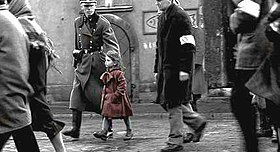
I sat down for a bit, half listening to our presenter, half trying to get my bearings. I flashed to a scene in Schindler’s List. The black and white film had one moment of color. A little Jewish girl in a red coat, her body later appears in a pile of corpses. It was 1993 and she reminded me of my then 5-year-old friend in Prague, Suzanka, who was living too close to the genocide in Yugoslavia. I burst out sobbing in the Phipps Plaza movie theater. The memory, as I sat on barrack steps in Auschwitz, caused me to burst out sobbing again.

Gradually, I wiped my eyes and rejoined the tour as we entered the slightly warmer barracks and viewed their displays. Our guide returned to the refrain, “You must remember,” and how the total count of those exterminated may never be known, because the Nazis burned the paperwork along with the bodies. Each display was more devastating than the last; children’s shoes, human hair removed from the gassed to make into fabric, luggage waiting to be claimed. The one that put me back in my panic was the massive collection of crutches, canes, and prosthetic limbs of the “invalids,” deemed too defective to work and put to immediate death. That specter of ablism did not fade with the Third Reich.

I soldiered on for the rest of the tour, through gas chambers, past the gallows, in front of the “wall of death,” where prisoners were shot, and down to the ovens, and finally to the spot where Auschwitz Commandant Rudolf Höss was finally hung on this day (April 2) in 1947. But this was only the first half of the trip. Auschwitz had a sequel, Auschwitz II-Birkenau, ordered built by Heinrich Himmler in 1941 to accelerate the extermination of the Jews. Mike ferried us over to the second, much larger camp, much of which was destroyed by the Nazis at the end of the war in a futile attempt to hide their crimes. Our guide walked us along the train tracks where prisoners were divided between those who would be forced into labor than those who were marched straight to the gas chambers. Babies and small children were thrown into open burning pits. I stood there, as a father, unable to move. Where was goodness? Where was God? Where was the empathy that should have been present among Hitler’s willing executioners?

On the ride home, we were all silent, including puking girl. I thought about what I had seen in Ukraine; the faces of frightened children forced out of their homes by an unprovoked war-monger. I thought about the concerns of my Polish friends, that nuclear weapons would turn them to ash like those who left Auschwitz and Birkenau through the chimneys. I thought about the new rise of authoritarianism in the form of Putin and Trump, that gleefully weaponizes hate and the threat of violence. I thought about the anti-trans laws and voter suppression acts that are slowly eroding democratic freedoms in my “beacon of liberty” home country.

The first chapter of Ellie Wiesel’s Night is a cautionary tale. The Jews who lived in his Hungarian village thought they were far enough from the war not to worry about the rumors of Nazi anti-Semitism. When they were pushed into a ghetto, many thought it was to protect them from the violence of the Allied invasion, and when they got to the platform at Birkenau, and Wiesel saw his mother and sister forced into the line for the gas chambers, many thought that no such horror would be allowed in the mid-twentieth century. The Holocaust was not a sudden tsunami of death. It was a slowly rising tide that drowned those who never realized they were so far from the shore.

That tide is rising again. I will not sit on my hands and hope things get better. I will use every tool at my disposal. This trip has taught me that I must.

In the Toilet Paper Tube of History: Watching the Battle for Ukraine in Real Time

February 27, 2022

We’re all gerbils crawling through an endless toilet paper tube. Most of the time we don’t notice the tube, because we’re focused on our forward motion. But every once in a while, we realize that we’re stuck in a freaking cardboard tube and it’s controlling everything about what we can see and where we can go.

History is that toilet paper tube. I remember how on a Tuesday morning, September 11, 2001, I realized the events I was watching on my father’s television in Roswell, Georgia would impact every aspect of my world.  There were two realities, pre-9/11 and post-9/11. The tube was tight, preventing me from getting on a flight back to Portland. And it’s touched our reality ever since.

I feel that way again, watching the Russian invasion of Ukraine. I was focused on the tasks at hand, getting my students through winter quarter, adjusting to life as a single parent, waiting for The Marvelous Mrs. Maisel to start a new season. And then on Wednesday night all that changed as Putin sent tanks and troops across the border in an unprovoked invasion of a sovereign nation. I had a similar feeling when I was 15-years-old on New Year’s Eve 1979, watching Soviet tanks roll into Afghanistan. It felt like the whole world shifted on its axis a bit.

Now as Russian troops bomb Kyiv, it seems like the axis shift is massive. Thursday I took time to talk to my University of Oregon students and ask them to be present in this moment. They will likely talk to their grandchildren 50 years from now about the first days of the third world war. Rising gas prices, bread shortages, fear of conscription are surely weighing on their minds. But for these Generation Z students, most born after 9/11, this will all get very real when the Russian cyber hacks shut Instagram down.

Historical parallels aside (Hitler pulled the same stunt in 1939), it’s clear that we have entered a geo-political order where Russia is not our friend. (Sarah Palin must be smirking.) We will divide modern history into before 02/23/2022 and after 02/23/2022. Will this end up in the similar global turmoil that followed Hitler’s invasion of Poland? It seems entirely possible. Vladimir Putin is this generation’s murderous madmen with designs on expanding his empire by any means necessary. Putin’s statement Wednesday that nations that come to Ukraine’s defense will face “consequences you have never seen” is chilling given the fact that Russia holds 45% of the world’s nuclear weapons.

Maybe this will be a limited conflict and, well, sorry freedom-loving Ukrainians. Yeah, it went sideways with Hitler, but Putin is an ethnic nationalist of a different stripe. It will be fine. Let’s get back to the other existential crises, like COVID and global warming. Why should Russian tanks rolling through Chernobyl be an issue in suburban America? It will be OK. Have you seen the price of milk? Let’s riot!

Of course, the good people of Ukraine didn’t think Russian bombs would be falling on their suburban neighborhoods either. A child Cozy’s age was killed today on the westside of Kyiv. Global conflicts have the tendency to spread. Quickly. Watching the children heading for the Polish border makes me wonder where I would send my daughter if the war spreads to this part of the world. Hopefully we can get her to Mexico if things get hot here. The United States is not guaranteed to exist forever. Four years of Trumpism weakened our democracy and greatly inflated Russia. That could create a cascade of crises that puts the USA in the rear view mirror. You may not be safe as you think.

The reason of this concern is rooted what I did in the first 12 hours of the invasion. I spent it on the dark corners of the web in the places where white supremacists, Qanon believers, and Trump nuts dwell. They, to the one, threw their support to Putin, seeing Biden’s policies as part of a liberal Jewish plot to push Putin and Trump’s buttons and cheered Putin’s fascistic ethnic nationalism. They want that wider war to launch their “boogaloo” race war in America. And they are armed. Heavily. Timothy McVeigh is their hero. The ethnic cleansing of Yugoslavia is their game plan. And Putin and Trump are their leaders.

Fortunately, like those Ukrainian soldiers on Snake Island who defiantly said, “Russian warship, go fuck yourself!” the majority of Americans have no tolerance for the anti-American “America First” con artists and their little boy soldiers. Yeah, 4.5 million viewers tune into white supremacist Tucker Carlson’s Fox News show each evening but that means that over 327 million Americans don’t. Hopefully, unlike Ukrainian citizens right now, we won’t all have to take crash courses in how to fire AR-15s. It’s going to take a lot of hard work and thoughtful mobilization. We’ll certainly have the time after Russian hackers take down Instagram. Maybe then we will see the toilet paper tube we are in.

Watching America die, I sent a Statue of Liberty to Donald Trump

June 20, 2018

My wife crossed the border from Mexico into Texas when she was 8 years old. She was on foot with her mother in the middle of the night. An old man carried her across the desert because she had lost a shoe on a railroad track. Within 15 minutes of entering the country, her and her mother were picked up by a U.S. Boarder Patrol van. Welcome to America.

She was never separated from her mother, who was trying to lead her to a better life in the United States. But spending a night in jail together in a new country must have been frightening enough. The men were kept in one cell and women and children in another cell. After processing, the Border Patrol dumped them back at the Mexican border. Fortunately, the father of the coyote (the people that ferry migrants across the border) felt guilty that his group got caught and tried again the next night. He waived the additional $3000 per person price which was a good thing because my future mother-in-law barely any pesos left in her pocket.

Because of a provision in the Violence Against Women Act of 1994 (authored by Senator Joe Biden), Andrea was awarded a green card in 2010.  The section allows the victims of domestic violence visas and a path to residency. It’s sad that women have to experience excruciating abuse to feel safe in this country. It’s also sad that Republicans tried to have the provision removed in 2012.

ct-migrant-children-tender-age-shelters-20180619

As my wife and I watch the news stories of Donald Trump’s new “zero tolerance” immigration policy that has resulted in thousands of children and babies being stripped from their parents’ arms, we wonder what happened to the country that passed VAWA 24 years ago. A father from Honduras Marco Muñoz, after having his 3-year-old son taken away from him by Homeland Security agents in Granjeno, Texas, was so distraught that he hung himself in his cell. These children look so much like our 3-year-old daughter and the thought of ICE agents taking Cozy from us to God-knows-where is unbearable. It’s like watching an episode of The Handmaid’s Tale but it’s the evening news. Even seasoned journalists are in tears. How is this happening in America?

This policy, created by Trump’s favorite in-house racist Stephen Miller and deemed “Biblically justified” by Attorney General Jeff Sessions and White House Press Secretary Sarah Huckabee Sanders, has disgusted even Conservative voices like Ted Cruz and Paul Ryan. In a recent op-ed for the Washington Post, former First Lady Laura Bush compared Trump’s policy to the U.S. internment of the Japanese during World War 2. Even Tea Party rocker Cherie Currie (once of The Runaways) posted, “Bottom line is you don’t separate a helpless child from their parents. No matter what. Not ever.”

Beside the fact that somebody is making a lot of money off these private shelters that are now housing children and babies, including converted Walmart stores, the trauma these kids will face because of Trump’s irrational policy will last a life-time. Children screaming for their mothers won’t deter this White House from its “zero tolerance.” The majority of Americans oppose this draconian action as inherently counter to our values, but what can we do?

It’s not “your” country.

At the root of this problem is this binary thinking of “us and them.”  A lot of white people think this is “their” country and they have some sort of divine right to decide who gets in and that, somehow, their family came to America the “right way.”  There is so much ignorance here to unpack, it hurts. Before the The Immigration Act of 1924 (the Johnson-Reed Act) , there was no legal or illegal immigration into this country (unless you we coming from China). People just showed up. My great grandfather, Michael Blazak, arrived in 1891 from what is now the Czech Republic. He just got off the boat and started his life as an American. The 1924 law restricted immigration from non-European and non-Protestant countries (Only WASPs allowed) and has been praised by Jeff Sessions as a policy that was created to end “indiscriminate acceptance of all races.” My Catholic ancestor wouldn’t have made it in and Jews trying to escape Hitler in the 1930s were turned back.

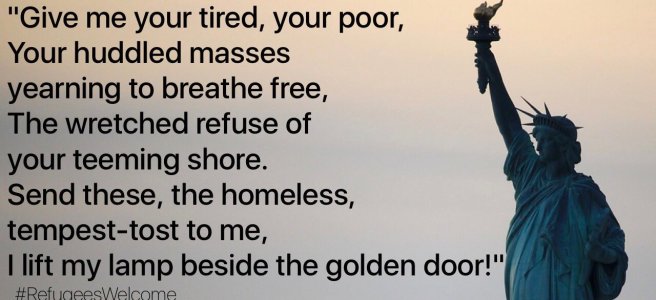
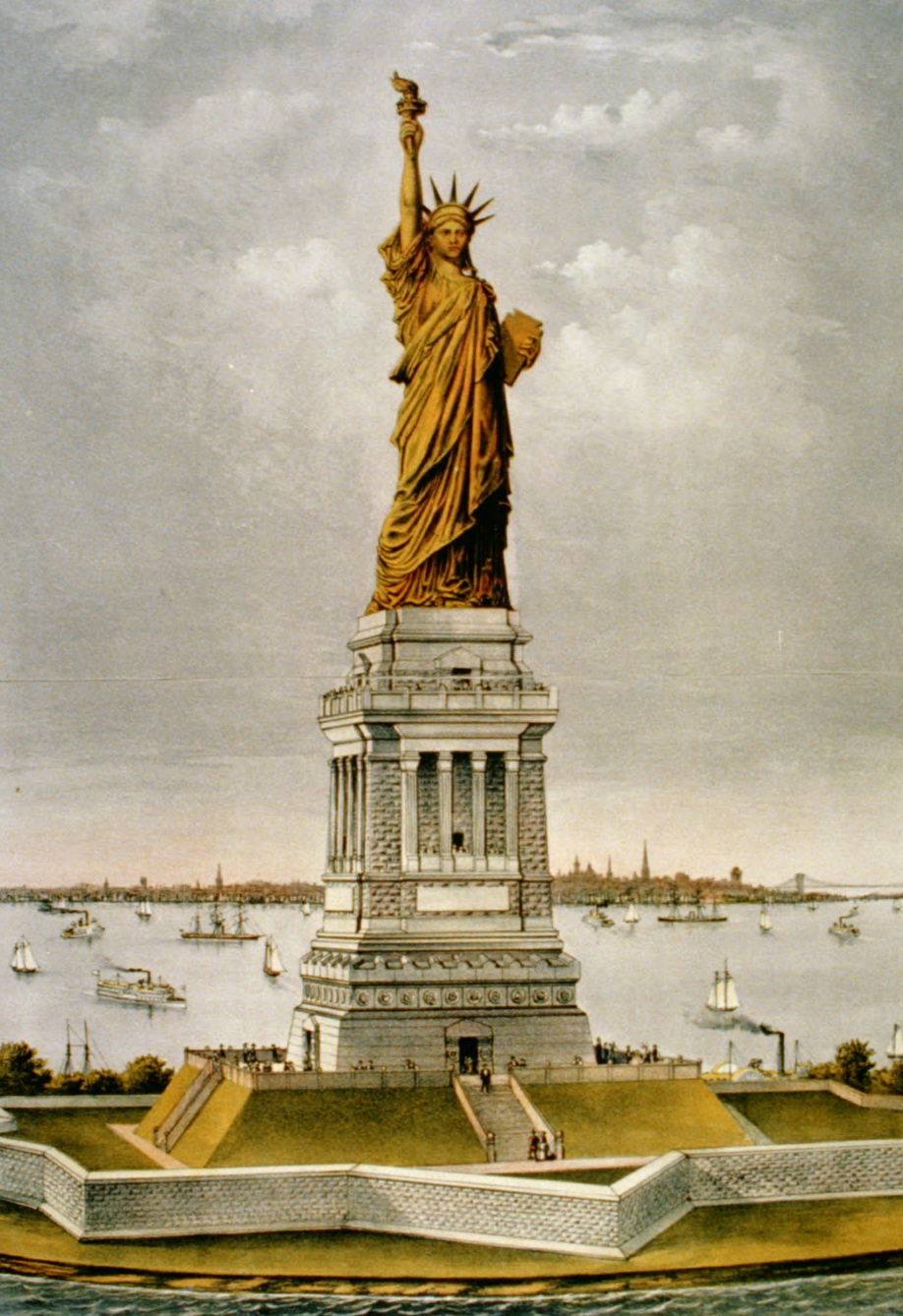
When my great grandfather came into New York Harbor, he passed the very new Statue of Liberty (dedicated in 1886). He might have missed the poem at the base of the statue. “The New Colossus” was written by Emma Lazerus who had been aiding the refugees from the anti-Semitic pogroms of Eastern Europe, looking for safety and freedom in America. I hope someone translated the sonnet for him as he contemplated his uncertain future in this new land.

statueofliberty1890s

Not like the brazen giant of Greek fame,

With conquering limbs astride from land to land;

Here at our sea-washed, sunset gates shall stand

A mighty woman with a torch, whose flame

Is the imprisoned lightning, and her name

MOTHER OF EXILES. From her beacon-hand

Glows world-wide welcome; her mild eyes command

The air-bridged harbor that twin cities frame.

“Keep, ancient lands, your storied pomp!” cries she

With silent lips. “Give me your tired, your poor,

Your huddled masses yearning to breathe free,

The wretched refuse of your teeming shore.

Send these, the homeless, tempest-tost to me,

I lift my lamp beside the golden door!”

The world looks to America for that freedom and but the golden door been shut and the lamp has been extinguished. It’s now a false promise of America as a baby is literally taken from its immigrant mother’s breast. I would like to point out that you will not see any undocumented immigrants from Russia, Ukraine, or Canada in any these Trump camps (and there are plenty undocumented whites in America). I have a friend from Ireland who over-stayed their visa but has no worries that ICE agents will come knocking. This is the great clampdown on brown people because it is not “their” country. Make America 1924 again.

We have been here before

Screen Shot 2018-06-20 at 12.24.01 AM

I have the privilege of having a friend who has been through this before. George Nakata was 9 years old, living in Portland, when the Japanese bombed Pearl Harbor in 1941. President Roosevelt signed an executive order ordering the “evacuation” of every Japanese person, alien or “non-alien” (aka U.S. citizen) on the West Coast, to be rounded up and placed in internment camps. 120,000 people, most American citizens, were ripped from their homes, losing everything. Young George spent the summer of ’42 in a converted animal stable on the outskirts of the city. The Oregonian proudly declared my town to be the first “Jap Free City” in America. George was then shipped off to a camp in arid Idaho where the soldiers pointed their guns in, not out. He rightly calls it a concentration camp.

No Japanese-Americans were ever found guilty of engaging in espionage or colluding with the enemy. In fact, the 442nd battalion, made up of all Japanese American soldiers, liberated Nazi death camps and is the most decorated battalion in U.S. military history. In 1988, President Reagan formerly apologized for the mass internment but as George is fond of saying, they never put a Statue of Liberty on the West Coast.

If you ever get the chance to hear a holocaust survivor speak, please do. There aren’t many left. I’ve heard several and inevitably someone will ask, “When Hitler was first elected, why didn’t you just leave?” The answer is always the same. People thought it was a temporary bout of political madness. That it would be corrected at the next election. But then there was no next election. A policy was instituted here and a new law was passed there. Like the frog in the slowly heated pot, all of a sudden there was no escape. Democracy seamlessly transitioned into authoritarianism.

This is where we are. We are in it. America is dying.

We have a president, not elected by the people, but by the electoral college who is having a love affair with dictators right before our eyes and we are unfazed. It’s as if we are watching a reality show and as long as the kids behind the chain-link fences are not white, it’s just a show and not reality. But these people are slowly raising the temperature and at some point there will be no escape. Childish Gambino might think this is America, but it won’t be on my watch. Trump has described undocumented immigrants as an “infestation” and hinted that legal immigrants who receive federal benefits could be next. If they will do this to babies and toddlers, what makes you think they won’t do it to you? Because you’re white?

There is much we can do. I’ve called my senators and asked them to make the security of these children a priority. We can appeal to the decency of the Trump supporters in our circles. The emperor has no clothes! Remember your values! We can make November 2018 a massive referendum on these lunatics who are trying to hijack this country. I envision a Revenge of the Jedi wave striking down Trump’s evil space force. But there is one thing that might be more direct.

Send Trump Lady Liberty

I’m not willing to let these “America first!” nutzis define the values of this country. Not while the Statue of Liberty remains above ground. Maybe Mr. Trump needs to be reminded of what this country stands for. We don’t tell immigrants that their children are being taken for “a bath” and then place them in “tender age shelters.” Does that sound revoltingly familiar to you?

Screen Shot 2018-06-20 at 12.49.30 AM

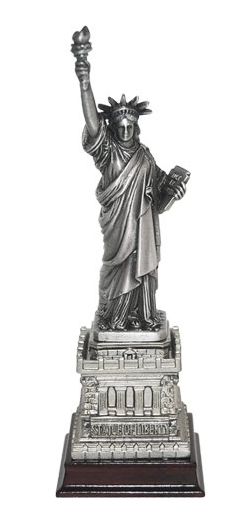
I just sent a miniature Statue of Liberty (that I bought for 12 bucks on Amazon) to President Trump at the White House. I have a dream that, in the spirit of Abbie Hoffman, every American, conservative, liberal, or otherwise does the same. I want the White House mailroom to have boxes and boxes of statuettes to deliver to the president. And maybe a few thousand copies of “The New Colossus” as well. Here’s the address:

President Donald Trump

c/o The White House

1600 Pennsylvania Avenue NW

Washington, DC 20500


And if that goes well, maybe we can commission statues of Lady Liberty to be erected in San Francisco Bay and the stretch of Texas desert where my wife crossed the border, missing one shoe, many years ago. Let’s lift our lamp beside the golden door.  Por favor. #LadyLibertyforTrump

81wy7+risxL._SY450_


SaveSave

SaveSave

Confronting Ableism by “Looking” in the Mirror

February 5, 2018

I’ve got eighteen interviews in the bag for my Recovering Asshole podcast. Each of them has been a step on the path of me understanding my vast privileges. I’ve learned about white fragility and what it’s like to live in a large woman’s body. I’ve gained insight from transgendered, immigrant, and even left-handed perspectives. Perhaps the most revealing interview was the most recent one (#18) about disabilities and ableism. My desire to have this conversation was rooted in my fear about not knowing how to talk about and to people with physical and mental disabilities. My shame was the realization that, in my life, I had probably done more harm than good.

eugencartoon

As a sociologist of extremism, I’ve lectured about the history of eugenics in Hitler’s Third Reich. The first act of the “Final Solution” was the “Law for the Prevention of Progeny with Hereditary Diseases.” All people with an “inherited disease” (which included everything from physical “deformities” to alcoholism) were ordered to be sterilized in an effort to perfect Germany’s Aryan “master race.” In 1939, Hitler began Operation T4 that killed over 70,000 disabled Germans and Austrians in one year, utilizing poison gas as a warm-up for the mass extermination of Jews and others in concentration camps. Of course, the United States had it’s own eugenics programs that included the forced sterilization of “unwanted” populations.

But, as usual, we are appropriately horrified by the extreme manifestations of such bigotries but are unable to identify the same tendencies and leanings in ourselves. “What could I possibly have in common with a Nazi?” we ask as we skip over a news story about the brutal genocide of the Rohingya occurring in 2018.

My podcast interview was with Grant Miller, who is a Portland disability activist who works with a great arts program called PHAME, and is working with Portland Art Museum on disability access issues.  I really wanted to dive into a conversation about how we even talk about people with disabilities. Does Grant “suffer” from a disability? Is he just “differently abled”? As I progressive as I think I am, I realized I didn’t even know what kind of language to use. I always tell folks, when in doubt about subjects like this, just ask the people themselves.

1928699_79721769306_7569519_n

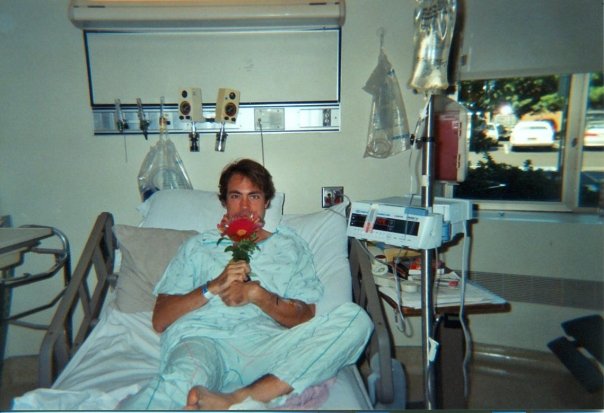
I prefaced this conversation with caveat that my path towards empathy really began in 2002 when I had a brain hemorrhage and a subsequent stroke. I was in the hospital for almost a month and had to relearn how to walk. Suddenly, I was the guy holding up traffic as I slowly crossed the street with a cane. I reflected on all the times I had gotten angry because of the speedy norm of modern life. Hurry up!

You can listen to the interview yourself (or the read the transcription, which I hadn’t even considered until Grant pointed it out). It’s 60 minutes of me stepping in it. They are not “hearing impaired” people, they’re deaf. People aren’t confined to wheelchairs, they are wheelchair users. (Many people are, in fact, liberated by wheelchairs.) Even the way we use metaphors disregards the experience of the disabled. You can’t “walk in someone’s shoes” if they can’t walk themselves. You can’t have “you eyes opened” to an issue if you are blind. All this reflects our internalized ableism.

Sound_and_Fury

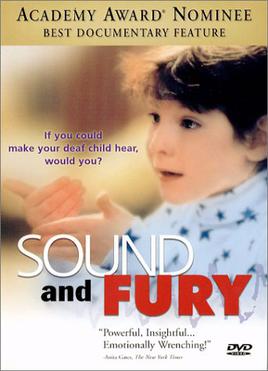
What we have in common with Hitler is the persistent belief that there is an absolute definition of what is “normal.” That if your hands, or legs, or brain don’t work the exact same way mine do, you are some sort of abhorrent deformity that needs to be fixed, no matter how invasive or traumatizing the process might be. My awareness of this was raised by a deaf student of mine at Portland State who shared a brilliant 2000 documentary about cochlear implants called Sound and Fury. Perhaps well-meaning doctors, with new technology on their side, have begun to “cure” deaf people with these fancy Star Trek-looking brain implants. What the documentary points out is that there is a thriving Deaf community that doesn’t need to be “fixed.” If we just bothered to learn their language (American Sign Language), we could’ve just asked them.

Screen Shot 2018-02-03 at 11.40.55 PM

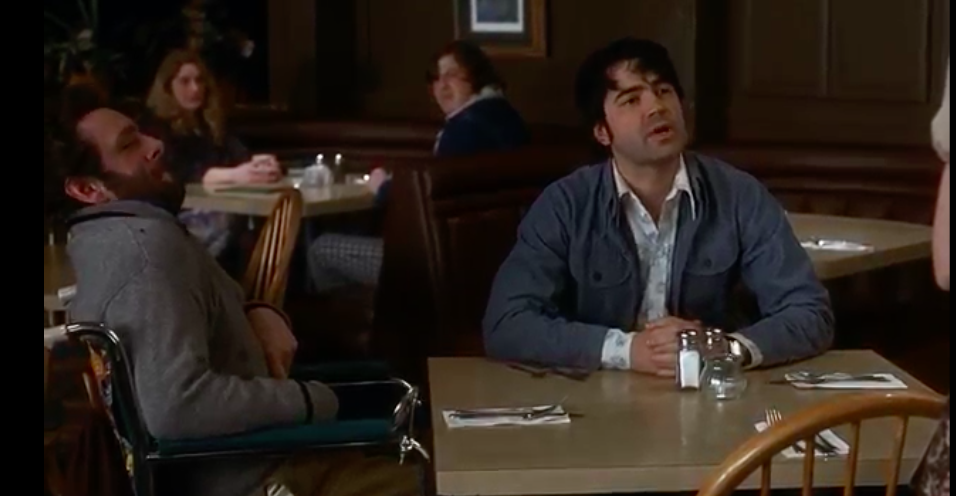
And that’s the theme of the ableism – that “they” (people with various disabilities) should be more like “us” (people without disabilities) to be more “normal.” My city, Portland, had laws in the 1880s that are now known as Ugly Laws. They made it virtually illegal to be in public if you were “crippled” or “deformed.” You could be arrested and fined. There’s an amazing 2007 movie called The Music Within that’s about the birth of the disability rights movement, and there’s a scene in that movie (filmed in Portland) where a man with a severe case of cerebral palsy is trying to dine in a Portland restaurant in 1974 and is arrested under one of these Ugly Laws. That act was the genesis of the movement that gave us the Americans with Disabilities Act of 1990. It’s a powerful scene. How dare this man be disabled in public? He was making “normal” people feel uncomfortable!

Why were they uncomfortable? Could it possibly be their ableist privilege that was poking  them in their chest? But then maybe before getting all high and mighty about a scene in the movie I should look in the mirror.

Alligator boy hoax specimen in Weekly World News

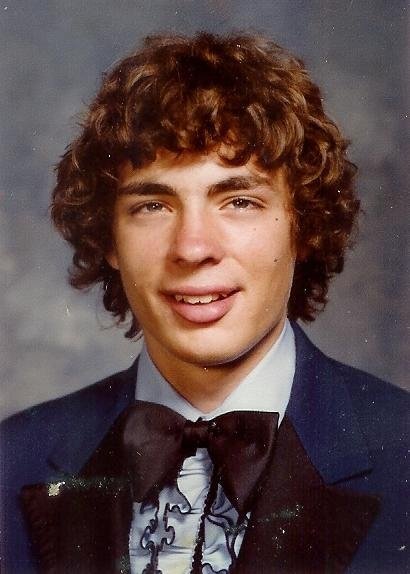
I was in high school in Stone Mountain, Georgia in the late 1970s and early 1980s. It was the period before the ADA began making institutions more accessible but after the period when the best career trajectory for the disabled was in a circus sideshow. (Although, I am old enough to remember the Florida sideshow attraction known as Alligator Boy.) It was a time when kids with disabilities were beginning to be “streamlined” into the general public school population and, like those white students at Little Rock Central High School in 1957, we weren’t exactly welcoming.

1910257_58602489306_3887_n

It sickens me to say this, but not only did we give those kids a wide birth, like their disabilities were contagious, we shared “funny” nicknames for them behind their backs. (I won’t repeat any here. Just know I am in tears as I write this.) I know teenagers can be cruel, but I have to think the obstacles these fellow Redan Raiders faced just to make it to the end of sixth period had to have been greater than anything I could imagine. And no doubt they suffered from their social isolation. I missed out not only their potential friendship, but being a better person by witnessing their courage in just showing up. I participated in their marginalization, no doubt diminishing their high school experience, but I also hurt myself in the process. I’m thinking of digging out my yearbook and trying to track them down to see if it’s not too late.

All forms of bigotry are based on dehumanizing people who don’t fit into the dominant group’s definition of “normal.” Blacks, homosexuals, Muslims, and even the left-handed have, at times, been defined as less-than or even sub-human. Slave traders believed Africans had no souls. (That was B.A. – Before Aretha.) People from Latin America without proper immigration papers are “illegals” or “aliens,” not human beings. There is no clearer example of how this tendency works than how we have demonized people with disabilities as “abnormal.” We might not be overtly racist in polite company anymore, but saying, “That’s so retarded” barely gets a reaction. Add racism, sexism, anti-Semitism, Islamophobia, homophobia to the recipients of those bigotries to someone who is also disabled and you get a recipe for some old fashioned hate.

csm_Rights-based-Model_01_55e64c53ad

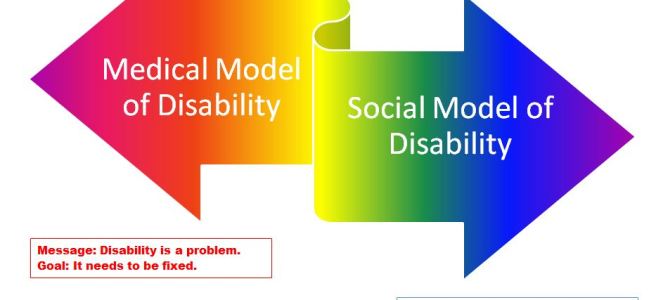
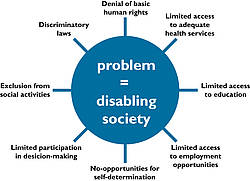
Our current way of thinking about disabilities, whether congenital or acquired, is rooted in the medical model. Disabled people have a problem and therefore are a problem, but one that can be, at least partially, fixed. And if not fixed, then we can find a place for them, either out of sight or working (for reduced wages) at Goodwill. The disability community is pushing for a more social model that places the root of the problem, not on the person, but how society is organized to marginalize that person. The barriers can be physical. (Are doors wide enough to accommodate people who use wheelchairs?) The barriers can also be our attitudes, including falling into the classic “us vs. them” dichotomy. There is only us.

According to the 2010 census, nearly one in five Americans experiences some form of disability, and yet so many of these physical and attitudinal barriers remain. I’d like to highlight that that means four in five Americans might be missing out on the benefit of the full participation of the the other fifth because of our fear or ignorance or indifference or belief that we are somehow more “normal”  than the disabled. Thanks to my conversation with Grant, I understand (I didn’t say “see”) this issue more deeply and am ready to be the advocate I should have been in high school. I see you. All of you.

SaveSave