
January 24, 2025
This series is intended to evaluate each product of the James Bond film franchise through a feminist lens, and the relevance of the Bond archetype to shifting ideas of masculinity in the 2020s.
Live and Let Die (1973, directed by Guy Hamilton)
Now we’re into “my” Bond. The era of Roger Moore. And we’re still in America. Director Guy Hamilton and screenwriter Tom Mankiewicz are back to give us a Bond version of a seventies blaxploitation film. Producers couldn’t bribe Sean Connery (with $5.5 million) to put his white dinner jacket on one more time so the scramble for the next Bond began. Steve McQueen, Paul Newman, Anthony Hopkins, and (again) Burt Reynolds were considered but the license to kill went to Roger Moore (the first English actor to play the role), who had long been considered for the job. In the 1960s, Moore starred in The Saint, a British mystery thriller series, so he was 007 in training. Moore’s Bond comes off as more bourgeois than Connery’s, making his snarky quips much more funny. Maybe the comedic writing was just better in the seventies, but Live and Let Die has plenty of laugh out loud lines.

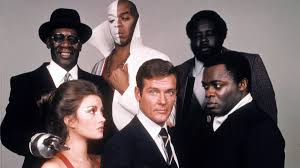
Live and Let Die is not a European film. The action takes place in New York (starting at the UN, then moving to Harlem), New Orleans, and the fictional island of San Monique. (Producers wanted to use Haiti, but the instability of Papa Doc Duvalier’s island forced filmmakers to move back to Jamaica and invent a tropical name.) There’s no Blofeld this time (but there is an underground lair!). Instead we get Mr. Big, a drug kingpin who has relationship with a Caribbean dictator named Kanaga (played by Yaphet Kotto, who had just played in the blaxploitation flick, Across 110th Street). The primary Bond “girl” this time is played by 21-year-old actress Jane Seymour. Since Pussy Galore (Goldfinger), the formula for the Bond girl has been a woman who is somehow in league with the bad guys who Bond peels away with his swarmy charm and Dudley Do-Right ethos. Here Solitaire (Seymour) is a psychic tarot card reader (as long as her virginity is intact) who belongs to the criminal Kanaga. Damsel in Distress Alert!!!

I didn’t see this movie when I came out the summer of 1973 (I was 9), but I knew all about it. The theme song was written and performed by Paul McCartney and Wings and was a radio staple that summer. I first saw it on TV a few years later and loved much of it, especially bayou boat chase that included a stunt that put the movie in the Guinness Book of World Records (which was like the Bible for kids in the 70s). As a boy in the Southern Klan town I was certainly challenged by the portrayals of black culture in the film that I found mostly frightening (especially the voodoo scenes). On its first TV screening the version that the Atlanta station showed removed the interracial kiss from the film. I missed out on that moment watching it age ll, but it was returned to the film by 1977 and, as a 13-year-old boy, I was already indoctrinated into the racist trope of black women as “sexual,” and was fixated on that scene. (The woman in question was CIA agent Rosie Carver, played by model Gloria Hendry.)
Live and Let Die was released at a time when “blaxploitation” films, made mostly by black filmmakers, started to find white audiences. Movies like Shaft (1971), Superfly (1972), and Cleopatra Jones (like Live and Let Die, in theaters the summer of ’73) were known for their gritty portrayals of black urban life, where black crime was often contrasted to the deeper crimes of racism. Live and Let Die contained many of these motifs and the images of James in Harlem capture a picture of urban decay that has long since gentrified. The film also finds great humor in the man out of place theme with Bond in his suit across 110th Street. “Can’t miss him. It’s like following a cue ball.” There’s a scene in a Harlem bar where Bond explains to a black waiter that ordering his whiskey “neat” means no ice, to which the waiter says, “Oh, we charge extra for that.” Brilliant.
Live and Let Die was hugely successful and worthy of our feminist analysis and probably a discussion about the portrayal of blackness as well.
Driver of Action – Maybe because there was (another) new Bond to introduce to the world, Roger Moore is the star of the show. We do get CIA agent Felix Leiter back in the fray (and a clever joke about a “Felix Lighter”). Felix (this time played by David Hedison) has, like in the last film, a team of unnamed CIA operatives, but this film is all about Bond in America, like a fish out of water. Everyone else is a bit player.

Role of Violence – One might make the case that the violence in LALD is ramped up because it’s Bond vs. black gangsters (This time Mr. Big smacks the Bond girl instead of James), but it’s a pretty standard body count, including four MI-6 and CIA agents. As has become tradition, the carnage is saved for the end of the film, including 007 opening fire on a voodoo gathering. The climax of the film has James and Solitaire dangling over a pool of sharks (lordy) that end with 007 literally blowing up Mr. Big (his guts raining down into the shark pool). And after that, Bond battles Tee Hee, Mr. Big’s metal clawed henchman, tossing him out of the window of a moving train. Moore is less physical than Connery and Lazenby’s Bonds (at 45, Moore was 16 years older than Lazenby). He’s also more likely to rely on wit than weapons.
Vulnerability – This one is less clear. Moore is stepping into an established caricature that is forged on a popular formula. James shaving while sitting in the bathtub is about as “naked” as we are privy to witnessing. We do get to see James’ kitchen, complete with art deco tiles and espresso machine (Paging Martha Stewart!), but we still know little about James when he’s not 007-ing. Even his relationship with Rosie, the bumbling CIA agent posing as “Mrs. Bond” is more predatory than empathetic. Moore’s more bougie Bond is still walled off.
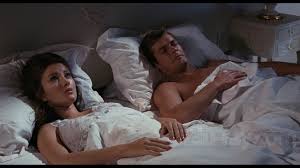
Sexual Potency – Bond is back. James quota of bedding three women is achieved in Live and Let Die. Bond’s first scene is him in the sack with a beautiful Italian agent, Miss Caruso, who has to hide in the closet when M and Moneypenny arrive at his apartment to give him his next mission. After they leave, he uses his cool magnet watch to unzip her dress for another round of “bonding.” In San Monique, he makes its with (double) agent Rosie in another interracial romp. When he calls her out for working for Mr. Big, looking for answers, he says, “And I’ll kill you if you don’t.” Having just had sex with him, she says, “But you couldn’t. You wouldn’t. Not after what we just done.” And his uber-creepy retort is, “Well, I certainly wouldn’t have killed you before.” Just a bit rapey. Finally, he beds the virginal Solitaire by tricking her with a tarot deck stacked with “Lover” cards so he can hit his quota. Even though her impropriety with Bond spells her death, she wants more 007 and begs him to come back to bed. “There’s no sense in going off half cocked,” he says in the best line of the film.
Connection – This new Bond is supremely detached, even from Moneypenny. When Rosie is killed, there’s not even a pause. There’s a reference to an MI-6 agent who was killed, and Bond says, “I rather liked him. We had the same hat maker.” That’s it. Even Felix is just a resource at the other end of a phone line. We do get the Bond/Bond girl end scene, this time not on a boat but a train to New York, headed for perhaps for some more cocking, somewhere south of Harlem.
Toxic Masculinity Scale: 5
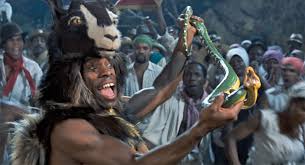
Summary Live and Let Die has a racial subtext that is a bit rough in 2025. Let’s start with the good news. Producers hired a ton of black performers for this film. Scenes shot in Harlem, New Orleans, and Jamaica are populated with black bodies. Cabaret singer B. J. Arnau’s soulful version of McCartney’s theme song is a high point of the film. Having said that, the movie is rife with racial stereotypes, from “pimp mobiles” and black gangsters peddling heroin in hollowed-out Harlem, to “mystical blacks” dancing with snakes and chanting voodoo mumbo. As a dumb white kid in rural Georgia, the film didn’t make me want to advocate for black people, it made me afraid of them. It was a spin on that “mystical black” trope when Geoffrey Holder, who plays voodoo-practicing Baron Samedi, became the pitchman for 7-Up in the “Uncola” commercials a few years later.
Contemporary viewers are likely to pin LALD as both racist and sexist. You’ve got the southern white cop who calls black men “boy” and you’ve got Bond who calls every woman “darling.” You get the sense that all the movements toward equity that we starting to become institutionalized in society in the seventies are kept at arms length by the WASP male fantasy of Bond. It’s a fair start for Moore, who comes in as a more older “gentleman” than Connery, which might lead one to think we’d get a Bond with a little more introspection. (You learn things as you age!) Instead we get sardonic raised eyebrows and lies to get women’s underwear off. That’s not an evolved man.

The action scenes in this movie are absolutely spectacular. I could watch the boat chase a hundred times. The surprise appearance of an underground lair with sharks is a chef’s kiss gift to Bond fans. And the one liners, delivered like a Blofeld laser, are side splitting. (“Butterhook!”) The score by Beatles producer George Martin is epic. And the voodoo and alligator scenes are completely terrifying. There’s so much to love in this film, even if Bond is stuck in a world that has left him behind. As Sheriff J. W. Pepper says to Bond, “What are you? Some kinda doomsday machine, boy?” No, just a device to preserve the old order.
Next: The Man with the Golden Gun (1974)
The James Bond Project #8: Diamonds are Forever (1971)
The James Bond Project #7: On Her Majesty’s Secret Service (1969)
The James Bond Project #6: You Only Live Twice (1967)
The James Bond Project #5: Casino Royale (1967)
The James Bond Project #4: Thunderball (1965)
The James Bond Project #3: Goldfinger (1964)



 Watching the Wheels