
January 19, 2025
This series is intended to evaluate each product of the James Bond film franchise through a feminist lens, and the relevance of the Bond archetype to shifting ideas of masculinity in the 2020s.
On Her Majesty’s Secret Service (1969, directed by Peter Hunt)

James Bond got married! Eon Productions had to scramble to find a new Bond after Sean Connery quit during the making of You Only Live Twice. Potential 007s included future Bond Timothy Dalton (too young) and Superman bad guy Terrence Stamp (too creepy?). Producer Albert Broccoli and first time director Peter Hunt settled on Australian model George Lazenby after seeing him in a chocolate bar commercial. Lazenby looked like a slightly younger Connery, but lacked the acting chops. He was offered a contract for seven Bond films but agreed to do only one, believing the 007 franchise would become passé in the 1970s.

On Her Majesty’s Secret Service was the first Bond novel authored by Ian Fleming after his spy became a big screen feature and was written to leave out the heavy reliance on gadgets Hollywood Bond relied on. The primary Bond girl was Countess Tracy di Vincenzo, played by Diana Rigg. From 1965 to 1968, Rigg played Emma Peel on the popular British spy TV show, The Avengers. (Rigg joined The Avengers to replace Honor Blackman, who had left to play Pussy Galore in Goldfinger.) Emma Peel was often considered the “female James Bond,” so bringing Rigg in may have been meant to offer a new role for the Bond “girl” at the end of the decade.
The film was premiered in the United States on December 19, 1969 while the country was consumed with the details surrounding the Charles Manson murders. By January, it topped the box office on both sides of the Atlantic but received mixed reviews for veering from the blockbuster Bond formula. Overtime, the film has gained respect for remaining closer to the Fleming novel than other screen adaptations, and that was Hunt’s intent. The script even comments on previous Bond films, such as the opening scene were Lazenby’s Bond rescues Rigg from the ocean and fights some random henchmen. Lazenby breaks the fourth wall and says to the camera, “This never happened to the other fellow.” Or when Bond resigns from MI-6 and looks at some of his gadgets from previous films with a smirk of disdain while they remain in his shabby office desk.
We do get tried and true Bond tropes, including an underground lair filled with henchmen, Bond at the Baccarat table, his appetite of Beluga caviar and Dom Perignon, flirting with Moneypenny, and Blofeld (this time played by American Telly Savalas). But in one way, this is a very different Bond film, one that ends with a Mrs. James Bond.
Let’s plug it in to our feminist matrix and see where we come out.

Driver of Action – We are in full solo Bond mode in OHMSS. We have no “team” helping drive the story. (Q only makes a brief appearance at the end of the film.) There is an MI-6 agent, apparently named Shaun, who keeps an eye on James, from a distance, in Portugal and Switzerland but is killed off pretty early. And there’s Draco, the head of a Portuguese crime syndicate, who helps Bond take down Blofeld at the end of the film. But it’s pretty much just James, including when he goes rogue from MI-6 after being taken off the Blofeld case by M. We do see Blofeld (as a prequel to Kojak) leading more of the action, including slapping on a pair of skis to race down the Alps to catch Bond. There’s also a killer bobsled race between Bond and Blofeld. And, sadly, Blofeld’s cat only appears briefly.
Role of Violence – Lazenby’s Bond seemed a little more skilled in fake martial arts skills than Connery. There’s more chops and flips but the body count is reserved for the the end of the film (although, early in the film, he slaps Rigg’s character pretty hard). He sends a few henchmen on skis to their deaths as they plunge off a cliff and during the climatic assault on Blofeld’s mountaintop lair, he machine guns a bunch of henchmen and a scientist who throws a bottle of acid at him. This Bond punched harder, but used his gun a lot less. Does that make him less manly or more?

Vulnerability – OK, this is the big one. The set up is that mob boss Darco wants Bond to marry his troubled daughter, Tracy (AKA TV bad ass Emma Peel). Darco says, “What she needs is a man to dominate her” (puke) and offers James a million pounds in gold as a dowery. Bond says he doesn’t need the money and says, “I have a bachelor’s taste for freedom.” But something strange happens. It seems like Bond is falling in love with Tracy. There’s even a very 1969 montage of James and Tracy doing “falling in love” stuff, like walking on the beach and window shopping for rings, set to an original song written by Burt Bacharach and Hal David called “We Have All the Time in the World,” sung my Louis Armstrong! Is this a chick flick? Maybe it’s all part of a ruse to get Darco’s help going after Blofeld.
Nope. After Tracy rescues Bond in a Swiss town and escapes more henchmen in one of the craziest chase scenes on film, Tracy and James end up hiding in the hayloft of a barn. Instead of making his usual sex moves (like he did several times earlier in the film), he tells her, “I’m thinking about us. I love you. Will you marry me?” (I’ll take “Things I’d Never Expect to Hear in a James Bond Film” for $200, Alex.) She agrees to be “Mrs. James Bond” and we have a very different 007 flick. Instead of sealing the deal, James decides they should sleep separately. “The proper time for this is our wedding night. That’s my New Year’s resolution,” he says. “Whatever you say, my dear,” says Tracy. “And that is yours,” James quips. OK, maybe not that different.

The last Bond film of the 1960s ends like the dozens of Elvis Presley films of the 1960s, with a wedding. The proficient bedder of endless women is now wedded in holy matrimony, with M (and the rest of us) in shock that it happened and poor Miss Moneypenny in tears. But there is no happily ever after. A car driven by Blofeld pulls up next to the newlyweds and Irma Bunt, Blofeld’s henchwoman, fills Bond’s Aston Martin with machine gun fire. The final scene of On Her Majesty’s Secret Service is James Bond in tears, holding his dead wife.
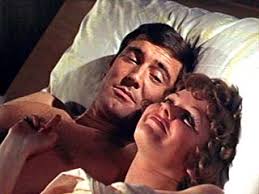
Sexual Potency – Before we forget, this is a James Bond film. When Tracy appears at the casino, the camera lingers on her cleavage. She ends up in Bond’s bed as a business transaction (he payed her gambling debt). The encounter is so transactional it creates doubt in the legitimacy of the “romance” that follows (enhanced by a scene at a bullfighting ring where Darco is trying to pass his daughter off to Bond.) When Bond gets into Blofeld’s lair, pretending to be a gay genealogist (don’t ask), he’s met with a dozen beautiful women (Blofeld’s “Angles of Death”) that he goes to work on, sleeping with two in one night while scheduling a third. “Work is piling up,” he snorts. He may be in love with Tracy, but Bond’s gotta Bond.
Connection – This Bond does seem to have some genuine affection for M and Moneypenny, even kissing Moneypenny on the lips. But, again, this is solo Bond in action. His connection to Tracy seems to become genuine when she rescues him from Blofeld’s henchmen, repeatedly kissing her on the cheek as she frantically drives her getaway car from their gunfire. In the end, he is alone again and viewers are told to get ready for the next chapter of our man Bond.
Toxic Masculinity Scale: 5
Summary Hunt and Lazenby’s Bond may be closer to Ian Fleming’s 007 than the formula viewers had had become used to, but there’s still plenty of sexism in OHMSS. The most obvious proponent of misogyny is Darco (played by Italian actor Gabriele Ferzetti). He just goes on and on telling Bond how his daughter needs to be manhandled and smiles at that fact that Bond got her in the sack. He even punches his daughter in the face, knocking her out, so she doesn’t try to rescue James in the gunfight. At the wedding he says to her, “Obey your husband in all things.” We also get get Bond ogling a Playboy magazine (and stealing the centerfold) and working his way through Blofeld’s scantily clad angels of death. “Just a slight stiffness coming on,” he says, sitting among them in his kilt.
Don’t expect Bond to be mourning his dead wife in the next installment, 1971’s Diamonds Are Forever. James will be back to his old tricks. But the final scene of On Her Majesty’s Secret Service gives a glimpse of a more human man than in all the previous 007 films, left to reconcile the cost of vulnerability when your job requires you to carry a license to kill.
Next: Diamonds Are Forever (1971)
The James Bond Project #6: You Only Live Twice (1967)
The James Bond Project #5: Casino Royale (1967)
The James Bond Project #4: Thunderball (1965)
The James Bond Project #3: Goldfinger (1964)




 Watching the Wheels