The James Bond Project #2: From Russia With Love (1963)

December 28, 2024

From Russia With Love (1963, directed by Terence Young)

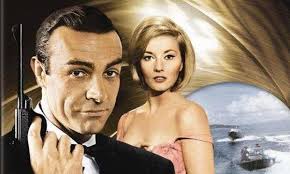
With the unexpected success of Dr. No, United Artists doubled the budget for the sequel and the bet paid off. (The $2 million film took in more than $78 million worldwide.) We are now firmly in a franchise of films made by men for men and their dates, starring manly man Sean Connery. Although it should be noted that Johanna Harwood, who had worked on the script for Dr. No, played a large role in the screenplay for From Russia With Love. Producers cast Italian beauty queen Daniela Bianchi as Bond Girl #2 Tatiana Romanova, after actress Elga Gimba Andersson refused to sleep with a United Artists executive. Bianchi, who could barely speak English, had her lines dubbed by a British actress.
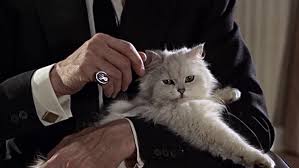
The film starts the Bond tradition of the opening credits being projected on to the bodies of scantily clad or nude women, firmly establishing that these are stories for boys. Instead of Jamaica, most of the action takes place in Turkey, although there are obligatory scenes in London and wherever SPECTRE Island is. There we meet the Dr. Evil of the Bond cinematic universe, Blofeld (or at least his cute cat). Leaving the Caribbean means we leave any and all black actors, and the primary Turkish character, Ali Kerim Bey, is played by Mexican actor Pedro Armendáriz. (In a bizarre side note, Armendáriz contracted neck cancer after filming a Howard Hughes film near a nuclear test site in Utah, and before he finished shooting his parts for From Russia With Love, shot himself with a gun that he snuck into his hospital room.)

From Russia With Love was filmed as the Cold War intensified and SPECTRE agents replaced Russian agents (who were the villains in Ian Fleming’s original Bond novel) to not further inflame tensions. President Kennedy told Life Magazine that From Russia With Love was one of his favorite novels. The film version premiered on October 10, 1963, the same day U.S. Attorney General Robert Kennedy (crazy guy’s dad) approved J. Edgar Hoover’s wiretapping of Martin Luther King, Jr.. The film was screened at the White House for JFK before he left for Dallas, where he was assassinated. From Russia With Love received mixed reviews, some saying it was slower than Dr. No, but has gone on to be held up as one of the best of the Bond series.

Here’s how FRWL charts with our five evaluations.

Driver of Action – Director Terrence Young had established a formula and he’s not going to break it on the sophomore outing. This is Bond in all his glory, now supplied with cool gadgets by MI-6’s Agent Q (played by Desmond Llewelyn, who remained as Q to 1999’s The World is Not Enough). There is a great “buddy” feature between Bond and Bey (similar to Dr. No’s Quarrel role) and a fun subplot about SPECTRE operatives Rosa Klebb and Kronsteen, groveling before Blofeld as they attempt to kill Bond for offing Dr. No. (The “R” in SPECTRE is for “revenge”- Special Executive for Counter-intelligence, Terrorism, Revenge and Extortion. FYI.) But the story doesn’t happen without their dastardly plot to kill Bond and the delight of our man James foiling their fiendishness.

Role of Violence – There is considerably less violence in Dr. No’s sequel. There are some cool explosions after a helicopter attack and a boat chase, but 007 only kills one person, SPECTRE assassin Donald Grant (played by Robert Shaw, who will always be Captain Quint in Jaws to me). Grant’s death is the result of a beautifully choreographed fight scene in a train car on the Orient Express. (Fight scenes in train cars become something of a trope in the Bond franchise.) The most shocking violence in the film is Bond’s full-handed smack across Russian agent Tatiana’s face, after which she repeatedly tells him that she loves him. I bet that clip has showed up in a few “Sexism in Film” classes.

Vulnerability – Again, there’s no chink in James Bond’s armor. No glimpse inside. Even when Bond is literally on his knees prostrate before assassin Grant, we know he has a plan to quickly turn the tables.
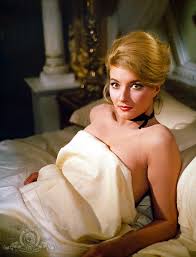
Sexual Potency – The first shot of Bond in the film is him making out with Sylvia Trench (from Dr. No) in a floating punt, probably on the banks of the River Cam in Cambridge. He’s playing hooky from MI-6 to work his way around the bases with Trench. (Is there a cricket version of “third base”?). When Bond first meets Tatiana, she is naked in his Istanbul hotel bed. Later she asks him, “James, will you make love to me in London?” He answers, “Day and night.” There’s another strange segment where Bond must decide which of two young, attractive “gypsy” women will be awarded the man they both want. They arrive at his room to seductive music. “This might take some time,” he says. We see the women the next morning with broad smiles as James leaves. All these women are happy for a piece of 007’s sexual mojo, even when he slaps them.

Connection – The scenes with Pedro Armendáriz as Ali Kerim Bey sparkle. They have immense chemistry, enhanced by the knowledge of the great pain he was in from his cancer. Had he lived, one could see Armendáriz as Bond’s Morocco Mole sidekick in future Bond films. But both Armendáriz and his character are dead by the end of the film. His relationship with Tatiana is less mutual, even though they have to pretend to be a married couple while on the train, and she dreams of marrying him when they reach London. She even saves him from the venomous boots of Rosa Klebb in a hotel room in Venice and his heart is unmoved. Like the closing scene in Dr. No, we end with Bond and Bond Girl #2 romantically floating together in a boat, this time a gondola, with end credits urging viewers to get ready for Bond #3, Goldfinger, which will most certainly present us with Bond Girl #3.

Toxic Masculinity Scale: 7/10

Summary From Russia With Love really front loads the male gaze on women’s bodies thing. From the opening credits, to the (very) long shot of Ali Kerim Bey’s girlfriend’s cleavage, to a very oily masseuse on SPECTRE Island, to the camera endlessly hovering on a belly dancer’s torso, there’s plenty to ogle. Then there’s the weirdly placed “duel” between two scantily glad “gypsy girls” that has zip to do with the plot. If there’s any sense of balance, we do get Bond wrapped in a towel, which probably had some men wondering what they needed to do to grow crops of hair on their chests.
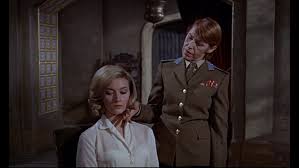
There’s also an odd lesbian subtext with Rosa Klebb. Props to having a female antagonist in the second Bond film. In 1963, there was a narrative that Russian (i.e. “communist”) women were more manly, so that tracks. But to make the point that women on the other side of the Iron Curtain are not bound by the same gender rules, they add a suggestion of sexual predation when Klebb is informing Tatiana of her mission to seduce Bond. And Romanova doesn’t seem to shirk as Klebb evaluates her body and places her hand on her leg. Russians, they not like us. (Or are they?)

From Russia With Love is rough film to place. It’s the most realistic of all the Bond films from the classic era. There’s a nice complexity to the plot but we know even less about the person of James Bond. It’s almost like Sean Connery is playing James Bond pretending to be a caricature of James Bond. A lot of people think this is one of the greatest British films ever made, but it felt flat to me. And the slapping scene seemed very un-Bond, even if it served as a reminder of how normalized violence against women is in film. Where is Wonder Woman when you need her?
Next: Goldfinger (1964)

The James Bond Project: #1: Dr. No

Why I love Black History Month. An Apology.

Feb. 19, 2015 Sometimes I got complaints from students at PSU who were unhappy with their grades or just wanted to see if they can take me down a few notches. One of my favorites was an annonymous complaint that I made fun of Black History Month, saying there was a sale on cottonballs at Walmart.

I know, it makes absolutely no sense. First of all, I have a better sense of humor than that. And second, I LOVE Black History Month! My joke about it is racists put it in the shortest and coldest month of the year. It should be in May. Give us 31 days, Honky!

But I got called into the “Office of Equity & Complaince” (Kafka reference here) and was interogated. It all blew over but I had to explain to the well-meaning bureaucrat in charge that my whole life has been dedicated to undoing biases like racism and sexism. It’s a feature of each of my classes. I went undercover in some of the most violent white supremacist groups in the world to learn how to do this.

Anyway, my trust in the institutions like that to be partners in that journey, instead of just “management,” died on that day. But it hasn’t taken anything away from my love of Black History Month. My favorite part of it is learning about cool things invented by African-Americans. It’s the nerd in me. One time there was this chubby skinhead chowing down on a bag of Lays Potato Chips. I told him he was a shitty Nazi because potato chips were invented by George Crum, a black guy. He looked sad.

But I wanted to tell another story today. It’s probably the best story the explains why a chose a path dedicated to anti-racism. When I was a freshman at Oxford College (a part of Emory University), winter quarter had a required thing called Oxford Studies. Everybody on campus reads the same book, goes to presentations and lectures and has a general conversation about it. Like an Ivy League Oprah’s Book Club.

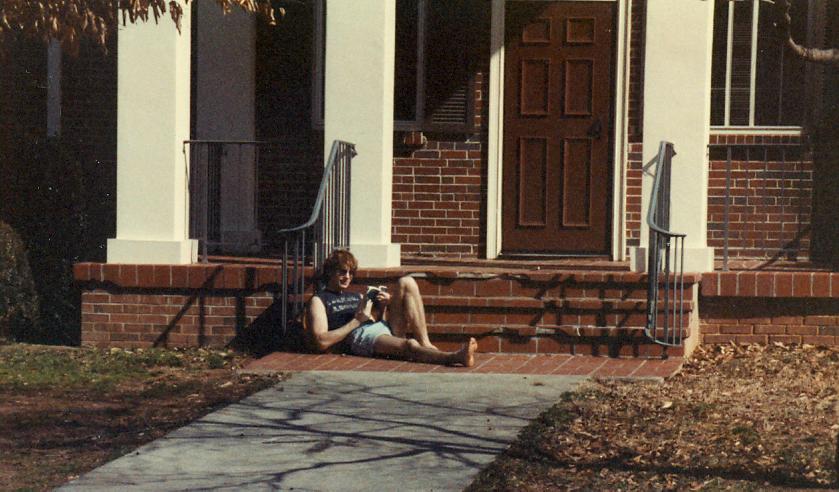
DICKEYMe reading in front of Dickey Dorm.

The winter of 1982 it was Why We Can’t Wait, Dr. Martin Luther King Jr.’s important 1964 book about the state of civil rights in America. Since it was a required book assigned to a bunch of young college kids (most from the South) who would rather be drinking hunch punch than reading another “important” book, there was a great celebration when the Oxford Studies term ended.

Someone in my dorm marked the occasion by ripping the book in half and throwing it into the urinal in the bathroom on our hall. I walked into the bathroom and saw our black janitor, who we all loved, standing in front of that urinal in tears. Here is a guy who cleaned the toilets of privileged white kids who go off to college at 18, not off to work. And here were the words of the man who wanted every child to have that chance in a dirty urinal. It was heartbreaking on a massive scale.

I tell this story because the 18-year-old kid who ripped up that book and dumped it in the john was me. It was just an impulse. Not meant to be racist. But I saw the impact that thoughtless act had on another human being and suddenly the whole thing became clear to me. I was a racist, the product of a racist culture that had the privilege of not thinking about the reality of race in America.

I became anti-racist activist in that moment, to make amends to that janitor who I never had the guts to apologize to. It’s 33 years later and I still cannot think about that moment without tears streaming down my face.

When I was a 16-year-old kid living in Stone Mountain, Georgia (the birthplace of the modern KKK), I was given an assignment in my journalism class to write an editorial. Here’s what I wrote. “If there’s a Black History Month, why can’t their be a White History Month?” If the teacher would have just said, “Randy, every month is ‘White History Month’,” I might have started on this path earlier and spared the knife I slowly pushed into our janitor’s back.

My daughter will know about race. She will know about the white privilege and the obstacles her Latino relatives and other people of color still face. Most of all she will know that these issues are very real and matter to people in the deepest ways.

Oxford83DOur janitor, on the left.

And to the janitor of Dickey Dorm at Oxford Collge in 1982, I want to say I am sorry. I will continue to make it up to you. I promise.

This book by Dr. King is available at Powell’s by clicking below. I plan on buying a new copy.

My little MLK story: Skinheads and feminists

January 19, 2015

Being from Atlanta I get to claim Martin Luther King, Jr. as my homeboy. I’ve spent a lot of time on Auburn Avenue, and not going to Ebenezer Baptist Church. The Royal Peacock Club was there, where the Supremes and James Brown performed. And the band I managed, Drivin’ N’ Cryin’ too! I was hit by a car on Auburn in front to the Sweet Auburn Rib Shack. I was on my Vespa scooter and sent flying. I ended up at Grady Hospital, now a Walking Dead location.

But before Atlanta, I was from Stone Mountain, Georgia. Our little town was mentioned by Dr. King in his famous 1963 “I Have A Dream” speech, but not because it was awesome. When I was a kid, I thought it was because it was awesome. (Stone Mountain has a giant granite mountain with a lazar show the ends with “Dixie” that I doubt MLK ever saw.) He mentioned my town because it was the birthplace of the modern Ku Klux Klan in 1915. Sad trombone.

Growing up around the Klan was the beginning of my interest in extremism and oppression. As a grad student at Emory University, I chose to go undercover in the late 1980s to study a new racist group, Nazi skinheads. My first study was a 13-month observation of a racist skinhead gang in Orlando, Florida called the O-Town Skins.

Much to my surprise, these rabid bigots were not morons, or bullies (although a few were sociopaths). They were reasonably intelligent kids who just had been given the wrong explanation for why their world was changing. (“It’s the Jews!”) The right explanation had something to do with Ronald Reagan. I would listen to them gripe about The Cosby Show and how this black family had so much more than their own.

I bonded with these guys, drank beer with them, and talked to them about their girl problems. I began to get too close to them and lose my objectivity. So, while I was home on a break from the study, I rode my scooter over to Martin’s tomb on Auburn and sat with him for a while. I wanted to reflect with the man by the cool reflecting pool and remember why I started the project. He once said, “I have decided to stick with love. Hate is too great a burden to bear.” I wanted to understand these skinheads so I could liberate them from their burden of hate. We sat together in the hot Atlanta night and I felt ready to go back into the field.

It was this study that turned me into a feminist. It became clear, as the research progressed, that the racism was just a vehicle for them to perform their masculinity. They saw black men, lesbians and feminists taking “their” white women. And Jews outsourcing “their” manufacturing jobs. And gay men threatening “their” sexual propriety. As the 80s became the 90s, they became obsessed with that “bitch” Hilary Clinton, who signified, to them, the end of the divine right of men. Hateful violence was their defense of their fragile masculinity, not far removed from the rhetoric of the conservative right. Much of this research ended up in my 2001 book with Wayne Wooden, Renegade Kids, Suburban Outlaws.

Martin Luther King’s love ethic is all around. It’s in the philosophies of bell hooks and Cornell West. It’s in the actions of youth outreach workers and gay rights advocates. And it’s in the work I’ve been doing since I interviewed that very first skinhead. Love undoes hate. If you try to understand the hater, including the misogynist, through love, you can turn them toward the light. As Dr. King told us long ago, “Love is the only force capable of transforming an enemy into a friend.”

The following book was mentioned in this blog. You can buy it from Powell’s by clicking the cover image below.