The James Bond Project #5: Casino Royale (1967)

January 11, 2025

This series is intended to evaluate each product of the James Bond film franchise through a feminist lens, and the relevance of the Bond archetype to shifting ideas of masculinity in the 2020s.

Casino Royale (1967, directed by John Huston and others)

After four hugely successful Bond films, it’s time for the first Bond spoof. Casino Royale was the first of Ian Fleming’s Bond books (published in 1953). The John Huston directed film brings back many faces from the first four films from the the United Artists Bond canon, including Ursula Andress (who, as MI-6 agent Vesper Lynd, sounds way too much like Melania Trump). Casino Royale is a comedy meant to mock many of the Bond conventions, so it’s going to score differently than the films produced by Eon Productions, the home to “official” 007 movie franchise.

Here we get an older Bond, played by David Niven, who is 20 years retired after a sad end of a relationship with his beloved Mata Hari. He stutters and is known for his celibacy. This ain’t Sean Connery’s Bond. He’s brought back to MI-6 by M (played by Huston himself) to deal with evil SMERSH. (We don’t know what SMERSH stands for but there was a counter-intelligence group in the Soviet Union with the same name). M is comically killed so Bond takes the helm of MI-6, where he is reunited with Miss Moneypenny, or at least her daughter. (Strangely, Moneypenny now has an American accent, played by Barbara Bouchet, who was born in Nazi Germany.) He orders all the “Double O” agents to change their names to “James Bond” to confuse and trap SMERSH baccarat player Le Chiffre, played with gusto by Orson Welles. Two of those agents include Peter Sellers and a very young Woody Allen.

Casino Royale is a madcap farce that lampoons the cool image of 007. There’s even a yakety sax soundtrack during chase and fight scenes (some played by Herb Albert). The funny Bond quips are turned up to 11, jumping from wry to hilarious. (“James Bond doesn’t wear glasses.” Bond: “Yes, it’s just because I like to see who I’m shooting.”) The film is fully located in the mid-sixties. The first shot is graffiti that says, “Les Beatles.” The scene where the Peter Sellers’ Bond is drugged is straight psychedelia. And the movie introduces the Burt Bacharach song, “The Look of Love,” sung by Dusty Springfield (and sung by Bacharach himself in 1997’s Austin Powers: International Man of Mystery). The film was released in April 1967 and Sgt. Peppers Lonely Hearts Club Band was released shortly after setting up the iconic “Summer of Love.”

This may be an anti-Bond Bond film, piercing some of the tried and true tropes of the previous four films, but it’s worth dropping it into our feminist matrix if just for point of comparison.

Driver of Action – There are multiple drivers of the story here, including multiple Bonds. Sir James Bond (Niven) plays almost a support role. The majority of the story centers around Evelyn Tremble (Peter Sellers as a Bond surrogate) and Vesper Lynd (Andress). A section of the film follows Bond’s daughter with Mata Hari, Mata Bond (played by Joanna Pettet) in an adventure in Berlin (which features A Hard Day’s Night’s Anna Quayle and a hilarious scene where a hole is blown in the Berlin Wall and a wave of East Germans run out). This is an ensemble cast.

Role of Violence – It’s a Bond film so there a guns and explosions. But much of the violence is done for laughs, aided by a comedic soundtrack. But, other than an army of fembots with machine guns, there is no overt violence. I don’t think Niven’s or Seller’s Bonds kill anybody.

Vulnerability – The premise of this story is that Bond experienced heartbreak from his true love, Mata Hari, and looks for a connection to his daughter Mata Bond (who is abducted into a SMERSH flying saucer). He’s developed a stammer that he’s self-conscious of and his fighting style as become what might be describes as “effeminate.”

Sexual Potency – The joke of the movie is that Bond is celibate and that 00 agents are being killed because they can’t resist women. Bond creates a program to train agents to resist females in a scene where Agent Cooper rebuffs seductive women by throwing them to the mat. There is one scene where Sir Bond forcibly kisses Moneypenny (or her daughter). Ursula Andress plays seductress to Peter Sellers’ Bond, as does Miss Goodthighs (played by a young Jacqueline Bisset). Additionally, Dr. Noah (not Dr. No), played by Woody Allen, has a fourth quarter evil plot. He has a biological weapon that will make all women beautiful and kill all men over 4 foot 6, making him the tallest (and most sexually attractive?) man on earth.

Connection – There are few autonomous men in this film. The last quarter of the movie features Sir James, Moneypenny, Mata, and Agent Cooper working together to bring down Le Chiffre at the Casino Royale. And the Calvary (literally!) arrives to help save the day. Bond’s connection to his daughter seems sincere as is his desire to shepherd MI-6 in the post-M era. The film ends with the cast, having been blown up, floating in heaven, while Woody Allen’s character drops down to hell.

Toxic Masculinity Scale: 2

Summary Casino Royale is not a feminist critique of Bond. It’s a mid-sixties comedy so there are plenty of jokes rooted in sexism. For example, after M dies, Bond is sequestered in his house with his eleven seductive daughters (actually SMERSH agents) and his equally seductive widow (played with great hilarity by Deborah Kerr). But the film also completely mocks Bond’s Lothario reputation. (Woody Allen as James Bond should make the point.) There are plenty of nods to the Bond franchise, including an underground lair and even women in gold paint, but the ensemble nature of Casino Royale stands in stark contrast to Bond 1 to 4.

Unlike the previous film, Thunderball, whose cast is entirely gone, many cast members from Casino Royale are still with is, including Ursula Andress, Woody Allen, Joanna Pettet, Barbara Bouchet, and Jacqueline Bisset. I’d love to know how they see the film’s depiction of Bond and of women from a contemporary lens. The film is both hilarious and, at times, a complete mess, but also provided a break from the Bond formula. Sometimes stepping out of something allows us a fresh perspective on it. Two months later there would be another Sean Connery Bond flick headed to theaters. I wonder if viewers saw it differently after watching Casino Royale.

Next: You Only Live Twice (1967)


The James Bond Project #4: Thunderball (1965)

The James Bond Project #3: Goldfinger (1964)

The James Bond Project #2: From Russia With Love (1963)

The James Bond Project: #1: Dr. No (1962)

The James Bond Project #3: Goldfinger (1964)
December 30, 2024

Goldfinger (1964, directed by Guy Hamilton)

“That’s my James!” Welcome to the James Bond blockbuster. With the massive success of From Russia With Love came an even bigger budget (and a new director). Goldfinger gave us franchise staples, like the pre-credits action scene, the bouncy Bond quips, infinite gadgets (including the loaded Aston Martin), the epic theme song, and multiple exotic locations (including rural Kentucky). And of course there are multiple women who are branded as Bond “girls” in the film who find their way into 007’s beefy arms.

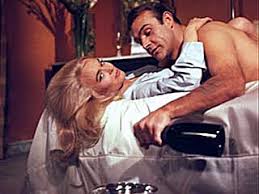
The box office smash surely benefited from the 1964 British Invasion and the American obsession with all things English. Bond even has a snarky line about the Fab Four after he beds Goldfinger’s girl Jill Masterson, chiding her not understanding his standards for chilled Champaign. “My dear girl, there are some things that just aren’t done, such as drinking Dom Pérignon ’53 above 38 degrees Fahrenheit. That’s as bad as listening to the Beatles without earmuffs.” (It should be noted that two of the actors in Goldfinger, Richard Vernon (Colonel Smithers) and Margaret Nolán (Dink), had just appeared in the Beatles’ film A Hard Days Night and the Beatles 1965 film, Help!, would be a send up of Goldfinger.)

Goldfinger cemented the formula for what a Bond film would be for decades to come. It was released in September of 1964, in a world that was increasingly surrendering to the ennui of the East-West Cold War, the same month as Lyndon Johnson’s apocalyptic “Daisy” campaign ad that ended with a mushroom cloud. I had been born 7 months earlier and would be socialized into a world that saw Bond as the modern model of masculinity. Let’s check Goldfinger with our five reference criteria.

Driver of Action – Goldfinger is the archetypical Bond film, the begins with him blowing some shit up in Mexico and ends with him making sweet love to Bond Girl #3 Pussy Galore on a desert island, telling her “This is no time to be rescued.” There is no “buddy,” as in the previous two films, just Bond, and his MI-6 and CIA supporters (who play minimal roles). Even the nefarious plotting by Goldfinger (played by former Nazi Gert Fröbe after Orson Welles proved to be too expensive) to irradiate all the gold in Fort Knox is a minor subplot. Goldfinger is all about watching Sean Connery as Bond move from scene to scene; Mexico, Miami, London, Switzerland, Kentucky. In the opening scene, he steps out of his wetsuit dressed in a white dinner jacket and you know this going to be 110 minutes of pure Connery.

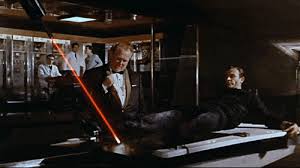
Role of Violence – Again, Bond has a relatively low bodycount in this film. People do die, especially women, including Jill Masterson. For her flirtation with Bond, she is painted gold and dies of “skin suffocation.” Her sister Tilly is killed by Oddjob, Goldfinger’s Korean henchman. But Mr. License-to-Kill is mostly restrained. A Mexican assassin gets an electric fan tossed into his bathtub. Some henchmen go over a cliff in a fiery crash after Bond shoots slick oil out of his Aston Martin. In the climatic scene in Fort Knox, Bond throws a henchman off a ledge and electrocutes Oddjob. (Apparently actor Harold Sakata was severely burned in the stunt.) Mostly Bond is the recipient of violence, including a laser beam aimed at his most manly parts while he is strapped to a table.

Vulnerability – Yeah, no. You wonder if we have to wait until the ‘90s to get new age sensitive James Bond. Whether strapped to a table with a laser heading toward his junk or locked in a Kentucky holding cell, or in a plane plummeting to the earth, we never see James break a sweat. 

Sexual PotencyGoldfinger is balls out on the message that Bond is the conquerer of women. In the opening sequence, he goes after a Mexican dancer and then uses her body to deflect an assassin. In Miami, he’s getting a poolside massage from his Florida fling, Dink (who’s cleavage was also featured in A Hard Days Night). Then there’s the romp with Jill who gets painted gold. In Switzerland, when a blonde passes him by in a ’64 Mustang convertible, he resists the urge to chase after her. “Discipline, 007, discipline,” he says to himself. She turns out to be Jill’s sister and they have a moment before Oddball kills her with his killer hat.

That brings us to Pussy Galore (the character, not the male fantasy). The Bond double entendres hit a new level here and Pussy’s name is mentioned constantly in the second half of the film. Galore is played by Honor Blackman, who was Diana Rigg’s predecessor on the highly popular British spy show, The Avengers. So she was coming in to Bondland a Judo-flipping badass, not a submissive DID (Damsel In Distress). In Goldfinger, she’s the leader of Goldfinger’s team of female pilots, playing a role in his grand slam plan. But there’s a scene in Goldfinger’s barn where James manhandles Pussy and the subsequent judo fight ends up with the two literally rolling in the hay. Galore tries to push Bond off her, but no woman can resist 007 and his assault ends in a passionate kiss. Woot, there it is.

Connection – Unbeknownst to the viewer, Pussy Galore’s Stockholm Syndrome turns her into an ally of Bond’s and Goldfinger’s evil plot is thwarted. As has already become an uber-cliche in Bond films, their end scene, making out under the parachute, casts no allusion that it’s the beginning of a beautiful relationship between James and Pussy. We know how this works. Women are transitory and co-workers are support players. Does Bond have any friends? A love that got away? He is supremely untethered. A man alone.

Toxic Masculinity Scale: 7

Summary –  Like an explosion of everything that was 1960s before LSD, Goldfinger is a magnum opus of a spy action film. The clever crime attempted (to irradiate the gold in Fort Knox to drive up the value of personal stocks of the metal) takes a back seat to watching Connery leap frog from woman to woman, often with his suped-up Bondmobile (Oh, to have stock in Aston Martin in 1964). Connery’s Bond is the Id unrestrained. One wonders what MI-6’s HR department would say about the workplace flirtations between Bond and Miss Moneypenny in the post #metoo era. But it’s the scene between Bond and Galore in the barn that reminds us that the debonair spy is not immune from the misogynistic value of male entitlement. A generation of boys learned women are to be taken by men, even if they resist. Pussy galore, indeed.

While contemporary audiences my get a bit of a creepy vibe from Goldfinger’s Bond, there’s a creeping trend that may be less noticed today. The third Bond film sees 007 more dependent on the technology provided by his employer. It may be a homing device in his shoe or an ejection seat in his car, but 1964 Bond is becoming less a man left to his own devices and more to the devices Q builds for him. Bond is the halfway point between the archetypical cowboy, fending for himself on the frontier, and Modern Man, juggling apps and monitoring social media, never not wired to the electronic collective. Where would Bond be without Q? Where would we be if the internet went down? One imagines that Bond would be better off, but not by much.

Next: Thunderball (1965)


The James Bond Project: #1 – Dr. No (1962)
The James Bond Project #2: From Russia With Love (1963)