
May 21, 2023
I spent most of my life in a narcissistic head cloud. I put it off to being a Pisces, but the fact of the matter is that I was habitually more interested in myself than other people. After all, both Mr. Rogers and my mother had told me, “You are special.” When my first wife was on her way out the door, I remember her saying, “You suck all the air out of a room, Randy.” I thought that was meant as a compliment. I would think that. Turns out Mr. Rogers (and Mom) were wrong. I wasn’t special. I was an asshole.
This “COVID-era” life change I’ve been going through has forced me to stop. Stop my awesome rocket ride through “Randyland.” I’d had plenty of clues along the way. As an ethnographer, my job was to skillfully interview subjects without them knowing it. I’d come out of the field after months of hanging out with white supremacists realizing I was missing data because I’d spent more time talking than listening. I realized my biggest grammar mistake was forgetting to end queries with question marks. One student’s review of a sociology class at Portland State was one sentence long: “Nobody loves Randy Blazak more than Randy Blazak.”
This lack of curiosity became an issue between Andi and I. She didn’t need another story. She need someone who was interested in her thoughts and observations. Someone who talked with her not at her. I needed to figure this curiosity thing out.

Even though it might be too late for Andi, I finally cracked this curious nut. I’ve mentioned in this blog how lucky I’ve been to find a somatic therapist who could help be corral my unwieldy lizard brain and help find methods to get my parasympathetic nervous system to help my behavior be in line with my “I’m a feminist!” values. She recently suggested a book by Buddhist Oren Jay Sofer called Say What You Mean: A Mindful Approach to Nonviolent Communication and it’s been a game changer. I’ve really relied a lot on mindfulness practices to get away from to my bad habits. Ruth King’s Mindful of Race and her emphasis on “Impact not intent” has been vital in deflating some of my patterns of harm. These books are sacred.
I’m currently working on a federally-funded project to interrupt violent extremism so I figured out I could read Sofer’s book for work. Turns it’s more about people like me than the Proud Boys. (Does that sound narcissistic?) While I was focused on the eminent fist fight between Marjorie Taylor Greene and Joe Biden, the conflict here was less domestic terrorism and more just domestic. Our interpersonal conflicts certainly can escalate into some ugly areas, of which, violence is only one stupid scenario, but fighting over someone not doing the kid’s laundry is enough.
The book follows three main strategies to get us out of the combative way we communicate; 1) Being present in the moment, 2) Bringing in curiosity and care, and 3) Focusing on what matters. Sounds simple but there’s a lot of detail in the process. The bottom line is we are really good at reacting and getting pulled into a fight to prove the validity of our position. But more often than not, that just ends in a pointless stalemate. My Facebook page is an endless battle between my blue state Portland friends and my red state Georgia homies and the line of scrimmage hasn’t moved an inch.
A key part of the middle of Say What You Mean is developing empathetic listening skills by practicing curiosity. Let’s be honest – for most of us – when other people are speaking, we’re just listening for a gap to say whatever we were going to say anyway. That’s what we’re listening for, not what that person is saying, but for a chance to hear our own voice. That’s why modern speech is full of linguistic space holders, like “like,” “um,” “you know,” “well,” “literally,” and my least favorite word on Earth, “actually.” All those linguistic cock blockers serve to keep the stream of sound coming out of our gobs and preventing anyone else from actually getting a word in edgewise. Literally.

I started trying empathetic listening out on my students. I broke my diversity class up into random pairs and gave them five minutes. Student A had to ask Student B, “What’s the most challenging thing about being your primary identity?” (For example, their race or their gender identity.) Then Student A had to SHUT UP AND JUST LISTEN FOR FOUR MINUTES. On the fourth minute Student A was to say, “It sounds like the hardest thing is…. Did I get that right?” At the end of the five minutes they’d switch roles and Student B would ask same question. Afterwards, the students reflected how validating it felt to be actually listened to and how they created a new bond with someone who seemed, at first, very different from them.
Was there something to his power of asking questions? I was soon to put it to the test myself.

My last blog post was about transphobia and the hellnado that was unleashed by Kid Rock going Columbine on a case of Bud Light. Being the king mixer that I am I posted it on the Boycott Bud Light Facebook page. Very quickly I got a DM from some dude named Jamie that read, “Fuck trannies faggit You look like a fucking freak from Portland.” I went into my standard battle mode, trying to convince Jamie that he was in the closet. And the fight was on. Then I stopped and thought, WWOJSD? What would Oren Jay Sofer do?
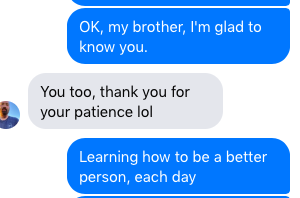
So I switched gears and started asking Jamie questions. Were transgender people an actual problem in his life? (No.) Did he know any transgender people? (No.) What did he think WAS the biggest problem in America? He went off on a vector about the war on drugs and pharmaceutical companies and I said, “Hey, man, I agree 100%!” All of a sudden we were on the same page and talking about a bunch of stuff we agreed on. Jamie texted, “Sorry for calling you names, that’s pretty immature of me. I shouldn’t be like that. You take care. I’ll be more open minded.” Wow. It was all I could do to not ask Jamie if we could be Facebook friends and maybe go grab a Bud Light. Just being curious changed everything. I talked to him like human being and not a sparing partner and we both benefited from it.
So if this approach worked with transphobe like Jamie could it work with my estranged wife? I started trying the technique out with Andi. “How did that make you feel?” “Can you tell me more about that?” “It sounds like that was really hard. Am I hearing you correctly?” And it wasn’t an act. The more I asked the more I wanted to know. She asked me to stick around so we could continue the conversation. I didn’t tell a single anecdote. Each one of her sentences left me wanting more and we talked for hours.
Curiosity won’t solve all our problems. I still have a lot of work to do to de-program my asshole tendencies. But it’s a start. And what if there’s something bigger at stake here. What if Congressman Jamie Raskin got curious about Lauren Boebert? What if Antifa Annie asked Proud Boy Billy about his childhood? Or what if Road Rage Rob asked Road Rage Roy, “Do you need a hug?” So whether it’s political incivility or fractured marriages there is great value in the advice of Vanilla Ice; stop, collaborate and listen. Let’s get curious. Stop talking and start asking questions. People just want to be heard. And then they’ll listen.



 Watching the Wheels