
February 7, 2025
This series is intended to evaluate each product of the James Bond film franchise through a feminist lens, and the relevance of the Bond archetype to shifting ideas of masculinity in the 2020s.
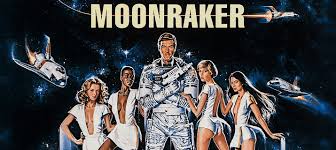
Moonraker (1979, directed by Lewis Gilbert)
Bond in space! For Your Eyes Only was supposed to be the last 007 of the ‘70s, but due to the popularity of Star Wars, Close Encounters of the Third Kind, and the sci fi genre, Eon Productions decided to launch James into orbit. For the last time, Lewis Gilbert directed an expansive epic action adventure that starts with Bond falling through the sky without a parachute and ends with him floating in space with this episode’s Bond “girl.” The story is that Steven Spielberg offered to direct Moonraker after he wrapped up Close Encounters, but producer Cubby Broccoli wanted to stick with Gilbert. One can only imagine what THAT film would have looked like. Instead we get a camp romp that pleased Bond fans but looks pretty silly now.

Moonraker sees Roger Moore closing in on 50 but bringing some svelte bona fides to an older Bond. Hair and makeup prop him up nicely. Bond is up against another evil industrialist, this time its rocket designer Hugo Drax (played by Michael Lonsdale, who looks way too much like Peter Dinklage in this movie). Drax, like the megalomaniac in the last movie, wants to kill all the people on earth and then repopulate the planet with his master race of humans who are hanging out in his space ark. Bernard Lee makes his final appearance as M, the role he played since the first Bond film in 1962. Bond is aided by CIA agent/astronaut Dr. Holly Goodhead (Woot! There it is!). Goodhead is played by Lois Chiles, who delivers every line like she’s loaded on valium. Even when everyone on Earth is about to die, her voice remains in the “Gee, what should I wear to work?” range. Maybe Chiles was trying to play against the sexist “hysterical female” archetype, but women are allowed to have emotions. Oh, and Jaws (Richard Kiel) is back and he’s in love.

As we’ve come to expect, Bond does some globetrotting before he leaves the globe. Moonraker takes him to California, Venice, Italy, and Brazil. There’s a boat chase in the canals of Venice, that’s played for comedy (and is really dumb) and there’s a boat chase on the Amazon (that’s pretty cool). In the film, Drax has built a fleet of space shuttles to launch from his underground lair (Yes!) in the Amazon. The real space shuttle wouldn’t be launched by NASA for another two years, on April 12, 1981. That gave movie goers in 1979 a glimpse into what the 80s might look like.
Moonraker premiered in London on June 26, 1979, a week after President Jimmy Carter and Soviet Premier Leonid Brezhnev signed the SALT II agreement in Vienna, bringing cold war tensions down a few notches. The film was United Artists widest opening picture and highest grossing of the Bond franchise to that point. There was no hit theme song this time. Shirley Bassey was brought back in after Frank Sinatra, Johnny Mathis, and Kate Bush (!) passed. At the end of the seventies, Bond’s philandering was becoming tired, leaving audiences wondering if the franchise would survive into the 1980s.
Let’s drop Moonraker into our analysis matrix.
Driver of Action – As we’ve established, the Moore Bond films firmly place James in the driver seat, typically with the female spy sidekick who he can also sleep with. Dr. Goodhead doesn’t drive much of the story in Moonraker, and, like, the last film, needs to be rescued from the bad guy. Even though she’s a CIA agent AND an astronaut, James is still running the operation. We do get the team of M, Q, Moneypenny, and (now) the Defense Minister wedged in to help the ludicrous plot move along.
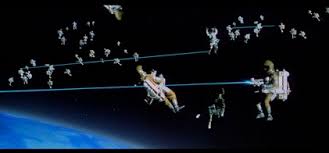
Role of Violence – 007 has a pretty low bodycount in this film. He shoots a would-be assassin out of a tree while pheasant hunting and, other than killing Drax at the end, that’s about it. There is a crazy climactic space battle with lasers when, somehow, a battalion of U.S. soldiers are crammed into the cargo bay of a space shuttle and then attack Drax’s space station. (I’m guessing this is where Trump got his idea for a U.S. Space Force.) Not sure where all the laser guns were in 1979, but Bond doesn’t really engage in any of the violence (like in the last film when he was mowing suckers down). Maybe older Bond has lost his taste for blood.
Vulnerability – Moore’s Bond is a robot. When he discovers Goodhead alive in Drax’s underground lair (beneath a shuttle that’s about to lift off), he says “Thank God you’re safe.” That’s it.
Sexual Potency – I could write a dissertation on this one. The FDA wouldn’t introduce Viagra until 1998 and one wonders if the mad scientists at Pfizer dreamed of a drug that would give men Bond boners. 007 is MI-6’s heat seeking missile. He’s rapacious. There isn’t a skirt he won’t chase, except for Miss Moneypenny, who is now matronly and completely off Bond’s radar. (How I miss their banter.) Speaking of Moneypenny, at the start of the film M asks her if 007 is back from his mission. “He’s on his last leg, sir,” she replies. The next shot is Bond’s hand on a flight attendants bare leg. “Any higher Mr. Bond and my ears will pop,” she says. (Of course she’s a double agent and Bond is sent flying out of the plane without a parachute, leading to one of the greatest action stunts in movie history.)
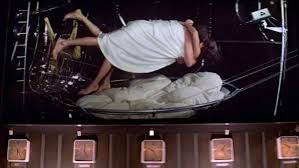
Bond may have failed at getting her knickers down, but you can’t keep a good Double O down. He makes passes at every woman under 40 that passes his field of vision. He would have made the moves on Drax’s hench-women, but he had to wrestle a giant anaconda. Shit happens. He does end up in bed with Corinne Dufour, Drax’s personal pilot, played by The Story of O’s Corinne Cléry. (She is killed by dogs for her transgression.) He also beds his MI-6 contact in Rio, Manuela. In his hotel room, she bares her leg and James asks, “How do you kill 5 hours in Rio if you don’t Samba?” Then he unties her frock. James meets Dr. Goodhead in California at Drax’s compound, but then again in Venice where he realizes she is CIA. He seduces her into bed and makes the case that she should team up, but she slips away in the morning. The film ends with Bond and Goodhead having sex in zero gravity onboard a Space Shuttle. As is the gag now, the MI-6 brass is watching and M asks what Bond is doing. Q replies, “I believe he is attempting re-entry, sir.” Thank you and goodnight.
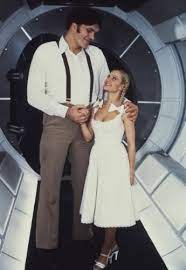
There also a side story worth commenting on. The monstrous Jaws is “redeemed” by falling in love in Rio. He’s a giant and she’s tiny with braided pigtails and glasses, dressed like a farm girl with heaving cleavage. Next to him, she looks like a child and I think that’s the point. She doesn’t speak, only stares lovingly her 7 foot 2 man. When Jaws realizes there’s no room for him and “Dolly” in Drax’s fascist utopia, he helps Bond to thwart the evil plot. The odd pair then open a bottle of champaign as the space lair is destroyed. The whole thing is icky.
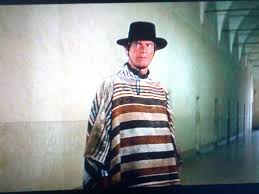
Connection – Again, Moore’s Bond is a man untethered to anyone. There’s a scene where he’s riding a horse in Brazil looking like a gaucho. It’s an obvious nod to Clint Eastwood, the penultimate seventies model of masculinity, the high plains drifter. His connection to Goodhead is wafer thin. In the obligatory coitus end scene, James and Holly are having space sex and she says, “Take me ’round the world one more time.” He drolly replies, “Why not?” Boring sex is boring.
Summary Moonraker is so broad and silly it’s just a romp at this point. The countless henchmen scientists in their yellow jumpsuits, the martial arts attack by Drax’s Asian manservant in a glass museum that destroys dozens of priceless artifacts, escaping the bad guy in a Carnival celebration (Thunderball redux), pretending to be weightless by moving slowly, it’s all in good fun. But the fact that Moore and Chiles seem so completely bored by the script drags down the campiness of Bond ’79. And Jaws and his child bride may have delighted young fans in the Carter era, but it just seems kind of sad now.
These seventies 007 movies have consistently missed an easy opportunity to be a part of the decade where feminism went mainstream. Most of them attempted to pair James up with a female spy that could have been his equal or even taught him a few things. Instead they played the role to attract the male gaze and be yet another notch on James’ bedpost. Yawn. Will things be different in the third decade of our hero?
Next: For Your Eyes Only (1981)
The James Bond Project #11: The Spy Who Loved Me (1977)
The James Bond Project #10: The Man with the Golden Gun (1974)
The James Bond Project #9: Live and Let Die (1973)
The James Bond Project #8: Diamonds are Forever (1971)
The James Bond Project #7: On Her Majesty’s Secret Service (1969)
The James Bond Project #6: You Only Live Twice (1967)
The James Bond Project #5: Casino Royale (1967)
The James Bond Project #4: Thunderball (1965)
The James Bond Project #3: Goldfinger (1964)
 Watching the Wheels