The James Bond Project #11: The Spy Who Loved Me (1977)

February 5, 2025

This series is intended to evaluate each product of the James Bond film franchise through a feminist lens, and the relevance of the Bond archetype to shifting ideas of masculinity in the 2020s.

The Spy Who Loved Me (1977, directed by Lewis Gilbert)

This was the first Bond film I saw in the theater. My dad took my little brother and I to see the PG-rated Spy Who Loved Me the summer of ’77. I was 13 and what I remember most was the brief glimpse of Barbara Bach’s (or her body double’s) right breast in the submarine shower scene. I was 13, OK? But The Spy Who Loved Me was a return to form after the limp Man with the Golden Gun in 1974. It had all your musts, including oodles of cool gadgets from Q, Bond in his tux and bad girls in bikinis, scores of henchmen willing to die for a megalomaniac, and sharks. My absolute favorite part of the film when I was a kid (besides the boob) was the Lotus Esprit that turned into a submarine, complete with missiles. I thought that was the coolest thing on earth and dreamed of a submarine car of my own. Ironically, in 2013 actual megalomaniac supervillain Elon Musk bought the film’s Lotus for £616,000 in hopes of turning it into a workable submarine. (Like most of his crazy ideas, he failed.)
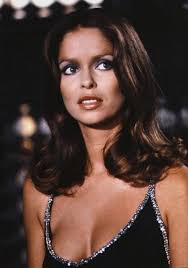
Roger Moore definitely is getting his mojo back in his third installment in the Bond franchise. While his lines still fall a bit flat, he’s got Bond “girls” dripping from his arms. On top of the TSWLM list is Barbara Bach as KGB agent Anya Amasova, AKA Agent XXX (get it?). Bach was a model and Spaghetti Western actor who would next star in Caveman (1980) with her future husband, Beatle Ringo Starr. (Rumors were that Moore wanted Brigitte Bardot for the role.) As a sort of seventies Blofeld, this installment’s villain is wealthy industrialist Karl Stromberg, who wants to destroy the world so he can build a new world under the ocean. Stromberg is played by Curt Jürgens, who starred with Bardot in And God Created Woman in 1956. Added to the cast is Richard Kiel, who stars as the indestructible steel toothed giant, Jaws. The return of You Only Live Twice director Lewis Gilbert helped to bring some of the Connery-era swagger back to 007’s mission.

As is expected, the exotic locales splash across the screen. Bond riding a camel across the Egyptian desert and then chasing the bad guys through the Giza ruins was not filmed on an English set. It was there on sight, as were the scenes filmed on the Italian island of Sardinia. We return to some classic Bond tropes, like assassins on skis (On Her Majesty’s Secret Service) and underwater battles (Thunderball). There’s sexy one-liners (Her: But James, I need you! Him: So does England.) And sexist one-liners (James commenting on a woman in a bikini in a boat, in front of Anya, posing as his wife – “What a handsome craft. Such lovely lines.”) And while we don’t get an underground lair, we get an under WATER lair that serves its purpose.

The Spy Who Loved Me premiered in the United States on August 3, 1977, the same day that the Tandy Corporation debuted the first mass produced microcomputer, the TRS-80, forever changing popular culture and gadgets in James Bond movies. The film received mixed reviews but fared better than its predecessor. Boosted by a great theme song, sung by Carly Simon (and constantly on the radio the summer of 1977), the film was United Artists biggest grossing movie to date, but competed in theaters with the box office sensation that was Star Wars, putting it at #8 for the year (between The Deep and Oh, God!)

Let’s put The Spy Who Loved Me in our feminist evaluation machine.
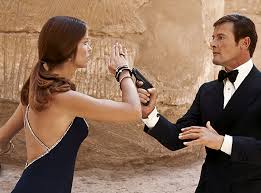
Driver of Action – I’m getting the feeling that the formula for Moore’s Bond films are it’s just him. Even though he’s paired up with a Soviet spy, Anya Amosova, this isn’t a buddy film. She’s primarily sexy arm candy whom 007 has to rescue. (Although there is one scene in Egypt where she throws up her arms in a Charlies Angels karate pose that I thought was going to give us some Russian aggression, but no such luck.) James does not even have a support team. We get brief cameos by Q and Moneypenny, but this is just James.

Role of Violence – 007 kills some people in TSWLM. At the start of the film he shoots a Soviet agent (who is Anya’s boyfriend) with a rocket ski poll while skiing backwards. He drops one of Stromberg’s henchmen off a roof in Cairo, and then kills a half dozen more in a crazy car chase in Sardinia, including killing a bikini-clad helicopter pilot with a missile from his submerged Lotus. When the action moves to Stromberg’s tanker, which is being used to capture nuclear submarines, 007 with a machine gun goes on a rampage. There are literally bloodless corpses everywhere. Where’s the blood? And James shoots Stromberg multiple times in his underwater HQ. 

Vulnerability – There is actually a mention of Bond being married in the film. Anya brings up that he was married and his wife was killed and he stops her from going any further. It was almost a moment of James the person. The break from James performing “007” was jarring but it only lasted for a split second and then it was back to Robot Bond.

Sexual Potency – This version of Bond wants to be as horizontal as possible. Miss Moneypenny might be too old for him in the late 70s, but every other women on the screen is fair game for his jacked up libido. To be fair, the film starts with a twist on the familiar theme. A man that looks like James is in bed with a beautiful woman when the phone rings. We learn that the woman is actually a Soviet agent, Anya Amosava, and the man is just a lover. Never fear, the very next scene is James in bed with a Russian woman in Austria. It’s a clever trick perhaps meant to say that women can play this game. James in Egypt meets a very white sheik who has a harem of beautiful women. When Bond is offered one of the women for the night he says it would be rude to refuse the offer. In Cairo, he meets another woman who is linked to a connection. He tries to seduce her but ends up using her body to block an assassin’s bullet. Oh well.

The rest of the film is about James and Anya, cold war enemies who have teamed up for some “Anglo Soviet cooperation” to stop this dude who is stealing submarines and wants to blow up the world. Bond can’t keep his hands off her and she may just be playing him by letting his hands and lips wander. But there is a scene on a train (You know, the scene on the train!) where Jaws attacks James and Anya and Bond tosses him out of the train window (We’ve seen this movie before) and Anya says, “You saved my life.” The sexy sax version of theme song swells up as James takes her in his arms. Later, the film ends with 007 and XXX getting busy in a preview of Glasnost ten years down the road.
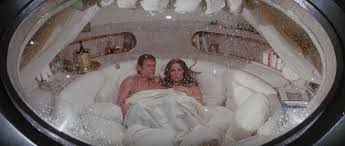
Connection – This is a weird one. (Surprise.) The film is called The Spy Who Loved Me and theme song is sung by a female so it’s reasonable it’s about Anya being loved by James. In the film Stromberg says Bond is “in love with a Russian agent.” But it doesn’t seem like either are in love with anyone. Anya seems to forgive him after finding out he killed her boyfriend, but it doesn’t seem the least bit romantic. This is the aloof Bond of the seventies. Even Q and Moneypenny are kept at arm’s length. Regardless, the film ends with James and Anya bobbing in the ocean in a luxury escape pod, complete with a bed and a chilled bottle of Dom Pérignon ’52. The pod floats into a cruising British destroyer where M and the British Ministers of Defense peer in through the window to see the two spies in flagrante delicto. “Bond! What do you think you’re doing?” asks the defense minister. “Keeping the British end up, sir.” And scene.

Toxic Masculinity Score: 6

Summary Watching this movie took me right back to the summer of ’77. The underwater submarine car battling frog men with their own subs was bliss for a 13-year-old boy. Catching a glimpse of Bach’s boob while sitting next to my dad was both terrifying and titillating. (See what I did there?) No part of me questioned the silly logic of the plot. Now I look at through the lens of 48 years of media. Stromberg has hundreds of henchmen all in red suits, like they were the henchmen of Squid Games. I wondered, who made these suits? Did Stromberg buy in bulk? Are they one size fits all? And do these henchmen get benefits? They all seem to be willing to die for him (and they all do). There should at least be life insurance in their benefits package. And dental.

The Spy Who Love Me, through that modern lens, has a pretty dim view of women. Bach, a few years after the film, said as much, telling People Magazine in 1983 that in the film Bond, “is a chauvinist pig who uses girls to shield him against bullets.” Moore himself said much the same in the 1970s. “Bond, like myself, is a male chauvinist pig. All my life I’ve been trying to get women out of brassieres and pants.” At least Bond doesn’t smack any women in this film on his way to thwart the accelerationist doomsday plot of this episode’s mad genius. While the mushroom clouds over the Atlantic might dampen the joie de vivre of the cold warriors warming things up the film’s climax, were left wondering will the aging Commander Bond will run out of notches on his belt before producers run of out of Ian Fleming novels to film.

Next: Moonraker (1979)

The James Bond Project #10: The Man with the Golden Gun (1974)

The James Bond Project #9: Live and Let Die (1973)

The James Bond Project #8: Diamonds are Forever (1971)

The James Bond Project #7: On Her Majesty’s Secret Service (1969)

The James Bond Project #6: You Only Live Twice (1967)

The James Bond Project #5: Casino Royale (1967)

The James Bond Project #4: Thunderball (1965)

The James Bond Project #3: Goldfinger (1964)

The James Bond Project #2: From Russia With Love (1963)

The James Bond Project: #1: Dr. No (1962)

Death By a Thousand 9/11s

September 11, 2021

They say one person’s terrorist is another person’s freedom fighter. From the perspective of a lowly stormtrooper inside the Death Star, Luke Skywalker and his band of rebel fighters, guided by an archaic religion, were not heroes, but mass murderers. Was the U.S drone strike that targeted ISIS-K in Kabul on August 29th a part of our righteous war on terror or was it a terrorist attack that killed seven children (and no ISIS fighters)? Remember when Bill Maher said, on his show Politically Incorrect, the 9/11 hijackers were not cowards, but those who launch cruise missiles from 2000 miles away were and ABC canned him? Are we even allowed to ask these questions?

Today is not the day to debate whether or not the attacks twenty years ago were terrorism. They most certainly were. If they weren’t, the word has no meaning. Anyone who was alive and old enough to pay attention on September 11, 2001 (and now a quarter of Americans weren’t), felt the terror. I had just flown to Atlanta on 9/10 for my 20th high school reunion and my dad woke me up in time for me to see the second plane slam into the World Trade Center. I remember saying out loud, “What the hell is happening?” as Peter Jennings attempted to translate the untranslatable. It was about to get worse. Much worse.

The U.S. government defines terrorism as, ““the unlawful use of force and violence against persons or property to intimidate or coerce a government, the civilian population, or any segment thereof, in furtherance of political or social objectives” (28 C.F.R. Section 0.85). Much of my work is built around the description of hate crimes as acts of terrorism. Why do we not think of the 9/11 attacks as merely 2,977 murders? Because all Americans were the targets. I had a friend from college who was in Tower 1. Osama bin Laden didn’t know about him, or have anything against him personally. (Three of my former Emory classmates were killed in the New York attacks.) He was a random target, a death meant to intimidate a larger civilian population. And it worked. It was several months after 9/11 before I could enter a tall building or drive over a Portland bridge without thinking of a passenger plane crashing into it.

Hate crimes work the same way. Like the victims of 9/11, targets are randomly selected for their symbolic value, to coerce others like the targets that they aren’t wanted here. Leave. A burning cross, a gay bashing, a swastika on a synagogue, all meant to terrorize large populations. After the 9/11 attacks hate crimes against American Arabs and Muslim (and people perceived to be Arab and/or Muslim) increased 500%. Four days after the attack a Sikh named Balbir Singh Sodhi was shot in the head in a gas station in Mesa, Arizona by a white male who claimed he seeking revenge for the 9/11 attacks. Not only were Arab and Muslim-Americans living in fear, but so were Sikhs and others. (Here in Portland, an Italian man was beaten by three teenagers after the attacks because he was perceived to be Middle Eastern.) 2001 wasn’t an anomaly. Just this week, data released but the FBI revealed that hate crimes increased dramatically in 2020. Who is terrorizing whom?

On this sad occasion, I’m reminded of how the Bush-Cheney-Halliburton Administration tried to falsely pin 9/11 on Saddam Hussein, leading to the invasion of the wrong county, a protracted and completely unnecessary war that was responsible for the death in over 4000 U.S. troops, and over half a million Iraqi men, women, and children killed. But we were the ones fighting terrorism. We couldn’t possibly be the terrorists. Could we?

I visited Ground Zero the summer following the attack and I could still smell the dust of all the souls who had been atomized on that Tuesday in September. I’ve been to New York at least a dozen times since then and always notice what’s not there and what is. My recurring 9/11 dreams were central to my 2016 novel, The Dream Police. At the 9/11 memorial when I see the names of the victims who were pregnant women, I can’t help but convulse and every trip I make to Washington DC, I have a moment when I wonder what would have happened if the fourth plane had hit its intended target, the U.S. Capitol building. I carry this as trauma as does every American, to varying degrees, who remembers that day.

But we also carry the trauma of all the other acts of terrorism, many done in our name or done by people who look like us against people who don’t look like us. We’ve become blasé to the trauma and really good at rationalizing the traumatizing of others. We’ve become masters at dehumanizing the “other.” They see us as “infidels” and we see them as “fanatics.” They see us as “libtards” and we see them as “Nazis.” Nobody is just a human being capable of love and redeemable imperfection. If you told members of the radical right or the radical left they could push a button to launch a drone strike to wipe out the other side, the air would be filled robots on their death trips.

Trauma requires healing and there has been a lot of healing in the last 20 years. New Yorkers are resilient. The passengers on Flight 93 showed great courage in the face of their own deaths. And the work of the war machine that launches drone strikes into wherever continues at the Pentagon. But the healing is hampered by all the other terror we inflict on each other. An open wound never truly heals.

I will never forget that day. The confusion of wondering if it was real or a movie. The image of people choosing to jump rather than burn. The realization that the world would never be the same. But I will also never forget a lot of other things, including what happened in a Mesa, Arizona gas station four days after the attack and what happened two weeks ago in Kabul. Never forget any of it.

A Star Wars for Our Daughters

December 19, 2015

There are no major spoilers in this post about The Force Awakens, including anything about the Wookie-Ewok wedding at the end of the film.

Now that the long wait is over, I can reveal what makes The Force Awakens perhaps the best Star Wars film of the series. This opinion is greatly influenced by the fact that I am now the father of a little girl and have a vested interest in the world being a fairer and kinder place for females.

When the first Star Wars film came out in 1977 I was a 13-year-old boy waiting in line for the first screening at the Lefont Tara theater in Atlanta. The word was out among comic book and sci-fi fans that this was a different kind of space movie. I bought a program that listed all the actors who would soon be icons. When that giant Empire ship moved across the opening scene, all our jaws dropped. I don’t remember any girls in the audience but there must have been a few.

comicon77

Later that year, at the Atlanta Comicon, I entered a costume contest. We didn’t call it “cosplay” yet. In honor of the Marvel Kiss comic book, I went as Paul Stanley. I was beat out by a Jawa and a Sand Person. Star Wars had taken hold of the universe.


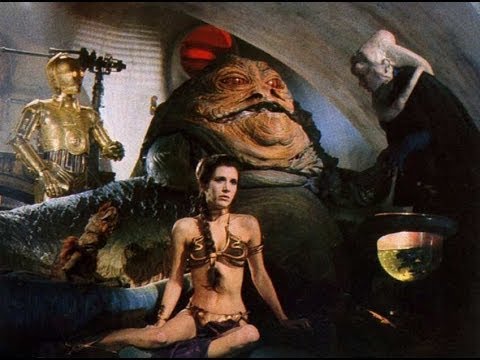
hqdefaultWhen the third Star Wars film, The Return of the Jedi, came out in 1983 I was a 19-year-old college boy (I saw it opening day at Phipps Plaza in Atlanta). This is the film where Princess Leia (Carrie Fischer) is enslaved by the grotesque Jaba the Hut and forced to wear a bikini with a chain around her neck. The image was featured prominently in the movie posters and promotional materials and is the only thing a lot of fanboys remember about that film. I should point out that badass Leia ends up strangling Jaba with that chain in what could be viewed the greatest feminist metaphor in all film history. (Similarly, I’m sure some claim Game of Thrones is feminist because a few of the many rapists on the show get beheaded. Um, no.)
Kim_Kardashian_Princess_Leia_costume-e1316495359256

But that image has remained iconic among the sci fi boy world. Not the killing of the slaver but the eroticizing of the slave. Carrie Fischer has said how much she resented director Richard Marquand putting her body on display in that scene. But how many boys wanted a slave Leia of their own? I’m willing to bet that 99% of comic conventions have at least one “Slave Leia” cosplayer in attendance with Jaba the Hut-like boys getting wood right and left. Even Kim Kardashian has worn the outfit. So there’s that.

I try not get sucked into the pop culture hype machine (Adele, meh.), but I would be lying if I didn’t say my 13-year-old self was reawakened by the fact that J.J. Abrams was doing the next chapter of Star Wars, the follow up to The Revenge of the Jedi. Besides the cool Star Trek/Star Wars link, Abrams is just two years younger than me and has the same reverence for the Skywalker mythology.

And a mythology it is, deeply rooted in the most ancient heroic tales. If you’ve never heard religion scholar Joseph Campbell (The Power of Myth) discuss the links between Star Wars and the ancient myth of the reluctant hero, you should. It’s a life-changing analysis. These are old tales. But they are typically stories about boys and men.

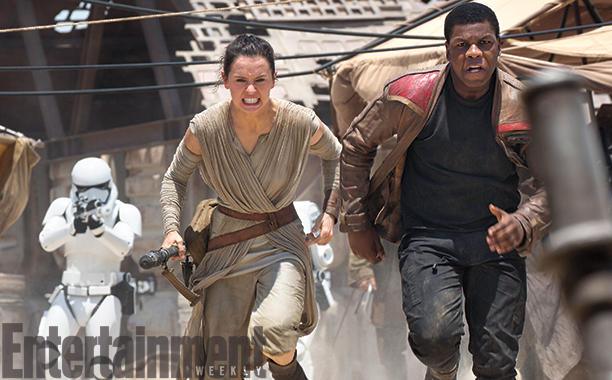
That’s why The Force Awakens is such an absolute joy. Yeah, it’s great to see our old heroes rolled out of the prop closet. (Harrison Ford looks only a bit more rusted than C-3P0.) But our reluctant Skywalker hero is now a female named Rey, played genderlessly by newcomer Daisy Ridley. The nearly all-male cast of the original has been expanded to include plenty of amazing female actors, including Fischer, Game of Thrones star Gwendoline Christie, and Oscar award winner Lupita Nyong’o.

The cast is also much more ethnically diverse, including Finn, the other reluctant-hero, played by black Brit John Moyega, and a Latino X-wing fighter named Poe (Oscar Isaac). This made my Mexican wife very happy but of course it infuriated racist trolls and Donald Trump supporters who lamented the “political correctness” of the casting and mounted a pointless #BoycottStarWarsVII campaign on Twitter.

star-wars-the-force-awakens-rey-finn

Having a female hero like Rey surely means a lot to the scores of female fans. When Finn tries to hold her hand during an attack by the bad guys, she rips her hand away and assures him that she can take care of herself. And that’s the sub-plot of the film. What at first appears to be a “damsel in distress” scenario gets turned on its head and here comes our girl to the rescue. (Sorry if that’s a spoiler.) Even Han Solo recognizes her badassness. She’s ultimately a Skywalker-Solo hybrid who drives a giant movie on her never uncovered shoulders.

There’s sort of a sad test to measure the “feministness” of a film called the Bechdel Test. Do two women in a movie have a conversation about something other than a man? Lots of  “chick-flicks” have a female heavy cast but the dialogue is often about their men (i.e. every Jennifer Lopez movie ever made). The Force Awakens has several scenes that pass including one with (now) General Leia Organa and Rey.

star_wars_poster_full.0.0

J. J. Abrams has a teenage daughter so I have to think he thought of her and how her experience sitting in a theater would be different than a girl sitting in the theater in 1977. Abrams and producer Kathleen Kennedy have given us an epic tale that puts a female protagonist at the center for at least three films (Star Wars 8 and 9 are scheduled for 2017 and 2019). Along with this year’s successful Mad Max film, it serves to rewrite the narrative that boys like action and girls like romance. (The other side of ledger would be films that deal with the romantic emotional lives of boys and men. Where is this generation’s Woody Allen?)

When we think about movies and video games that are targeted at boys and boyish men, there are usually lots of explosions, chases, shooting, and scantily clad women who need to be rescued. It’s a male-driven narrative. The Force Awakens has plenty of those tropes but seriously tweaks the primary one and that may be a game changer for a generation of fanboys and their sisters.

Like 1977 (and 1980 and 1983), I was in the theater Thursday for the opening night of The Force Awakens. I had our tickets months in advance. I could barely contain myself with excitement as I fell through a time hole to my adolescent self.  And like 1977, the theater audience was 90% male. (Do these guys have wives or girlfriends? Some brought Star Wars toys, though. That may be part of the puzzle of patriarchal pop culture.) When the John Williams score started and the Star Wars logo appeared on the screen, we all screamed with approval (as we did whenever any of the original cast of characters and spaceships appeared). The film was wonderfully loyal to the original trilogy in all the important ways, but was a huge departure in one very significant way. Hopefully that evolution continues. Carrie Fischer made it clear to her young female cast mates, “Avoid the slave girl costume.

Andrea and I always have a good conversation after a film and it was immediately clear how important it was to her to have a female protagonist in such a massively hyped film. She loved having a hero that looked like her. It was a subtle message buried inside an epic tale that all those boys in the audience will hopefully digest without even thinking, Oh, the main hero was a girl! That’s how change happens. After our post-film analysis, Andrea excitedly said, “I can’t wait until our daughter is old enough to show her this movie.” Me either.