2025 was a weird year for music. There was so much anxiety as Trump drug America into the gutter, I kept waiting for the soundtrack to kick in to amplify our revolution. Luckily we had regular gems dropped by Jesse Welles, the Arkansas bard. Watching him perform “Join ICE” on Colbert last month gave me hope that protest music still matters. I leaned heavily on the North Carolina punk band, The Muslims and their great 2021 album, Fuck These Fuckin Fascists, to get me through. That and my local jazz station, KMHD. But there were a dozen or so new releases that really brought me immense listening pleasure this year.
My 11-year-old daughter, who one year ago was a hardcore Swiftie, buzzing from seeing one of Taylor’s final Eras concerts, has moved on. “Dad, you love Taylor Swift more than I do.” I get what’s happening. She’s differentiating herself. I’ve loved the K-Pop that is now at the top of her charts, especially Stray Kids, but if I like it TOO much, I’ll ruin it for her. We did have a great moment in October listening to Swift’s new The Life of a Showgirl stream through the house (from separate rooms). Cozy was meh, and I was blown away by the song craft and the dialed back production that seemed very 70s FM to my ears. This is the Taylor Swift album I’ve been waiting for. By the fifth track, “Eldest Daughter,” I knew this album would be spinning non-stop.
It was a great year to be a Beatle fan, starting off with the best Ringo Starr solo album in ages, Look Up, where our drummer goes back to his first love of country music with great joy. The thirtieth anniversary of the Beatles Anthology series gave us Anthology 4. The collection included 13 unreleased tracks, plus the three remastered “Threatles” songs. The compilation was so lovingly assembled by Giles Martin, it felt like stepping into the studio with the boys. There is still magic to be discovered (and the Rubber Soul cuts were revelatory).
My absolute favorite discovery of 2025 is the Denver band, Dead Pioneers, fronted by Paiute spoken word artist, Gregg Deal. Their 2023 debut album and 2025’s PO$T AMERICAN slam punk rock power and indigenous indignation in a way that is both humorous and revolutionary. The PO$T AMERICAN tracks, “My Spirit Animal Ate Your Spirit Animal” and “STFU” nearly blew out my speakers this year. After the first listen, I immediately ordered a Dead Pioneers t-shirt and began saying prayers that they’d come to Portland. There has been a great void in my music collection by indigenous artists. If anyone should be raging against the machine in ICE America, it’s the first people. PO$T AMERICAN is everything I loved about The Clash 45 years ago. The more I listen the more I learn and the louder the drums get.
This series is intended to evaluate each product of the James Bond film franchise through a feminist lens, and the relevance of the Bond archetype to shifting ideas of masculinity in the 2020s.
Casino Royale (1967, directed by John Huston and others)
After four hugely successful Bond films, it’s time for the first Bond spoof. Casino Royale was the first of Ian Fleming’s Bond books (published in 1953). The John Huston directed film brings back many faces from the first four films from the the United Artists Bond canon, including Ursula Andress (who, as MI-6 agent Vesper Lynd, sounds way too much like Melania Trump). Casino Royale is a comedy meant to mock many of the Bond conventions, so it’s going to score differently than the films produced by Eon Productions, the home to “official” 007 movie franchise.
Here we get an older Bond, played by David Niven, who is 20 years retired after a sad end of a relationship with his beloved Mata Hari. He stutters and is known for his celibacy. This ain’t Sean Connery’s Bond. He’s brought back to MI-6 by M (played by Huston himself) to deal with evil SMERSH. (We don’t know what SMERSH stands for but there was a counter-intelligence group in the Soviet Union with the same name). M is comically killed so Bond takes the helm of MI-6, where he is reunited with Miss Moneypenny, or at least her daughter. (Strangely, Moneypenny now has an American accent, played by Barbara Bouchet, who was born in Nazi Germany.) He orders all the “Double O” agents to change their names to “James Bond” to confuse and trap SMERSH baccarat player Le Chiffre, played with gusto by Orson Welles. Two of those agents include Peter Sellers and a very young Woody Allen.
Casino Royale is a madcap farce that lampoons the cool image of 007. There’s even a yakety sax soundtrack during chase and fight scenes (some played by Herb Albert). The funny Bond quips are turned up to 11, jumping from wry to hilarious. (“James Bond doesn’t wear glasses.” Bond: “Yes, it’s just because I like to see who I’m shooting.”) The film is fully located in the mid-sixties. The first shot is graffiti that says, “Les Beatles.” The scene where the Peter Sellers’ Bond is drugged is straight psychedelia. And the movie introduces the Burt Bacharach song, “The Look of Love,” sung by Dusty Springfield (and sung by Bacharach himself in 1997’s Austin Powers: International Man of Mystery). The film was released in April 1967 and Sgt. Peppers Lonely Hearts Club Band was released shortly after setting up the iconic “Summer of Love.”
This may be an anti-Bond Bond film, piercing some of the tried and true tropes of the previous four films, but it’s worth dropping it into our feminist matrix if just for point of comparison.
Driver of Action – There are multiple drivers of the story here, including multiple Bonds. Sir James Bond (Niven) plays almost a support role. The majority of the story centers around Evelyn Tremble (Peter Sellers as a Bond surrogate) and Vesper Lynd (Andress). A section of the film follows Bond’s daughter with Mata Hari, Mata Bond (played by Joanna Pettet) in an adventure in Berlin (which features A Hard Day’s Night’s Anna Quayle and a hilarious scene where a hole is blown in the Berlin Wall and a wave of East Germans run out). This is an ensemble cast.
Role of Violence – It’s a Bond film so there a guns and explosions. But much of the violence is done for laughs, aided by a comedic soundtrack. But, other than an army of fembots with machine guns, there is no overt violence. I don’t think Niven’s or Seller’s Bonds kill anybody.
Vulnerability – The premise of this story is that Bond experienced heartbreak from his true love, Mata Hari, and looks for a connection to his daughter Mata Bond (who is abducted into a SMERSH flying saucer). He’s developed a stammer that he’s self-conscious of and his fighting style as become what might be describes as “effeminate.”
Sexual Potency – The joke of the movie is that Bond is celibate and that 00 agents are being killed because they can’t resist women. Bond creates a program to train agents to resist females in a scene where Agent Cooper rebuffs seductive women by throwing them to the mat. There is one scene where Sir Bond forcibly kisses Moneypenny (or her daughter). Ursula Andress plays seductress to Peter Sellers’ Bond, as does Miss Goodthighs (played by a young Jacqueline Bisset). Additionally, Dr. Noah (not Dr. No), played by Woody Allen, has a fourth quarter evil plot. He has a biological weapon that will make all women beautiful and kill all men over 4 foot 6, making him the tallest (and most sexually attractive?) man on earth.
Connection – There are few autonomous men in this film. The last quarter of the movie features Sir James, Moneypenny, Mata, and Agent Cooper working together to bring down Le Chiffre at the Casino Royale. And the Calvary (literally!) arrives to help save the day. Bond’s connection to his daughter seems sincere as is his desire to shepherd MI-6 in the post-M era. The film ends with the cast, having been blown up, floating in heaven, while Woody Allen’s character drops down to hell.
Toxic Masculinity Scale: 2
SummaryCasino Royale is not a feminist critique of Bond. It’s a mid-sixties comedy so there are plenty of jokes rooted in sexism. For example, after M dies, Bond is sequestered in his house with his eleven seductive daughters (actually SMERSH agents) and his equally seductive widow (played with great hilarity by Deborah Kerr). But the film also completely mocks Bond’s Lothario reputation. (Woody Allen as James Bond should make the point.) There are plenty of nods to the Bond franchise, including an underground lair and even women in gold paint, but the ensemble nature of Casino Royale stands in stark contrast to Bond 1 to 4.
Unlike the previous film, Thunderball, whose cast is entirely gone, many cast members from Casino Royale are still with is, including Ursula Andress, Woody Allen, Joanna Pettet, Barbara Bouchet, and Jacqueline Bisset. I’d love to know how they see the film’s depiction of Bond and of women from a contemporary lens. The film is both hilarious and, at times, a complete mess, but also provided a break from the Bond formula. Sometimes stepping out of something allows us a fresh perspective on it. Two months later there would be another Sean Connery Bond flick headed to theaters. I wonder if viewers saw it differently after watching Casino Royale.
This series is intended to evaluate each product of the James Bond film franchise through a feminist lens, and the relevance of the Bond archetype to shifting ideas of masculinity in the 2020s.
Goldfinger (1964, directed by Guy Hamilton)
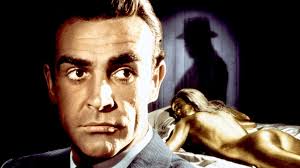
“That’s my James!” Welcome to the James Bond blockbuster. With the massive success of From Russia With Love came an even bigger budget (and a new director). Goldfinger gave us franchise staples, like the pre-credits action scene, the bouncy Bond quips, infinite gadgets (including the loaded Aston Martin), the epic theme song, and multiple exotic locations (including rural Kentucky). And of course there are multiple women who are branded as Bond “girls” in the film who find their way into 007’s beefy arms.
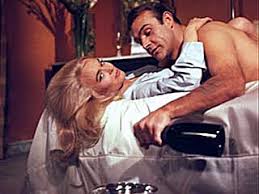
The box office smash surely benefited from the 1964 British Invasion and the American obsession with all things English. Bond even has a snarky line about the Fab Four after he beds Goldfinger’s girl Jill Masterson, chiding her not understanding his standards for chilled Champaign. “My dear girl, there are some things that just aren’t done, such as drinking Dom Pérignon ’53 above 38 degrees Fahrenheit. That’s as bad as listening to the Beatles without earmuffs.” (It should be noted that two of the actors in Goldfinger, Richard Vernon (Colonel Smithers) and Margaret Nolán (Dink), had just appeared in the Beatles’ film A Hard Days Night and the Beatles 1965 film, Help!, would be a send up of Goldfinger.)
Goldfinger cemented the formula for what a Bond film would be for decades to come. It was released in September of 1964, in a world that was increasingly surrendering to the ennui of the East-West Cold War, the same month as Lyndon Johnson’s apocalyptic “Daisy” campaign ad that ended with a mushroom cloud. I had been born 7 months earlier and would be socialized into a world that saw Bond as the modern model of masculinity. Let’s check Goldfinger with our five reference criteria.
Driver of Action – Goldfinger is the archetypical Bond film, the begins with him blowing some shit up in Mexico and ends with him making sweet love to Bond Girl #3 Pussy Galore on a desert island, telling her “This is no time to be rescued.” There is no “buddy,” as in the previous two films, just Bond, and his MI-6 and CIA supporters (who play minimal roles). Even the nefarious plotting by Goldfinger (played by former Nazi Gert Fröbe after Orson Welles proved to be too expensive) to irradiate all the gold in Fort Knox is a minor subplot. Goldfinger is all about watching Sean Connery as Bond move from scene to scene; Mexico, Miami, London, Switzerland, Kentucky. In the opening scene, he steps out of his wetsuit dressed in a white dinner jacket and you know this going to be 110 minutes of pure Connery.
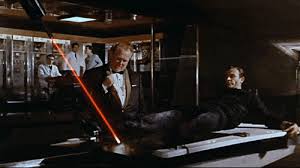
Role of Violence – Again, Bond has a relatively low bodycount in this film. People do die, especially women, including Jill Masterson. For her flirtation with Bond, she is painted gold and dies of “skin suffocation.” Her sister Tilly is killed by Oddjob, Goldfinger’s Korean henchman. But Mr. License-to-Kill is mostly restrained. A Mexican assassin gets an electric fan tossed into his bathtub. Some henchmen go over a cliff in a fiery crash after Bond shoots slick oil out of his Aston Martin. In the climatic scene in Fort Knox, Bond throws a henchman off a ledge and electrocutes Oddjob. (Apparently actor Harold Sakata was severely burned in the stunt.) Mostly Bond is the recipient of violence, including a laser beam aimed at his most manly parts while he is strapped to a table.
Vulnerability – Yeah, no. You wonder if we have to wait until the ‘90s to get new age sensitive James Bond. Whether strapped to a table with a laser heading toward his junk or locked in a Kentucky holding cell, or in a plane plummeting to the earth, we never see James break a sweat.
Sexual Potency – Goldfinger is balls out on the message that Bond is the conquerer of women. In the opening sequence, he goes after a Mexican dancer and then uses her body to deflect an assassin. In Miami, he’s getting a poolside massage from his Florida fling, Dink (who’s cleavage was also featured in A Hard Days Night). Then there’s the romp with Jill who gets painted gold. In Switzerland, when a blonde passes him by in a ’64 Mustang convertible, he resists the urge to chase after her. “Discipline, 007, discipline,” he says to himself. She turns out to be Jill’s sister and they have a moment before Oddball kills her with his killer hat.
That brings us to Pussy Galore (the character, not the male fantasy). The Bond double entendres hit a new level here and Pussy’s name is mentioned constantly in the second half of the film. Galore is played by Honor Blackman, who was Diana Rigg’s predecessor on the highly popular British spy show, The Avengers. So she was coming in to Bondland a Judo-flipping badass, not a submissive DID (Damsel In Distress). In Goldfinger, she’s the leader of Goldfinger’s team of female pilots, playing a role in his grand slam plan. But there’s a scene in Goldfinger’s barn where James manhandles Pussy and the subsequent judo fight ends up with the two literally rolling in the hay. Galore tries to push Bond off her, but no woman can resist 007 and his assault ends in a passionate kiss. Woot, there it is.
Connection – Unbeknownst to the viewer, Pussy Galore’s Stockholm Syndrome turns her into an ally of Bond’s and Goldfinger’s evil plot is thwarted. As has already become an uber-cliche in Bond films, their end scene, making out under the parachute, casts no allusion that it’s the beginning of a beautiful relationship between James and Pussy. We know how this works. Women are transitory and co-workers are support players. Does Bond have any friends? A love that got away? He is supremely untethered. A man alone.
Toxic Masculinity Scale: 7
Summary – Like an explosion of everything that was 1960s before LSD, Goldfinger is a magnum opus of a spy action film. The clever crime attempted (to irradiate the gold in Fort Knox to drive up the value of personal stocks of the metal) takes a back seat to watching Connery leap frog from woman to woman, often with his suped-up Bondmobile (Oh, to have stock in Aston Martin in 1964). Connery’s Bond is the Id unrestrained. One wonders what MI-6’s HR department would say about the workplace flirtations between Bond and Miss Moneypenny in the post #metoo era. But it’s the scene between Bond and Galore in the barn that reminds us that the debonair spy is not immune from the misogynistic value of male entitlement. A generation of boys learned women are to be taken by men, even if they resist. Pussy galore, indeed.
While contemporary audiences my get a bit of a creepy vibe from Goldfinger’s Bond, there’s a creeping trend that may be less noticed today. The third Bond film sees 007 more dependent on the technology provided by his employer. It may be a homing device in his shoe or an ejection seat in his car, but 1964 Bond is becoming less a man left to his own devices and more to the devices Q builds for him. Bond is the halfway point between the archetypical cowboy, fending for himself on the frontier, and Modern Man, juggling apps and monitoring social media, never not wired to the electronic collective. Where would Bond be without Q? Where would we be if the internet went down? One imagines that Bond would be better off, but not by much.
If I was my current age in 1964, as Beatlemania swept America, I would have absolutely hated the Fab Four. I would have been a 60-year-old jazz purist, dedicated to be-bop, hard-bop, and post-pop. I wouldn’t have had time for West Coast bop (sorry Brubeck), let alone mop top non-bop. I would have taken one look at the grinning lads from Liverpool, surrounded by millions of screaming girls, while they did their white people version of the Isley Brothers’ “Twist and Shout,” and turned up my nose. “That’s pre-packaged bubblegum. I listen to serious music, like Miles and Trane,” I would have said.
Turns out those millions of teenage girls were right.
I’m not making that mistake 60 years later. I am fully in the grip of Swiftmania and I have my 9-year-old daughter to thank for it.
I’m deep in the bag for TS. The haters are the people who knee-jerk react to the trope that “Popular = Bad.” After all, the masses are asses, as L7 sang. Anything as massive as Taylor Swift must suck. That’s the same thing they said about the Beatles in 1964, who clogged up the pop charts with their “Yeah, yeah, yeahs!” But here’s the thing. You can dig L7 (and the Yeah! Yeah! Yeahs! and Miles and Coltrane) AND Taylor Swift. Tay is on my playlists next to punk bands like Destiny Bond and jazz freaks like Sun Ra. I’m not going to let your hipster elitism deny me the appreciation of this crazy trip, especially when it is being led by my Swiftie 4th grader.
Like a lot of people, I drug my heals on the Taylor Train. I prefer Tuareg music from Mali over the American Top 40. But her 2022 lofi dream pop album, Midnights, caught my attention. It took me to some unexpected places that I missed from my youth (like the sound of the wind down at 3 am). But it was when Cozy, my always enthusiastic about something daughter, switched her attention from the Animal Crossing video game to Taylor Swift that I bought my ticket onboard the Swift Express.
Cozy’s cohort followed mine in many ways. In third grade, it was all about the songs. “Cruel Summer,” always got a, “Turn it up, Dad” in the car. (For me it was “Burning Love,” by Elvis Presley.) Fourth grade is more about the artist. Cozy’s girl gang has lots of Taylor Talk before, during, and after school. (By the end of 4th grade, I’d seen most of Elvis’ 33 movies.) The Eras tour sweatshirts are like their team jerseys. Cozy makes song bracelets in hopes that one day she’ll be able to trade them at an actual concert. She’s made her bedroom into a shrine to Taylor with taped up magazine pictures and a rotating “Top 13” favorite song list. (13 is a magical number in Taylor-world.) At 13, my room was split between shrines to Kiss and the Beatles. She falls asleep each night to the TS CD’s I’ve loaded into her mother’s ancient iMac computer. And I assume all her friends live in a similar Taylor bubble.
Cozy’s fanaticism is infectious. She knows every Swift lyric, including to the “Anthology” version songs on Swift’s new album. She knows the outfits of the Eras tour including the “22 hat.” (I have no idea, but she tells me she’s going to show me a YouTube video that explains it.) When the new album, The Tortured Poets Department, dropped at 9 pm on April 18th, we sat together as it streamed into our lives. The next day we raced to the record store to pick up a vinyl copy and record a review for my YouTube channel. That night, her crew had a Swiftie listening party where all the girls dressed as a different era. Thanks to her mom’s make-up skills, Cozy nailed the Reputation look. I don’t know what would be the 1964 version of that, but I’d like to think 4th grade Randy (Ringo’s Version) would have most certainly been combing his hair forward.
It might be different if this was 1997 and I had a nine-year-old who was gaga over the Backstreet Boys. Taylor Swift is an insanely talented artist. Like Paul McCartney, she could sneeze and a brilliant song would come out. Like Bob Dylan, she can take the story of her life, slam words together, and create poetry that we will be analyzing for generations. If you don’t believe me, listen to Dylan’s 1975 track, “Tangled Up in Blue,” written after his separation from his wife Sara, and then the ten minute version of Swift’s “All Too Well,” written after her break up with Jake Gyllenhaal, and tell me they don’t fit together like two socks in a drawer. But because Swift is a young woman (and blonde and thin) her artistry is dismissed. There are plenty of music lovers who extol Joni Mitchell in 2024, who also derided her in 1970 for trying to “be Dylan.” I don’t know what will be seen as “classic” in 2074, but, if there is radio 50 years from now, “Cruel Summer” and the dozens of other Swift hits will be playing to welcoming ears of Gen Z elders and their mutant children.
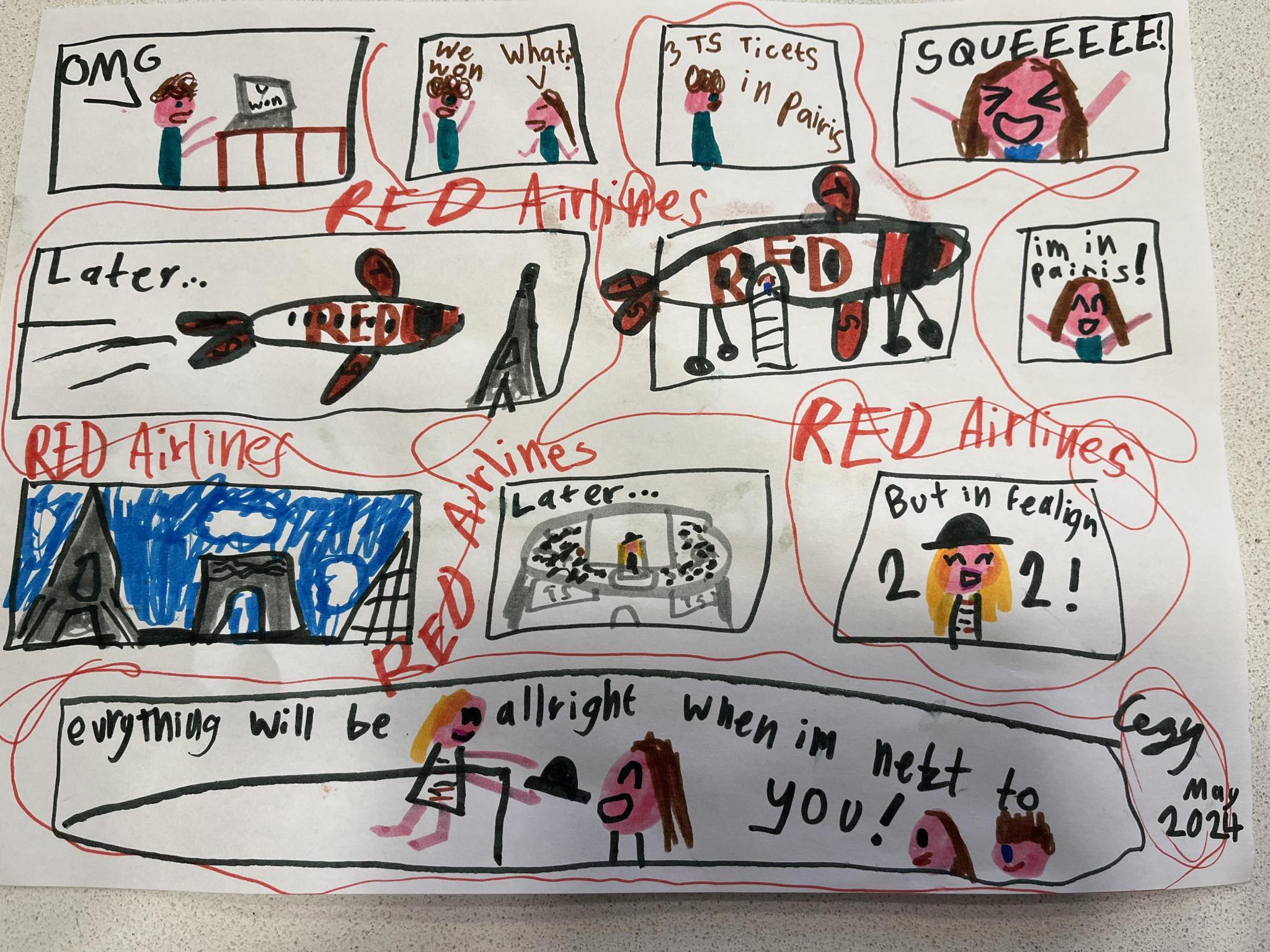
The mission now is to get Cozy to a Taylor Swift concert. Taylor is playing at Wembley Stadium in London (where I saw Live Aid in 1985) on Cozy’s birthday on August 17th. The cheapest, behind the stage, tickets start at $1200. Tickets to see the Beatles in 1964 were five bucks. For the price of one Taylor Swift ticket I could have bought 240 Beatle tickets. (Yes, I did the math.) I’ve entered contests, bugged friends in London, and watched StubHub like a lunatic. I want Cozy to have this experience. She even described seeing Taylor in concert with her mom and dad as her “perfect day” in a recent family therapy session. When I was her age, my parents took me to see Elvis Presley and it turned me inside out. So, somehow, this will happen.
All this is just a truckload of fun. It’s as much about Cozy’s joy as it is about the wonderful music that Taylor Swift makes. Yes, some of those songs make me cry (“All You Had to Do Was Stay” was written about my own break up, I’m convinced). But I’ll remember (all too well) dancing in the kitchen with my kid to “Shake it Off” and re-discovering the way music can completely consume you. I have my Beatlemania thanks to Cozy. And I’m screaming my lungs out.
I don’t remember what Beatlemania was like. I was born in February 1964 as the mop tops from Britain invaded the U.S.. The footage of them on Ed Sullivan and the girls screaming is exhilarating. We now look at that month as the moment the 1960s started; when the black and white era of the Kennedy assassination became a technicolor explosion of youth counterculture. But not everyone loved the Beatles in 1964. Conservative columnist William F. Buckley, wrote in the Boston Globe, “The Beatles are not merely awful; I would consider it sacrilegious to say anything less than that they are god awful. They are so unbelievably horribly, so appallingly unmusical, so dogmatically insensitive to the magic of the art that they qualify as crowned heads of anti-music, even as the imposter popes went down in history as ‘anti-popes.’”
Buckley wasn’t alone. A chorus on the right proclaimed the Beatles as “communists” and encouragers of “race mixing.” They were framed as untalented puppets, designed to upset the American moral order with sex, drugs, and rock and roll. John Lennon, in a lengthy interview with a British columnist in 1966, briefly commented on the sad state of contemporary religion. “We’re more popular than Jesus now; I don’t know which will go first—rock ’n’ roll or Christianity,” he said. The comments were reported out of context in the United States and the backlash was fierce. Right-wing stalwarts, the Ku Klux Klan, organized boycotts of Beatles concerts and claimed Ringo was “a Jew.” Conservative southern radio stations held Beatle bonfires and there were numerous death threats against the band. The Beatles quit touring and retreated to the studio to find other ways to speak to the youth of the world.
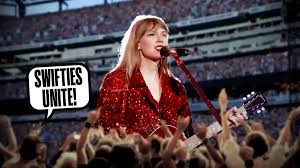
I was just a baby for all that. I didn’t experience Beatlemania first hand. But I am experiencing Swiftmania and if feels like basically the same thing. If the Ku Klux Klan could burn Taylor Swift music streams, there would be bonfires across the nation.
First things first. This is not about Taylor Swift’s music. Old people always hate young people’s music. My dad thought AC/DC was not music and there a million people my age who think Taylor Swift’s music is also noise. I recently posted on a classic rock page that Swift will be my daughter’s Joni Mitchell, and some of the Boomers shit bricks. And then I posted the Buckley quote about the Beatles, and they just grunted. The word “crap music” was use repeatedly. OK, boomer. I did an episode on my YouTube channel about Swift’s 2023 Midnights album and how it as essential LP for any vinyl collectors collection. There is little doubt that Swift is immensely talented. This is not about that.
This is about gender and what happens when a woman is in control of her own life. Especially on Super Bowl Sunday. Taylor Swift has sold over 200 million records but I hear more about the existential threat she poses to America itself than the countless people to whom she brings joy. She’s got seven albums on the top 40 of Billboard’s album chart at the moment, but, apparently, she’s ruining football and America as we know it.
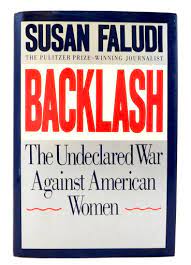
Susan Faludi, in her seminal 1991 book, Backlash: The Undeclared War Against American Women, gave us the roadmap for the conservative freakout about the girl from West Reading, Pennsylvania. Faludi argued that anytime in American history women gain power there is a patriarchal “backlash” to put them “back in their place.” One hundred years ago, women gained political power by winning the right to vote. The 1920s then generated flappers and housewives as the new feminine ideals, to push women away from using their collective voice at the ballot box. During WW II, women gained economic power as an army of Rosie the Riveters traded their dish rags in for blowtorches to build the weapons of war. And they had their own money to spend since their men were off on the battlefield. The end of the war brought back the demand that women return to the kitchen, or focus on the glamour like the new phalanx of blonde bombshells on the silver screen. Backlash #2. In the 1960s, women gained social power as the second wave feminist movement, again, worked to liberate them from domestic drudgery, as Mrs. John Doe flowered into Ms. Cindy Nobra. Faludi argued, in 1991, that the third backlash came in the form of the supermodel and the media message that women’s primary value is in their ability to attract men.
Faludi’s work was seen as helping to launch the third wave feminist movement of the 1990s and 2000s that culminated with the #MeToo movement in 2017. But by 2017, the fourth backlash was in full swing. There was never a greater movement to put women “back in their place” (and back into back alleys) than the rise of Donald J. Trump. I’ve reported here about my 2018 conversation with Gloria Steinem. When I asked Ms. Steinem how she explains the rise of Trump, she told me, “You know when a women is at most risk of being killed by her abuser is the moment she tries to escape him. When the battered wife tries to leave, that’s when he is his most violent. That’s where we are.” The way the MAGA movement has characterized the obese elderly Trump as a virile, chiseled, hyper-masculine macho man has become patriarchy’s ultimate weapon against women and their basic rights of self-determination.
Enter Taylor Swift.
Swift’s storied career, from her 2006 debut album to now (“Cruel Summer” is STILL on my radio in this cruel winter) has been a tale of wrestling control from men. Whether it’s songs dishing on ex-boyfriends who have done her wrong or fighting to reclaim her back catalog from Scooter Braun’s Big Machine record label, this has never been a woman who is going to shut up and just be pretty. She has, throughout for her career, stood up for the underserved. In 2015, when Apple was going to premier its new streaming music service with a three month free offer, they announced that artists would not receive any payment for their music being streamed during those three months. Taylor, who could afford the dip in income, saw how smaller artists were being ripped off and pulled all her music off the platform until Apple changed its policy. It did. Swift has donated millions to a wide variety of needs, including libraries, schools, flood, tornado, and hurricane relief, police departments, and victims of sexual assault. She’s paid off fans medical bills and student loans. Her philanthropy makes the “Christian charity” of her accusers look like pennies tossed in the church collection plate.
More than endorsing Joe Biden, it’s this persona of a woman in control of her life that triggers fragile conservative men most. Trump has said, defending his “Make America Great Again” slogan, America was last great in the 1950s, in the era of Father Knows Best, when women (and especially trans women) did not challenge the “natural” authority of men. (Make America Backlash 2 Again) Swift is not interested in going backwards in time to make men happy. In the most simplest of terms, Taylor Swift does not give a fuck. So American men are putting their wife beaters on and popping open a can of Bud Light (whoops, triggered by that beer) and getting ready to teach Taylor and all women like her a lesson. And they are manning up for Super Bowl Sunday, ready flex their atrophied muscles.
Let’s try to first extend a wee bit of empathy to these fragile men. The world has changed a lot since Trump says America was last great. Men are no longer the kings of their castles. Unlike in 1964, women can now have their own credit cards and punish sexual harassers. More women are going to college now than men (I see this in my classroom) and the workforce is now dominated by female labor. Unlike the days of Father Knows Best, now three fourths of women 25 to 54 are full time employees. Young women no longer marry the first man that asks them as a means to move out of their fathers’ houses. They do they same thing men do. They play the field and ditch the guys that don’t meet their needs (and sometimes write songs about them). In the 1950s, the average age for women’s first marriage was 20 (that’s average, so that means for every “spinster” that finally married at 30, two 15-year-old girls got married.) Now the average age for women’s first marriage is over 28. Swift is 34 and don’t expect her to “settle down” anytime soon. Her life is just getting started. (And let’s be 100% honest; Some of those young women in 1964 who bowed to social pressures to get married, weren’t interested men as romantic partners. Being out and gay now is another trigger for men who feel they are entitled to women and their bodies.)
So you can imagine manly men are feeling a little threatened. Their manly man world is fading in the rear view mirror of the the Kia Forte. Taylor Swift represents everything that wrong with their picture of how the world should look. And now she’s a fixture in the very last arena of the manosphere, the NFL. What’s a boy to do?
Fortunately for these fellas, the real manosphere, aka “society,” is dug in and fighting back, especially in a backlash. You don’t have to wade into the dark web as it vomits out deep fake nudes of Swift and endless discussions of the best methods to sexually assault her. It’s right there in the mainstream media, including among some women, like former Fox News host Megyn Kelly, who carry the water for the fragile men. (Kelly tried to organize a boycott of Swift for her support of relief work for children in Gaza. It failed miserably.) The conservative bashing of Swift has been, well, swift, including a bizarro conspiracy theory that Swift is a George Soros-funded Pentagon psyop operation to hand the Kansas City Chiefs the Super Bowl win (Isn’t San Fransisco the bastion of liberal politics?) and put Joe Biden back in the White House. Seriously.
The freak-out men are having about the “feminizing” of society is shaping the electorate as well. Recent research from Stanford University found that, while Gen Z women around the world are moving toward liberal positions, their male counterparts are moving to the right. Among the younger generation, there are really two cohorts, Gen Z women who are voting to regain their abortion rights and flocking to Taylor Swift concerts so big they can be seen from space, and Gen Z males who are tracking down fake nudes of Swift and trying rebuild their grandfather’s vision of gender roles, where the men where men and the women were REALLY good at making sandwiches. The fact that Swift has actively been registering these young women to vote must terrify these men, who are convinced this is the fall of the Roman Empire.
The Republican Party could embrace these young women, but as usual their party is the old man screaming at the kids to get off his lawn. Their fantasy of themselves as manly warriors will translate as more misogyny towards Swift, and towards women and girls in general. And there will be violence. Violence towards women who stand up for themselves and violence against other men as men signal that they are the volatile sex, so beware. But women, like Taylor, will shake it off and work to fix men’s mistakes, just like they always have.
As the father of a daughter who is growing up with the music Taylor Swift on the radio (Hearing Cozy riff the lyrics to “Cruel Summer” in the back of the car is pure bliss), I’m glad this pop singer is driving a massive wedge into the fading world of manly men. My daughter’s world will embrace her in a way my mother’s world never could. Like Madonna 40 years earlier, Swift will lead the charge against this generation’s backlash. “I’m so sick of running as fast as I can, wondering if I’d get there quicker if I was a man,” as she sings in “The Man.” My daughter’s future will have more space for her as a human being because of Taylor Swift, Beyoncé, Lady Gaga, Kesha, Lizzo, Cardi B, and all the other women on the charts who are doing this pop music thing by their own rules. But there are a lot of terrified boys and men to win over. Don’t fight this, boys. Mother is telling you it’s going to be OK. Enjoy the game.
Postscript: For all the women who don’t have the wealth or white privilege of Taylor Swift, but are in the trenches day in and day out working for gender equity without a subculture of fans to protect them, let’s lift them up in our songs, too.
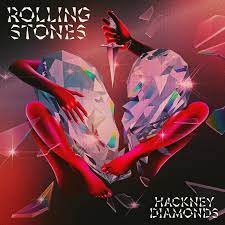
2023 A.D. will always be the first (and only?) year that my daughter saw new releases from the Beatles and the Stones in the same year. The thrill of taking her to the record store to get the new Rolling Stones album and ask for the “new single by the Beatles” created great memories for both of us. Obviously, for us Beatle freaks, the release of “Now and Then” in November was the musical highlight of the year. Cozy proclaimed it her “favorite song of all time” and I devoted an episode of my YouTube channel to it. I’ll never forget first hearing John’s AI cleaned up voice singing, “I know it’s true.” Chills to have the Fab Four together one last time.
There wasn’t a massive concert binge this year. The highlights were taking Cozy and her friend to see Ringo Starr in Bend in June and the brilliant DakhaBrakha show at Revolution Hall in August. Most of the live music was enjoyed at small local Portland venues, like Mississippi Studios, No Fun, and Turn, Turn, Turn (which is sadly closing at the end of year). I am looking forward to shows at the new Doug Fir in 2024.
2023 was year I really utilized Spotify to do some deep dives. Long chronologies of Brian Eno and explorations of Ethiopian jazz, the thrill of having an ever expanding universe of music was like my teenage dream manifest. I used Spotify to make probably hundreds of playlists (I currently have 925 playlists on the platform) and even used it to DJ a loft party in the East Village in New York in February. Its ease of use certainly cut into my album purchases in 2023.
Most of my vinyl purchases (Did I even buy a CD in 23?) were old jazz sides from the numerous little record stores that keep popping up in my neighborhood. I did listen to a lot of albums, especially by Taylor Swift (Sorry, not sorry.) 2023 was the year I became a fan, especially of her brilliant 2022 release, Midnights. I finally got it. And it gave me a fun way to connect with my students, dropping TS lyrics in the middle of lectures. The album that dominated the year (and my car radio) was the Barbie soundtrack. It exploded into the music world much the way the Saturday Night Fever soundtrack did in 1977. Some of the hype of 2023, I just didn’t get. Boygenius I thought was a snooze fest. And, even though I’ve been massive fans in the past, releases by PJ Harvey, Yo La Tengo, and Sufjan Stevens didn’t catch my attention (but I did dig that one new Paramore song, “This is Why”).
So here is my annual Top 20. Not necessarily the 20 best releases of 2023, but the albums I spent a lot of time on and really lived in. At the top of the list is a Brooklyn band called Geese. Their album, 3D Country (released in June) was the most wide open (in the style of John Spencer Blues Explosion) and yet diverse album of the year. Their track, “I See Myself” wormed its way into my soul and I’m sure made it on to many mixtapes of young hipsters in love. Besides the Stones, some old favorites showed up, including Dolly Parton and her “rock” album (worth it for her environmental anthem, “World On Fire”) and Dexy’s Midnight Runners and their feminist manifesto, Feminine Divine.
Here we go.
Geese – 3D Country
Rolling Stones – Hackney Diamonds
The New Pornographers – Continue as a Guest
Olivia Rodrigo – Guts
The National – First Two Pages of Frankenstein
Taylor Swift – 1989 (Taylor’s Version)
Lana Del Rey – Did You Know That There’s a Tunnel Under Ocean Blvd
Jason Isbell and the 400 Unit – Weathervanes
John Cale – Mercy
Blur – The Ballad of Darren
Anohni (Antony & the Johnsons) – My Back Was a Bridge For You to Cross
Fred Again and Brian Eno – Secret Life
Dexys – Feminine Devine
Dolly Parton – Rockstar
Bob Dylan – Shadow Kingdom
The Kills – God Games
Quasi – Breaking the Balls of History
Ryuichi Sakamoto – 12
Black Thought – Glorious Game
Brad Mehldau – Your Mother Should Know: Brad Mehldau Plays The Beatles
Honorable mention for albums from Rhiannon Giddens, PIL, Rancid, The Zombies, Rufus Wainwright, Bad Bunny, and Metallica. I still need to listen to that new Wilco album. (And this week the ANOHNI album is my favorite.)
It was a challenge to come up with the right Christmas present last year for my wife, Andi. We were a month into our separation and I definitely couldn’t half-ass it. Half-assing it through the marriage is what got me in this horrible situation. I got her a LSAT study book (which she used) and a trip to Paris (which she didn’t use). So, a year later, I really wanted to show up. It was time to center her instead of my idea of her. We’re back under the same roof, but still separated. I want her to know I’ve learned something this year.
There are always “things” we want. (If I don’t get The Beatles Get Back DVD from Santa, I’m buying it myself.) But things are transitory. They matter and then they don’t. What if there was a gift that was both lasting and reflected a partner who pays attention? A gift that recognizes the personhood of the recipient, not just their role as a gift receiver.
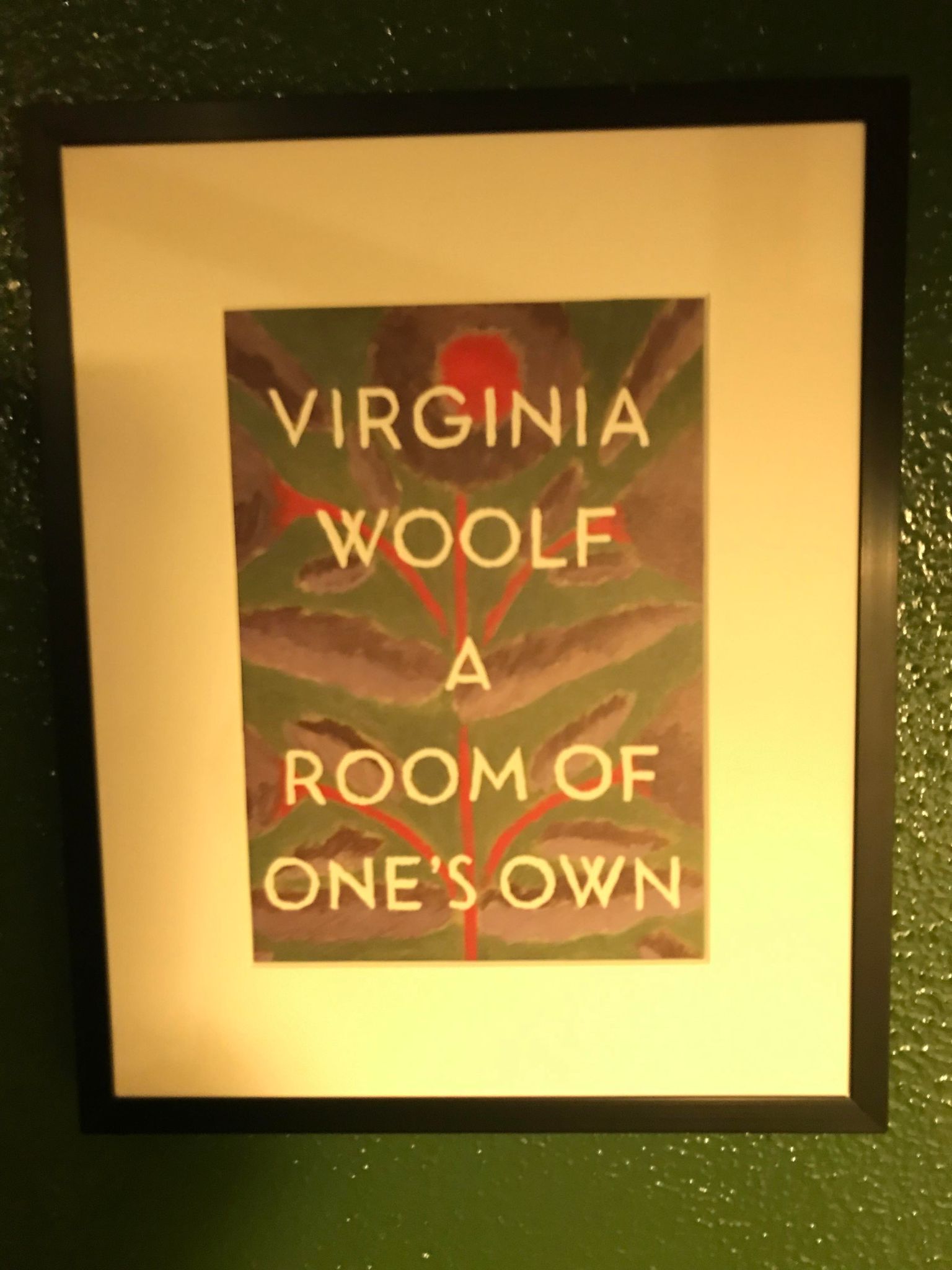
One of the great works I read in grad school was Virginia Woolf’s A Room of One’s Own (1929). If the home is a metaphor for society, it’s the man’s house. Rooms for women are assigned specific gendered tasks; the kitchen, the laundry room, the nursery, the sewing room. Men get their den to just exist in. What is women’s equivalent of the man cave? Woolf argued if women are to write fiction, they need a room of their own. If they want to live outside the constraints of their proscribed roles, they must have a safe space inside their own homes to explore their options. Like men do every day.
I bought my house in 1999 and turned every room into my own. That included a room for my vinyl collection and a separate room for my CDs. When Andi moved in in 2013, we had to shoehorn her life into my space. My closet for her clothes. My kitchen drawers for her pans. My walls for her paintings. She was a lodger in Randyland. How could she ever feel like she truly belonged here?
So that could be my gift; a room of her own. Andi plans on going to law school in the fall and will need a study space, or just a “be” space. My CD room was upstairs with big east-facing windows. It was the perfect candidate to be de-Randified and transformed into a comfy study. I had to build shelves in another room to store my thousands of CD. It had to be all her room, no Blazak artifacts. Since it was upstairs, I could work on in while she was at work or “out,” without her knowing what I was up to.
So I got to work, painting, fixing cracks in the wall, finding a desk and a comfy reading chair, and framing the book cover of Woolf’s classic for the wall. Cozy helped too, contributing a plant and a framed picture of her and her mother. Oh, and a white furry rug she found at IKEA. A bottle of mescal and a note in the desk and the job was done. I purposely under-decorated. It would defeat the entire idea if I filled her room with my ideas. She can create the space in her image.
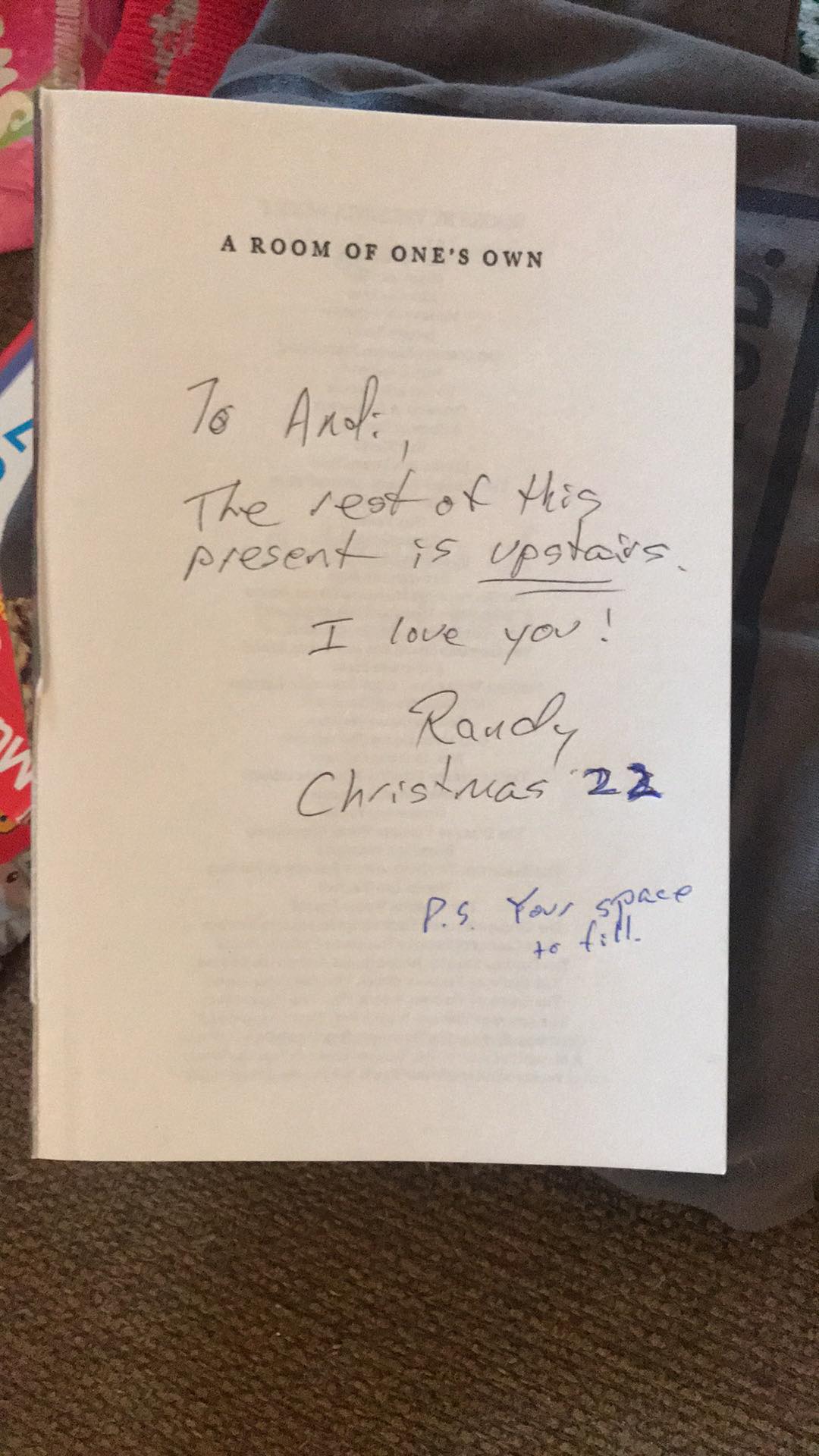
I wrapped a copy of A Room of One’s Own (sans cover) after inscribing in it, “The rest of this gift is upstairs,” and placed it under the tree. I put Cozy to bed (after watching Home Alone) and hoped she’d be home in time to open presents in the morning.
Christmas Morning
Like Santa, Andi arrived in the wee hours and we opened presents. Cozy was most excited about the Minecraft Lego set. (Mr. Claus went through the ringer for that one.) Andi’s present for me was a Joni Mitchell biography. The last gift was her Woolf book and then Cozy and I led her upstairs to see the room I’ve been working on for several weeks.
I think she liked it. “It’s probably the most thoughtful gift you’ve ever given me,” she said. I want her to have her space in this male owned house. I want her to want to stay.
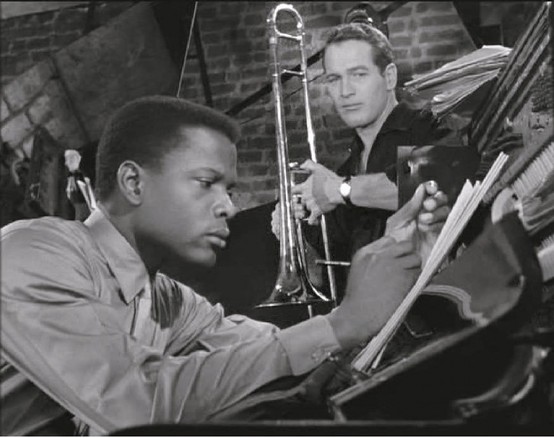
My first album was a four-record set called, #1 Hits of the ‘60s. I ordered it C.O.D. in 1973 after I saw Mickey Dolenz, of the Monkees, hawking it on our local UHF channel (WTCG). My mom had to pay for it when it arrived, but I immediately chose Lulu’s “To Sir, With Love” as my favorite track of the 52 songs. So when the 1967 movie of the same name was scheduled to play on the 4 O’clock movie, I knew this latchkey kid would be parked in front of the TV.
What that 9-year-old living in a Georgia Klan town got was his first introduction to Mr. Sydney Poitier. I loved the story of American who tamed the rowdy British kids by breaking the traditional rules of the classroom. He was dignity and respectful control in the face of youthful chaos. Perhaps I craved that. The fact that that he was black man corralling white kids added to the juxtaposition. But he didn’t treat them as children, and they transitioned into young adulthood under the guidance of “Sir.” There was nothing in my Georgia schools like this. This white boy immediately thought, I want to be like Sydney Poitier.
The film itself, directed and written by James Clavell, is overly sentimental and plagued with real gender problems, but it tackled British racial politics the same season that the Beatles were singing, “All Your Need is Love.” To my young mind, it was all about Pointier’s poise and composure as he deconstructed the politics of the public school, literally throwing out the book (into the classroom trashcan) to take the students to museums and other London adventures. I’d had a taste of Montessori under my belt from the second half of second grade (the first half was wasted in Bible school), and I craved that educational freedom.
So I became a teacher. The first classes I taught were as a young graduate student at Emory University. In one sociology class, taught on the second floor of the Candler Library, I had my own Mark Thackery moment. (Thackery was Poitier’s character in the film.) Instead of working class hoodlums, my students were the privileged children of wealth. It was clear that students weren’t invested in the curriculum I had created for my Youth Subculture class, so I went into a monologue about the corrosive nature of privilege and the opportunity of youth to define itself in its own historical moment. Then I threw the three required texts out of the library window and told them we would never meet in that classroom again. I channeled Sydney as we took the class out into the world. (I later went and retrieved those books from the bushes below the window.)
That dignified grace was a hallmark of so many of Poitier’s roles, including favorites like The Defiant Ones (1958), A Raisin in the Sun (1961), and Guess Who is Coming to Dinner (1967). His seminal role as Virgil Tibbs in In the Heat of the Night (1967) was a pretty accurate picture of policing in my rural Georgia town and planted the seed police reform in my young brain. I became obsessed with his films, never missing them on the 4 O’Clock movie or when I’d sneak downstairs into the recroom to watch Paris Blues (1961) on the late movie. When I learned about his civil rights work, I had permission to question the racism of my peer culture. Other kids had their role models, this was mine. Sydney and I had the same birthday (February 20) and I knew that the best thing I could be was to be like Sydney Poitier.
There will never be anyone like him, but I carry his Mark Thackery with me into the classroom every time, with love.
Like most people who survived the epic disaster film that was 2020, I had high hopes for 2021. I kept singing that Who song from Tommy; “I got a feeling ’21 is gonna be a good year.” Trump was defeated, the COVID vaccine was coming, and things seemed to be great on the home front. Man, I was wrong on all counts.
January 6 was the first day of winter classes at PCC, Andi’s 31st birthday, and the day Donald Trump staged a coup to flush American democracy down the toilet. As I Zoomed with my sociology students, we split screened in realtime the assault on the capitol, while my wife realized that the folks who have their birthdays on September 11 now had some fellow travelers.
Then the Delta variant busted through the vaccine barricades destroying any hope of kicking off the new Roaring 20s. It took me down in August, as I spent ten days flat on my back, hoping I wouldn’t cough a lung out. I survived thanks to Andi and Cozy dropping food and medicine into the basement. And that wasn’t even my worst moment of 2021.
Much of this early part of this year, this blog was dedicated to thoughtful policy pieces responding to the January 6th insurrection but then it turned personal. Over the summer my bad habits hit a low point, leading to the realization of the impact of a sexual assault that happened to me when I was just four years old. I tried to make sense of how that explained my narcissistic tendencies but it just made things more unstable in my relationship. In October, Andi moved out to rescue her sense of self. It was exactly what I needed to put the pieces together and leave that 4-year-old boy back in 1968. The time we spend together now is more meaningful than ever. You can’t say you love someone and take them for granted year after year. The personal growth the last third of this year has been so exciting, thanks to good reading, great therapists, and a loving wife who lives just down the street.
There were plenty of great moments this year, including our cross country, Atlanta to Portland, road trip. The meandering journey took us to the Arizona-Mexico border where Andi crossed when she was 8, and leading to one of my favorite blog posts of the year. This year I also joined the faculty at the University of Oregon, returning to the physical classroom to discuss racism twice a week with 150 students in Eugene. I read a lot of self-help books, listened to newly released Beatles songs, watched Cozy turn 7, sweeping into second grade (after over a year in remote), and had a hundred amazing dates with Andi. My meditation and mindfulness practices help me navigate even the hardest of moments.
I’m not going to make any predictions about 2022. It could go either way. Andi and I have tickets for a much-needed trip to Paris in March (as spouses, lovers, or just friends, we’ll see) so I hope the Omicron variant doesn’t lead to a global shutdown this spring. I do know I will continue to work on the hard issues and the hardest issue of all is myself.
Looking back at this entry from a year ago, I thought 2021 was going to kick off the new “Roaring 20’s.” Instead the year was hammered by Delta and Omicron variants, record inflation, and a broken supply chain. There was still a ton of great music that slipped out, and a return of live music. (Favorite show: The Monkee’s Mickey Dolenz and Mike Nesmith shortly before Nesmith’s sad death on December 10.)
Most of my musical consumption this year came from making playlists on Spotify, especially when I was laid low by COVID in August. (The fever sent me on a Steely Dan bender for some reason.) Spotify gave me a great musical project source thanks to my University of Oregon students. As an extra credit assignment, I created a “Race & Ethnicity Mix Tape” playlist. They submitted songs of racial consciousness and healing and we ended up with 229 tunes. Thanks to my Gen Z students, several artists were new to me. (Joey Bada$$ was popular in the mix.)
The musical highlight of the year was definitely the long-awaited release of Peter Jackson’s 8-hour Beatle documentary, Get Back, airing on Disney+ over the Thanksgiving holiday. Insight into the Beatles’ process and a chance to re-write the Let It Be record made it endlessly engrossing. Filmed the same year, 1969, Summer of Soul (on Netflix) gave a brilliant look at a Harlem black music festival that was overlooked by history as Woodstock hogged the limelight.
This year’s top album pics are not necessarily the best selling or most critically-acclaimed releases of 2021. I’m sure Tyler, The Creator’s Call Me If You Get Lost is amazing and I’ll dive into Adele’s 30 and Kasey Musgraves’ Star-Crossed when I’m not quite as melancholy (i.e., living it). These are the albums that brought me joy and repeated listenings in ’21. I recognize that three of these artists, Wanda Jackson, Charles Lloyd, and Ringo Starr, are in their 80s. Paul McCartney turns 80 in June and Tony Allen would be 80 but died last year at 79. They demonstrate the longevity of creativity, and are balanced out by teenagers Olivia Rodrigo and Young Thug (who recently turned 20).
The top spot is reserved for The Beatles (surprise, surprise). The 5-disc “Super Deluxe” release of 1970’s Let It Be(remixed by Beatles producer George Martin’s son Giles) provided endless moments of Beatle discovery from the vaults, including a Fab Four version of George Harrison’s “All Things Must Pass.” The packaging was stellar and stood as likely the last gift of unheard Beatle music for fans. The “in the room” outtakes served as a perfect soundtrack to the Get Back film.






























 Watching the Wheels