The James Bond Project #5: Casino Royale (1967)

January 11, 2025

This series is intended to evaluate each product of the James Bond film franchise through a feminist lens, and the relevance of the Bond archetype to shifting ideas of masculinity in the 2020s.

Casino Royale (1967, directed by John Huston and others)

After four hugely successful Bond films, it’s time for the first Bond spoof. Casino Royale was the first of Ian Fleming’s Bond books (published in 1953). The John Huston directed film brings back many faces from the first four films from the the United Artists Bond canon, including Ursula Andress (who, as MI-6 agent Vesper Lynd, sounds way too much like Melania Trump). Casino Royale is a comedy meant to mock many of the Bond conventions, so it’s going to score differently than the films produced by Eon Productions, the home to “official” 007 movie franchise.

Here we get an older Bond, played by David Niven, who is 20 years retired after a sad end of a relationship with his beloved Mata Hari. He stutters and is known for his celibacy. This ain’t Sean Connery’s Bond. He’s brought back to MI-6 by M (played by Huston himself) to deal with evil SMERSH. (We don’t know what SMERSH stands for but there was a counter-intelligence group in the Soviet Union with the same name). M is comically killed so Bond takes the helm of MI-6, where he is reunited with Miss Moneypenny, or at least her daughter. (Strangely, Moneypenny now has an American accent, played by Barbara Bouchet, who was born in Nazi Germany.) He orders all the “Double O” agents to change their names to “James Bond” to confuse and trap SMERSH baccarat player Le Chiffre, played with gusto by Orson Welles. Two of those agents include Peter Sellers and a very young Woody Allen.

Casino Royale is a madcap farce that lampoons the cool image of 007. There’s even a yakety sax soundtrack during chase and fight scenes (some played by Herb Albert). The funny Bond quips are turned up to 11, jumping from wry to hilarious. (“James Bond doesn’t wear glasses.” Bond: “Yes, it’s just because I like to see who I’m shooting.”) The film is fully located in the mid-sixties. The first shot is graffiti that says, “Les Beatles.” The scene where the Peter Sellers’ Bond is drugged is straight psychedelia. And the movie introduces the Burt Bacharach song, “The Look of Love,” sung by Dusty Springfield (and sung by Bacharach himself in 1997’s Austin Powers: International Man of Mystery). The film was released in April 1967 and Sgt. Peppers Lonely Hearts Club Band was released shortly after setting up the iconic “Summer of Love.”

This may be an anti-Bond Bond film, piercing some of the tried and true tropes of the previous four films, but it’s worth dropping it into our feminist matrix if just for point of comparison.

Driver of Action – There are multiple drivers of the story here, including multiple Bonds. Sir James Bond (Niven) plays almost a support role. The majority of the story centers around Evelyn Tremble (Peter Sellers as a Bond surrogate) and Vesper Lynd (Andress). A section of the film follows Bond’s daughter with Mata Hari, Mata Bond (played by Joanna Pettet) in an adventure in Berlin (which features A Hard Day’s Night’s Anna Quayle and a hilarious scene where a hole is blown in the Berlin Wall and a wave of East Germans run out). This is an ensemble cast.

Role of Violence – It’s a Bond film so there a guns and explosions. But much of the violence is done for laughs, aided by a comedic soundtrack. But, other than an army of fembots with machine guns, there is no overt violence. I don’t think Niven’s or Seller’s Bonds kill anybody.

Vulnerability – The premise of this story is that Bond experienced heartbreak from his true love, Mata Hari, and looks for a connection to his daughter Mata Bond (who is abducted into a SMERSH flying saucer). He’s developed a stammer that he’s self-conscious of and his fighting style as become what might be describes as “effeminate.”

Sexual Potency – The joke of the movie is that Bond is celibate and that 00 agents are being killed because they can’t resist women. Bond creates a program to train agents to resist females in a scene where Agent Cooper rebuffs seductive women by throwing them to the mat. There is one scene where Sir Bond forcibly kisses Moneypenny (or her daughter). Ursula Andress plays seductress to Peter Sellers’ Bond, as does Miss Goodthighs (played by a young Jacqueline Bisset). Additionally, Dr. Noah (not Dr. No), played by Woody Allen, has a fourth quarter evil plot. He has a biological weapon that will make all women beautiful and kill all men over 4 foot 6, making him the tallest (and most sexually attractive?) man on earth.

Connection – There are few autonomous men in this film. The last quarter of the movie features Sir James, Moneypenny, Mata, and Agent Cooper working together to bring down Le Chiffre at the Casino Royale. And the Calvary (literally!) arrives to help save the day. Bond’s connection to his daughter seems sincere as is his desire to shepherd MI-6 in the post-M era. The film ends with the cast, having been blown up, floating in heaven, while Woody Allen’s character drops down to hell.

Toxic Masculinity Scale: 2

Summary Casino Royale is not a feminist critique of Bond. It’s a mid-sixties comedy so there are plenty of jokes rooted in sexism. For example, after M dies, Bond is sequestered in his house with his eleven seductive daughters (actually SMERSH agents) and his equally seductive widow (played with great hilarity by Deborah Kerr). But the film also completely mocks Bond’s Lothario reputation. (Woody Allen as James Bond should make the point.) There are plenty of nods to the Bond franchise, including an underground lair and even women in gold paint, but the ensemble nature of Casino Royale stands in stark contrast to Bond 1 to 4.

Unlike the previous film, Thunderball, whose cast is entirely gone, many cast members from Casino Royale are still with is, including Ursula Andress, Woody Allen, Joanna Pettet, Barbara Bouchet, and Jacqueline Bisset. I’d love to know how they see the film’s depiction of Bond and of women from a contemporary lens. The film is both hilarious and, at times, a complete mess, but also provided a break from the Bond formula. Sometimes stepping out of something allows us a fresh perspective on it. Two months later there would be another Sean Connery Bond flick headed to theaters. I wonder if viewers saw it differently after watching Casino Royale.

Next: You Only Live Twice (1967)


The James Bond Project #4: Thunderball (1965)

The James Bond Project #3: Goldfinger (1964)

The James Bond Project #2: From Russia With Love (1963)

The James Bond Project: #1: Dr. No (1962)

The James Bond Project #4: Thunderball (1965)

January 8, 2025

This series is intended to evaluate each product of the James Bond film franchise through a feminist lens, and the relevance of the Bond archetype to shifting ideas of masculinity in the 2020s.

Thunderball (1965, directed by Terence Young)

Adjusted for inflation, Thunderball is the largest grossing of all Bond films. And it looked big, being the first Bond flick shot in widescreen Panavision. This was supposed to be the first Bond feature in 1962, but a legal dispute held it up in court. However, original director Terence Young was back at the helm so it had a very “classic Bond” feel. We end up back in the Caribbean (the Bahamas this time) so we see more black faces, including Bond team member Pinder, played by Earl Cameron (who some will remember from Dr. Who). And also sharks. Lots of sharks.

My initial thought watching this film was that all these “Bond Girls” look alike. Same cheek bones, same hair style, same dubbed in voice. Maybe it was just post-holiday malaise, but I found myself repeatedly confused as to which actress Sean Connery’s Bond was making the moves on. By film #4, they were virtually cookie cutter. The primary Bond girl in Thunderball is Domino. Producers originally considered Julie Christie, Raquel Welch, and Faye Dunaway for the part, but settled on beauty queen Claudine Auger (Miss France!). By film four you get the feeling that half the draw of a Bond film is just the cavalcade of beautiful women for James to plow through. However, there is a scene where SPECTRE assassin Fiona Volpe (played by Italian actress Luciana Paluzzi) blows up a car with rockets on her motorcycle and then takes off her helmet to reveal her flowing red hair that is pretty, um, empowering.

Thunderball premiered in Tokyo on December 9, 1965 at a time when the anti-Vietnam War movement was gaining steam in the U.S.. (On November 27, tens of thousands of protestors marched from the LBJ White House to the Washington Monument.) Thunderball skirts Cold War tensions by, again, making SPECTRE the bad guys. This time, #2, Emilio Largo (played by Italian actor Adolfo Celi), is ransoming NATO for £100 million in diamonds after stealing two nuclear bombs (a plot later spoofed in the first Austin Powers movie).

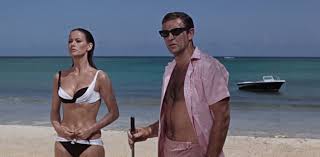
What this Bond film is most famous for is not the women or the evil plot (both a bit tired by 1965), but the extensive underwater filming. A quarter of this film takes place underwater, including shots of cool submersible vehicles and a massive speargun battle between the good guys and the bad guys. It must have been spectacular to see it on the widescreen in the mid-1960s. Apparently, the ocean shooting in Nassau had to be done at low tide because of the constant threat of sharks and the scene where Bond is in a salt water pool full of sharks almost ended with Connery getting chomped. The tropical locale means we get plenty of bikinis and bare-chested Bond as well as boats exploding (now a Bond film staple).

Let’s plug Thunderball into our feminist matrix.

Driver of Action – For the first time, we almost get Bond as a part of a team. Presumably assembled by MI-6, we get an on-the-ground team in Nassau put together to help James avert nuclear catastrophe, including familiar faces like CIA bro Felix Leiter (this time played by Rik Van Nutter) and MI-6 gadget guy Q, who, in Bermuda shorts, laments having to meet 007 “in the field.” He’s also joined by Pinder, another unnamed Afro-Caribbean dude, and CIA agent Paula Caplan, played by Martine Beswick (back from her role as “Gypsy Girl #2” in From Russia with Love). It’s mainly Felix who bales James out (in his handy CIA helicopter), but it should be noted that Paula is kidnapped by SPECTRE and commits suicide rather than rat on James. She’s the DDID. (Dead Damsel in Distress.) But it’s still Bond in the driver seat, whether he’s dodging sharks or ordering Beluga caviar.

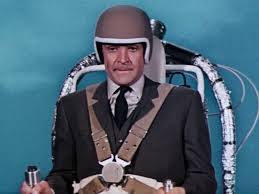
Role of ViolenceThunderball opens with Bond killing SPECTRE assassin Jacques Bouvar (who is dressed as a woman, so there’s that) and then escaping with a supercool (for 1965) jetpack. There’s a few henchmen (dressed in black, like an episode of Batman, which debuted the following year) that Bond kills, although they may just be stunned. Some henchmen throw another henchman into a pool of sharks. And whole bunch of frogmen, good, bad, and otherwise, get shot by spearguns in the Caribbean, some likely by 007. Other than the epic underwater battle, the body count is not giant and those scuba dudes who are killed are probably then eaten by sharks, so, the circle of life.

Vulnerability – It’s 007, so audiences don’t expect an inner window into Bond’s heart and it seems even more walled up than ever. He’s less dependent on technology than in Goldfinger, but James swallowing a radioactive pill so the CIA can track him seems like some kind of weird acknowledgement that maybe James can’t do everything by himself. There’s also a moment where James is trying to rescue Paula from Largo’s compound and he accidentally drops his gun off the roof he’s on. The look on his face seems to say, “Uh oh. My dick just fell off.”

Sexual Potency – Here’s where Thunderball goes off the rails. The first part of the movie, Bond is camped out at an English health spa called Shrublands, where he continually sexually harasses a masseuse (physiotherapist?) named Patricia (played by Molly Peters, featured in Playboy’s 1965 “James Bond’s Girls” spread). He forcefully kisses her and then when she thinks Bond’s bad experience on a, more Medieval than medicinal, stretching rack is her fault (it was a henchman) she frets that if her boss finds out, she could lose her spa job. “My silence could have a price,” James says then pulls her away for some quid pro quo sex. In the end, they’re in bed, with Bond doing the massaging.

Then there’s James’ relationship with SPECTRE agent Volpe. Her red hair is a classic signifier of a libidinous woman and when Bond walks uninvited into her bathroom to find her naked in her bathtub, he smirks with the recognition that he’s about to get another notch in his belt, “as if it was intended.” Because she’s a wicked redhead, she takes off Bond’s clothes and they end up in the sack where he tells her, “you should be locked up in a cage.” Rawr. Post coitus, she (and her henchmen) turn the tables on Bond, who seems shocked that he got caught with his pants down. In a moment for the Bond Girl demographic, she says, “But of course, I forgot your ego, Mr. Bond. James Bond, who only has to make love to a woman and she starts to hear heavenly choirs singing. She repents, and immediately returns to the side of right and virtue. But not this one.” Snap.

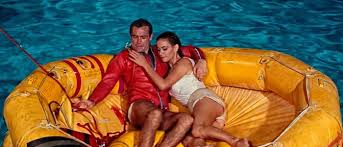
The final scenes are about rescuing Miss France/Domino from bad guy Largo. Bond sucks sea urchin poison from her foot and then they make love on the beach. When 007 says he needs her help catching Largo, she dejectedly says, “Of course. That’s why you make love to me.” Sex as transactional in Bond films. And also now cemented as a cliche, the film ends with Bond and Domino in a boat, this time a rescue raft floating in the Caribbean.

ConnectionThunderball begins and ends with Bond alone, acting or celebrating (with his prize) his actions. We do get to see a section of the Bond working with a team, but it’s sort of like Superman and his super-friends. Bond is in the lead. Again, as by Film 4, Bond is now the archetype of the man alone. He mocks love (including with Moneypenny), but he never actually has it. I wonder if writers ever considered developing a bromance between James and Felix. Maybe, at some point in this chronology, we’ll meet a James Bond who cares about somebody.

Toxic Masculinity Scale: 8

Summary By 1965, James Bond had officially become a franchise, produced by men to maximize 007 revenue. In the opening credits, the only females listed are “continuity girl” and “wardrobe mistress.” The fledgeling second wave feminist movement hadn’t yet turned its attention to Hollywood and the impact of this picture of gender. The normalization of sexual harassment in the 1960s (here, Bond’s treatment of spa worker Patricia) would later be unpacked by the brilliant AMC series Mad Men (2007 – 2015). But Bond is such a cad in Thunderball it makes watching his witty banter with the other characters in the film a lot less fun to watch. 

We do get tastes of gender subversions. There’s Volpe (Italian for “fox”) blowing stuff up, motorcycle between her legs, and later removing 007’s clothes and then sexually besting him. (“But not this one.”) Again, we get a female hotel concierge ogling Bond’s backside and Paula, the female CIA agent (who dies because, you know, lady CIA agents). But it all stands in the shadow of Bond’s hyper-masculinity. He even tries to feminize Largo by saying of his skeet shooting rifle, “That gun looks more fitting for a woman.” Huh?

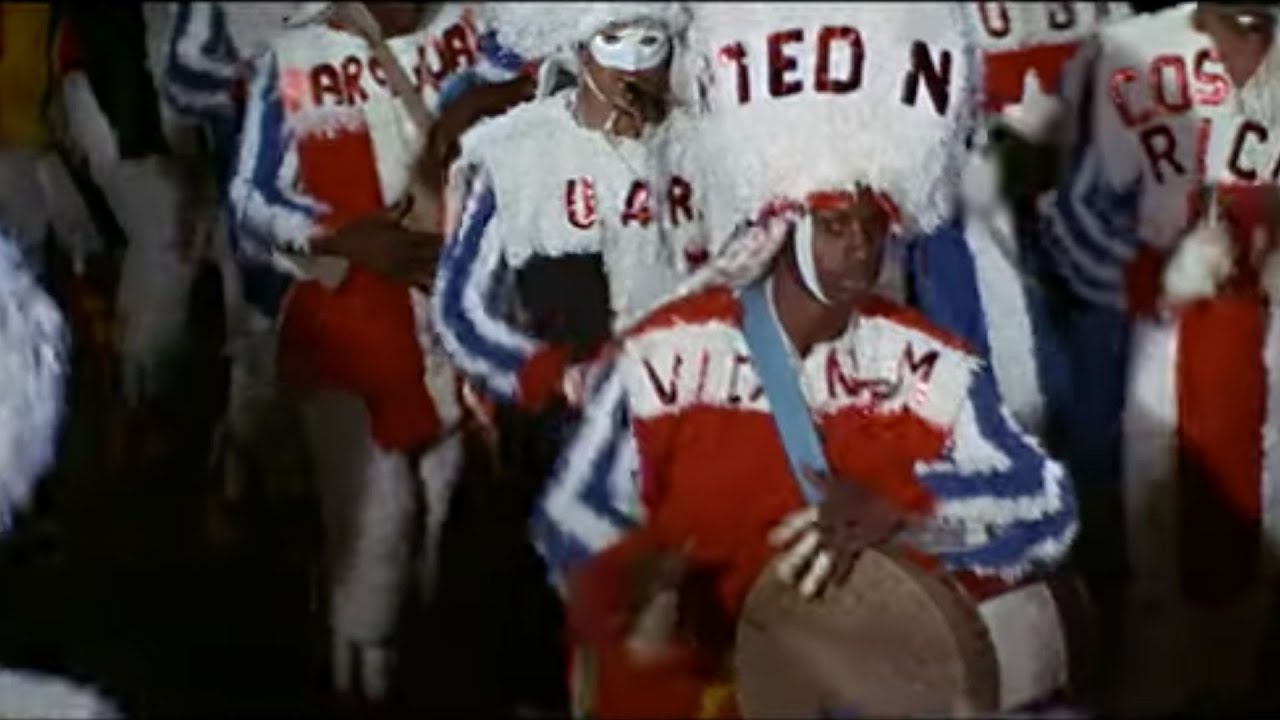
On a personal note, I appreciated the return to the Caribbean, especially Nassau where I experienced a particular “man making” experience as a 17-year-old boy. I loved the scenes shot during Junkanoo; Carnival in the Bahamas. It caught a glimpse of the decolonization that was happening in the black world in the 1960s and while there was no dreadlock rasta in Thunderball, behind the highly paid white actors in the camera’s focus there were a bunch of black faces who knew the world was changing. Those are the Bahamians I met when I was there as a teenager in the 1980s.

Next: Casino Royale (1967)

The James Bond Project #3: Goldfinger (1964)
The James Bond Project #2: From Russia With Love (1963)

The James Bond Project: #1: Dr. No (1962)