
April 15, 2025
This series is intended to evaluate each product of the James Bond film franchise through a feminist lens, and the relevance of the Bond archetype to shifting ideas of masculinity in the 2020s.
GoldenEye (1995, directed by Martin Campbell)
The first Bond film in the fourth decade of the 007 franchise is something of a synthesis of all the previous EON Production films and a fair send-off for EON producer Cubby Broccoli, who died five months after its release. After a long six year gap, while Eon dragged Timothy Dalton into development hell, Bond was back with Pierce Brosnan as the new British MI-6 commander. GoldenEye fused License to Kill’s vengeful 007 with the smarmy, Casanova Bond of the past. The first Bond film not to be based on an Ian Fleming story is a sweeping tale that presents Bond with his first post-Cold War conflict and was tailor-made for 90s audiences who were getting used to the widescreen violence in films like Natural Born Killers.

Brosnan, who had been offered the role before Dalton, comes in a more upper crust English, but also more boyish, Bond who has parachuted into a third-wave feminist world. This disconnect is magnified by the new M, now played by Dame Judi Dench. The new M states a clear opinion on the archetype that is Bond, James Bond. “I think you’re a sexist, misogynist dinosaur, a relic of the Cold War, whose boyish charms are wasted on me,” she tells him. Welcome to the 90s, James. We still have Desmond Llewelyn as Q to link us to the Bond cannon. This installment’s Bond “girl” is Swedish model and actress Izabella Scorupco, who forces a rough Russian accent. Also trying to be Russian (or Georgian) is “sadistic lust murderer” Xenia Onatopp (There’s the names we love in these films), played by Famke Janssen (soon to be Jean Grey in the X-Men films).
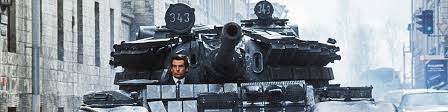
GoldenEye starts with a flashback to the Cold War days with 007 and 006 on a mission in the Soviet Union where 006 (played by the great Sean Bean) is killed. Bond blames himself, setting up the revenge redux. After an epic scene where James dives into a falling plane (This is the first Bond film to use CGI), we flash forward to the present where new Russia is losing track of its shit and we’re off. The scene where James is chasing the rogue Russian general through the streets in St. Petersburg in a giant Russian tank was classic 007 thrills on the big screen. I remember watching it in the Lloyd Center Cinema and thinking it was the wildest thing filmmakers could cock up for a James Bond movie.
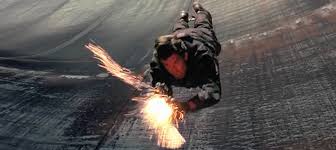
This installment gives us plenty of Bond staples fans crave. There’s Bond in a tux, playing baccarat, there’s Bond in the Caribbean, there’s the double entendre quips (none very clever), and thousands of bullets fired at our James with nary a scratch. The film also features some epic stunts, including a record setting bungee jump off a Russian (actually Swiss) dam that has to be seen to believed. Brosnan plays Bond closer to Moore than Connery and his bourgeois demeanor adds to the “Man out of place” element that makes this film kinda fun. Cubby Broccoli’s daughter, Barbara, took over the production as her father’s health failed, so some of the gender commentary may have been here doing.
Let’s see how GoldenEye fares in our feminist matrix.
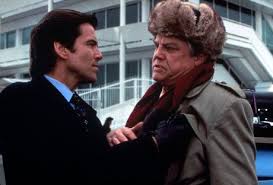
Driver of Action – New Bond, new star. Q and his lab techs show up for comedic effect. There’s a new CIA agent, Jack Wade, to help out (Joe Don Baker is back!) because Felix is still legless from the shark. The new post-communist Russia really plays the support role. In the gap between Yeltsin and Putin, it presented a blank slate to the world, where the need for secret agents might be a thing of the past. But this film rests purely on the shoulders of Remington Steele star Pierce Brosnan.
Role of Violence – There’s a lot of slaughter in GoldenEye, largely due to Bond’s use of machine guns. I had to ask ChatGBT the body count because I lost track. AI reports James killed 47 people in the film, mostly Russian soldiers. (Wasn’t the Cold War over?) There’s also some weird violent sexual scenes with Xenia Onatopp (we’re to believe that violence is her kink) and a scene where 007 knocks her unconscious.
Vulnerability – For the first time in a Bond film, we learn that James’ parents were killed in a mountain climbing accident when he was a boy. But there’s no sense that this plays a role in his present psyche. It’s just presented as a factoid to contrast the story that 006’s parents were killed by Stalin. There’s no James in love and only a mild sense of guilt that 006’s death might be his fault.
Sexual Potency – Here’s the James Bond rule of three. 1) Caroline – An MI-6 psychologist, sent to evaluate James, gets seduced by our agent who has a bottle of bubbly in the glovebox. He’s going to let her give him, “a very thorough evaluation.” Wink. 2) Xenia Onatopp – It’s more fighting than sex. James is taken aback by her biting his lip and drawing blood. Her death (pulled into a tree by a helicopter) is also played as sexual but in 2025 seems just weird. 3) Natalya Simonova (played by Izabella Scorupco), a Russian computer programmer, is Bond’s “love” interest/damsel in distress in the film. He forcibly kisses her and then suddenly they’re a romantic couple. (This quasi-rape trope seems all too common in 007 flicks.)
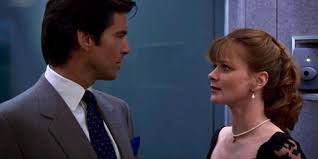
It should be mentioned that Bond’s relationship with Moneypenny (now played by Samantha Bond) is firmly located in 90s feminist positions. She’s not having any of James’ “charm” offensive. Bond: “What would I do without you?” Moneypenny : “As far as I can remember James, you’ve never had me.” Bond: “Hope springs eternal.” Moneypenny: “This sort of behavior could qualify as sexual harassment.” Finally.
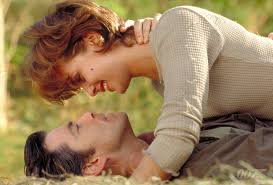
Connection – Brosnan plays Bond detached, as we have come to expect. There’s a hint of a back story between 006 and 007 that might have been nice to know about. As is expected, he and Natalya end the film together, not in a boat but in a Cuban meadow. They think they’re alone, but there is some coitus interruptus from the United States Marines, so they’ll have to save their victory sex for another day, or never. There’s no real chemistry between these two so the door is open for Bond’s next “girl.”
Toxic Masculinity Scale: 5
Summary The opening title sequence of GoldenEye, with women smashing hammers and sickles to a song written by U2 (and sung by Tina Turner) locates the film in a new era. The Cold War was the golden era of the Flemming novels and the platform for Bond’s good vs. evil adventures. Now New Bond is forced (again?) to find his relevance. Is he a 90s-action hero, right up there with Arnold Schwarzenegger, or a washed-up antique who has lost his cultural relevance? His elevated violence and philandering may be intended as a middle finger to the politically correct shifts in cinema.
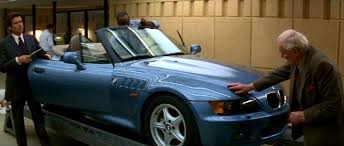
The tech in GoldenEye is a co-star along with lots of product placement. (Welcome to the new global market place.) IBM is featured front and center (and a great scene where a young Alan Cumming gets an “email”). The Aston Martin is replaced with a BMW, fully loaded with Q’s gadgets. “You have a license to kill, not to break the traffic laws,” Q tells an impish Bond. GoldenEye also gives us that most central staple of Bond Baddie accessories, the underground lair, hidden below a lake, from where a deadly satellite is controlled. Its explosive destruction is everything that Bond fans buy movie tickets to see.
GoldenEye premiered on November 13, 1995 at Radio City Music Hall, as the war in Yugoslavia, the largest hot war resulting from the end of the Cold War, was reaching its peak. The direction of Martin Campbell and the production of Barbara Broccoli (with Judi Dench’s M) represented a chance to reboot the franchise in a world without the Soviet Union. What issues would MI-6 confront as the 20th century closed? With the help of CGI, the promise of epic stunts and a horny agents would be a part of it.
Next: Tomorrow Never Dies (1997)
The James Bond Project #18: License to Kill (1989)
The James Bond Project #17: The Living Daylights (1987)
The James Bond Project #16: A View to a Kill (1985)
The James Bond Project #15: Never Say Never Again (1983)
The James Bond Project #14: Octopussy (1983)
The James Bond Project #13: For Your Eyes Only (1981)
The James Bond Project #12: Moonraker (1979)
The James Bond Project #11: The Spy Who Loved Me (1977)
The James Bond Project #10: The Man with the Golden Gun (1974)
The James Bond Project #9: Live and Let Die (1973)
The James Bond Project #8: Diamonds are Forever (1971)
The James Bond Project #7: On Her Majesty’s Secret Service (1969)
The James Bond Project #6: You Only Live Twice (1967)
The James Bond Project #5: Casino Royale (1967)
The James Bond Project #4: Thunderball (1965)
The James Bond Project #3: Goldfinger (1964)




 Watching the Wheels