The James Bond Project #5: Casino Royale (1967)

January 11, 2025

This series is intended to evaluate each product of the James Bond film franchise through a feminist lens, and the relevance of the Bond archetype to shifting ideas of masculinity in the 2020s.

Casino Royale (1967, directed by John Huston and others)

After four hugely successful Bond films, it’s time for the first Bond spoof. Casino Royale was the first of Ian Fleming’s Bond books (published in 1953). The John Huston directed film brings back many faces from the first four films from the the United Artists Bond canon, including Ursula Andress (who, as MI-6 agent Vesper Lynd, sounds way too much like Melania Trump). Casino Royale is a comedy meant to mock many of the Bond conventions, so it’s going to score differently than the films produced by Eon Productions, the home to “official” 007 movie franchise.

Here we get an older Bond, played by David Niven, who is 20 years retired after a sad end of a relationship with his beloved Mata Hari. He stutters and is known for his celibacy. This ain’t Sean Connery’s Bond. He’s brought back to MI-6 by M (played by Huston himself) to deal with evil SMERSH. (We don’t know what SMERSH stands for but there was a counter-intelligence group in the Soviet Union with the same name). M is comically killed so Bond takes the helm of MI-6, where he is reunited with Miss Moneypenny, or at least her daughter. (Strangely, Moneypenny now has an American accent, played by Barbara Bouchet, who was born in Nazi Germany.) He orders all the “Double O” agents to change their names to “James Bond” to confuse and trap SMERSH baccarat player Le Chiffre, played with gusto by Orson Welles. Two of those agents include Peter Sellers and a very young Woody Allen.

Casino Royale is a madcap farce that lampoons the cool image of 007. There’s even a yakety sax soundtrack during chase and fight scenes (some played by Herb Albert). The funny Bond quips are turned up to 11, jumping from wry to hilarious. (“James Bond doesn’t wear glasses.” Bond: “Yes, it’s just because I like to see who I’m shooting.”) The film is fully located in the mid-sixties. The first shot is graffiti that says, “Les Beatles.” The scene where the Peter Sellers’ Bond is drugged is straight psychedelia. And the movie introduces the Burt Bacharach song, “The Look of Love,” sung by Dusty Springfield (and sung by Bacharach himself in 1997’s Austin Powers: International Man of Mystery). The film was released in April 1967 and Sgt. Peppers Lonely Hearts Club Band was released shortly after setting up the iconic “Summer of Love.”

This may be an anti-Bond Bond film, piercing some of the tried and true tropes of the previous four films, but it’s worth dropping it into our feminist matrix if just for point of comparison.

Driver of Action – There are multiple drivers of the story here, including multiple Bonds. Sir James Bond (Niven) plays almost a support role. The majority of the story centers around Evelyn Tremble (Peter Sellers as a Bond surrogate) and Vesper Lynd (Andress). A section of the film follows Bond’s daughter with Mata Hari, Mata Bond (played by Joanna Pettet) in an adventure in Berlin (which features A Hard Day’s Night’s Anna Quayle and a hilarious scene where a hole is blown in the Berlin Wall and a wave of East Germans run out). This is an ensemble cast.

Role of Violence – It’s a Bond film so there a guns and explosions. But much of the violence is done for laughs, aided by a comedic soundtrack. But, other than an army of fembots with machine guns, there is no overt violence. I don’t think Niven’s or Seller’s Bonds kill anybody.

Vulnerability – The premise of this story is that Bond experienced heartbreak from his true love, Mata Hari, and looks for a connection to his daughter Mata Bond (who is abducted into a SMERSH flying saucer). He’s developed a stammer that he’s self-conscious of and his fighting style as become what might be describes as “effeminate.”

Sexual Potency – The joke of the movie is that Bond is celibate and that 00 agents are being killed because they can’t resist women. Bond creates a program to train agents to resist females in a scene where Agent Cooper rebuffs seductive women by throwing them to the mat. There is one scene where Sir Bond forcibly kisses Moneypenny (or her daughter). Ursula Andress plays seductress to Peter Sellers’ Bond, as does Miss Goodthighs (played by a young Jacqueline Bisset). Additionally, Dr. Noah (not Dr. No), played by Woody Allen, has a fourth quarter evil plot. He has a biological weapon that will make all women beautiful and kill all men over 4 foot 6, making him the tallest (and most sexually attractive?) man on earth.

Connection – There are few autonomous men in this film. The last quarter of the movie features Sir James, Moneypenny, Mata, and Agent Cooper working together to bring down Le Chiffre at the Casino Royale. And the Calvary (literally!) arrives to help save the day. Bond’s connection to his daughter seems sincere as is his desire to shepherd MI-6 in the post-M era. The film ends with the cast, having been blown up, floating in heaven, while Woody Allen’s character drops down to hell.

Toxic Masculinity Scale: 2

Summary Casino Royale is not a feminist critique of Bond. It’s a mid-sixties comedy so there are plenty of jokes rooted in sexism. For example, after M dies, Bond is sequestered in his house with his eleven seductive daughters (actually SMERSH agents) and his equally seductive widow (played with great hilarity by Deborah Kerr). But the film also completely mocks Bond’s Lothario reputation. (Woody Allen as James Bond should make the point.) There are plenty of nods to the Bond franchise, including an underground lair and even women in gold paint, but the ensemble nature of Casino Royale stands in stark contrast to Bond 1 to 4.

Unlike the previous film, Thunderball, whose cast is entirely gone, many cast members from Casino Royale are still with is, including Ursula Andress, Woody Allen, Joanna Pettet, Barbara Bouchet, and Jacqueline Bisset. I’d love to know how they see the film’s depiction of Bond and of women from a contemporary lens. The film is both hilarious and, at times, a complete mess, but also provided a break from the Bond formula. Sometimes stepping out of something allows us a fresh perspective on it. Two months later there would be another Sean Connery Bond flick headed to theaters. I wonder if viewers saw it differently after watching Casino Royale.

Next: You Only Live Twice (1967)


The James Bond Project #4: Thunderball (1965)

The James Bond Project #3: Goldfinger (1964)

The James Bond Project #2: From Russia With Love (1963)

The James Bond Project: #1: Dr. No (1962)

The James Bond Project: #1 – Dr. No (1962)

December 27, 2024

As a latchkey kid who grew up on the 4 O’Clock movie (with a father often away on sales trips), most of my young models of masculinity came through the family color TV. Those films offered me the standard trinity of white manhood: John Wayne, Elvis Presley, and James Bond. All three were good with their fists and spared few words for the ladies. John Wayne was the iconic “strong silent” man who solved problems with a gun. In the 2000s, I taught a summer class at Portland State University called, “Hollywood Elvis and Post-War Masculinity” that used Presley films to explore changes in parameters of male roles. But it was Bond that I most wrestled with as a feminist man. Was he a patriarchal archetype or a subversion of it?

After the 1996 film Swingers brought back lounge culture, I found myself fantasizing about the Sinatra swagger and the Bond confidence. I’d sit at the roulette wheel in casinos in Old Las Vegas, on Fremont Street, dressed in a vintage suit, surrounded by frat boys in khaki shorts and backwards baseball hats. Was I an agent of the backlash or mocking gender, the same way drag queens deconstruct femininity? And now, what is the relevance of Bond’s manly schtick in MAGA America, where sex offenders are running the show?

So I decided I need a winter binge to address the question. The James Bond Project is intended review every Bond film, from 1962 to the present, to glean insight into the gendered appeal of 007, genital warts and all. And here’s the matrix for our evaluation:

  1. Driver of Action – Team player or rugged individual?
  2. Role of Violence – Body count
  3. Vulnerability – Behind the mask
  4. Sexual Potency – Lady “killer”
  5. Connection – Autonomous into the sunset

Toxic Masculinity Scale  (1 to 10)

Dr. No (1962, directed by Terence Young)

The first Bond film is based on the sixth novel in Ian Fleming’s famous series on the British spy and is set against the backdrop of Kennedy’s Space Race. Producers cast Sean Connery, 31, after Carey Grant said he wasn’t interested in playing Bond more than once. Dr. No, released October 5, 1962 (less that two weeks before the Cuban Missile Crisis), introduces all the series staples; “Bond, James Bond,” “Shaken, not stirred,” a license to kill, SPECTRE and the underground lair, creative ways to kill the heroes, and Bond hitting on Miss Moneypenny.

My first thought watching it was that it was nice to see so many black people in a movie from 1962. I’m used to any film made before 1968 being made by, for, and about white people. Dr. No is set in Jamaica, so the cast diversity makes sense. The Caribbean was a common Bond locale (and where I saw my first big screen inter-racial kiss – more on that later). Jamaica was granted its independence in 1962, but in the film it still feels like a British colony. No reggae yet, just limp calypso and CIA officers hanging around airports. But it gave the world its introduction to 007 James Bond, the suave spy with a license to kill.

Driver of Action – There is no doubt that Bond is his own man. His boss, M, tries to replace his Beretta handgun with a new model, which James (unsuccessfully) tries to sneak out of the office. Other than that and a scene where Bond and Honey Ryder (played by Bond “Girl” #1 Ursula Andress) pass out after drinking Dr. No’s drugged coffee, there is never a moment where Sean Connery’s Bond isn’t in complete control. There are car chases, jungle chases, and scenes where Bond outsmarts would-be assassins (including smashing a tarantula to an epic musical score). Even though, for part of the film, he has a black sidekick named Quarrel and female accomplice (Honey Ryder), Bond drives the story and camera lens.

Role of Violence – 007 takes out a handful of baddies, including a corrupt geology professor and some blokes who go over a cliff in a fiery crash. “I think they were on their way to a funeral,” he quips. Compared to the massive body count of your average John Wick movie, there is surprisingly little violence in Dr. No. I found myself wishing 007 had watched a few of my favorite Kung Fu self defense reels on Instagram to better defend himself from henchmen and CIA operatives. Dr. No doesn’t even try to kill Bond, although he does strap Honey Ryder down to be drowned by a rising tide. Spoiler alert: Bond kills Dr. No in a radioactive pool.

Vulnerability – There is no moment when James shows any weakness or gives us any backstory. Was there (ever) a Mrs. Bond? Does he have a panic attack if his martini is stirred? Does he ever suffer from erectile dysfunction when bedding double agents? This may be the feature that resonates with men so much. Bond is a cartoon character of a man with no internal monologue, just commanding action.

Sexual Potency – This isn’t a Doris Day movie. Bond gets plenty of play. At the start of the film he beds a woman he meets playing baccarat in a casino. Her name is Sylvia Trench, and we’re off to the races for how women are named in Bond films. Then he spends a night between the sheets with MI-6 secretary Miss Taro, who is (of course known to James) working for the bad guys. Surprising to no-one, he ends the film in the arms of blonde bombshell Ursula Andress, bobbing in a dingy in the Caribbean. In the scene with Miss Taro, unprompted, he grabs her and kisses her, reminding me of Trump’s comments in the Access Hollywood tape. “You know I’m automatically attracted to beautiful… I just start kissing them. It’s like a magnet. Just kiss. I don’t even wait. And when you’re a star they let you do it. You can do anything.”

Connection – Bond has passing connections with Quarrel (played by John Kitzmiller) and American CIA agent Felix Leiter (played by Hawaii Five-O’s Jack Lord), but they’re just vehicles for Bond to complete his mission. Bond even seems briefly sad when Quarrel is burned alive by the bad guys. But James Bond is the model of the autonomous male. He is a self-contained unit who doesn’t “need” anyone. Sex is transactional, not romantic. Even the end scene with Honey Ryder is not a “and they lived happily ever after” moment. You get the feeling that Ryder, in her iconic white bikini, will be dropped off at the next beach as 007 jets off on his next mission.

Toxic Masculinity Scale: 5/10

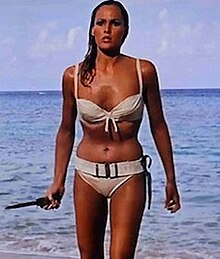
Summary – Watching a young Sean Connery chew up every frame he’s in is infinitely entertaining. Yeah, Ursula Andres on the beach (knife in hand) is a classic male gaze moment where even Bond says, “I’m just looking,” but the gaze is all on 007. There’s even a scene where a female concierge in a Kingston hotel stares at Bond’s ass. James Bond is the spectacle. All eyes are on him. It’s man’s world. Dr. No is 55 years before Patty Jenkins ground-breaking Wonder Woman movie. Action is man’s work, with bikini-clad damsels in distress.

Fortunately, there is no homophobia or overt misogyny in Dr. No. Women are beautiful and disposable but also strong, with agency. No bimbos in Bondland and toxicity is toned down in the Kennedy era. The film establishes the archetype of the autonomous “love ‘em, and leave ‘em” hero franchise to be mimicked by countless others, from Matt Helm to Austin Powers. At his core, Bond is always cool and always in control. Men want to be him and women want to be with him. But we all want to know, its that all there is?

Next: From Russia with Love (1963)