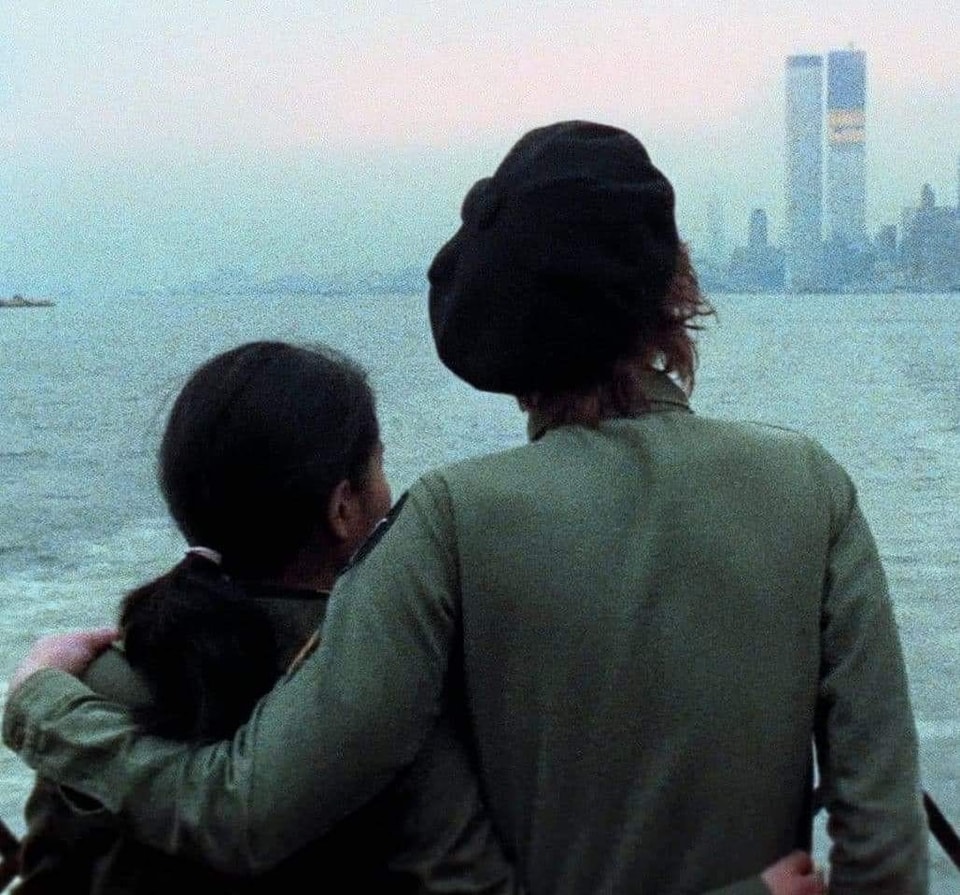
Standing, Again, at Ground Zero: Trying to capture the depth of 9/11 for my child

December 26, 2025

New York is like a giant magnet. I’ve been making pilgrimages to the city for over 40 years now for many different reasons. I had a speaking engagement there in 2018 and took my four-year old daughter and delighted at her constant wide eyes. (Although I had to tell her the bad news that if the Elmo in Times Square asked for a hug, we’d have to call the police.) So when Cozy, now 11, said what she wanted for Christmas was a trip to the Big Apple, I knew what we had to do.

There were some obligatory stops on the four-day stay in Manhattan, including shopping at Macy’s, the top of the Empire State Building, and the Christmas Tree at Rockefeller Center. But we were staying downtown, just a few blocks from the New York Stock Exchange, so I mustarded up the courage to suggest that we visit the 9/11 memorial. Born in 2014, my sixth-grader had limited knowledge about the event, other than it was a terrorist attack. When I was 11, I didn’t know much about the events of 1951, 13 years before my birth. The Korean War, that was it. I didn’t want to give her a history lesson, I just wanted to convey to her the weight of that day.
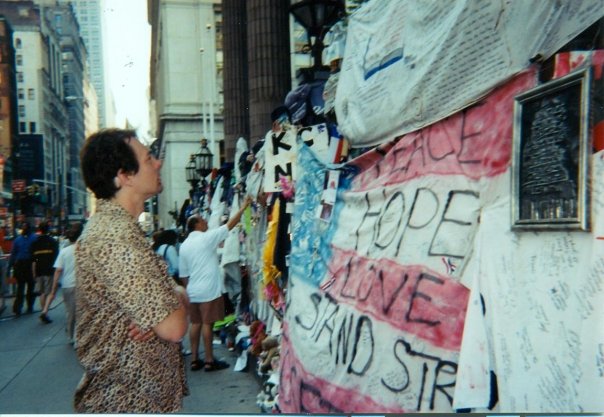
So on Tuesday morning, we walked over to the sacred ground as the rain mixed with snow. My first trip to Ground Zero was the summer of 2002, when the dust of the fallen was still drifting in the downtown air. Now, almost a decade and half later, the area has been completely transformed. “FiDi” is bustling under the new World Trade Center, opened the year Cozy was born. I had been to the memorial before, and it features in my 2015 novel, The Dream Police. But now it was all integrated into life in the city, a tourist destination.

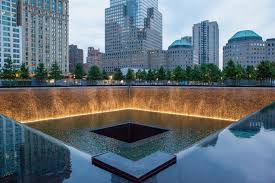
I guided her to the places where the twin towers stood, now two deep fountains, ringed by the names of the thousands of people who died on another Tuesday morning. I told Cozy how, in 1987, when I was managing a band on Island Records, I would sit between the two towers and watch the commuters come out of the WTC subway station, work shoes in hand, and go up into the skyscrapers I first saw in the 1976 version of King Kong. Then I started to choke up and had to step back for a second to collect myself.

There’s no way to convey the horror of that day so I just told her a few details. I told her about the people who chose to jump to their death rather than burn to death and the sound of bodies crashing to the ground. I told her about Fight 93 and the passengers who crashed their own plane to stop it from being used as a missile into the Capitol Building. I told her about the hundreds of firefighters who were buried alive trying to rescue those trapped in the towers. And I sobbed. I’m sobbing as I’m writing this.

Since September 11, 2001, two billion people have been born on this planet. To them, 9/11 is a story from history, like Pearl Harbor is to me. Cozy will study in greater detail. I was 37 on that day. Maybe when she’s 37, in 2051, she’ll have something worse than 9/11 to weld her to history. I hope not. But when she does learn more about it, I want her to picture herself in that spot in Manhattan, filled with real people and two holes in the ground. I want her to remember the sound of my voice as it cracked.

I wonder what her perspective on that day will be in 2051.  Will she remember the pointless wars it produced that took so many more lives? Will she remember the hate crimes that spiked after the attack and the Patriot Act that started to roll back our liberties. Or will she tell a story about how a divided nation found something to bring people together? Both can be true but I think the latter is more of the myth we tell ourselves about 9/11.
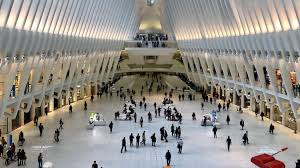
After the attacks, I had a recurring nightmare about being in the WTC subway station during the attack. The station begins to fill with water from all the broken water mains above and dead bodies float by me as I try to escape. That area is now the futuristic shopping mall called “Oculus.” We both were amazed at the open design with the subway stops adjacent to the shopping area. Cozy and I stopped by the Apple store where I bought a phone case, replacing my nightmare with some well-lit retail therapy.  It felt strangely healing.

She will learn more about that day; the ugly, the bad, and the good. Maybe, at some point, I’ll be ready to visit the museum and I can tell her more stories of that time, again through tears. I have so many memories, but it’s her story to discover now. I’ll tell her how I flew on 9/10 (with a camping knife in my bag) and, after the attacks, how silent the sky was with no planes above. And she can fold the tenor of my voice in with her own role in witnessing the history she’ll live through. 

Death By a Thousand 9/11s

September 11, 2021

They say one person’s terrorist is another person’s freedom fighter. From the perspective of a lowly stormtrooper inside the Death Star, Luke Skywalker and his band of rebel fighters, guided by an archaic religion, were not heroes, but mass murderers. Was the U.S drone strike that targeted ISIS-K in Kabul on August 29th a part of our righteous war on terror or was it a terrorist attack that killed seven children (and no ISIS fighters)? Remember when Bill Maher said, on his show Politically Incorrect, the 9/11 hijackers were not cowards, but those who launch cruise missiles from 2000 miles away were and ABC canned him? Are we even allowed to ask these questions?

Today is not the day to debate whether or not the attacks twenty years ago were terrorism. They most certainly were. If they weren’t, the word has no meaning. Anyone who was alive and old enough to pay attention on September 11, 2001 (and now a quarter of Americans weren’t), felt the terror. I had just flown to Atlanta on 9/10 for my 20th high school reunion and my dad woke me up in time for me to see the second plane slam into the World Trade Center. I remember saying out loud, “What the hell is happening?” as Peter Jennings attempted to translate the untranslatable. It was about to get worse. Much worse.

The U.S. government defines terrorism as, ““the unlawful use of force and violence against persons or property to intimidate or coerce a government, the civilian population, or any segment thereof, in furtherance of political or social objectives” (28 C.F.R. Section 0.85). Much of my work is built around the description of hate crimes as acts of terrorism. Why do we not think of the 9/11 attacks as merely 2,977 murders? Because all Americans were the targets. I had a friend from college who was in Tower 1. Osama bin Laden didn’t know about him, or have anything against him personally. (Three of my former Emory classmates were killed in the New York attacks.) He was a random target, a death meant to intimidate a larger civilian population. And it worked. It was several months after 9/11 before I could enter a tall building or drive over a Portland bridge without thinking of a passenger plane crashing into it.

Hate crimes work the same way. Like the victims of 9/11, targets are randomly selected for their symbolic value, to coerce others like the targets that they aren’t wanted here. Leave. A burning cross, a gay bashing, a swastika on a synagogue, all meant to terrorize large populations. After the 9/11 attacks hate crimes against American Arabs and Muslim (and people perceived to be Arab and/or Muslim) increased 500%. Four days after the attack a Sikh named Balbir Singh Sodhi was shot in the head in a gas station in Mesa, Arizona by a white male who claimed he seeking revenge for the 9/11 attacks. Not only were Arab and Muslim-Americans living in fear, but so were Sikhs and others. (Here in Portland, an Italian man was beaten by three teenagers after the attacks because he was perceived to be Middle Eastern.) 2001 wasn’t an anomaly. Just this week, data released but the FBI revealed that hate crimes increased dramatically in 2020. Who is terrorizing whom?

On this sad occasion, I’m reminded of how the Bush-Cheney-Halliburton Administration tried to falsely pin 9/11 on Saddam Hussein, leading to the invasion of the wrong county, a protracted and completely unnecessary war that was responsible for the death in over 4000 U.S. troops, and over half a million Iraqi men, women, and children killed. But we were the ones fighting terrorism. We couldn’t possibly be the terrorists. Could we?

I visited Ground Zero the summer following the attack and I could still smell the dust of all the souls who had been atomized on that Tuesday in September. I’ve been to New York at least a dozen times since then and always notice what’s not there and what is. My recurring 9/11 dreams were central to my 2016 novel, The Dream Police. At the 9/11 memorial when I see the names of the victims who were pregnant women, I can’t help but convulse and every trip I make to Washington DC, I have a moment when I wonder what would have happened if the fourth plane had hit its intended target, the U.S. Capitol building. I carry this as trauma as does every American, to varying degrees, who remembers that day.

But we also carry the trauma of all the other acts of terrorism, many done in our name or done by people who look like us against people who don’t look like us. We’ve become blasé to the trauma and really good at rationalizing the traumatizing of others. We’ve become masters at dehumanizing the “other.” They see us as “infidels” and we see them as “fanatics.” They see us as “libtards” and we see them as “Nazis.” Nobody is just a human being capable of love and redeemable imperfection. If you told members of the radical right or the radical left they could push a button to launch a drone strike to wipe out the other side, the air would be filled robots on their death trips.

Trauma requires healing and there has been a lot of healing in the last 20 years. New Yorkers are resilient. The passengers on Flight 93 showed great courage in the face of their own deaths. And the work of the war machine that launches drone strikes into wherever continues at the Pentagon. But the healing is hampered by all the other terror we inflict on each other. An open wound never truly heals.

I will never forget that day. The confusion of wondering if it was real or a movie. The image of people choosing to jump rather than burn. The realization that the world would never be the same. But I will also never forget a lot of other things, including what happened in a Mesa, Arizona gas station four days after the attack and what happened two weeks ago in Kabul. Never forget any of it.