Gender Notes: A Short Note About Nigeria

April 14. 2015

A year ago tonight, hundreds of Nigerian girls went missing in the middle of the night, kidnapped by extremists to be sold as virgin brides. Many are now free and three are going to school here in Oregon, but 219 girls are still missing.

Nigeria marks anniversary of Boko Haram’s kidnap of 200 schoolgirls

51Y07VKKHTL

In the early 1980s, I fell in love with Nigeria, through the music of King Sunny Ade. His “juju” music, from the Yoruba tribe, hypnotized me and transported me to mythical Africa. I saw him first play at the Agora Ballroom in Atlanta in 1982 and was entranced by the colorful cothing of his band and their talking drums. But there was more to the “Giant of Africa,” than cool music. Unfortunately, now when you hear about Nigeria the only news is about Boko Haram and their abduction of young girls. Besides the fact that this is the country where Paul McCartney recorded Band on the Run, there is a rich gender history, of which #BringBackOurGirls is only one part.

Rooted in tribal groups, Nigeria has three large ethnic populations, the Hausa, Igbo, and Yaruba people. The Yaruba are the largest and have a long tradition of empowered women. In the pre-colonial era, land was communally owned and women had a central role in commerce. Women were a big part of long distance trade and many accumulated great wealth, rising in positions of power.

One of the things I’ve lectured about for decades is the way women lose power as they age in America. After 21, it’s all down hill, babe. Western African culture had the opposite take. It’s not about your looks, it’s about your wisdom. So older Nigerian women gained power as they aged. The matriarchal elements of tribal culture made girls and women valued as contributors to the whole.

What ruined this was the European colonizers who brought their heavy duty Church-backed patriarchal rule to Mother Africa. And the first thing the British did was establish an education system that invited the boys to school and sent the girls home. It’s an oversimplification to say that colonialism brought patriarchy to Africa, but the culture from the north dramatically altered the matriarchal and gender balanced relations of Nigeria.

After independence in 1960, the post-colonial education system raised the status of women. After a long period of military juntas, Nigeria saw a new era of democracy begin in 1999. But Nigeria is far from a human rights bastion. Child labor and the rape of inmates are common as is child marriage. Last year Nigeria past a law that allowed the government to sentence same-sex couples who marry to 14 years in prison and anybody who supports gay rights to 10 years in prison.

South Africa Nigeria Kidnapped Girls
The rise of religious extremist gangs, like the Islamic Boko Haram, is the pressing threat to females in Nigeria, especially in the northeastern part of the country that they control. A year later their oppression of females goes unchecked. Amnesty International estimates that they have abducted at least 2000 girls and women. According to UNICEF, over 800,000 children have fled their homes because of the conflict between Boko Harum, government forces and civilian self-defense groups. The war against women rages on.

Report: At least 2,000 women abducted by Boko Haram

The gender issues that Nigeria is facing in 2015, females face in varying degrees all over the globe. For my and all our daughters,  #BringBackOurGirls.

Feminist Herstory Pt. 4 – The Swingin’ Second Wave arrives

April 10, 2015

We’re back for the occasional history of feminist theory. Earlier posts are here:

Feminist Herstory Pt. 1 – It is discovered that Women are PEOPLE!!!

Feminist Herstory Pt. 2 – Here comes the FIRST WAVE

Feminist Herstory Pt. 3 – Let’s Judge Ourselves as People

The 1960s were exploding with numerous waves of consciousness raising. In a short period of time, masses of people (especially young people) were re-evaluating how they thought about race, war, politics, social class, sexuality and gender. Boys began to grow their hair like girls and reject the marriage/house in the suburbs trajectory. Girls, with the help of the birth control pill in 1960, stopped waiting for Prince Charming and started practicing “free love.” A lot of the same old bullshit continued, but second wave feminists were active on numerous fronts.

2blog-msmagazine

In popular culture, Gloria Steinem not only went after Hugh Hefner on a 1960s talk show for referring to grown women as “girls,” but helped change the language itself. Single women were referred to as “Miss,” while married (claimed) women were “Mrs.” There was no equivalent shift for males. They were always “Mr.” whether they were single or not. Why not refer to females as “Ms.”? (Steinem founded Ms. Magazine in 1971, which became the standard bearer of second wave feminism.)

Feminist themes began creeping into 60s pop culture, in TV shows, like That Girl, and songs, like Aretha Franklin’s reworking of Otis Redding’s “Respect” and even the Rolling Stones’ “Mother’s Little Helper.” Much of the feminist energy was not just a rejection of the plastic suburban lifestyle, but the gender politics of larger liberation movements. For example, young women would show up to participate in anti-war and New Left groups, like the Students for a Democratic Society (SDS) and find males running the program and females expected to prepare food, not author manifestos.

My mother was typical of many middle-American women who heard about the feminist movement (“women’s lib”) from the fringes. She was 20 in 1963, when Friedan’s book came out, and newly married. She remembers seeing her on TV frequently in the 1960s, talking about The Feminine Mystique but not making the connection with her own situation. She recently emailed me about it:

Men were getting paid more than women for the same job, (and they still are). The big saying in the 60’s for men was “keep your wife barefoot and pregnant.” I also felt that with or without the feminist movement, a women could get ahead on her own with hard work a few brains, and knowing how to maneuver in a man’s world, such as starting a company, which I did.

Stepford wives

I think my mother, like a lot of women, didn’t see herself in the faces of the activists who were railing against “patriarchal oppression” and protesting against Playboy magazine and stay-at-home moms (which was never really the target). In the 1970s, she found a space to start her own consulting business. But that small space was created by the feminist pioneers who fought to get their foot in the door. It’s interesting that she pointed out the 1975 film, The Stepford Wives, as more influential on her ideas about gender power. The horror flick was rooted in the core principles of The Feminine Mystique; that you can only treat women like robots for so long.

The feminist movement of the late 1960s and early 1970s was wide-ranging and defied any simple characterization of what a “feminist” was. (But, as we shall see in the Part 5, it wasn’t exactly inclusive). Liberal feminists, like Friedan, pushed towards an equality of the sexes, focusing on issues like equal pay and an end to job-discrimination. Marxist feminists, like Jeanne Gross, pointed out that women gaining access to the same jobs that exploit men is not true liberation. Their position was that, since capitalism turns women into commodities (and not just prostitutes), the best way to end sexist exploitation is to end capitalism.  Radical feminists, like Charlotte Bunch, pointed out that patriarchy predates capitalism and what feminists should focus on is various systems of oppression. And then socialist feminists, like Barbara Ehrenreich, were concerned about how all of these issues impact women’s individual economic lives.

So when people tried to characterize feminists as “bra-burning man-haters,” they were really just perpetuating a caricature favored by those who defend sexism. First of all, despite some of the un-evolved men at the SDS meetings, there were men engaged in consciousness raising groups and exploring their own male privilege. The debate within feminism was healthy and held together around two basic ideas. First was the idea that society is primarily organized around male power and that patriarchy is insidious in virtually every aspect of life. The second idea was the slogan, “The personal is the political.” Individual experiences of oppression are manifestations of social patterns and the solution to personal problems is collective action. The personal is the political!

By the early 1970s, the debates within the feminist movement were raging. Liberal feminists mobilized women to break through the old boys clubs of power and start cracking the glass ceilings. Radical feminists asked if claiming 50 percent of a world created by men was really best for women. Would a military in which half the members were female really be a transformation of society, or just one where women were good at playing men’s games? Some feminists were increasingly frustrated with the reluctance of the men in their lives to share power. Is it possible to have a truly equal relationship with a man? Some feminists suggested lesbianism and separatism as the only way to escape abuse, oppression and dehumanization. This extreme position actually makes a lot of sense when you think about it but separatist groups, like the Furies Collective, added to image of feminists as hating men.

As men (including many progressive men) dug their heals in to defend their patriarchal power (you could be Mr. Radical and still want “your woman” to get dinner on the table), the rhetoric heated up. Rage towards “male domination” and “male chauvinist pigs” may have been justified, but it fed into the hype that feminism was all about stoking the “battle of the sexes.” For me as a 9-year-old in Stone Mountain, Georgia, this was all manifested in a tennis battle between Bobby Riggs and Billie Jean King. Riggs was a loudmouth who’d been a tennis champion in the 1940s. He seemed personally offended by the notion of female equality and made something of a comeback by challenging female tennis pros. The grand match was on September 20, 1973. There was a ton of hype about the ultimate “battle of the sexes” and anyone with a soul was rooting for King. Billie Jean beat Bobby’s ass in all three matches and he disappeared back into his cave. If you know the Elton John song “Philadelphia Freedom,” you know the right person won that round.

billie-jean-king-bobby-riggs-battle-of-the-sexes

Despite some of the rhetoric from some of the more militant factions, feminism was never about turning the oppression of women into the oppression of men. I think that was the fear of a lot of men. Just like Southern whites feared free blacks would torture whites as blacks had been tortured, many men feared free woman would go all Amazon on men, forcing them to bake three-level cakes and wear open-toed high heels. But feminism was geared towards ending oppression in general and men could be strong allies in that cause. But in the early 1970s, feminism needed a good look in the mirror to achieve that.

As the second wave moved into the 1980s, many feminists began to explore intersectionality and expand the big tent of feminism (that’s the subject of Part 5). Some liberal feminists, like Hilary Rodham Clinton, figured out how to beat men at their own game. But some Second Wavers got stuck in the early feminist thinking that cast women as universal victims and all men as dastardly agents of patriarchy. Some of those folks found an enclave working in Human Resources departments, zealously looking for sexual harassers, denying the agency of women. As we will discuss in a coming section, third wave feminists rejected this reductionary view as denying the complexity of gender power. But it makes for engrossing movies on the Lifetime Channel. Those evil men! But we still owe the second wave a great debt for naming the problem with no name and fighting it on multiple fronts.

The following book was mentioned in this post and available at Powell’s by clicking the cover below.


“That dude has intense eyes!” Normative maleness and my baby

April 6, 2015

One of the main goals of my Intro Sociology class at Portland State was to get students to develop an understanding of what feminism is really about. I would start with a riddle;

“OK, imagine a father hasn’t seen his son in 5 years. They are reunited and spend the day together. They go to a ballgame and out for burgers. On the way home there is a horrible crash and the father is killed. Barely alive and in need of surgery, the boy is rushed to the hospital. In the ER, the doctor rushes up and, with a shocked look, says, ‘I can’t operate on this child. He’s my son!’

So who is the doctor?”

In a room of 100 students there is almost always dead quiet. When I first heard this my mind went to SoapOperaLand. Maybe they were switched at birth and the doctor thinks this is his child.

The answer is much more simple. The doctor is the boy’s mother. But in a patriarchal culture we are taught to assume the male. It’s called normative maleness. “Female” is the default position. Actors (and actresses), poets (and poetesses).  Even with animals we assume the dog is a “he” even if we haven’t checked underneath to be sure.

tumblr_mdrweq1Eex1r4gisno1_500

It happens everyday. Cozy has plenty of pink but most of her clothes are not. She wears lots of clothes that were mine 50 years ago. We were at the videostore yesterday and a young clerk looked at her and Cozy gave him the “Whatchu lookin’ at, Willis?” stare. The kid said, “Man, that dude has intense eyes!” Yeah, it’s a girl, young brother. I did it just this morning. I got a note that a child of Cheap Trick singer Robin Zander, Holland Zander, might be interested in talking about my Dream Police novel. I immediately replied, “Please email him!” Turns out Holland is a she (and Robin is a he, a very awesome he). In the 2000s, whenever I would see a news headline that read something like, “Clinton headed to China,” I would think, “Oh, Bill’s taking a trip!” It was always Secretary of State Hilary Clinton. Always.

So I lecture on normative maleness and how it serves to make females fade from view. It’s even in our politics. There are political issues and then “women’s issues,” like health care and education. All the women in the class, whether they call themselves feminists or not, get it. A lot of the guys have sort of a “so what” look on their faces, but I get 10 weeks in a quarter to work my magic. There’s a similar  situation of normative whiteness, how we assume a person is white unless we are told otherwise. What’s the picture in your head when you hear the term, “All-American kid”? It’s probably not a girl named Fatima.

Having a baby is a good place to see this play out on a daily basis. Since gender is socially constructed, babies start out genderless. We horseshoe them into pink or blue realities from Day 1. (Now we can start before they are even born!). But, in reality, babies don’t look much like boys or girls. They look like babies.

PATTON

We were out at the coast yesterday, a nice Easter road trip to Lincoln City. Cozy was in awe of the Pacific. I love seeing her see things for the first time. I snapped a picture of her. As soon as I looked at it I realized that my baby looks like comedian Patton Oswalt! When I posted it on Facebook, a friend commented that all babies look like Patton Oswalt. Whew. Love the guy but my projection on my daughter, as it turns out, is more gendered than I thought. If she’s going into comedy, I see her as more of a Cecily Strong an Amy Schumer. (Although, Patton Oswalt seems like a perfectly happy person, so I’ll take him.)

I’m a bit off point here. It’s just very telling how many people think Cozy is a boy when she is wearing her green sweater or sucking on her blue binky. In this “genderless” moment she is completely free. I love her gender transgressions and I hope it sows the seeds of not feeling trapped in the “girl box.” She’s Cozy Fucking Blazak! She can construct her own definition of gender.

This Dar Williams song makes me think about the time she has to be genderless.

Dad and Baby Yoga – Ommmmmama

April 3, 2015

I wrote a blogpost a few weeks ago about the challenge of finding a baby yoga class that was open to dads. I appreciate that mom’s have a place to work their Warrior 2 without dudes showing off. At my yoga class at the gym there’s one blonde Adonis who rips his shirt off and shakes his long hair over his tattooed shoulders. There’s another guy who is always trying to outdo the yoga instructor. It was a lovely moment when he was going all out for a Crow Pose arm balance and he cut the cheese.

So I was super stoked when the good folks at Yoga Continuum changed their “Mama & Baby” class on Thursdays to “Baby & Me” after I emailed about dads. I felt it was a great victory, but the reality is that more and more dads are showing up for baby for yoga classes, so it’s gonna happen with or without me marching down NE Broadway with my yoga mat and my Baby Bjorn.

Yesterday was our first class. Lisa was our yoga master and it was a truly wonderful experience. My yoga class at 24-fitness is vinyasa-style, also known as “power yoga.” You are going to sweat your ass off. 50 people in a room planking. This was a much different experience. More personalized and focused on the connection between parent and child.

This type of yoga has three parts. The first part is some of the traditional stuff that adults go for, stretching, balancing, a bit of zen relaxation and maybe some core work. The second part is focused on the baby, including her own stretching and body awareness, as well as some nice massage. The third element is baby and parent together. This includes doing some poses with baby as a little dumbbell, but more stuff just holding baby, face to face bonding, or swinging her like a cheeky monkey. And she didn’t puke once!

11024789_10153724939124307_1862576838354150921_n

We sang children’s songs, including one I vaguely remember from second grade. Cozy smiled the whole time and the endorphins in my brain were just flowing, seeing how much she enjoyed it. Lisa was well aware that babies have a mind of their own and sometimes like to crawl off, but Cozy stayed with me. She giggled as she scooted under me during my Downward Dog pose. But it was a completely safe space for her to explore if you wanted to get off the mat.

It’s definitely different than my Sunday yoga class. I didn’t get the burn that I get from Vinyasa (although some poses holding a 20-pound wiggle worm worked hidden core muscles). The thing that I got out of it was an incredible hour of bonding with my child. She loved the attention, the songs, the touch, and the peaceful vibe. We are excited about going back and hope to see more dads on the mats, chanting Om. Namaste.

Buddhist babies vs. Freudian freaks

March 31, 2015

Other than the parents you see on TLC and Nancy Grace, I think most folks want to raise children who are compassionate and caring and not monsters who follow the flowchart into mass murder. It’s not easy because all babies start out as future Charles Mansons.

According to the good Doctor Freud, we are born with primitive Id drives, the pleasure principle. The Id is the “Me” in us all that wants it right now, whatever it is. Babies are selfish creatures. If it feels good, do it! (As I type this Cozy is farting. At least I hope it’s just farting.) This aids in baby’s survival. I want to eat! I want to sleep! I want to crap my pants! Deal with it, Dad!

Around age 2, the kids starts recognizing that society don’t play that shit forever and you gotta start learning the rules. Potty training is the big one. All of sudden those biological urges that were just followed now have some social restraints. You can’t just pee whenever you need to. This is the development of the Superego, according to Freud. It’s the “They” that is meant to balance the “Me.” Our Ego sits between them and decides who we should listen to, the devil on our left shoulder (Id) or the angel on our right (Superego).

The problem is this “psychodynamic” isn’t always balanced perfectly. Sigmund blames the parents here. (I knew it!) An overbearing parent that pushes potty training and other rules too early or too harshly creates an overpowering superego and a grade A neurotic. Imagine a 3-year-old Woody Allen. “Why should penis envy be limited to girls?”

As a fellow neurotic, I would say the opposite is even more frightening. When the superego doesn’t show up, you are left with the unrestrained Id and a full-blown sociopathic personality. Eric Hickey’s wonderfully researched and insanely creepy book, Serial Murderers and Their Victims, makes the case that at least 80% of serial killers are sociopaths. Look at the three child antecedents of any self-respecting serial killer; bed wetting, animal cruelty, and fire starting. If it feels good do it. Fuck society.

So as a neurotic, I live in fear that I will raise a serial killer. Fortunately, since Cozy is female the statistics are in her favor. (Only about 15% of serial killers are ladies.) She won’t have the same rush of teenage testosterone telling her to listen to the devil. But we are in by no means safe from her wrath.

Cozy Blazak, 7 months, is a raging Id. She knows what she wants and she will tell you. She doesn’t have words. It’s more like a low guttural growl. Have you ever seen Linda Blair in The Exorcist? When I first heard it, I thought she was pooping. No. She’s wanting. When she sees me preparing a bottle, Arrrgh! When we’re having morning coffee, Arrrgh! (She likes to rub her teeth on the mug.) When Dad’s gotta a spoonful of peanut butter in his mouth, Arrrgh! When Mom is topless, Arrrgh! Oh wait, that’s me.

She is consumed with desire. It’s certainly a normal state in our consumerist society. Like shoppers at the opening bell on Black Friday ready to kill to save $20 on a Keurig coffee machine, we are trained to want. But that way leads to misery and credit card debt. As Jedi Master Yoda once said, “Once you start down the dark path, forever will it dominate your destiny, consume you it will.”

I think we can agree that Buddhists are pretty happy campers. Science backs up that their core principles are the things that make people the happiest.

10 things science (and Buddhism) says will make you happy

You don’t have to be a chanting monk in the Himalayas to adopt some basic principles of Buddhism. The most challenging for Americans is the issue of desire. Capitalism is based in desire. “I desire an Apple Watch, no matter the debt it may incur, the labor conditions that created it or the toxic waste it may generate. I NEED IT!!!!!” Shut the fuck up. You don’t “need” it. You need food, water, shelter and the occasional booty call.

Buddhists believe that all life is suffering and that suffering is caused by desire. If you eliminate desire, you eliminate suffering. Now I’m not about to eliminate my desire for the new Alabama Shakes album, but I’ve certainly cut back on wanting crap that I don’t really need and it feels good.

Can I pass this liberation from want to my daughter. What will a 5 or 15-year-old Cozy tell me that she “needs”? Of course, I will want to spoil her. But will freeing her from wanting the new i-gadget be more valuable than the gadget itself? Can I build an angel on her shoulder that sounds like Yoda?

I had a beautiful moment with a wonderful mentor named Albert Cohen. Cohen wrote Delinquent Boys in 1955 and it played a huge role in my thinking about racist skinheads. He was born in 1918 but is still alive and a vital voice in the field of criminology. We were having coffee in 1994 in Miami at the annual conference of the American Society of Criminology.

He was telling me that he was cleaning out his office at the University of Connecticut and getting rid of many of his old books. (I’m doing the same thing with my PSU office right now, sadly.) He was in the process of downsizing his life and moving, with his wife, into a smaller house. His mother was still alive and living in a retirement home. He said something powerful at that moment:

“We spend our lives accumulating things. Now I’m trying to get rid of most of the things I’ve collected over the years. All the things my mother cares about in the world now fit into a drawer next to her bed.”

We live in an id-driven culture of want. It causes so much suffering. Cozy is in the Id stage right now and that’s important, but comes a time to be free from want.

This book was mentioned in this blog and available at Powell’s by clicking the cover.

10 Things I Forget (Dad of 7 Month Old Edition)

March 27, 2015

  1. I forget what it’s like to sit on a couch that doesn’t smell like regurgitated breast milk.
  2. I forget not to run my fingers through my hair after I’ve changed a diaper.
  3. I forget the rear-view mirror is used to see traffic behind the car.
  4. I forget that the baby can now leave the room.
  5. I forget to read the weekly to see what cool bands are playing.
  6. I forget that we cosleep with a baby, but am reminded when, during sex, a 20 pound troll doll bounces across the mattress.
  7. I forget that I used to make fun of people who didn’t go to parties because they had kids.
  8. I forget what it’s like to have domain over my own body as my nostrils are regularly penetrated by tiny little fingers.
  9. I forget that dust bunnies appear to be edible treats to rug rats.
  10. I forget that there are things to do when I’m looking at her. Like breathe.

A dad

Time is a Thief. It stole my baby!

March 23, 2015

Time is not a constant. Sometimes it moves very slowly, like when you are waiting in line at the post office, tortured by seconds. There are devices meant to slow time even further. Have you ever spent 20 minutes on a StairMaster? And sometimes time races by. It’s already Spring! Today is my father’s 73rd birthday. I remember his 30th birthday and thinking he was so old. That was about 5 days ago.

The people who know the most about the flexibility of time are athletes. Races are won in hundredths of seconds but a well-covered wide-receiver catching a football feels it all happens in extreme slow motion. I remember a street survey about basketball great Michael Jordan. They asked people what they thought his top hang-time was, from when his feet left the ground to when his hand slammed the ball in the basket. Answers ranged from 5 seconds to over a minute. His record hang-time was 0.928 seconds.

10735314_1432197907078125_1958315754_n

Parents know this time flexibility so well and now I do as well. The mantra, “They grow up so fast” gets uttered multiple times a day. It’s insane. Just yesterday, Cozy was a little blob, swaddled in a cradle. Today she is a 35 week old kid, scooting across the floor, curious what’s around the next corner.

And yes, I’m still counting weeks. Seven months and 6 days if you prefer. I’m one of those parents. How old is your daughter? She’s 156 months. Oh, you mean 13. Gotta slow time down.

This weekend we went to Target and bought a Magic Bullet so we could start making our own baby food for Cozy (and Piña Coladas for us). She’s eating the same things we are now. (OK, you can refer to the earlier post on breast milk, which now has over 3200 hits.) Last night we all had chicken soup. This morning she shared my PB&J sandwich. Who is this person?

I know how we anthropomorphize our animals (My cat prefers French impressionism), so I am aware I may be writing more into this child’s brain than is actually there. Regardless, I often feel like she is now a fully formed person with her own opinions and tastes. Maybe time is moving too slow and I want to hurry up and have a conversation with her about what a douche Ted Cruz is. Or maybe time is moving too fast, and I’ve forever lost those times when I could just stare at her and not worry what household danger she is crawling towards.

One of my favorite memories of my grandmother happened one Christmas. The gathered Blazaks were at my Uncle Dick’s house in Chattanooga. Before dinner we were all in the living room, singing “Silent Night” in front of the crackling fireplace. After the song, Grandma lifted up her hands and pretended to take a picture. Then she said, “I just wanted a snapshot of this moment.”

There’s a BB King lyric that goes, “Oh, time is a thief that will rob you of your years. And never return one yesterday.” I just want a snapshot of this moment before it blows away. Cozy has peanut butter and jelly on her face for the first time. Where does the time go?

10014587_10153693793909307_7474433390438016550_n

A Crawling Baby is the Harbinger of Doom

March 18, 2015

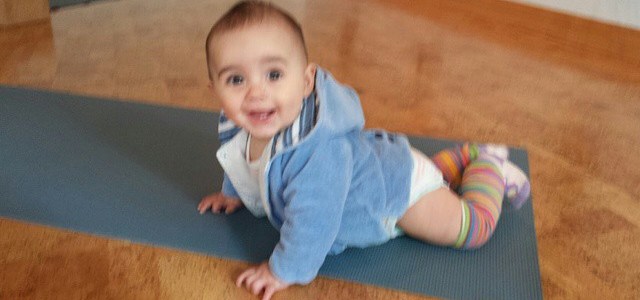
Cozette Blazak turned 7 months yesterday. You know what that means – She’s a crawling Kingsnake! Suddenly my house is a danger zone of death traps. Even the bed is now the cliff Thelma & Louise shot over.

Her mobility started a few months ago with rolling. The first time she figured out how to roll over we were over the moon. What a landmark! It also reduces the chances the baby will die of SIDS, so that’s good. The flip of that is now she wants to roll over every time you want to change her damn diaper. Suddenly our sedentary newborn was on the move, rolling all over the floor like the meatball that rolled off the spaghetti.

Watching her roll around the nursery floor became a new pastime for us. You could see her bright mind enjoying the mobility as she explored her environment. We’d watch her problem-solve when she’d roll under the crib. That’s when she figured out how to back up. She’d scoot herself backwards all over the place. But forward movement remained elusive.

maxresdefault

But then a funny thing happened. Cozy discovered the laws of physics. If she could get herself up to her knees, she could rock back and forth and she could use gravity to launch herself forward a few inches. It looked painful but she was thrilled to move in the same direction she was looking. Then it was just a hop, skip and jump to the army crawl and the standard baby crawl. It was like that scene from Santa Claus Is Coming To Town. “Put one foot in front of the other and soon you’ll be walking out the door.”

The big breakthrough came when we put a flashlight on the floor about five feet in front of her and she made a B-line for it. “Go toward the light!” we shouted. Maybe she was having a birth memory. When people “die” on the operating table and report being in a tunnel headed to a bright light, I’m like yeah, you’ve been there before. It’s called a “vagina.” Cozy knew it. Get born, keep warm.

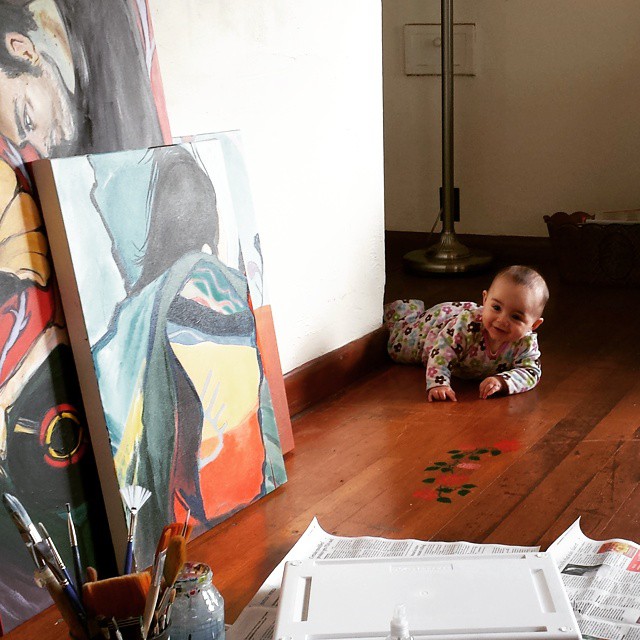
Of course now the thrill has turned to terror. Where’s the baby? Under the bed. Suddenly, I realize how un-baby-proofed this house is. The hard wood floors that seemed so cool, the vintage door frames, the stack of sneakers with their laces so inviting. Everything is something to bang your head on or to choke on. The rooms I didn’t take the crappy old carpet out of when I bought this house are now safe (safer) zones.

The bed is the scary one. Your bed is supposed to be the place where you feel most safe. Now that Andrea is not working, we can sleep in on weekdays. Awesome, right? Well, we co-sleep with Cozy. She likes to sleep in, too. But once she wakes up, she’s on the move, headed for the edge of the bed like it’s Niagara Falls. Maybe it’s time to sleep on a futon. That’s what unemployed artists sleep on, right? You can’t fall far off of a futon.

When Cozy was a new baby, I was anxious for her to do something other than coo and be beautiful. Friends said, “Enjoy this phase when she’s stuck where you put her.” I get it now. She just crawled across the bedroom floor and opened my wife’s bureau drawer, looked back at me and smiled. “Look what I can now, fucker.” Oh, I’m starting to long for swaddled baby who was right where you left her. A lawyer friend just emailed me, “Get ready to give chase on the drop of a dime from here on out.” Lord.

The great part of this is I can see how her mobility helps her cognitive development. The down side is she is now crawling out the bedroom door, toward the hardwood floor and mom in the kitchen. The Beatles’ “She’s Leaving Home” is playing in my head.

1742308_749161755190868_1464501061_n

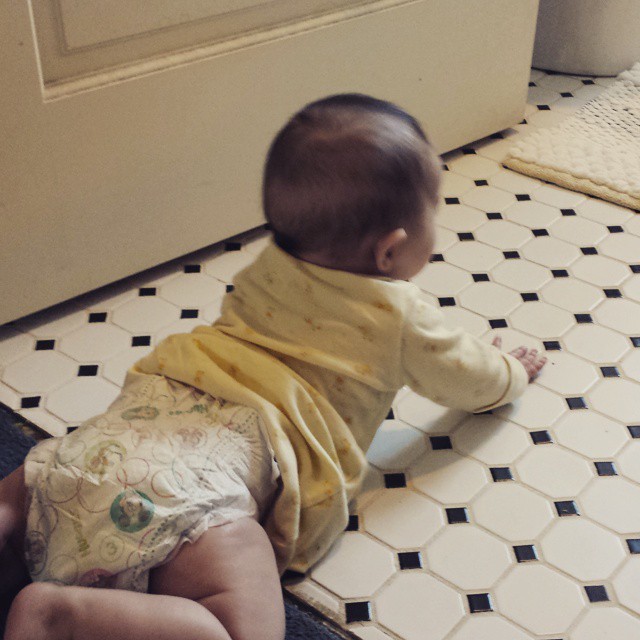
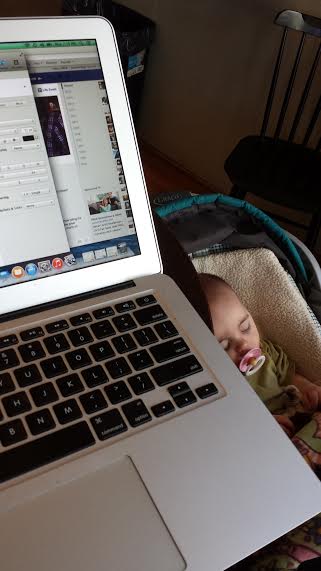
I’ll bring her back in in a second, like a turtle being placed back at the starting line of a turtle race. I can always lure her back by placing the laptop on the floor with her picture on it. Narcissism knows no age. But at the moment she is in the bathroom, feeling how the tile floor is different from the carpet. I hope this little rugrat doesn’t disappear down the laundry chute.

She’s leaving home, bye, bye.

Dad, the Provider – A request for a kick start

March 16, 2015

Whenever I lecture about traditional gender roles, I mention how, in our culture, man is supposed to be the provider. (Whenever you discuss gender roles, you should always specify which culture you’re talking about.) And women are supposed to be the provided for. Obviously that has changed a lot in the past 40 years. More women are working now than men – a weird nexus between feminism and Reaganomics.

So when I left my job at Portland State in January, I also left my role as the provider of my family. Sociologically, I’m fine with that. But as a socialized being (this is the intellectual vs. the emotional trip), it’s been very hard. The uncertainty of my family’s future is something I’ve worked my whole life to avoid. And here it is.

My parents divorced when I was 17. I know a part of it was my mom started making more money than my dad and I think he felt it undermined his position in the house. We all suffered because of that version of masculinity. I think I’d be fine if my wife was bringing home mad stacks of (vegan) bacon. I rather enjoy planning dinner for her. But the sad reality is that she just lost her job on Friday. (Hey, I thought the economy was getting better!)

So my work as a writer is even more important now. It’s not just a luxury to write. I’m writing for our future. I know there are bloggers who make a living on their wonderful blogs. I don’t think Watching the Wheels is there yet. But I’m hoping the fiction writing is the ticket. As I mentioned in an earlier blog post, my first novel, The Mission of the Sacred Heart, did pretty well for a self-published book and has been optioned for a screenplay (and might actually generate some income down the road).

unnamed-1

My fabulous wife had the idea of starting a Kickstarter campaign to fund the new book. We picked $10,000 as a goal to pay for some of the cost, the rewards for funders (and the 8% of fees that gets taken out). It won’t pay the mortgage for a year, but it will give us a few months. Very quickly, friends started chipping in. $40 here, $100 there. We’re already over the 10% mark but these things go into a slump after the kickoff, which scares the hell out of me.

So I’m putting this project out there into the Dad blogosphere to help fund the book and the family. There are some great rewards for pledges, but if you can’t chip in $10 for a really cool book project, I’d appreciate if you can pass it around to your network. And if you ever loved Cheap Trick’s Dream Police album, this thing is made for you.

My wife and I are a total team on this project. She’s really helped make it happen. We are both trying to be providers. The next chapter is starting. Thanks!

Here’s the link: PORTLAND WRITER DREAMS OF DREAM POLICE

My first novel is available at Powell’s Books. You can just click the cover.

Babies are on acid.

March 12, 2015

The baby brain must be an amazing place. Everything is a new sensation and nothing really connects yet. Door? What is this concept? There’s just a magic portal to another dimension. Light? Sometimes I can just see more stuff. Someone controls that? WTF.

They are learning at such a fast rate. We should be envious of how quickly they can put shit together. Cozy just figured out waving. Every parent of a little bean knows that every day it’s some new discovery. I’m still waiting for “Dada,” but until then I’ll settle for the raspberries she blows when she sees me.

At the moment it’s clear that babies are on drugs. It’s gotta a be like Alice In Wonderland times a thousand, with all these new images, sounds, tastes, and feelings. We gave Cozy a taste of Nutella the other day and her eyes about popped out of her head like she just hit a Whip-It.

Neuroscientists don’t believe babies dream. They spend half their sleeping time in REM sleep but don’t have enough experience to fill all that time with dreams, so it’s used to build the brain pathways. That could imply the waking state is more like a dream to them and you know how weird your dreams can get.

What Do Babies Dream About?

I’ve watched Cozy stare at her hand for 10 minutes straight like it was a season finale of House of Cards. I did that on my one big acid experience and my hand turned into a paw, and then a fish fin and then an amoeba. I de-evolved and realized I contained the DNA of the first living thing on earth and the alien life that thing came from. I can only wonder what my daughter was thinking.

One of the most misused words in American culture is “surreal.” It’s used by any dingbat who wants to say something was “awesome.” It’s like when people say, “My head literally exploded.” Wow. That must’ve hurt. Surrealism is an artistic movement that taps in the the subconscious to create dreamlike juxtapositions of images. Just think John Lennon in 1967. He was the walrus (or was it Paul?). That’s all to say that I think Cozy is the girl with kaleidoscope eyes. She must see so much. Our house is filled with art, so it must be an endless trip.

11005112_346191145574284_1991229504_n

I know when I was a little kid, living below the parent eye-level, I could stare at a crack in the wall and imagine that there was a whole world in there. I used to stare into the blue light on my parents hi-fi and see the rabbit hole to Wonderland. I’ve seen my daughter doing similar things and would love to have a peak into her perceptions. Right now she is staring at the bedroom ceiling like it’s a Cecile B. DeMille epic.

And what is she looking at? Sometimes I think she sees things that we can’t. I’ve caught her looking past my shoulder with great intent, like a scene from The Conjuring. This house is over a hundred years old, so it could be a ghost of God knows what, maybe an early Portland hipster. Hopefully she’s getting good fashion advice. “Oooo, Cozzzyyyy, never wear Crocssssss.”

It must be weird not to be able to communicate clearly with the people around you. I’ve been to countries where I didn’t speak the language and it also felt dreamlike. I was lost in Venice and the only Italian I knew was, “Dov’è la stazione?” Then people would just start babbling some gobbledygook. Goo goo ga joob. What is it like for a baby to want to say, “Dad, your beard is made of ants and I really need a dry diaper.”

There’s a lot lamenting the loss of child-like wonder as we get older. Instead of imagining what could be, we just ruminate on our own past. When we’re young, everything is ahead of us, all that potential. What do you want to be? Finally we get to a point where nothing is ahead of us and it’s all refection. What could I have been?

But a lot of that wonder is pure hallucination. I know that when I was 12, I saw Bigfoot on a camping trip in Colorado. Know it! When I was 7 and playing in the woods by myself (ah, those were the days), I knew there was a 300-foot tall bear that lived in those woods. Knew it! And when I was 3, I was convinced that cartoon characters would appear on my bedroom wall to entertain me. OK, that was 1967 so somebody might have spiked my juice.

I love that Cozy goes off to her own private Idaho on a regular basis. I want to be able to keep that part of her brain flowing while preparing her to handle some of harsh realities of the world. Can you be 1967 AND 1968? Life is but a dream.