The James Bond Project #19: GoldenEye (1995)

April 15, 2025

This series is intended to evaluate each product of the James Bond film franchise through a feminist lens, and the relevance of the Bond archetype to shifting ideas of masculinity in the 2020s.

GoldenEye (1995, directed by Martin Campbell)

The first Bond film in the fourth decade of the 007 franchise is something of a synthesis of all the previous EON Production films and a fair send-off for EON producer Cubby Broccoli, who died five months after its release. After a long six year gap, while Eon dragged Timothy Dalton into development hell, Bond was back with Pierce Brosnan as the new British MI-6 commander. GoldenEye fused License to Kill’s vengeful 007 with the smarmy, Casanova Bond of the past. The first Bond film not to be based on an Ian Fleming story is a sweeping tale that presents Bond with his first post-Cold War conflict and was tailor-made for 90s audiences who were getting used to the widescreen violence in films like Natural Born Killers.

Brosnan, who had been offered the role before Dalton, comes in a more upper crust English, but also more boyish, Bond who has parachuted into a third-wave feminist world. This disconnect is magnified by the new M, now played by Dame Judi Dench. The new M states a clear opinion on the archetype that is Bond, James Bond. “I think you’re a sexist, misogynist dinosaur, a relic of the Cold War, whose boyish charms are wasted on me,” she tells him. Welcome to the 90s, James. We still have Desmond Llewelyn as Q to link us to the Bond cannon. This installment’s Bond “girl” is Swedish model and actress Izabella Scorupco, who forces a rough Russian accent. Also trying to be Russian (or Georgian) is “sadistic lust murderer” Xenia Onatopp (There’s the names we love in these films), played by Famke Janssen (soon to be Jean Grey in the X-Men films).

GoldenEye starts with a flashback to the Cold War days with 007 and 006 on a mission in the Soviet Union where 006 (played by the great Sean Bean) is killed. Bond blames himself, setting up the revenge redux. After an epic scene where James dives into a falling plane (This is the first Bond film to use CGI), we flash forward to the present where new Russia is losing track of its shit and we’re off. The scene where James is chasing the rogue Russian general through the streets in St. Petersburg in a giant Russian tank was classic 007 thrills on the big screen. I remember watching it in the Lloyd Center Cinema and thinking it was the wildest thing filmmakers could cock up for a James Bond movie.

This installment gives us plenty of Bond staples fans crave. There’s Bond in a tux, playing baccarat, there’s Bond in the Caribbean, there’s the double entendre quips (none very clever), and thousands of bullets fired at our James with nary a scratch. The film also features some epic stunts, including a record setting bungee jump off a Russian (actually Swiss) dam that has to be seen to believed. Brosnan plays Bond closer to Moore than Connery and his bourgeois demeanor adds to the “Man out of place” element that makes this film kinda fun. Cubby Broccoli’s daughter, Barbara, took over the production as her father’s health failed, so some of the gender commentary may have been here doing.

Let’s see how GoldenEye fares in our feminist matrix.
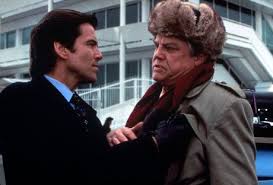
Driver of Action – New Bond, new star. Q and his lab techs show up for comedic effect. There’s a new CIA agent, Jack Wade, to help out (Joe Don Baker is back!) because Felix is still legless from the shark. The new post-communist Russia really plays the support role. In the gap between Yeltsin and Putin, it presented a blank slate to the world, where the need for secret agents might be a thing of the past. But this film rests purely on the shoulders of Remington Steele star Pierce Brosnan.

Role of Violence – There’s a lot of slaughter in GoldenEye, largely due to Bond’s use of machine guns. I had to ask ChatGBT the body count because I lost track. AI reports James killed 47 people in the film, mostly Russian soldiers. (Wasn’t the Cold War over?) There’s also some weird violent sexual scenes with Xenia Onatopp (we’re to believe that violence is her kink) and a scene where 007 knocks her unconscious.

Vulnerability – For the first time in a Bond film, we learn that James’ parents were killed in a mountain climbing accident when he was a boy. But there’s no sense that this plays a role in his present psyche. It’s just presented as a factoid to contrast the story that 006’s parents were killed by Stalin.  There’s no James in love and only a mild sense of guilt that 006’s death might be his fault.

Sexual Potency – Here’s the James Bond rule of three. 1) Caroline – An MI-6 psychologist, sent to evaluate James, gets seduced by our agent who has a bottle of bubbly in the glovebox. He’s going to let her give him, “a very thorough evaluation.” Wink. 2) Xenia Onatopp – It’s more fighting than sex. James is taken aback by her biting his lip and drawing blood. Her death (pulled into a tree by a helicopter) is also played as sexual but in 2025 seems just weird. 3) Natalya Simonova (played by Izabella Scorupco), a Russian computer programmer, is Bond’s “love” interest/damsel in distress in the film. He forcibly kisses her and then suddenly they’re a romantic couple. (This quasi-rape trope seems all too common in 007 flicks.)
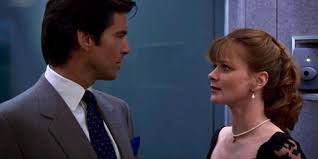
It should be mentioned that Bond’s relationship with Moneypenny (now played by Samantha Bond) is firmly located in 90s feminist positions. She’s not having any of James’ “charm” offensive. Bond: “What would I do without you?” Moneypenny : “As far as I can remember James, you’ve never had me.” Bond: “Hope springs eternal.” Moneypenny: “This sort of behavior could qualify as sexual harassment.” Finally.
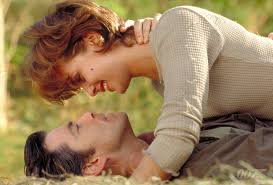
Connection – Brosnan plays Bond detached, as we have come to expect. There’s a hint of a back story between 006 and 007 that might have been nice to know about. As is expected, he and Natalya end the film together, not in a boat but in a Cuban meadow. They think they’re alone, but there is some coitus interruptus from the United States Marines, so they’ll have to save their victory sex for another day, or never. There’s no real chemistry between these two so the door is open for Bond’s next “girl.”

Toxic Masculinity Scale: 5

Summary The opening title sequence of GoldenEye, with women smashing hammers and sickles to a song written by U2 (and sung by Tina Turner) locates the film in a new era. The Cold War was the golden era of the Flemming novels and the platform for Bond’s good vs. evil adventures. Now New Bond is forced (again?) to find his relevance. Is he a 90s-action hero, right up there with Arnold Schwarzenegger, or a washed-up antique who has lost his cultural relevance? His elevated violence and philandering may be intended as a middle finger to the politically correct shifts in cinema.
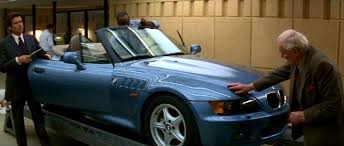
The tech in GoldenEye is a co-star along with lots of product placement. (Welcome to the new global market place.) IBM is featured front and center (and a great scene where a young Alan Cumming gets an “email”). The Aston Martin is replaced with a BMW, fully loaded with Q’s gadgets. “You have a license to kill, not to break the traffic laws,” Q tells an impish Bond. GoldenEye also gives us that most central staple of Bond Baddie accessories, the underground lair, hidden below a lake, from where a deadly satellite is controlled. Its explosive destruction is everything that Bond fans buy movie tickets to see.

GoldenEye premiered on November 13, 1995 at Radio City Music Hall, as the war in Yugoslavia, the largest hot war resulting from the end of the Cold War, was reaching its peak. The direction of Martin Campbell and the production of Barbara Broccoli (with Judi Dench’s M) represented a chance to reboot the franchise in a world without the Soviet Union. What issues would MI-6 confront as the 20th century closed? With the help of CGI, the promise of epic stunts and a horny agents would be a part of it.

Next: Tomorrow Never Dies (1997)

The James Bond Project #18: License to Kill (1989)

The James Bond Project #17: The Living Daylights (1987)

The James Bond Project #16: A View to a Kill (1985)

The James Bond Project #15: Never Say Never Again (1983)

The James Bond Project #14: Octopussy (1983)

The James Bond Project #13: For Your Eyes Only (1981)

The James Bond Project #12: Moonraker (1979)

The James Bond Project #11: The Spy Who Loved Me (1977)

The James Bond Project #10: The Man with the Golden Gun (1974)

The James Bond Project #9: Live and Let Die (1973)

The James Bond Project #8: Diamonds are Forever (1971)

The James Bond Project #7: On Her Majesty’s Secret Service (1969)

The James Bond Project #6: You Only Live Twice (1967)

The James Bond Project #5: Casino Royale (1967)

The James Bond Project #4: Thunderball (1965)

The James Bond Project #3: Goldfinger (1964)

The James Bond Project #2: From Russia With Love (1963)

The James Bond Project: #1: Dr. No (1962)

I stand with the women who march: Anatomy of a backlash

January 18, 2017

Politics would make a great spectator sport. How many years did Donald Trump question President Obama’s legitimacy, spreading the cockamamie lie that he wasn’t born in America? One soft-spoken Congress member from Georgia questions Trump’s legitimacy and Baby Hands has a full scale meltdown. It’s entertaining! But it’s not funny. It’s real. And people know this and they’re getting involved. And I don’t mean on Twitter.

womensmarch

Instead of focusing on the circus of Inauguration Day (No wonder Ringling Brothers is calling it quits. Who can compete!), my focus is on the day after and the Women’s March on Washington. Trump may have secured Pat Boone to sing at his event (Glad to know Pat’s still alive!), but the real star power will be in the streets with an estimated 200,000 marchers in DC. Julianne Moore, Jessica Chastain, and Chelsea Handler will be there and a lot of other women who Baby Hands will surely tweet about. (“She’s totally overrated. A real dog.”) And an estimated million people will join sister marches around the country, including here in Portland. You should see my wife and daughter there.

Unlike a lot of “pop culture feminism,” the march promises to be truly intersectional. I’ve written about intersectionality in this blog. Let’s just say, for now, that feminism doesn’t just belong to middle-class white females with degrees in Women’s Studies. The organizers of the march have made a point of making it open to all identities who see the new oppression of sexually harassing politicians as a growing problem and the liberationist positions of feminism as the solution. Their four-page statement says upfront, “Our liberation is bound in each other’s.” So expect to see bell hooks marching alongside Katy Perry and Malala Yousafzai next to Scarlett Johansson. Trump may have 3 Doors Down, but they’ve got Solange. You can read the full statement here:

Guiding Vision and Definition of Principles

9780385425070

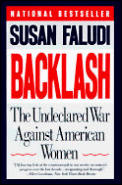
I wanted to locate this march historically and sociologically, because this isn’t just about a president who brags about sexually assaulting women. The election of Donald Trump represents a significant backlash against the empowerment and true equality of women and girls. Susan Faludi popularized the concept in her award-winning 1991 book, Backlash: The Undeclared War Against American Women. The text was a crucial theoretical component of my doctoral dissertation on the rise of racist skinheads and I just pray she is working on a 2017 edition.

So here’s the mini-version of her thesis. Faludi argues, with convincing evidence, that each time women make collective gains of empowerment there is a corresponding backlash that tries to push them back into their second class role. She lays out three historical periods in the twentieth century.

suffraget

First was the women’s suffrage movement and what has become known as first wave feminism. Among the gains made were things like access to birth control and, in 1920, the right to vote. This political empowerment was met in the 1920s with the double backlash of the flapper and the housewife. One was cute and ditzy, like cartoon Betty Boop, the other was obsessed with care for the home, the children, and a new invention, fashion magazines.  The message was clear, women don’t politically organize, they have fun or wash their hair before hubby gets home.

ww2dame

The second wave was about women’s economic empowerment during World War II. As men were off at war, many women were in factories and shipyards, building the weapons of war. Their symbol was Rosie the Riveter. The federal government funded daycare. Theaters were showing films starring Betty Davis, Lauren Bacall on other dames who didn’t take any guff from men. And women had their own money with no men telling them how to spend it. When the war ended in 1945 and the men came home, it was time for women to leave the tank factory and go back to the kitchen. Betty Davis was replaced with Marilyn Monroe and the 1950s became the glamor era when women were meant to be seen and not heard. Backlash #2.

Women's Liberation Parade

The second wave feminist movement socially empowered women in the 1960s and 1970s. Betty Friedan’s book 1963 book, The Feminine Mystique, and her National Organization of Women brought women into the streets on a range of issues, including workplace harassment, pornography, and abortion rights. “Women’s Lib” became a part of the counterculture of the baby boom generation and every aspect of culture was inspected through  feminist lens (although it was typically a white feminist lens). The great attack on patriarchy was met with the third backlash in the 1980s, Ronald Reagan and the ultimate weapon – THE SUPERMODEL. More than ever women were bombarded with the message that they were their looks and would only lose power as they aged instead of gaining it.

It has been argued that Faludi helped launch third wave feminism in the 1990s. Third wave is more intersectional and not afraid to take on micro-aggressions along with macro power structures. But Faludi’s model would predict that the turn of century wave of personal empowerment for women (including transwomen, lipstick lesbians, Muslim feminists, and a bunch of other cool categories) would be met with yet another backlash. Who would have guessed that this backlash would have come in the form of a TV gameshow host with a fake tan, fake hair, and a wall of fake news stories.

grab

The new War on Women began before the Trump candidacy. But the fact that the first female major party candidate for president was defeated by a guy who runs beauty pageants and brags about never having heard his latest wife fart was the tipping point. More disturbing than Trump’s “grab ‘em by the pussy” comments were his flock, chanting “Trump the bitch” at his rallies. It was like an army of anti-feminists had suddenly been released from the gates of hell. And now their fake “Good ol boy” (Lordy) and his porn-model wife are moving into the people’s house. Don’t expect much support for women’s issues for the next four years. They’re already going after Planned Parenthood.

My cousin, Chamisa Kellogg, is in DC for the march. She’s an incredible artist who has created the piece below to commemorate this moment in history. She just sent me this message – “The ‘Pussy Grabs Back’ drawing was based on a photo I took at a protest in Portland, Oregon two days after the 2016 Presidential Election. As the Million Women’s March 2017 draws near, I find myself reiterating my goals and beliefs in gender equality, and the importance of affordable healthcare for all, including women (who may sometimes need abortions). I’m selling high-quality archival prints of this drawing on my etsy shop, and all profits from sales will go to Planned Parenthood.”

You can purchase a print at THIS LINK.

pussy-riot

So women will be marching in 2017 just like they marched in 1917. But the beautiful thing about Faludi’s model is the backlash never pushes women all the way back to where they were. Once women have tasted political, economic, social, and personal empowerment, that genie doesn’t go back into the bottle. It may be one step backwards, but there were two steps forward first. Donald Trump may want to make America great “again,” back to a time when women were more like Melania, seen and not “being a bitch,” counting calories and not wage gap data, but he’s looking at more than one march coming his way. The future is female.

See you in the streets.

future

Feminist Herstory Part 6 – Revolution Grrrl Style Now!

September 22, 2015 (Happy birthday, Joan Jett!)

We’re back for the occasional history of feminist theory. Earlier posts are here:

Feminist Herstory Pt. 1 – It is discovered that Women are PEOPLE!!!

Feminist Herstory Pt. 2 – Here comes the FIRST WAVE

Feminist Herstory Pt. 3 – Let’s Judge Ourselves as People

Feminist Herstory Pt. 4 – The Swingin’ Second Wave arrives

Feminist Herstory Pt. 5 – Hey, Soul Sister

Sexual_Personae__Camille_Paglia

In the early 1990s, it was clear there was something going on with feminism. As the second wave became an established voice in academia and the media, things begin to change. There was a wave of books finding a new audience of young women and men, like Naomi Wolf’s The Beauty Myth (1991), Susan Faludi’s Backlash: The Undeclared War Against American Women (1991), and Camile Paglia’s Sexual Personae: Art and Decadence from Nefertiti to Emily Dickinson (1990). No one could figure out if Paglia, for example, was a feminist or an anti-feminist. She wrote about patriarchy and sexuality in a way that pissed-off established feminists, like Germaine Greer (but got her on a lot of talk shows). Was this a new kind of feminist voice?

At the time I was teaching my signature class at Emory University called The Sociology of Youth Subcultures (which I continued to teach at Portland State). I had a young graduate student named Lauraine LeBlanc in the class. Lauraine was a Canadian with a Mohawk and deeply involved in the punk subculture. A big part of the class was the exploration of link between music and youth and I made the students several compilation tapes, mixing everything from Minor Threat to the Sugarhill Gang (and violating countless copyright laws). Lauraine told me about a new scene coming out of Olympia, Washington called Riot Grrrl.

Born at Evergreen State College, the Riot Grrrrl movement built on the failed promise of punk rock. In the 1970s, punk emerged as an androgynous subculture that rejected the beauty myth and the macho bullshit of mainstream hard rock (with Alice Cooper hacking up female mannequins and all). In 70s punk, females had a place on the stage or in front of it. But by the 1980s, punk had devolved into “hard core” and females bands faded out and females being groped in the pit at Corrosion of Conformity shows faded in.

every-girl-is-a-riot-girl

So the radical kids at Evergreeen and in other scenes across the country began to create pro-women punk rock. There was an explosion of bands like Bikini Kill, Heavens to Betsy, and Bratmobile. What the bands lacked in musical chops, they made up in passion. Most bands had only female members and the songs were about things like rape victimization and menstruation, stuff you were not going to hear Ozzy Osbourne singing about (although allied male groups, like Nirvana did take up the banner).  They drew on influences like Patti Smith, Joan Jett and Yoko Ono and even the Black Panther Party for Self Defense. It was so exciting that something new was happening in music and it was coming from young women who were sick of being told that if they wanted to be in band, they had to be the sexy lead singer.

I got a first hand lesson in Riot Grrrl ethics when I went to see the band 7 Year Bitch in Portland in May 1996. I will always be the guy who wants to get as close to the band as possible. I was a huge fan of 7 Year Bitch. The four women from Seattle rocked full on, so I pushed my way to the front of the stage at EJ’s, the tiny punk club on Sandy Boulevard. Within seconds a young woman said, “Hey man, you guys always have the space in front of the stage. How about tonight letting us have it?” I got it. I’m a tall view-blocking guy and guys who look like me often want to get rough in the mosh pit. Female fans usually get pushed farther and farther away from the action. I got how much that must suck for a young woman who just wants to rock. I smiled and watched the show from bar. Man, those riot grrrls were in heaven.

riotequalsnotquiet

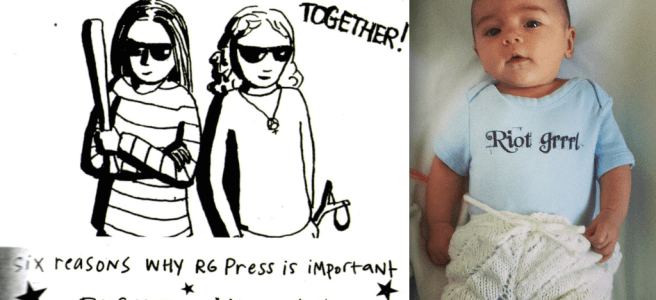
Lauraine brought me tapes, CDs, and lists of bands I needed to seek out. She also supplied me with zines, homemade magazines, made by young, pre-internet, women who didn’t want to be told by Cosmopolitan or Glamour how to do gender. They re-appropriated the dismissive term, “girl,” as the angry “grrrl” and wrote it across their chests. Boys who didn’t get it could fuck off. I learned a lot from Lauraine LeBlanc that semester, including how to think about gay and lesbian subcultures. Lauraine ended up turning her interest in the voices of young women in punk into her doctoral dissertation and one of the best books ever written about gender and youth culture, Pretty in Punk: Girl’s Resistance in a Boys’ Subculture (1999). It is required reading in my Subcultures class.

51BzH1yAaoL._SY344_BO1,204,203,200_

The Riot Grrrl scene was part of a larger trend that became known as Third Wave Feminism. The Third Wave took a cue from black feminists, like bell hooks, and rejected the monolithic voice of mainstream feminism. There wasn’t one feminist position, there were millions. And the voice was local. Like postmodernists, who love to deconstruct all things social, third wavers deconstructed what it meant to be a feminist. Supposedly, wearing lipstick and a short skirt made you a sex object and potential rape victim. Third wavers asked why can’t you be a feminist AND dress how you like? Can’t you be for the eradication of sexism and enjoy silly pop culture?

sepia

So it’s not surprising that by the late 1990s, “grrrl power” had morphed into the girl power tag associated the Spice Girls (more on them next chapter). Any female in music was being called a riot grrrl, including Madonna and Gwen Stefani. But any girl power is a good thing, right? But the ethics of the subculture survived its diffusion into the mainstream, with institutions like the Rock and Roll Camp for Girls, based here in Portland, Slut Walks, and the continuation of much-revered band, Sleater-Kinney. Sara Marcus’ 2010 book, Girls to the Front The True Story of the Riot Grrrl Revolution, is now required music history reading. The 2013 film, Punk Singer, about Bikini Kill’s Kathleen Hanna has brought the message to a whole new generation of girls who weren’t even alive in the 1990s.

We’ll discuss next about how Third Wave Feminism is about a lot more than a punk rock position statement, but the call of the wild attracted a lot of kids (and a few older sociologists) with the battle cry, “Revolution, grrrl-style now!”

1928699_78649639306_2160086_n

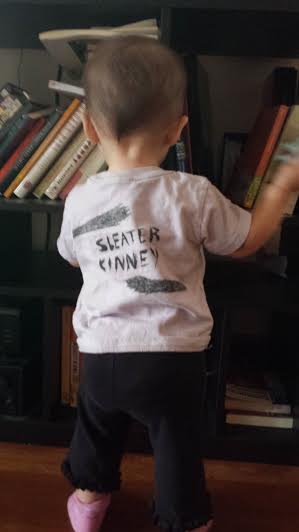
I got to see one of the first Sleater-Kinney shows in 1995 and Andrea recently went to their reunion show here in Portland and got a T-shirt for our daughter Cozy. Cozy will grow up with this music in her house and be her own rebel girl. I’m glad I live in a time with people like Kathleen Hanna and Carrie Brownstein, of Sleater-Kinney (and Portlandia) and all the other strong young women who rocking out on their own terms. Sisters are doing it for themselves, and it sounds damn good.

unnamed

The following books mentioned in this post are available at Powell’s by clicking on the covers below.