The James Bond Project #7: On Her Majesty’s Secret Service (1969)

January 19, 2025

This series is intended to evaluate each product of the James Bond film franchise through a feminist lens, and the relevance of the Bond archetype to shifting ideas of masculinity in the 2020s.

On Her Majesty’s Secret Service (1969, directed by Peter Hunt)

James Bond got married! Eon Productions had to scramble to find a new Bond after Sean Connery quit during the making of You Only Live Twice. Potential 007s included future Bond Timothy Dalton (too young) and Superman bad guy Terrence Stamp (too creepy?). Producer Albert Broccoli and first time director Peter Hunt settled on Australian model George Lazenby after seeing him in a chocolate bar commercial. Lazenby looked like a slightly younger Connery, but lacked the acting chops. He was offered a contract for seven Bond films but agreed to do only one, believing the 007 franchise would become passé in the 1970s. 

On Her Majesty’s Secret Service was the first Bond novel authored by Ian Fleming after his spy became a big screen feature and was written to leave out the heavy reliance on gadgets Hollywood Bond relied on. The primary Bond girl was Countess Tracy di Vincenzo, played by Diana Rigg. From 1965 to 1968, Rigg played Emma Peel on the popular British spy TV show, The Avengers. (Rigg joined The Avengers to replace Honor Blackman, who had left to play Pussy Galore in Goldfinger.) Emma Peel was often considered the “female James Bond,” so bringing Rigg in may have been meant to offer a new role for the Bond “girl” at the end of the decade.

The film was premiered in the United States on December 19, 1969 while the country was consumed with the details surrounding the Charles Manson murders. By January, it topped the box office on both sides of the Atlantic but received mixed reviews for veering from the blockbuster Bond formula. Overtime, the film has gained respect for remaining closer to the Fleming novel than other screen adaptations, and that was Hunt’s intent. The script even comments on previous Bond films, such as the opening scene were Lazenby’s Bond rescues Rigg from the ocean and fights some random henchmen. Lazenby breaks the fourth wall and says to the camera, “This never happened to the other fellow.” Or when Bond resigns from MI-6 and looks at some of his gadgets from previous films with a smirk of disdain while they remain in his shabby office desk.

We do get tried and true Bond tropes, including an underground lair filled with henchmen, Bond at the Baccarat table, his appetite of Beluga caviar and Dom Perignon, flirting with Moneypenny, and Blofeld (this time played by American Telly Savalas). But in one way, this is a very different Bond film, one that ends with a Mrs. James Bond.

Let’s plug it in to our feminist matrix and see where we come out.

Driver of Action – We are in full solo Bond mode in OHMSS. We have no “team” helping drive the story. (Q only makes a brief appearance at the end of the film.) There is an MI-6 agent, apparently named Shaun, who keeps an eye on James, from a distance, in Portugal and Switzerland but is killed off pretty early. And there’s Draco, the head of a Portuguese crime syndicate, who helps Bond take down Blofeld at the end of the film. But it’s pretty much just James, including when he goes rogue from MI-6 after being taken off the Blofeld case by M. We do see Blofeld (as a prequel to Kojak) leading more of the action, including slapping on a pair of skis to race down the Alps to catch Bond. There’s also a killer bobsled race between Bond and Blofeld. And, sadly, Blofeld’s cat only appears briefly.

Role of Violence – Lazenby’s Bond seemed a little more skilled in fake martial arts skills than Connery. There’s more chops and flips but the body count is reserved for the the end of the film (although, early in the film, he slaps Rigg’s character pretty hard). He sends a few henchmen on skis to their deaths as they plunge off a cliff and during the climatic assault on Blofeld’s mountaintop lair, he machine guns a bunch of henchmen and a scientist who throws a bottle of acid at him. This Bond punched harder, but used his gun a lot less. Does that make him less manly or more?

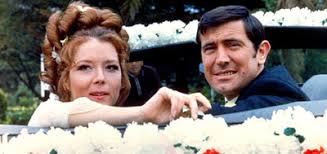
Vulnerability – OK, this is the big one. The set up is that mob boss Darco wants Bond to marry his troubled daughter, Tracy (AKA TV bad ass Emma Peel). Darco says, “What she needs is a man to dominate her” (puke) and offers James a million pounds in gold as a dowery. Bond says he doesn’t need the money and says, “I have a bachelor’s taste for freedom.” But something strange happens. It seems like Bond is falling in love with Tracy. There’s even a very 1969 montage of James and Tracy doing “falling in love” stuff, like walking on the beach and window shopping for rings, set to an original song written by Burt Bacharach and Hal David called “We Have All the Time in the World,” sung my Louis Armstrong! Is this a chick flick? Maybe it’s all part of a ruse to get Darco’s help going after Blofeld.

Nope. After Tracy rescues Bond in a Swiss town and escapes more henchmen in one of the craziest chase scenes on film, Tracy and James end up hiding in the hayloft of a barn. Instead of making his usual sex moves (like he did several times earlier in the film), he tells her, “I’m thinking about us. I love you. Will you marry me?” (I’ll take “Things I’d Never Expect to Hear in a James Bond Film” for $200, Alex.) She agrees to be “Mrs. James Bond” and we have a very different 007 flick. Instead of sealing the deal, James decides they should sleep separately. “The proper time for this is our wedding night. That’s my New Year’s resolution,” he says. “Whatever you say, my dear,” says Tracy. “And that is yours,” James quips. OK, maybe not that different.

The last Bond film of the 1960s ends like the dozens of Elvis Presley films of the 1960s, with a wedding. The proficient bedder of endless women is now wedded in holy matrimony, with M (and the rest of us) in shock that it happened and poor Miss Moneypenny in tears. But there is no happily ever after. A car driven by Blofeld pulls up next to the newlyweds and Irma Bunt, Blofeld’s henchwoman, fills Bond’s Aston Martin with machine gun fire. The final scene of On Her Majesty’s Secret Service is James Bond in tears, holding his dead wife.
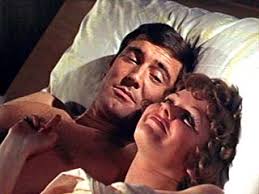
Sexual Potency – Before we forget, this is a James Bond film. When Tracy appears at the casino, the camera lingers on her cleavage. She ends up in Bond’s bed as a business transaction (he payed her gambling debt). The encounter is so transactional it creates doubt in the legitimacy of the “romance” that follows (enhanced by a scene at a bullfighting ring where Darco is trying to pass his daughter off to Bond.) When Bond gets into Blofeld’s lair, pretending to be a gay genealogist (don’t ask), he’s met with a dozen beautiful women (Blofeld’s “Angles of Death”) that he goes to work on, sleeping with two in one night while scheduling a third. “Work is piling up,” he snorts. He may be in love with Tracy, but Bond’s gotta Bond.

Connection – This Bond does seem to have some genuine affection for M and Moneypenny, even kissing Moneypenny on the lips. But, again, this is solo Bond in action. His connection to Tracy seems to become genuine when she rescues him from Blofeld’s henchmen, repeatedly kissing her on the cheek as she frantically drives her getaway car from their gunfire. In the end, he is alone again and viewers are told to get ready for the next chapter of our man Bond.

Toxic Masculinity Scale: 5

Summary Hunt and Lazenby’s Bond may be closer to Ian Fleming’s 007 than the formula viewers had had become used to, but there’s still plenty of sexism in OHMSS. The most obvious proponent of misogyny is Darco (played by Italian actor Gabriele Ferzetti). He just goes on and on telling Bond how his daughter needs to be manhandled and smiles at that fact that Bond got her in the sack. He even punches his daughter in the face, knocking her out, so she doesn’t try to rescue James in the gunfight. At the wedding he says to her, “Obey your husband in all things.” We also get get Bond ogling a Playboy magazine (and stealing the centerfold) and working his way through Blofeld’s scantily clad angels of death. “Just a slight stiffness coming on,” he says, sitting among them in his kilt.

Don’t expect Bond to be mourning his dead wife in the next installment, 1971’s Diamonds Are Forever. James will be back to his old tricks. But the final scene of On Her Majesty’s Secret Service gives a glimpse of a more human man than in all the previous 007 films, left to reconcile the cost of vulnerability when your job requires you to carry a license to kill.

Next: Diamonds Are Forever (1971)
The James Bond Project #6: You Only Live Twice (1967)

The James Bond Project #5: Casino Royale (1967)

The James Bond Project #4: Thunderball (1965)

The James Bond Project #3: Goldfinger (1964)

The James Bond Project #2: From Russia With Love (1963)

The James Bond Project: #1: Dr. No (1962)

The James Bond Project #6: You Only Live Twice (1967)

January 12, 2025

This series is intended to evaluate each product of the James Bond film franchise through a feminist lens, and the relevance of the Bond archetype to shifting ideas of masculinity in the 2020s.

You Only Live Twice (1967, directed by Lewis Gilbert)

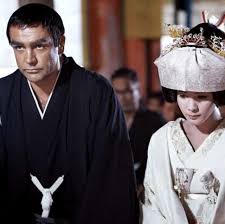
This might be the most Bondy Bond of all. Not only does it have the usual staples; underground lairs, evil global plots, white bikinis, and Blofeld’s pussy cat, but also a massive army of ninja warriors. I probably enjoyed it too much. Maybe it was the brilliant score by John Barry and dead volcanoes erupting. Maybe it’s because I watched it on a Saturday morning, hyped up on coffee and taking a break from the devastating news of the L.A. fires. Yeah, this was supposed to be Sean Connery’s last 007 film. The Scottish actor was worried he’d be forever typecast and announced that he’d be Bond no more before You Only Live Twice premiered. Maybe Connery’s weariness added to the “I could not give a damn” laconic attitude of 1967 Bond, making him that much more appealing to old school notions of rogue masculinity. It’s either Bond on auto-pilot or Bond fully realized. I can’t decide.

The screenplay for You Only Live Twice was written by acclaimed children’s book author Roald “Willie Wonka” Dahl. Dahl was a friend of Ian Flemming’s and (very) loosely adopted his novel for the screen. The original source paid mind to Japanese culture and Dahl retained the detailed Japanese wedding scene in the script. (Unlike other globe-hopping 007 films, the action here is primarily in Japan.) But Dahl had to create much of the plot himself. For example, producers told him Bond needed to make love to three women in the movie so he had to add two additional relationships in the screenplay.

The story is set in the 1960s space race between the US and USSR. We finally get to see Blofeld’s face and it’s great British actor Donald Pleasence. The British are trying to broker the peace between America and Russia as space capsules start disappearing from orbit. (Keep calm and don’t start World War 3.) They put Bond on the case who discovers that SPECTRE is helping an Asian country (presumably China) start a war between cold war adversaries so they can emerge from the ashes. (This plot seemed like it was as much 2025 as 1967. Because, you know, China.) After faking his own death, Bond ends up in Tokyo, after being shot out of a submarine torpedo tube without an air tank. (007 has very good lungs.) A welcomed sight is the large number of Japanese actors who were hired to make up a large percentage of the cast. Welcomed after the Hollywood tradition of making up white actors to look “Oriental.” (Breakfast at Tiffany’s, I’m looking at you.)

There are flushes of anti-Asian racism in You Only Live Twice. Connery’s first scene is in Hong Kong and Bond is in bed with an Asian woman. The first line of the film is, “Why do Chinese girls taste different from all other girls?” He then talks about how Peking duck is different from Russian caviar, but he loves them both. She replies, “Darling, I give you very best duck.” I laughed and I shouldn’t have. There’s a section where James has to be transformed into a Japanese villager that seems to mainly involve him putting on a Beatle wig. And so on. You Only Live Twice premiered in London on June 12 (with Queen Elizabeth in attendance), the same day the U.S. Supreme Court issued the Loving v. Virginia decision, legalizing interracial marriage, so maybe audiences were ready to see James in bed with non-white women. The film has plenty of that.

How doe Far East Bond fit in our analysis?

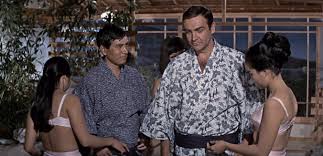
Driver of Action – After the ensemble romp of Casino Royale, we’re back to solo Bond. We don’t even get Felix Leiter on the scene. We do get Tiger Tanaka, head of the Japanese Secret Service (played by Tetsurō Tamba) to provide James with his ninja training and fix him up with his undercover Japanese wife, played by Mie Hama (who I remember from 1962’s King Kong vs. Godzilla). Tanaka also serves as something of a pimp for James. Taking Bond home, he says, ““Consider my house yours, including all of my possessions.” Then four young women in their underwear walk out. “In Japan, men always come first. Women come second,” he says as the women bathe Bond.

Role of Violence – 007 has a license to kill a ton of people in this movie. He shoots an assassin and then three or four dockworkers (while single-handedly fighting dozens), and countless henchmen in Blofeld’s under-volcano lair. There’s a SPECTRE agent who failed to kill Bond who Blofeld dumps in a pool of piranhas. (Bond also throws a henchman into the piranha pool.) The climatic battle between ninjas and henchmen probably has a body count above a hundred. There seems to be no remorse for anyone killed. It’s just entertainment.

Vulnerability – In the novel of You Only Live Twice, Bond’s mock Japanese bride is a woman named Kissy Susuki and the union produced a child. In the film she is not named. Before the wedding Bond asks Tiger Tanaka, “Is she pretty?” He replies, “She has a face like a pig,” and Bond grimaces. Of course she’s beautiful and later plays a role in James’ rescue. As has become rote, Connery’s Bond has zero moments of weakness, although the technology used is through the roof in this film. He needs his damn gadgets. Yet, Bond seems bulletproof. Literally. There are countless rounds fired at Bond, including from four attack helicopters and Jimmy doesn’t even suffer a scratch.

Sexual Potency – In 1967, I’m banking on the fact that part of the pitch of You Only Live Twice was that is was chocked full of “exotic” Asian women. From the first scene with Bond in bed with Aki (played by Akiko Wakabayashi)l, who throughout the film rescues 007 in her white sports car, to Tanaka’s House girls, there is plenty of “exotic” on display. (It’s worth noting that when Tanaka offers Bond one of his “girls” for Bond to take back to his room, Bond picks the one that’s most likely a white actress made up to look Japanese.) Then there’s Helga Brandt, a SPECTRE assassin who has James tied to chair and becomes sexual with him. (She’s a redhead. That’s what they do.) James talk her out of holding him and then uses her knife to cut the straps on her dress. “Oh, the things I do for England,” he mutters. (She later tries to again kill him by jumping out of the plane she’s flying.) James also tries to get busy with his mock wife, but she pushes him away and he then pushes away a plate of raw oysters. “Well, I won’t need these,” he says. Is JB suffering from ED?

Connection – Bond’s connection to his co-workers is minimal. M and Q make brief appearances. Q arrives in Tokyo to bring a cool mini-helicopter with heat seeking missiles! Even Bond’s usually flirtatious relationship with Moneypenny seems to have cooled off. He doesn’t even sexually harass her. When Aki, who saved Bond’s bacon more than once, is poisoned in bed next to him, he seems nonplussed. Connery’s weariness by the fifth film is reflected in Bond’s lack of effort with the women in the film and also in a stanza from the theme song, sung by Nancy Sinatra: “You drift through the years and life seems tame ‘til one dream appears and Love is its name.” As must now be required, the film ends with Bond and his mock wife (Kissy Suzuki is definitely a “Bond girl”) in a boat, another rescue raft in another sea. ”Now about that honeymoon,” he says to her. Then viewers are told that On Her Majesty’s Secret Service is on its way (along with the next batch of Bond girls).

Toxic Masculinity Score: 7

Summary It was Ian Fleming’s intent that readers of You Only Live Twice learn more about Japanese culture. When the book came out in 1964, we were only 19 years from the nuking of Japan and the end of WWII. Dahl devoted screen time to Sumo wrestling, the traditional wedding, and the rise of Japanese corporate power (there are a lot of Toyotas in this flick). But we also get nods to the Japanese version of patriarchy with Tiger Tanaka’s house girls as well as the standard English Bond jokes, like when Helga, referring to a warning about smoking, says, “Mr. Osato believes in a healthy chest” as her own chest fills the camera frame.

One wonders what You Only Live Twice would have been like if the James Bond-Kissy Suzuki marriage had been truer to the original novel. Instead we get tired James floating off be played by another actor, likely stepping into the well-established formula.

Next: On Her Majesty’s Secret Service (1969)

The James Bond Project #5: Casino Royale (1967)

The James Bond Project #4: Thunderball (1965)

The James Bond Project #3: Goldfinger (1964)
The James Bond Project #2: From Russia With Love (1963)

The James Bond Project: #1: Dr. No (1962)

The James Bond Project #5: Casino Royale (1967)

January 11, 2025

This series is intended to evaluate each product of the James Bond film franchise through a feminist lens, and the relevance of the Bond archetype to shifting ideas of masculinity in the 2020s.

Casino Royale (1967, directed by John Huston and others)

After four hugely successful Bond films, it’s time for the first Bond spoof. Casino Royale was the first of Ian Fleming’s Bond books (published in 1953). The John Huston directed film brings back many faces from the first four films from the the United Artists Bond canon, including Ursula Andress (who, as MI-6 agent Vesper Lynd, sounds way too much like Melania Trump). Casino Royale is a comedy meant to mock many of the Bond conventions, so it’s going to score differently than the films produced by Eon Productions, the home to “official” 007 movie franchise.

Here we get an older Bond, played by David Niven, who is 20 years retired after a sad end of a relationship with his beloved Mata Hari. He stutters and is known for his celibacy. This ain’t Sean Connery’s Bond. He’s brought back to MI-6 by M (played by Huston himself) to deal with evil SMERSH. (We don’t know what SMERSH stands for but there was a counter-intelligence group in the Soviet Union with the same name). M is comically killed so Bond takes the helm of MI-6, where he is reunited with Miss Moneypenny, or at least her daughter. (Strangely, Moneypenny now has an American accent, played by Barbara Bouchet, who was born in Nazi Germany.) He orders all the “Double O” agents to change their names to “James Bond” to confuse and trap SMERSH baccarat player Le Chiffre, played with gusto by Orson Welles. Two of those agents include Peter Sellers and a very young Woody Allen.

Casino Royale is a madcap farce that lampoons the cool image of 007. There’s even a yakety sax soundtrack during chase and fight scenes (some played by Herb Albert). The funny Bond quips are turned up to 11, jumping from wry to hilarious. (“James Bond doesn’t wear glasses.” Bond: “Yes, it’s just because I like to see who I’m shooting.”) The film is fully located in the mid-sixties. The first shot is graffiti that says, “Les Beatles.” The scene where the Peter Sellers’ Bond is drugged is straight psychedelia. And the movie introduces the Burt Bacharach song, “The Look of Love,” sung by Dusty Springfield (and sung by Bacharach himself in 1997’s Austin Powers: International Man of Mystery). The film was released in April 1967 and Sgt. Peppers Lonely Hearts Club Band was released shortly after setting up the iconic “Summer of Love.”

This may be an anti-Bond Bond film, piercing some of the tried and true tropes of the previous four films, but it’s worth dropping it into our feminist matrix if just for point of comparison.

Driver of Action – There are multiple drivers of the story here, including multiple Bonds. Sir James Bond (Niven) plays almost a support role. The majority of the story centers around Evelyn Tremble (Peter Sellers as a Bond surrogate) and Vesper Lynd (Andress). A section of the film follows Bond’s daughter with Mata Hari, Mata Bond (played by Joanna Pettet) in an adventure in Berlin (which features A Hard Day’s Night’s Anna Quayle and a hilarious scene where a hole is blown in the Berlin Wall and a wave of East Germans run out). This is an ensemble cast.

Role of Violence – It’s a Bond film so there a guns and explosions. But much of the violence is done for laughs, aided by a comedic soundtrack. But, other than an army of fembots with machine guns, there is no overt violence. I don’t think Niven’s or Seller’s Bonds kill anybody.

Vulnerability – The premise of this story is that Bond experienced heartbreak from his true love, Mata Hari, and looks for a connection to his daughter Mata Bond (who is abducted into a SMERSH flying saucer). He’s developed a stammer that he’s self-conscious of and his fighting style as become what might be describes as “effeminate.”

Sexual Potency – The joke of the movie is that Bond is celibate and that 00 agents are being killed because they can’t resist women. Bond creates a program to train agents to resist females in a scene where Agent Cooper rebuffs seductive women by throwing them to the mat. There is one scene where Sir Bond forcibly kisses Moneypenny (or her daughter). Ursula Andress plays seductress to Peter Sellers’ Bond, as does Miss Goodthighs (played by a young Jacqueline Bisset). Additionally, Dr. Noah (not Dr. No), played by Woody Allen, has a fourth quarter evil plot. He has a biological weapon that will make all women beautiful and kill all men over 4 foot 6, making him the tallest (and most sexually attractive?) man on earth.

Connection – There are few autonomous men in this film. The last quarter of the movie features Sir James, Moneypenny, Mata, and Agent Cooper working together to bring down Le Chiffre at the Casino Royale. And the Calvary (literally!) arrives to help save the day. Bond’s connection to his daughter seems sincere as is his desire to shepherd MI-6 in the post-M era. The film ends with the cast, having been blown up, floating in heaven, while Woody Allen’s character drops down to hell.

Toxic Masculinity Scale: 2

Summary Casino Royale is not a feminist critique of Bond. It’s a mid-sixties comedy so there are plenty of jokes rooted in sexism. For example, after M dies, Bond is sequestered in his house with his eleven seductive daughters (actually SMERSH agents) and his equally seductive widow (played with great hilarity by Deborah Kerr). But the film also completely mocks Bond’s Lothario reputation. (Woody Allen as James Bond should make the point.) There are plenty of nods to the Bond franchise, including an underground lair and even women in gold paint, but the ensemble nature of Casino Royale stands in stark contrast to Bond 1 to 4.

Unlike the previous film, Thunderball, whose cast is entirely gone, many cast members from Casino Royale are still with is, including Ursula Andress, Woody Allen, Joanna Pettet, Barbara Bouchet, and Jacqueline Bisset. I’d love to know how they see the film’s depiction of Bond and of women from a contemporary lens. The film is both hilarious and, at times, a complete mess, but also provided a break from the Bond formula. Sometimes stepping out of something allows us a fresh perspective on it. Two months later there would be another Sean Connery Bond flick headed to theaters. I wonder if viewers saw it differently after watching Casino Royale.

Next: You Only Live Twice (1967)


The James Bond Project #4: Thunderball (1965)

The James Bond Project #3: Goldfinger (1964)
The James Bond Project #2: From Russia With Love (1963)

The James Bond Project: #1: Dr. No (1962)

The James Bond Project #3: Goldfinger (1964)
December 30, 2024

Goldfinger (1964, directed by Guy Hamilton)

“That’s my James!” Welcome to the James Bond blockbuster. With the massive success of From Russia With Love came an even bigger budget (and a new director). Goldfinger gave us franchise staples, like the pre-credits action scene, the bouncy Bond quips, infinite gadgets (including the loaded Aston Martin), the epic theme song, and multiple exotic locations (including rural Kentucky). And of course there are multiple women who are branded as Bond “girls” in the film who find their way into 007’s beefy arms.

The box office smash surely benefited from the 1964 British Invasion and the American obsession with all things English. Bond even has a snarky line about the Fab Four after he beds Goldfinger’s girl Jill Masterson, chiding her not understanding his standards for chilled Champaign. “My dear girl, there are some things that just aren’t done, such as drinking Dom Pérignon ’53 above 38 degrees Fahrenheit. That’s as bad as listening to the Beatles without earmuffs.” (It should be noted that two of the actors in Goldfinger, Richard Vernon (Colonel Smithers) and Margaret Nolán (Dink), had just appeared in the Beatles’ film A Hard Days Night and the Beatles 1965 film, Help!, would be a send up of Goldfinger.)

Goldfinger cemented the formula for what a Bond film would be for decades to come. It was released in September of 1964, in a world that was increasingly surrendering to the ennui of the East-West Cold War, the same month as Lyndon Johnson’s apocalyptic “Daisy” campaign ad that ended with a mushroom cloud. I had been born 7 months earlier and would be socialized into a world that saw Bond as the modern model of masculinity. Let’s check Goldfinger with our five reference criteria.

Driver of Action – Goldfinger is the archetypical Bond film, the begins with him blowing some shit up in Mexico and ends with him making sweet love to Bond Girl #3 Pussy Galore on a desert island, telling her “This is no time to be rescued.” There is no “buddy,” as in the previous two films, just Bond, and his MI-6 and CIA supporters (who play minimal roles). Even the nefarious plotting by Goldfinger (played by former Nazi Gert Fröbe after Orson Welles proved to be too expensive) to irradiate all the gold in Fort Knox is a minor subplot. Goldfinger is all about watching Sean Connery as Bond move from scene to scene; Mexico, Miami, London, Switzerland, Kentucky. In the opening scene, he steps out of his wetsuit dressed in a white dinner jacket and you know this going to be 110 minutes of pure Connery.

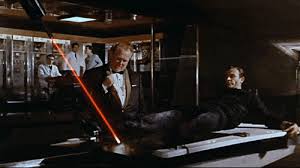
Role of Violence – Again, Bond has a relatively low bodycount in this film. People do die, especially women, including Jill Masterson. For her flirtation with Bond, she is painted gold and dies of “skin suffocation.” Her sister Tilly is killed by Oddjob, Goldfinger’s Korean henchman. But Mr. License-to-Kill is mostly restrained. A Mexican assassin gets an electric fan tossed into his bathtub. Some henchmen go over a cliff in a fiery crash after Bond shoots slick oil out of his Aston Martin. In the climatic scene in Fort Knox, Bond throws a henchman off a ledge and electrocutes Oddjob. (Apparently actor Harold Sakata was severely burned in the stunt.) Mostly Bond is the recipient of violence, including a laser beam aimed at his most manly parts while he is strapped to a table.

Vulnerability – Yeah, no. You wonder if we have to wait until the ‘90s to get new age sensitive James Bond. Whether strapped to a table with a laser heading toward his junk or locked in a Kentucky holding cell, or in a plane plummeting to the earth, we never see James break a sweat. 

Sexual PotencyGoldfinger is balls out on the message that Bond is the conquerer of women. In the opening sequence, he goes after a Mexican dancer and then uses her body to deflect an assassin. In Miami, he’s getting a poolside massage from his Florida fling, Dink (who’s cleavage was also featured in A Hard Days Night). Then there’s the romp with Jill who gets painted gold. In Switzerland, when a blonde passes him by in a ’64 Mustang convertible, he resists the urge to chase after her. “Discipline, 007, discipline,” he says to himself. She turns out to be Jill’s sister and they have a moment before Oddball kills her with his killer hat.

That brings us to Pussy Galore (the character, not the male fantasy). The Bond double entendres hit a new level here and Pussy’s name is mentioned constantly in the second half of the film. Galore is played by Honor Blackman, who was Diana Rigg’s predecessor on the highly popular British spy show, The Avengers. So she was coming in to Bondland a Judo-flipping badass, not a submissive DID (Damsel In Distress). In Goldfinger, she’s the leader of Goldfinger’s team of female pilots, playing a role in his grand slam plan. But there’s a scene in Goldfinger’s barn where James manhandles Pussy and the subsequent judo fight ends up with the two literally rolling in the hay. Galore tries to push Bond off her, but no woman can resist 007 and his assault ends in a passionate kiss. Woot, there it is.

Connection – Unbeknownst to the viewer, Pussy Galore’s Stockholm Syndrome turns her into an ally of Bond’s and Goldfinger’s evil plot is thwarted. As has already become an uber-cliche in Bond films, their end scene, making out under the parachute, casts no allusion that it’s the beginning of a beautiful relationship between James and Pussy. We know how this works. Women are transitory and co-workers are support players. Does Bond have any friends? A love that got away? He is supremely untethered. A man alone.

Toxic Masculinity Scale: 7

Summary –  Like an explosion of everything that was 1960s before LSD, Goldfinger is a magnum opus of a spy action film. The clever crime attempted (to irradiate the gold in Fort Knox to drive up the value of personal stocks of the metal) takes a back seat to watching Connery leap frog from woman to woman, often with his suped-up Bondmobile (Oh, to have stock in Aston Martin in 1964). Connery’s Bond is the Id unrestrained. One wonders what MI-6’s HR department would say about the workplace flirtations between Bond and Miss Moneypenny in the post #metoo era. But it’s the scene between Bond and Galore in the barn that reminds us that the debonair spy is not immune from the misogynistic value of male entitlement. A generation of boys learned women are to be taken by men, even if they resist. Pussy galore, indeed.

While contemporary audiences my get a bit of a creepy vibe from Goldfinger’s Bond, there’s a creeping trend that may be less noticed today. The third Bond film sees 007 more dependent on the technology provided by his employer. It may be a homing device in his shoe or an ejection seat in his car, but 1964 Bond is becoming less a man left to his own devices and more to the devices Q builds for him. Bond is the halfway point between the archetypical cowboy, fending for himself on the frontier, and Modern Man, juggling apps and monitoring social media, never not wired to the electronic collective. Where would Bond be without Q? Where would we be if the internet went down? One imagines that Bond would be better off, but not by much.

Next: Thunderball (1965)


The James Bond Project: #1 – Dr. No (1962)
The James Bond Project #2: From Russia With Love (1963)

The Secret Life of Fourth Grade Girls

June 7, 2024

As Cozy approaches the end of her stint as a fourth grader, I’d like to take a moment to reflect on the evolution of peer culture for a 9-year-old. The difference between third grade (which is technically “primary school”) and fourth have been like night and day, and the primary shift is all about who she wants to hang out with. I’m still Daddy and get plenty of time and love, but her friend group is now her preferred time occupier. There’s a new sheriff in town and it’s a passel of pre-tween girls.

In her seminal 1982 piece of feminist scholarship, In a Different Voice: Psychological Theory and Women’s Development, Carol Gilligan charted how children generally play in mixed-sex groups through primary school. Cozy certainly had as many male friends as female friends. But then, as children begin to approach adolescence, they split up along gender lines; boys on one side of the playground and girls on the other. As a parent who is both at drop off and pick up, I’ve watched this phenomenon evolve over the school year. It’s like watching the formation of competing gangs.

We know that puberty is starting earlier for kids over recent decades. Every decade that passes, the average age of the onset of puberty moves up three months, according to recent research. This due to a number of factors including lack of exercise and changing diet. Researchers also think COVID accelerated precocious puberty, so there’s that. The bottom line is I was not ready for my child to be launched into adolescence quite yet, but here we are. Cozy has a bra.

At the moment, the gender split has a decidedly childlike element. It’s not about dating or harassment. It’s about bikes. That’s right, Cozy is in a biker gang. It’s a regular occurrence now that three or four girls on bikes show up in front of our house and holler, “Hey, Cozy! Come out and ride with us!” I encourage her to watch out for cars and then advise her to do a good job terrorizing the neighborhood. While her male counterparts are playing video games, the girls of Sabin Elementary are owning the streets and it’s glorious.

I spent a large part of my fourth grade year riding bikes with my friends, so I trust her as she rides out of view. In my time, boys ruled the streets while girls stayed home and learned how to fold clothes. If there’s any “domestic apprenticeship” in this house, it’s me telling Cozy to pick up her clothes before she ding dong ditches the boys on the next block. The girl bike gang is a revolution on wheels. I can only imagine what they talk about when they ride to the park to lay on the fourth grade gossip and pop culture obsessions.

The dark side of the peer bonding has been some actions that drift into the bullying zone. Cozy’s both flirted with it and been the subject of it. We’ve taken away her phone twice because of reports of chats that tease and exclude. I can’t police her interactions, 24-7, but I can limit her access to screens where impulsive actions are a lot easier. But the bright side is seeing Cozy’s peer group engage in pop culture separate from their parents. Her squad is firmly in the Swiftie camp and they will sing Taylor’s songs at full volume (including in the back of my car). It must be like what was like 60 years ago when The Beatles took over America. I love it.

Gilligan’s 1982 book offered a darker picture of this period. Gilligan found that when girls and boys peel away from each other, girls start to evaluate themselves by how well they can attract boys’ attention, not by how smart or athletic they are. She discussed that girls’ self-esteem plummeted around age 13 as they are repeatedly told that their worth is in their looks, forcing them to compete with each for the middle school Prince Charming. “Boys don’t make passes at girls who wear glasses.”

I’m hoping none of this patriarchal hell lands on my daughter. I can’t change 8000 years of male dominated culture, but I can hope, a) things have changed a lot since 1982, and b) she’s a lesbian. For now, she’s rolling with her girlfriends, having sleepovers, and evaluating clues in Taylor Swift songs (mostly clues about a guy named Joe). Unlike Gilligan’s 13-year-olds, Cozy is bonding with her diverse pool of girl power classmates. (In 1998, I presented a paper on how the Spice Girls were positively impacting girls ability to bond.) As they ride off into the summer, I’m going to support their freedom and close friendships. They’re gonna need it.

Why Are Conservative Boys So Triggered By Barbie?

“Where did my friends go?” Wives as Unpaid Therapists

September 14, 2022

Masculinity is a truly fragile thing. In our youth, we are hit over the head with the message pushing male bonding. No girls allowed in the treehouse. There are plenty of negatives associated associated with that, including that it devalues all things female and blocks girls and women out of the avenues of power (“Bros before hos!”), but there is an unintended benefit to all the bro-time.

Men aren’t supposed to talk about their feelings and that’s what gets us into trouble. “When boys cry, they cry bullets,” I remember a child psychologist saying on The Oprah Winfrey Show after the 1999 Columbine shooting. But when we do manage to share a bit of vulnerability, it tends to be with our bros, maybe after a few beers or a lost match. We learn that we can lean on our male friends without being called a “cry baby” because they are looking for the same thing. Then after opening up, we have to “cowboy up” and revert to the same stoic bullshit.

So what happens when we get married?

The story goes that marriage means leaving our male friends behind on the playground, soccer pitch, or tavern. Male friends celebrate the interest of a single man and now he must trade his dudes in for a woman. John Lennon had to leave the Beatles for Yoko and her screaming. And now the wife is the “best friend.” On one feminist level, that makes a lot of sense if the man is leaving the toxic grab-ass world of Bro Culture to finally see at least one woman as an equal partner, but on another feminist level what does this really do for the wife?

This is exactly what happened in my marriage.

And soon as Andi and I connected and certainly after we got married and became parents, I shed my wonderful posse of friends, most of them men. No more going out to shows together, planning weekends at festivals, or just hanging out after work. She became “my world.” That can seem very romantic and much of it seems like a wonderful dream, but I never once saw the burden I was laying on her by making her “my person.”

She suddenly was cast into numerous roles, from my therapist to my financial (and fashion) advisor, all of which were unpaid. I relied on her opinion and no-one else. In co-dependent relationship, we often give people power they don’t actually want. You can put me in charge of the criminal investigation of Donald Trump, and while that might sound awesome, I don’t actually want that power. And it is a power thing because it’s not equally shared. If I played the exact same roles for her, it wouldn’t be an issue. I didn’t expect her to do the laundry but I did expect her to “fix” me.

I would often be confused by her response to me saying things like, “You saved me.” I considered it a compliment. But it wasn’t her job to save me. And who was supposed to save her if she was spending her time on the project that was her husband? She couldn’t save herself because she was supposed to be saving me. All this saving. It didn’t occur to me to just save my goddamn self. After all, I had her to do that.

It’s not surprising that my wife began to quietly resent me. My broad social circle shrunk down to just her and it must have been suffocating. She was my “rock,” which meant I relied on her for everything, without really returning the favor. Where, previously, I might complain about work with my friends over a beer, it was now on her shoulders. The encouragement to make it through the matrix of life now only came from her (and phone calls with my other female/therapist, my mother). Where was the reciprocity?

One of the wonderful things this separation has given us is the space to save ourselves. Watching her evolution this past year, free of my emotional burdening (and constant need of her approval) has been wondrous. I now have an amazing therapist who I pay to do the emotional servicing I expected from Andi. And I’m rebuilding my friendships with peers. I live in a city with countless coffeeshops and bars. There are plenty of places to share some bonhomie with my dudes.

The division of labor makes sense. Brothers, don’t expect your wife or girlfriend to be your “everything.” It’s not fair to them. You are not their project. Learn from my mistakes, save yourself. And get a good therapist.

Gender – Nature vs Nurture 8: The Looking Glass Self

August 7, 2022

There was a clear moment this past year when Dad picking out Cozy’s outfit for the day slammed into “societal expectations.” For the historical record, there is an event in the life of a second grader that sounds like this; “Dad, I don’t like how that makes me look!”

Legendary sociologist George Herbert Mead (1863 – 1931) often referred to Charles Cooley’s concept of the “looking glass self.” When “I” look in a mirror, I see “Me.” Me is society’s reflection and I evaluate myself by that reflection. It has nothing to do with who I am, only how they see “me.” I love mentioning to my students how they will never see their own face as it is. They will only see photos, videos, and reflections in mirrors, all versions of their face mediated by some external source. You don’t actually look like what you look like on Instagram. Sorry.

Even the most rugged individual’s sense of self is shaped by society. You’re a mountain man? Society says you have to have a beard, jeans, and flannel shirts. “But that’s just what I’m comfortable in,” says the rugged individual. “You know what’s even more comfortable?” asks George Herbert Mead. “Silk pajamas!” “But that will make me look like a cissy!” says the mountain man. Bam, society.

So me picking out my daughter’s clothes is starting to get filtered through the various mirrors of society. That’s not necessarily bad (“Pick out your own damn outfit,” Dad has screamed), but as we know, “society” is kinda messed up, like a funhouse full of distorted mirrors.

The first mirror is gender. This trip hits girls first. The boys in her second grade class seemed oblivious to what they should wear. Cozy has already been playing at wearing make-up with her friends. She has even said, “That outfit makes me look fat.” (Mom and Dad had a big “family time” conversation about that one.) And the way the fifth grade girls dress at her elementary school dress looks more college co-ed fashion than “kidswear.” According to feminist sociologists, like Carol Gilligan, all of this will be put in the service of attracting boys. 

Instead of being evaluated on her brains, her humor, or her ability to build a sustainable fairy house out of a bundle of sticks, society wants to primarily place her value in her “attractiveness.” Gilligan found that the self-esteem of 13-year-old girls plummeted as they began to realize that their worth was not based on what they had to offer the world but what they had to offer boys. The soccer player quits the team to become the cheerleader. Her research was first published in 1982. Forty years later, I fear the creeping insecurities of the 13-year-old girl who is told, “Boys don’t make passes at girls who wear glasses,” will arrive in the gender politics of 3rd grade.

The second mirror is race. Less visible to white girls, BIPOC girls know that white girls set the beauty standards, whether it’s the latest fashion, straight hair, or Instagram make-up tips. My brunette mixed-race daughter has commented, more than once, about wanting an outfit because the “blondies” will like it. Already in second grade, the Aryan girls are the mirror that the other girls are seeing themselves in (and never seeing a blondie looking back at them). This isn’t any critique of Cozy’s blonde classmates. We live in a white supremacists patriarchal culture that puts “blonde girls,” at the peak of the attractiveness scale, but that scale is changing rapidly.

The third mirror is class. Not only are these kids looking up to the wealthy, to keep up with the Kardashians, they (or their parents) are expected to shell out the money so they can “look cool.” The first day of school everyone gets evaluated in their new outfits and the poor kids are always shamed. “Your momma is so poor that when I asked her what’s for dinner tonight she lit her pocket on fire and said, hot pocket.” We can still find Cozy outfits at Goodwill but we are about 60 seconds away from that door closing and it’s gotta be the latest trend OR SHE WILL DIE. We’re trying to give her a bohemian ethic that rejects wealth in favor of a decidedly downwardly mobile artist esthetic. My credit card really needs her to be a beatnik.

All of this is tied to the process of “our baby” becoming her own person. But, as Mead explained, her sense of self is being formed by the culture she lives in and more than once I have been tempted to smash the mirror.

Here comes third grade.

President Snowflake: How Trump’s fragile masculinity made me a better man.

November 19, 2020

If there was ever a time America needed a leader, it’s now as COVID deaths surge past a quarter million. But sad Donald Trump is in his bunker, tweeting madly that he won the election “by a lot.” No stimulus program for Americans falling into homelessness. No national mask mandate to save additional lives. Just Baby Donald having a temper tantrum and a circus of sycophants too afraid to tell the Emperor that the world is laughing at him.

The pathetic end of Donald J. Trump is not only a lesson in how not to be a president. It’s also a vital lesson in how not to be a man. Of course, Mr. “Grab’ em by the pussy” has provided that service for years.

The lockdowns of 2020 have certainly presented challenges for single people, but there have been challenges for those of us that are boo’d up as well. The pandemic has forced many of us married and “coupled up” (as they say on Love Island) to learn how to truly co-exist in a confined space, without the easy exit hatch of “let’s just go out.” There’s only so much Netflixing you can do. At some point, it gets real. And as if providing (finally) some kind of national service, there’s President Hissy-fit giving the men of America a perfect example of how not to handle this moment.

From the very beginning, Trump has made it all about him. From his word-salad lie-fests before his adoring cult crowds to his denial of the Biden victory, “America first” has always been code for “Trump first” and you almost feel sorry for the schleps that still fall for this con man. (“Quick! Donate to President Trump’s legal team so he prove those black votes in Detroit and Atlanta were illegal! We take PayPal!”) Trump always centers himself and you don’t have to look at Melania’s face to see that that’s his fatal flaw.

But this isn’t about Trump. It’s about all us men who do the same thing. We’ve been socialized to believe it’s a man’s, man’s, man’s world and women are there as our support system. (BEHIND every great man… is a woman who should be out in front.) The world is about our male hopes and plans and adventures and successes and failures and wet dreams. That’s why Betty Friedan’s The Feminine Mystique (1963) resonated with so many women. It simply asked, but what about me? Arn’t I a person, too?

Sadly, the second wave feminist movement that Friedan helped launch did not fully humanize females in America. It made a lot of progress (Thank you, Title IX and hello Vice President Harris!), but it still looks like a penis-centered culture. At least American Ninja Warrior puts the the top two female contestants through to the finals. We can find plenty of reasons to find cracks in patriarchy. (I’ll credit Nancy Pelosi for keeping Trump’s nuts in a vice grip and the daughters of NFL fans for prioritizing Beyoncés BLM anthems over Go Daddy commercials and cheerleaders in halter tops.) We can see progress all around us (if we turn blind eye to the epidemic of rape in the country), but there are still people who want to make America “Father Knows Best” again.

We can talk about this on a societal level (RBG was right. We’ve had generations of all-male Supreme Courts. When do we get an all-female Supreme Court?) But this is about the personal journey of men stepping away from the destructive (including to men) effects of patriarchy.

More than that, this about me learning how to love my wife.

If patriarchy, on a macro-level, is about centering men’s voice and minds in society, on a personal level it’s about doing the same Goddamn thing in our relationships. Hi ladies, welcome to my world. Can you make me a sandwich? Feminist Dorothy E. Smith has written how women are given control of the “domestic sphere” so men can have pretty much everything else on earth. And that can include the space in a relationship.

Now, to be clear, I have claimed feminism as a core value in my life since the 1980s and proudly left my job to become a stay-at-home dad, inspired by my favorite househusband John Lennon. I can thrill you with stories of escorting women into abortion clinics past the screaming banshees of Operation Rescue and challenging students to accept that God is most likely female, but I still internalized patriarchy in the same sad way I internalized white supremacy.

That became most clear this year during long, under quarantine, conversations with my wife. Like most people, we’ve had our fair share of COVID-magnified conflicts; about money, about parenting, about who is going to wash the dishes. She was quick to point out how quickly I would go into defensive mode and try to “prove” my case, like we were on opposing debating teams. We’re on the same team! I forgot! But it became all about me and how I was somehow aggrieved.

What I should have been doing is asking questions. Why do you feel this way? What can I do to help? I should have centered her and put my amazing wife first in the discussion, but instead  I retreated into “Randyland,” wondering why she had a “well, fuck this shit” look on her face. Maybe if I slept downstairs I could comeback, refreshed with an even clearer articulation of my position, complete with PowerPoint slides. Meanwhile, my wife felt more and more alone as I plotted strategies in my head instead of re-coupling (also a term from Love Island).

This is going to sound completely basic to many people (and maybe a few men), but I have literally burned through every relationship by doing this. By making it about me. That’s not how love is supposed to work. You’re supposed to put your partner’s emotional well-being before your own, but in patriarchal America I didn’t get that role modeling, not from my father and not from Starsky & Hutch. The result was relationships crashing and burning and me thinking that I was just a “psycho-chick magnet.” If they were psycho, it was because I centered myself instead of them.

There is a parallel phenomenon here with regard to race called White Fragility. America has the handbook and is starting to figure that out. (Thanks, Robin!) It’s not about you, Karen, so stop centering yourself and start centering black voices. Maybe, we need a book called Male Fragility: Why Men Get Their Panties in a Wad.

My wife is strong as hell and sure enough doesn’t need a guy like me who doesn’t put his partner before himself. I should have gotten that lesson a long time ago. I’m not the king of my castle. But somewhere, between long, hard conversations with her and watching Baby Trump center himself instead of the nation we hired him to lead, I got it. Don’t be like Trump. Hey Donald, it’s not about you. It’s about America. She’s trying to tell you how she feels. Please listen.

Female Role Models For My Daughter (and all those boys)

July 6, 2019

There’s a classic riddle I offer my sociology students when I want them to think about gender.

A man is spending a day with his young son who he is meeting for the first time. They do the usual father-son things like going to a ball game and having ice cream in an ice cream shop. At the end of the day, there is a horrible car accident and the father is killed.The boy is critically injured and taken to the Emergency Room. The attending doctor sees a child in need of critical aid brought into the ER and gasps, saying, “I can’t operate on this child. He’s my son!” 

Who is the doctor?

The first time I heard this riddle my mind did all kinds of backflips. Maybe the doctor was the step-father or maybe there were, somehow, two fathers in this universe. Then someone said, “The doctor is his mother” and I felt like a complete idiot. It’s a valuable lesson in how our brain is trained for normative maleness. Oddly, if I had grown up in the USSR, the answer to the riddle would have been obvious as the majority of medical doctors in the old Soviet Union were women. We’re not at gender equity yet, but I have great hope for my daughter’s generation. (Our daughter has a female doctor, by the way.)

The vestiges of patriarchy still pervade my 4-year-old’s preschool life. A male classmate told her that “girls can’t be bosses,” even though the owner of the school is a woman. I hope she called bullshit on the boy but I know she gets a lot of reinforcement of the “men are in charge” narrative even if at home dad is folding laundry while mom clocks in the hours at work.

00003564753958

The day after we got back from Mexico, a tornado blew down our street in Portland. It was only an EF 0, but we were in the car right next to it and saw it take down the biggest tree in the neighborhood. Quickly, police and fire departments were on the scene, as the rain poured and power lines flailed about in the wind. As I gave interviews to local news crews, I saw Cozy talking to a female police officer about the twister. I realized that, thanks to my dragging her to endless meetings with law enforcement, she’s met enough female cops and FBI agents to know that women are in important positions of power all around her.

160417_morgan_photo_craig_mitchelldyer_portland_thorns_fc

Earlier this summer we took her to her first Portland Thorns game so she could see thousands of people cheering for our amazing female athletes. For her, it was just a normal sporting event, nothing remarkable that all the players on the pitch were women. What was even cooler was that she got to see tons of boys and men (including her dad) cheering for the mighty Thorns, at a record crowd in Providence Park, as they took down the Chicago Red Stars.

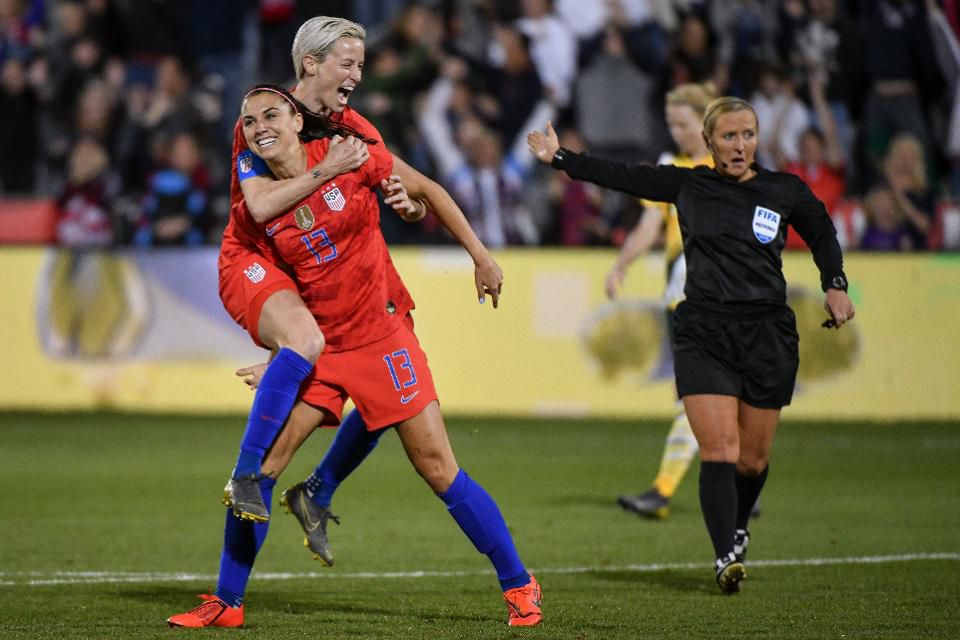
That’s been one of the most thrilling parts of watching the women’s World Cup matches this summer. Sure it’s great to see girls getting to see women play hard and fast soccer to a global audience (even if they are paid significantly less than male FIFA players), imagining that they could do it too. That there is space in a male-dominated world for female athletes and careers in their sport. But it’s also important that so many boys are showing up to root for women. It’s the beautiful game. We might have a misogynist in the White House, but the walls are coming down in football stadiums all around the world as men cheer on their sisters.

Gender socialization is real. It happens when we are conscious of it. (We live in a Barbie-free Zone.) But also when we don’t see it. I hope Cozy has taken note of all the women running for president, the women who she meets who work in local and national government, the female firefighters who responded to the tornado on our street, the female sportscasters on TV, and all the moms of friends who are working and bringing home the vegan bacon. But I also hope all her little male friends take note of the exact same thing.

https---specials-images.forbesimg.com-dam-imageserve-1140675465-960x0.jpg?fit=scale

I was of two-minds about the 2011 Beyoncé song, “Run the World” The refrain, of course, was “Girls!” It was an empowering anthem but masked the fact that men (and their anti-woman/anti-Mother Earth agenda) still pretty much run the show, from Afghanistan to Alabama. Girls need to be armed with this truth, patriarchy is real and will not die easily. A few World Cup matches isn’t going to change that. But I think the girls (and boys) of Gen Z, might be able to see what that world will look like. It will look like a million people cheering as a talented female puts the ball into the back of the net.