The James Bond Project #26: Spectre (2015)

This series is intended to evaluate each product of the James Bond film franchise through a feminist lens, and the relevance of the Bond archetype to shifting ideas of masculinity in the 2020s.

Spectre (2015, directed by Sam Mendes)

August 7, 2025

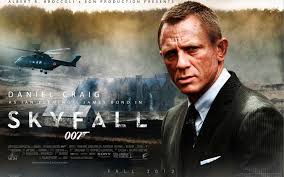
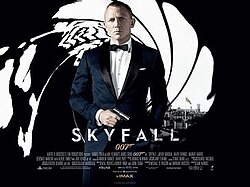
Yeah, it’s a formula, but when it works, you are in for a wild ride. There is not a scene or line in Spectre that one can not see coming from Sean Connery instead of Daniel Craig. The second half-century of Bond begins where we saw 007 50 years, locked in a death match with Ernst Stavro Blofeld. The long legal dispute between Eon Productions and screenwriter Kevin McClory finally resolved, we are gifted classic Bond that reunites these iconic arch rivals. Director Sam Mendes is back at the helm after Nicolas Winding Refn (Drive, 2011) backed out of the project. Here we go.
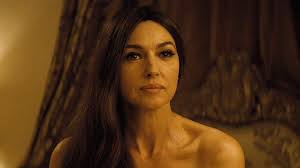
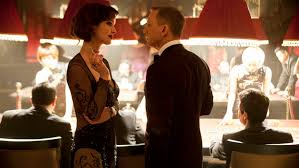
Ralph Fiennes (Lord Voldemort, himself) has replaced Judi Dench as M after Dench’s M was killed in Skyfall. Craig (46) is still doing his own stunts and tore his meniscus during filming. Brief love interest Lucia Sciarra, played by Italian actress Monica Bellucci, 50, would have been the first time a “Bond girl” was older than Bond himself. But the true “Bond girl” of the film is psychologist Madeleine Swann, played French actress Léa Seydoux, 30. The twenty-first century Blofeld is played by Christoph Waltz, the break-out star of Inglourious Basterds (2009), who completely owns the role.
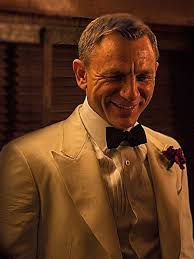
Spectre has all the staples you want in a Bond film; Bond in a white dinner jacket, Bond fighting inside a careening helicopter, Bond battling a mute assassin on a moving train, Bond going rogue, the classic Aston Martin, and Blofeld’s pussy cat. There are exotic locations that range from Mexico City’s Day of the Dead celebration (with 1500 extras) to a (not underground) lair in the Sahara desert. Shot on 35mm film but shown in IMAX theaters, Spectre makes the most of the Bond spy formula in a gift for 007 fans that also departs from the formula in some important ways.

The plot revolves around Blofeld’s SPECTRE (also back after legal wrangling) controlling the data flow from the first world’s intelligence agencies, making Blofeld the Big Brother for all intel on Earth. Ernst is watching you. Monneypenny is back behind the desk in M’s office but she and Q are secretly helping James. (We’ve seen this film before.) Bond has been left breadcrumb’s by Dench’s M and has bailed from MI-6 to find out about the conspiracy that threatens the global order. But on the way to beat Blofeld, something happens to Bond. Something we haven’t seen since 1969.

Let’s plug Spectre in to the matrix and see what happens.

Driver of Action – Unlike Skyfall that gave ample screen time to Dench, Spectre is back in the lone rogue spy narrative. M, Moneypenny, Q and MI-6’s Bill Tanner are the support team and Felix Leiter is mentioned but never shown. 007 has no female or male partner in this film. The center of the eye’s gaze.

The Role of Violence – Bond only kills a few dozen people in this film, including a bunch of Blofeld’s henchmen (it’s a dangerous job), assassin Marco Sciarra (by throwing him out of helicopter in Mexico City), and assassin Hinx (played by professional wrestler Dave Bautista), who he throws out of a train. Madeleine does press him on his chosen life as a killer, to which he replies, “It was that or the priesthood.”
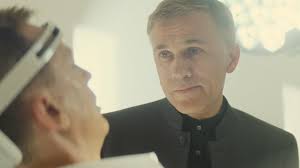
Vulnerability – This is a tough one. We get the obligatory Bond being tortured scene and 007 keeps his wits. But we also get Blofeld claiming to have been behind the suffering of Bond’s losses, including M, Vesper Lynd, Bond’s love interest from Casino Royale (2006), and (unmentioned because Craig is leading a “reboot”), James’ wife Tracy, from On Her Majesty’s Secret Service (1969). “I am the author of all your pain, James.” Even so, Bond never breaks. It is not until he develops an emotional attachment to Madeleine, which magically creeps out at the end of the film, that we that 007 has a soft white underbelly.

Sexual Potency – Here’s our Lothario. The first scene of the film has a masked Bond ushering a beautiful woman into a hotel room in Mexico City, she removes her mask and we think Spectre is going to begin with a bang, but 007 escapes out the window to do some assassin work. Then, in Italy, he sleeps with the wife of the assassin he killed in Mexico. Finally, after an epic fight scene on a train, all juiced up on adrenaline, he beds Madeleine. It’s like the old song goes, “Fuckin’ and fightin’, it’s all the same.”

Connection – This is where the franchise takes a left turn. Bond, apparently, has fallen in love. It’s so slight, it’s barely noticeable until the final scene. When Blofeld is drilling into James’ skull Madeleine tells him that she loves him. That gives Bond the jolt to go apeshit and save the day (and the girl). Later, she says she doesn’t want any part of James’ action hero lifestyle (her father was an assassin, after all) and they calmly walk way from each other. But when Blofeld captures her and forces James to save one more damsel in distress, I guess he decides he loves her and, like James f’ing Bond, saves her and gets Blofeld. Instead of killing him, he says, “I’ve got something better to do.”  Then he throws away his gun and walks away with Madeline. The epilogue scene is not them in a boat, but James and Madeline driving away in the restored Aston Martin, presumably leaving MI-6 to be with the woman he loves.

Toxic Masculinity Scale: 2

Summary One does not expect James Bond to leave the life of a spy for love. Even when George Lazenby’s Bond got married in 1969, 007 was still 007-ing. But Madeline’s pressuring James’ being “always alone” created a crack in his iron wall, apparently. So we get Bond riding off into the sunset for a new life. No more killing and random hook ups, right? Right?

This installment has plenty of gifts for longtime 007 fans, including a modern Aston Martin DB10, Q’s exploding watch, finding out the Blofeld’s father raised an orphaned James, learning how Blofeld got the facial scar associated with Donald Pleasence’s performance of the character, and the return of Blofeld’s white Persian cat (“Hello, pussy,” says 007). While the plot is purely Bond by the numbers, the scope of Mendes production is as satisfying as it needs to be.

Spectre opened in London on October 26, 2015 the same day as a massive 7.5 earthquake struck the Himalayas. The film opened to mixed reviews but record-breaking box office receipts. The theme song, written and performed by Sam Smith, won both the Oscar and Golden Globe for best Theme song. The film’s ending had some asking if Spectre was the end of the 53-year-long 007 franchise, but Craig’s Bond had one more outing up his tuxedo sleeve.

Next: No Time to Die (2021)
The James Bond Project #25: Skyfall (2012)

The James Bond Project #24: Quantum of Solace (2008)

The James Bond Project #23: Casino Royale (2006)

The James Bond Project #22:  Die Another Day (2002)

The James Bond Project #21:  The World Is Not Enough (1999)

The James Bond Project #20:  Tomorrow Never Dies (1997)

The James Bond Project #19: GoldenEye (1995)

The James Bond Project #18: License to Kill (1989)

The James Bond Project #17: The Living Daylights (1987)

The James Bond Project #16: A View to a Kill (1985)

The James Bond Project #15: Never Say Never Again (1983)

The James Bond Project #14: Octopussy (1983)

The James Bond Project #13: For Your Eyes Only (1981)

The James Bond Project #12: Moonraker (1979)

The James Bond Project #11: The Spy Who Loved Me (1977)

The James Bond Project #10: The Man with the Golden Gun (1974)

The James Bond Project #9: Live and Let Die (1973)

The James Bond Project #8: Diamonds are Forever (1971)

The James Bond Project #7: On Her Majesty’s Secret Service (1969)

The James Bond Project #6: You Only Live Twice (1967)

The James Bond Project #5: Casino Royale (1967)

The James Bond Project #4: Thunderball (1965)

The James Bond Project #3: Goldfinger (1964)
The James Bond Project #2: From Russia With Love (1963)

The James Bond Project: #1: Dr. No (1962)

The James Bond Project #25: Skyfall (2012)

This series is intended to evaluate each product of the James Bond film franchise through a feminist lens, and the relevance of the Bond archetype to shifting ideas of masculinity in the 2020s.

Skyfall  (2012, directed by Sam Mendes)

July 31, 2025

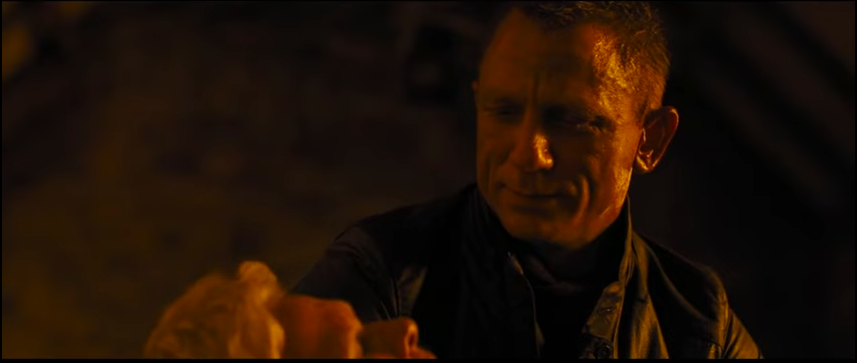
Daniel Craig is back for his third stint as Bond, a little older, a little more beat up in a film that further tweaks the 007 formula. There are some classic staples here, including James gambling in his tux, James under the ice, James fighting on top of a moving train, James in rooftop motorcycle chase, exotic locations, random hook ups, and the Aston Martin, but American Beauty (1999) director Sam Mendes brings enough innovation to Skyfall to bring a bolt of electricity to the franchise, marking its fiftieth anniversary.

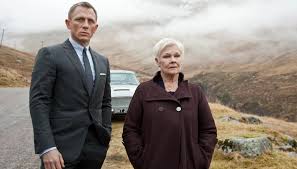
The most obvious shift from the formula here is that Skyfall is as much a Judi Dench movie as a Daniel Craig movie. M’s outsized role is fitting as it would be her last in the franchise. (She dies.) Also different is the strange twist that there really is no “Bond Girl” in this film. There’s not even a leggy woman on the movie posters! French actress Bérénice Marlohe’s character, Sévérine, almost plays the part, but she’s only briefly in the film. (She dies.) The most exciting addition is the return of Miss Moneypenny and this time she has a first name (“Eve”), she’s an action hero, and she’s black. We also get a Millennial Q, who has no time for gadgets.

The cast of Skyfall is robust, with 28 Days Later’s Naomie Harris as Moneypenny, Ralph Fiennes as head of intelligence Gareth Mallory, and Albert Finney as the housekeeper at Skyfall (a part Sean Connery was considered for as a nod to the fiftieth anniversary of Dr. No). The role of Bond Bad Guy went to No Country for Old Men break-out star Javier Bardem. Bardem dyed his hair blonde for the role, drawing comparisons with Julian Assange. Bardem also plays his character, Raoul Silva, as “gay” against James’ straight man role, although when Silva is sexually suggestive with James, Bond replies, “What makes you think this is my first time?” I remember the internet chat asking if 007 has been bi all these decades.

The flimsy plot follows a former MI-6 agent who is revealing the identity of fellow agents because M sold him out after Hong Kong was returned to China. Skyfall is the first Bond film to actually be partially filmed in China with segments in Shanghai and Macau. (Other locations include Instabul and Scotland). What the film lack in sense it make up for in bombast, including seeing our man James finally get shot, twice. (Although he does get winged by a speargun in 1965’s Thunderball.) But being shot clean through, and falling off a massive train bridge can’t kill Bond. He plays dead for a few months and then comes back to save the day.

Twenty-first century Bond has been described as “cool, not camp.” Let’s plug Skyfall’s 007 into our evaluation matrix.

Driver of ActionSkyfall is as much about M and her past choices as it is about James Bond. We do get some Bond backstory (and even see his parents’ grave), but this film is built on M’s career as spymaster in a changing global political landscape. We even get Judi Dench shooting at henchmen! Moneypenny also takes on a sidekick role often reserved for Bond girls. Is Eve Moneypenny Skyfall’s Bond girl?

The Role of Violence – An A.I. source says Bond kills 23 people in the film. It’s hard to tell because Bardem (as bad guy Silva) has so many henchmen. (Why, we don’t know.) Bond kills all of them. He also drops an assassin from a Hong Kong skyscraper. It’s interesting that everyone Bond shoots dies, but he bounces back from being shot like a Phoenix on coke.

Vulnerability – We do get a bit more of Bond’s soft white underbelly in Skyfall. Besides the backstory of James the orphaned child (not much emotion shared here but M quips, “orphans make the best recruits), we get a window into “dead 007,” as James lets the world think he’s dead as a means of retirement. He’s in some Black Sea coastal village, doing shots on the bar with the boys and a scorpion on his hand, having drunken sex, and letting his rock hard body atrophy with self indulgence. It’s not very believable but it sets up his comeback. When M asks him where he’s been, he replies, “Enjoying death.” Later, he states that his hobby is, “resurrection.” But there are plenty of allusions to spycraft being a “young man’s game,” and James being past his prime. (Craig had two more 007 films on his contract.)

Sexual Potency – Is the Bond “rule of 3 back”? Old Bond is still Horny Bond. While he’s “dead” we see drunk James having sex a local (or maybe she’s a contractor for Halliburton, we don’t know). Later, he climbs in the shower with sex-trafficking victim Sévérine, which seems just a tad misogynistic. I mean, c’mon James. Then he watches as she’s murdered by Silva. The big question is if 007 sleeps with Moneypenny after she shaves his face, while he’s clad only in a towel. It’s implied that, after 50 years of sexy banter, he seals the deal. There is an implication that Moneypenny with a gun is closer to his equal, even if she does shoot him on accident. But the message is consistent, that Bond is sexually irresistible to beautiful young women. (James sleeping with M would’ve made for a better film.)

Connection – The connection Bond has to M drives the film. Not only does he come back from the dead to help her, but he takes her to his childhood hiding place to keep his “mum” safe. The job of protecting and vindicating M is the framework of this episode. The connection with Moneypenny is noteworthy as is his lack of connection with the new, younger Q. Dench’s M dies in Bond’s arms, saying, “I did get one thing right.” Her trust and faith him were justified and now death has ended that bond.

Toxic Masculinity Scale: 3

Summary Bond’s interaction with Sévérine is highly problematic. Maybe we’re more sensitive in a post-Epstein era, but it should be clear that you don’t show up naked in the shower of a woman who is clearly a traumatized sex trafficking victim. Maybe it’s business as usual in a Bond film, but the scene was more anger-inducing, than “sexy.” However, the fact that Skyfall is really an M-centered film, with 007 in a supporting role, elevates the film as portraying a gender dynamic unique in the 007 canon.

For the 50th anniversary of Eon’s Bond franchises, there are familiar friends, like a title sequence featuring female bodies (and an Oscar-winning theme song by Adele), sharp dry quips from James (“Only a certain kind of woman wears a strapless dress with a Beretta 37 strapped to her thigh.”), and the return of the Aston Martin, along with the Bond theme music. (When Silva’s men blow up the car, 007 goes Rambo.) There’s even a glimpse of the vintage of the Macallan scotch Silva pours for Bond, 1962. Easter eggs aside, Bond’s emotions are still restrained but M (Dench) reveals the truth behind James masculine stoicism.

Skyfall premiered at Royal Albert Hall on October 23, 2012, while Hurricane Sandy was lashing America’s east coast. The film, as articulated by M, shares that the cold war world that produced Dr. No in 1962 now exists “in the shadows,” without clear enemies but with a new climate of danger. Mendes as director was an inspired choice to frame the action in service to M instead of Bond. Mendes would direct the next Bond as well as the Oscar/Golden Globe winning 1917 (2019). Medes is now directing four biopics on the members of the Beatles. For the kick-off of the next half-century of 007, Mendes would soon bring back a familiar foe to Bond’s universe.

Next: Spectre (2015)

The James Bond Project #24: Quantum of Solace (2008)

The James Bond Project #23: Casino Royale (2006)

The James Bond Project #22:  Die Another Day (2002)

The James Bond Project #21:  The World Is Not Enough (1999)

The James Bond Project #20:  Tomorrow Never Dies (1997)

The James Bond Project #19: GoldenEye (1995)

The James Bond Project #18: License to Kill (1989)

The James Bond Project #17: The Living Daylights (1987)

The James Bond Project #16: A View to a Kill (1985)

The James Bond Project #15: Never Say Never Again (1983)

The James Bond Project #14: Octopussy (1983)

The James Bond Project #13: For Your Eyes Only (1981)

The James Bond Project #12: Moonraker (1979)

The James Bond Project #11: The Spy Who Loved Me (1977)

The James Bond Project #10: The Man with the Golden Gun (1974)

The James Bond Project #9: Live and Let Die (1973)

The James Bond Project #8: Diamonds are Forever (1971)

The James Bond Project #7: On Her Majesty’s Secret Service (1969)

The James Bond Project #6: You Only Live Twice (1967)

The James Bond Project #5: Casino Royale (1967)

The James Bond Project #4: Thunderball (1965)

The James Bond Project #3: Goldfinger (1964)
The James Bond Project #2: From Russia With Love (1963)

The James Bond Project: #1: Dr. No (1962)

The James Bond Project #20:  Tomorrow Never Dies (1997)

April 17, 2025

This series is intended to evaluate each product of the James Bond film franchise through a feminist lens, and the relevance of the Bond archetype to shifting ideas of masculinity in the 2020s.

Tomorrow Never Dies (1997, directed by Roger Spottiswoode)

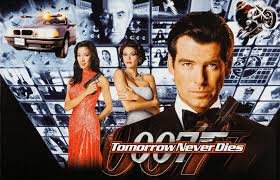
OK, who wouldn’t be excited for a film that paired James Bond and Michelle Yeoh? I mean seriously. Yeoh was still more known as a Hong Kong action star and was three years from 2000’s Crouching Tiger, Hidden Dragon, but this pairing was inspired. Tomorrow Never Dies, Pierce Brosnan’s second 007 film (and the first after producer Cubby Broccoli’s death) is another post-Cold War blockbuster that ramps up the violence and pits James against a megalomaniac media mogul who is probably supposed to be Rupert Murdock, if Rupert Murdock thought nuking Beijing could improve ratings.

The casting of TND (the title inspired by the Beatles’ “Tomorrow Never Knows”) is mostly spot on. Bond “girl” Michelle Yeoh, as ass-kicking Chinese agent Wai Lin, is genius. Terri Hatcher, hot off Lois & Clark, as a past “love” interest of James, grabs the screen. Judi Dench is in full command as M. Joe Don Baker is back as CIA agent Jack Wade. Desmond Llewelyn is hilarious as Q (“Grow up, 007”). There’s a funny bit with Vincent Schiavelli (Mr. Vargas in Fast Times at Ridgemont High) as a professor/assassin. But Jonathan Pryce’s portrayal of evil media magnet Elliot Carver is so cartoonish, it kills the good versus evil paradigm. More like, good versus goofy. (Anthony Hopkins was offered the role but declined in favor of making The Mask of Zorro.)

The writing is much sharper than GoldenEye, including James’ quips. Even Miss Moneypenny gets in the action. “You always were a cunning linguist, James.” And the action is bigger. There are a lot of explosions in this film. A lot. The direction by Roger Spottiswoode (Turner & Hooch, 1989) is meant to fill the wide screen with non-stop action. Apparently, Michelle Yeoh wanted to do all her own stunts but Spottiswoode had to hold her back for liability concerns. 

Tomorrow Never Dies has lots of Bond staples; 007 in a tux, 007 scuba diving, 007 flying a plane that’s not his, 007 not being struck by any of the thousands of bullets being fired at him. And he’s got a woman in every port. Most of the film takes place in Hamburg, Germany, Saigon, Vietnam, and the South China Sea. Bookended with theme songs by Sheryl Crow and k.d. lang, it’s Bond carving out space in a woman’s world. “Never argue with a woman,” he says in the film.

Let’s plug Tomorrow Never Dies into our matrix.

Driver of Action – The second half of this film actually feels like a buddy film. Once Michelle Yeoh drops into the plot, there are two action stars on the screen. I don’t know if Eon Productions magically knew that Yeoh would become one of the biggest movie stars of the 21st century, but she’s driving a lot of the action at the end of the film. She has to do a bit of time as a damsel in distress to justify the sexual chemistry (Bond still can’t have a woman who is an equal), but, so far in the franchise, this is close to a screen share as we’ve seen.

Role of Violence – Bond with a machine gun and hand grenades is a killing machine. It’s another bloodbath. It’s so far removed from Connery’s Bond, it’s hard to believe it’s the same character. The climatic finale, where he kills Carver with a giant drill, used to sink battle ships, is particularly gruesome. But Wai Lin is wailing away as well, mostly using marital arts, so there’s a female balance to 007’s orgy of violence.

Vulnerability – Brosnan’s Bond is zipped up like Moore’s but there is the tiniest glimpse of humanity this episode. It’s established that he has a history with Carver’s wife, Paris (Terri Hatcher). When she appears in his Hamburg hotel room, he’s drawn to her but expresses some guilt over abandoning her. “What happened, James? Did I get too close?” He says yes and they “reconnect.” Carver finds out and has her killed and then Bond confronts the man who killed her and shoots him in the head at point blank range.

Sexual Potency – We’re back to the criteria of 3. After the opening titles, we find James in bed with a beautiful Oxford University professor (yeah, right) “brushing up on a little Danish” after sex. Then, after reconnecting with Paris, he slips her dress off that they have sex (which gets her killed). And then he ends up with Wai Lin. Despite changing social norms, you get the feeling the Eon just gave up and let Bond be Bond.

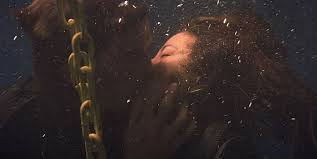
Connection – Until Wai Lin shows up, we don’t get much connection. James has no scenes with M and only briefly with Moneypenny. He softens up around Paris but she is killed before he has a chance to rescue her. Wai Lin falls back into the Damsel in Distress mode when Carver throws her into the water tied to a massive chain and she appears to drowned. James saves her with a long underwater kiss, blowing air into her lungs. But the connection between James and Wai seems more about a celebration of having just saved the world from Rupert Murdoch than anything romantic. Although they do end the film KISSING IN A RAFT in the South China Sea while the British Navy looks for them. Traditions matter!

Toxic Masculinity Scale: 5

Summary Scarface Sex Fiend Bond is somewhat balanced out by a strong female M (although Dench as a maternal concern for our man James) and a scene-stealing action star doubling as this episode’s Bond girl. Q’s tech plays an outsized role with a remote controlled BMW 750 that has a scene all to itself, and a fully-loaded cell phone (meh). Both Bond and Carver play their sexism cards. When Carver catches Wai on his stealth ship, he dangles her in front of 007 and says, “And it seems you can’t resist any woman in my possession.”

Something that stands out are the henchmen in TND. They have really cool outfits and a loaded armory, but I was left with two questions. Where are all the henchwomen? And how does one go about acquiring the job henchman? I’m assuming Carver paid top salary. Regardless, his massive stealth ship made a great stand-in for an underground lair, especially when it got blown up.

Tomorrow Never Knows premiered December 9, 1997, the same week as the Kyoto Protocol, the first global attempt to address climate change. The film was a massive success, earning a Golden Globe nomination, but kept out of the #1 spot by the behemoth that was Titanic. Its release was also timed to coincide with United Artist’s parent company, MGM, becoming a publicly traded corporation, making James Bond a massive cash cow at the end of the century.

Next: The World Is Not Enough (1999)

The James Bond Project #19: GoldenEye (1995)

The James Bond Project #18: License to Kill (1989)

The James Bond Project #17: The Living Daylights (1987)

The James Bond Project #16: A View to a Kill (1985)

The James Bond Project #15: Never Say Never Again (1983)

The James Bond Project #14: Octopussy (1983)

The James Bond Project #13: For Your Eyes Only (1981)

The James Bond Project #12: Moonraker (1979)

The James Bond Project #11: The Spy Who Loved Me (1977)

The James Bond Project #10: The Man with the Golden Gun (1974)

The James Bond Project #9: Live and Let Die (1973)

The James Bond Project #8: Diamonds are Forever (1971)

The James Bond Project #7: On Her Majesty’s Secret Service (1969)

The James Bond Project #6: You Only Live Twice (1967)

The James Bond Project #5: Casino Royale (1967)

The James Bond Project #4: Thunderball (1965)

The James Bond Project #3: Goldfinger (1964)

The James Bond Project #2: From Russia With Love (1963)

The James Bond Project: #1: Dr. No (1962)

The James Bond Project #11: The Spy Who Loved Me (1977)

February 5, 2025

This series is intended to evaluate each product of the James Bond film franchise through a feminist lens, and the relevance of the Bond archetype to shifting ideas of masculinity in the 2020s.

The Spy Who Loved Me (1977, directed by Lewis Gilbert)

This was the first Bond film I saw in the theater. My dad took my little brother and I to see the PG-rated Spy Who Loved Me the summer of ’77. I was 13 and what I remember most was the brief glimpse of Barbara Bach’s (or her body double’s) right breast in the submarine shower scene. I was 13, OK? But The Spy Who Loved Me was a return to form after the limp Man with the Golden Gun in 1974. It had all your musts, including oodles of cool gadgets from Q, Bond in his tux and bad girls in bikinis, scores of henchmen willing to die for a megalomaniac, and sharks. My absolute favorite part of the film when I was a kid (besides the boob) was the Lotus Esprit that turned into a submarine, complete with missiles. I thought that was the coolest thing on earth and dreamed of a submarine car of my own. Ironically, in 2013 actual megalomaniac supervillain Elon Musk bought the film’s Lotus for £616,000 in hopes of turning it into a workable submarine. (Like most of his crazy ideas, he failed.)

Roger Moore definitely is getting his mojo back in his third installment in the Bond franchise. While his lines still fall a bit flat, he’s got Bond “girls” dripping from his arms. On top of the TSWLM list is Barbara Bach as KGB agent Anya Amasova, AKA Agent XXX (get it?). Bach was a model and Spaghetti Western actor who would next star in Caveman (1980) with her future husband, Beatle Ringo Starr. (Rumors were that Moore wanted Brigitte Bardot for the role.) As a sort of seventies Blofeld, this installment’s villain is wealthy industrialist Karl Stromberg, who wants to destroy the world so he can build a new world under the ocean. Stromberg is played by Curt Jürgens, who starred with Bardot in And God Created Woman in 1956. Added to the cast is Richard Kiel, who stars as the indestructible steel toothed giant, Jaws. The return of You Only Live Twice director Lewis Gilbert helped to bring some of the Connery-era swagger back to 007’s mission.

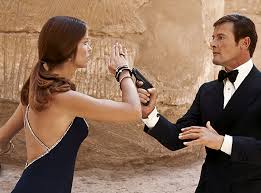
As is expected, the exotic locales splash across the screen. Bond riding a camel across the Egyptian desert and then chasing the bad guys through the Giza ruins was not filmed on an English set. It was there on sight, as were the scenes filmed on the Italian island of Sardinia. We return to some classic Bond tropes, like assassins on skis (On Her Majesty’s Secret Service) and underwater battles (Thunderball). There’s sexy one-liners (Her: But James, I need you! Him: So does England.) And sexist one-liners (James commenting on a woman in a bikini in a boat, in front of Anya, posing as his wife – “What a handsome craft. Such lovely lines.”) And while we don’t get an underground lair, we get an under WATER lair that serves its purpose.

The Spy Who Loved Me premiered in the United States on August 3, 1977, the same day that the Tandy Corporation debuted the first mass produced microcomputer, the TRS-80, forever changing popular culture and gadgets in James Bond movies. The film received mixed reviews but fared better than its predecessor. Boosted by a great theme song, sung by Carly Simon (and constantly on the radio the summer of 1977), the film was United Artists biggest grossing movie to date, but competed in theaters with the box office sensation that was Star Wars, putting it at #8 for the year (between The Deep and Oh, God!)

Let’s put The Spy Who Loved Me in our feminist evaluation machine.

Driver of Action – I’m getting the feeling that the formula for Moore’s Bond films are it’s just him. Even though he’s paired up with a Soviet spy, Anya Amosova, this isn’t a buddy film. She’s primarily sexy arm candy whom 007 has to rescue. (Although there is one scene in Egypt where she throws up her arms in a Charlies Angels karate pose that I thought was going to give us some Russian aggression, but no such luck.) James does not even have a support team. We get brief cameos by Q and Moneypenny, but this is just James.

Role of Violence – 007 kills some people in TSWLM. At the start of the film he shoots a Soviet agent (who is Anya’s boyfriend) with a rocket ski poll while skiing backwards. He drops one of Stromberg’s henchmen off a roof in Cairo, and then kills a half dozen more in a crazy car chase in Sardinia, including killing a bikini-clad helicopter pilot with a missile from his submerged Lotus. When the action moves to Stromberg’s tanker, which is being used to capture nuclear submarines, 007 with a machine gun goes on a rampage. There are literally bloodless corpses everywhere. Where’s the blood? And James shoots Stromberg multiple times in his underwater HQ. 

Vulnerability – There is actually a mention of Bond being married in the film. Anya brings up that he was married and his wife was killed and he stops her from going any further. It was almost a moment of James the person. The break from James performing “007” was jarring but it only lasted for a split second and then it was back to Robot Bond.

Sexual Potency – This version of Bond wants to be as horizontal as possible. Miss Moneypenny might be too old for him in the late 70s, but every other women on the screen is fair game for his jacked up libido. To be fair, the film starts with a twist on the familiar theme. A man that looks like James is in bed with a beautiful woman when the phone rings. We learn that the woman is actually a Soviet agent, Anya Amosava, and the man is just a lover. Never fear, the very next scene is James in bed with a Russian woman in Austria. It’s a clever trick perhaps meant to say that women can play this game. James in Egypt meets a very white sheik who has a harem of beautiful women. When Bond is offered one of the women for the night he says it would be rude to refuse the offer. In Cairo, he meets another woman who is linked to a connection. He tries to seduce her but ends up using her body to block an assassin’s bullet. Oh well.

The rest of the film is about James and Anya, cold war enemies who have teamed up for some “Anglo Soviet cooperation” to stop this dude who is stealing submarines and wants to blow up the world. Bond can’t keep his hands off her and she may just be playing him by letting his hands and lips wander. But there is a scene on a train (You know, the scene on the train!) where Jaws attacks James and Anya and Bond tosses him out of the train window (We’ve seen this movie before) and Anya says, “You saved my life.” The sexy sax version of theme song swells up as James takes her in his arms. Later, the film ends with 007 and XXX getting busy in a preview of Glasnost ten years down the road.

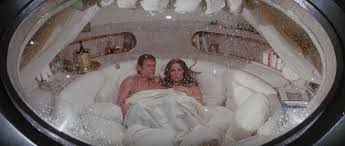
Connection – This is a weird one. (Surprise.) The film is called The Spy Who Loved Me and theme song is sung by a female so it’s reasonable it’s about Anya being loved by James. In the film Stromberg says Bond is “in love with a Russian agent.” But it doesn’t seem like either are in love with anyone. Anya seems to forgive him after finding out he killed her boyfriend, but it doesn’t seem the least bit romantic. This is the aloof Bond of the seventies. Even Q and Moneypenny are kept at arm’s length. Regardless, the film ends with James and Anya bobbing in the ocean in a luxury escape pod, complete with a bed and a chilled bottle of Dom Pérignon ’52. The pod floats into a cruising British destroyer where M and the British Ministers of Defense peer in through the window to see the two spies in flagrante delicto. “Bond! What do you think you’re doing?” asks the defense minister. “Keeping the British end up, sir.” And scene.

Toxic Masculinity Score: 6

Summary Watching this movie took me right back to the summer of ’77. The underwater submarine car battling frog men with their own subs was bliss for a 13-year-old boy. Catching a glimpse of Bach’s boob while sitting next to my dad was both terrifying and titillating. (See what I did there?) No part of me questioned the silly logic of the plot. Now I look at through the lens of 48 years of media. Stromberg has hundreds of henchmen all in red suits, like they were the henchmen of Squid Games. I wondered, who made these suits? Did Stromberg buy in bulk? Are they one size fits all? And do these henchmen get benefits? They all seem to be willing to die for him (and they all do). There should at least be life insurance in their benefits package. And dental.

The Spy Who Love Me, through that modern lens, has a pretty dim view of women. Bach, a few years after the film, said as much, telling People Magazine in 1983 that in the film Bond, “is a chauvinist pig who uses girls to shield him against bullets.” Moore himself said much the same in the 1970s. “Bond, like myself, is a male chauvinist pig. All my life I’ve been trying to get women out of brassieres and pants.” At least Bond doesn’t smack any women in this film on his way to thwart the accelerationist doomsday plot of this episode’s mad genius. While the mushroom clouds over the Atlantic might dampen the joie de vivre of the cold warriors warming things up the film’s climax, were left wondering will the aging Commander Bond will run out of notches on his belt before producers run of out of Ian Fleming novels to film.

Next: Moonraker (1979)

The James Bond Project #10: The Man with the Golden Gun (1974)

The James Bond Project #9: Live and Let Die (1973)

The James Bond Project #8: Diamonds are Forever (1971)

The James Bond Project #7: On Her Majesty’s Secret Service (1969)

The James Bond Project #6: You Only Live Twice (1967)

The James Bond Project #5: Casino Royale (1967)

The James Bond Project #4: Thunderball (1965)

The James Bond Project #3: Goldfinger (1964)
The James Bond Project #2: From Russia With Love (1963)

The James Bond Project: #1: Dr. No (1962)

The James Bond Project: #1 – Dr. No (1962)

December 27, 2024

As a latchkey kid who grew up on the 4 O’Clock movie (with a father often away on sales trips), most of my young models of masculinity came through the family color TV. Those films offered me the standard trinity of white manhood: John Wayne, Elvis Presley, and James Bond. All three were good with their fists and spared few words for the ladies. John Wayne was the iconic “strong silent” man who solved problems with a gun. In the 2000s, I taught a summer class at Portland State University called, “Hollywood Elvis and Post-War Masculinity” that used Presley films to explore changes in parameters of male roles. But it was Bond that I most wrestled with as a feminist man. Was he a patriarchal archetype or a subversion of it?

After the 1996 film Swingers brought back lounge culture, I found myself fantasizing about the Sinatra swagger and the Bond confidence. I’d sit at the roulette wheel in casinos in Old Las Vegas, on Fremont Street, dressed in a vintage suit, surrounded by frat boys in khaki shorts and backwards baseball hats. Was I an agent of the backlash or mocking gender, the same way drag queens deconstruct femininity? And now, what is the relevance of Bond’s manly schtick in MAGA America, where sex offenders are running the show?

So I decided I need a winter binge to address the question. The James Bond Project is intended review every Bond film, from 1962 to the present, to glean insight into the gendered appeal of 007, genital warts and all. And here’s the matrix for our evaluation:

  1. Driver of Action – Team player or rugged individual?
  2. Role of Violence – Body count
  3. Vulnerability – Behind the mask
  4. Sexual Potency – Lady “killer”
  5. Connection – Autonomous into the sunset

Toxic Masculinity Scale  (1 to 10)

Dr. No (1962, directed by Terence Young)

The first Bond film is based on the sixth novel in Ian Fleming’s famous series on the British spy and is set against the backdrop of Kennedy’s Space Race. Producers cast Sean Connery, 31, after Carey Grant said he wasn’t interested in playing Bond more than once. Dr. No, released October 5, 1962 (less that two weeks before the Cuban Missile Crisis), introduces all the series staples; “Bond, James Bond,” “Shaken, not stirred,” a license to kill, SPECTRE and the underground lair, creative ways to kill the heroes, and Bond hitting on Miss Moneypenny.

My first thought watching it was that it was nice to see so many black people in a movie from 1962. I’m used to any film made before 1968 being made by, for, and about white people. Dr. No is set in Jamaica, so the cast diversity makes sense. The Caribbean was a common Bond locale (and where I saw my first big screen inter-racial kiss – more on that later). Jamaica was granted its independence in 1962, but in the film it still feels like a British colony. No reggae yet, just limp calypso and CIA officers hanging around airports. But it gave the world its introduction to 007 James Bond, the suave spy with a license to kill.

Driver of Action – There is no doubt that Bond is his own man. His boss, M, tries to replace his Beretta handgun with a new model, which James (unsuccessfully) tries to sneak out of the office. Other than that and a scene where Bond and Honey Ryder (played by Bond “Girl” #1 Ursula Andress) pass out after drinking Dr. No’s drugged coffee, there is never a moment where Sean Connery’s Bond isn’t in complete control. There are car chases, jungle chases, and scenes where Bond outsmarts would-be assassins (including smashing a tarantula to an epic musical score). Even though, for part of the film, he has a black sidekick named Quarrel and female accomplice (Honey Ryder), Bond drives the story and camera lens.

Role of Violence – 007 takes out a handful of baddies, including a corrupt geology professor and some blokes who go over a cliff in a fiery crash. “I think they were on their way to a funeral,” he quips. Compared to the massive body count of your average John Wick movie, there is surprisingly little violence in Dr. No. I found myself wishing 007 had watched a few of my favorite Kung Fu self defense reels on Instagram to better defend himself from henchmen and CIA operatives. Dr. No doesn’t even try to kill Bond, although he does strap Honey Ryder down to be drowned by a rising tide. Spoiler alert: Bond kills Dr. No in a radioactive pool.

Vulnerability – There is no moment when James shows any weakness or gives us any backstory. Was there (ever) a Mrs. Bond? Does he have a panic attack if his martini is stirred? Does he ever suffer from erectile dysfunction when bedding double agents? This may be the feature that resonates with men so much. Bond is a cartoon character of a man with no internal monologue, just commanding action.

Sexual Potency – This isn’t a Doris Day movie. Bond gets plenty of play. At the start of the film he beds a woman he meets playing baccarat in a casino. Her name is Sylvia Trench, and we’re off to the races for how women are named in Bond films. Then he spends a night between the sheets with MI-6 secretary Miss Taro, who is (of course known to James) working for the bad guys. Surprising to no-one, he ends the film in the arms of blonde bombshell Ursula Andress, bobbing in a dingy in the Caribbean. In the scene with Miss Taro, unprompted, he grabs her and kisses her, reminding me of Trump’s comments in the Access Hollywood tape. “You know I’m automatically attracted to beautiful… I just start kissing them. It’s like a magnet. Just kiss. I don’t even wait. And when you’re a star they let you do it. You can do anything.”

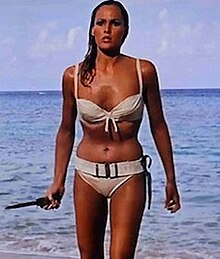
Connection – Bond has passing connections with Quarrel (played by John Kitzmiller) and American CIA agent Felix Leiter (played by Hawaii Five-O’s Jack Lord), but they’re just vehicles for Bond to complete his mission. Bond even seems briefly sad when Quarrel is burned alive by the bad guys. But James Bond is the model of the autonomous male. He is a self-contained unit who doesn’t “need” anyone. Sex is transactional, not romantic. Even the end scene with Honey Ryder is not a “and they lived happily ever after” moment. You get the feeling that Ryder, in her iconic white bikini, will be dropped off at the next beach as 007 jets off on his next mission.

Toxic Masculinity Scale: 5/10

Summary – Watching a young Sean Connery chew up every frame he’s in is infinitely entertaining. Yeah, Ursula Andres on the beach (knife in hand) is a classic male gaze moment where even Bond says, “I’m just looking,” but the gaze is all on 007. There’s even a scene where a female concierge in a Kingston hotel stares at Bond’s ass. James Bond is the spectacle. All eyes are on him. It’s man’s world. Dr. No is 55 years before Patty Jenkins ground-breaking Wonder Woman movie. Action is man’s work, with bikini-clad damsels in distress.

Fortunately, there is no homophobia or overt misogyny in Dr. No. Women are beautiful and disposable but also strong, with agency. No bimbos in Bondland and toxicity is toned down in the Kennedy era. The film establishes the archetype of the autonomous “love ‘em, and leave ‘em” hero franchise to be mimicked by countless others, from Matt Helm to Austin Powers. At his core, Bond is always cool and always in control. Men want to be him and women want to be with him. But we all want to know, its that all there is?

Next: From Russia with Love (1963)

What is the feminist position on the COVID-19 pandemic?

May 19, 2020

The nice thing about having a “paradigm” is that there’s a formula to plug in to when challenging issues emerge. Liberals and conservatives, religious fundamentalists and scientists all have “narratives” they can utilize to make sense of the world. Similarly, feminists have a good starting position, that elements in society work to uphold patriarchal male power structures or challenge them. That’s feminist thinking in a tiny nutshell.

Unknown

So what’s the feminist position on the coronavirus?

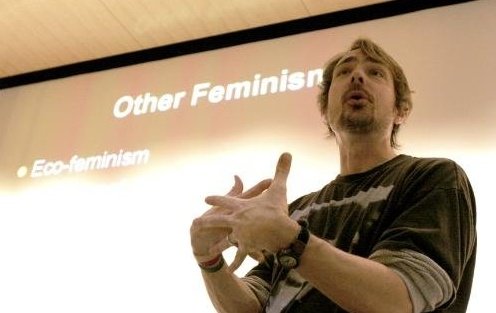
Feminism is not monolithic. There is as much debate within feminist circles. Just mention Hillary Clinton. A liberal feminist, a radical feminist, a Marxist feminist, and an eco feminist walk into a bar… So rushing to a feminist position on a global pandemic is harder than it looks. Even after three months of pondering the matter.

While no feminist would celebrate sickness and death (that’s a male thing), there could be a feminist “I told you so” element to this mess. Mother Earth might be offering humanity a time-out for the bad behavior of waging war and dumping killing pollution. Eco feminists highlight the importance of healing and with endless wars and traffic jams on pause for a minute, we get to experience the joy of a planetary healing. There are sea turtles on Miami Beach and dolphins swimming in the canals of Venice! Will we really want to return to the nasty business as usual after this micro-organism mandated retreat? Regardless, the lesson remains that man does not control this planet.

Unknown

And here’s a little “gender equality amid pandemic” point that my wife brought up; Zoom as a great equalizer. Zoom and other remote meeting platforms have become the new way to exist publicly. My classes have weekly Zoom meetings. On these platforms every person has an equal space, both in terms of the size of their video box and their volume. (“Everyone on mute?”) Since we are working and learning from home, the impression management is way down. Women don’t have to do their makeup and men don’t need a tie. We’re all equally casual in our Brady Bunch grids. I’ve done lecture videos after waking up from a nap and done interviews with a beer in my hand. There’s no judgement in a pandemic. We’re all in this bad hair day together. And if a woman is Zooming in to work with a toddler climbing on her neck, all respect for her for even bothering to unmute her video.

The other side of the ledger is less hopeful. There’s plenty of reasons to see this nightmare as another opportunity for patriarchal power grabs. The first thing to come across the wire when all this started was the impact that the lockdown was having on women who were in domestic violence situations, trapped in spaces with their abusers. By April, reports of calls spiking to domestic violence around the globe made the sad trend undeniable. Women began passing desperate messages in code to pharmacists, hoping for a lifeline away from the violence. Similarly, young LGBTQ people who are stuck at home with homophobic adults must be praying for the moment for this whole thing end.

The women on the frontline of the pandemic have taken the brunt of the risk. Working in health care and food services, taking care of the elderly, they are the most essential of workers, and the most expendable when the crisis hits the fan. They clean the bedpans of the infected, while Ivanka fixes her father’s make-up.

images

As is the norm these days, Donald Trump simplifies things for us. Watching him puff up his chest in his daily performance as the manly man in charge (He don’t need no mask!), is just a lesson in the absurd limits of masculinity. (The fact that he’s claiming to take hydroxychloroquine just adds to his soft orange underbelly.) But it’s not his buffoonery that props up patriarchy, although if a female leader demonstrated such incompetence, with nearly 100,000 Americans (so far) dead, she would have been eaten alive.

It’s Trump’s “war-time president” rhetoric that’s the big gender reveal. While things are cooling down on the battlefields of Afghanistan, Syria, and Yemen, look at how quickly we long to be going to war against something. And like those wars, it’s always futile. The War on Poverty, the War on Crime, and the War on Drugs didn’t end poverty, crime, or drugs either. And some would argue that they made those problems worse. Likewise, the war on Trump’s “invisible enemy” won’t “defeat” COVID-19. We learn to live with disease, and adapt to the coexistence. If you’ve ever gotten a flu shot or worn a condom, you have participated in that adaptation. Trump’s war has inflated the curve, not flattened it.

Unknown-1

When he refers to the “invasion” of the “Chinese virus,” (most infected folks entered the U.S. from Europe), he’s playing into the “Us vs. Them” binary that masks the naturally complex path diseases take. But he has to keep it simple for his simple base. This has involved the president of the United States of America sending tweets to quasi-domestic terrorists. His call to “liberate Michigan” (governed by “that woman,” as he calls her), and other states governed by Democrats, has triggered the anti-government militia men. Armed with AK-47s and rocket launchers (seriously) these “freedom” lovers in MAGA hats (and a handful of “their women”) have been seen on state capitals, spreading their germs and threatening to launch a civil war if they don’t get back their God-given right to go to the mall to buy camo wife-beaters.

Screen Shot 2020-05-19 at 12.26.52 PM

The “War on” rhetoric is tired but it works. It gets boys to men ginned up to go in to battle. And like all battles, there are casualties. The workers in the meat packing plants in Iowa who have died with ventilators down their throats are just abstract statistics to his base. And mostly brown statistics, at that. Ivanka is still healthy and the family stock price in hydroxychloroquine is only going up. As Sartre once wrote, “When the rich wage war it’s the poor who die.” Trump, the four-time draft dodger, is great at pretending to be a warrior (remember his celebration of “his generals”?), but the men, women, and children who will suffer and die because of his hubris are evidence of dire limitations of the blade and the perils of unchecked toxic masculinity.

So has this virus reinforced patriarchal power and the oppression that comes with it?

While we take a break from mass shootings and realize the great labor of all the women who stayed home with the kids without pay, I’m hoping we can use this moment to deflate the dumb puffed up chests of male rule. We have a moment to just talk to each other. Just think of all the conversations husbands are having with their wives because there is no basketball on TV. If ever there was a time to listen to women, it’s now. Maybe, anti-government/pro-Trump “protestors” aside, the earth is turning the corner. We’re ready for a paradigm shift.

images-1

“Speaking for all feminists…”

July 28, 2017

I’ve never pretended to speak for all male feminists, let alone all feminists on earth. I don’t even speak for my own feminism from a year ago. Life, its lessons (and a few good articles in Gender & Society) have their impact. Just like a person can’t step in the same river twice, one’s understanding of the world is constantly evolving. Take a look at Donald Trump. A year ago he pledged to be the advocate of transexual Americans and now he’s throwing them under the bus to divert attention from his multiple dumpster fires. He’s (de) evolving!

22e450699610f6dfcd16b9c570d4e2ae1ff3ce49

When I taught feminist theory at Portland State University, I would warn students about people who painted feminism with broad brushstrokes and feminists as simplistic caricatures. People like woman-hating personality Rush Limbaugh, who is fond of using the therm, “femi-nazi.” People who think being pro-woman means being anti-man. People who can’t even define feminism but spend their free time making the feminist-bashing memes that litter the internet.

Feminisms

The reality is that feminism is a many splendored thing. It’s a huge umbrella under which there are multiple ideas about gender relations. I’ve spent some time on this blog discussing liberal feminism, Marxist feminism, radical feminism, and Riot Grrrl feminism. There’s first, second, and post-modern third-wave feminism. Eco-feminism has a voice but so does free-market feminism. There are Muslim feminists, Catholic feminists, and conservative feminists. Even Sarah Palin calls herself a feminist. There’s also a growing phalanx of male feminists who I hope will become the fourth wave, smashing male domination from inside the old boys club.

Ain't_I_a_Woman

There’s plenty of disagreement within these camps. Just read bell hook’s first book, Ain’t I a Woman: Black Women and Feminism (1981). In it she writes, “It is obvious that many women have appropriated feminism to serve their own ends, especially those white women who have been at the forefront of the movement.” There are plenty of people who call themselves feminists in the pop world and have no idea what intersectionality is (and I’m guessing that includes Ms. Palin).

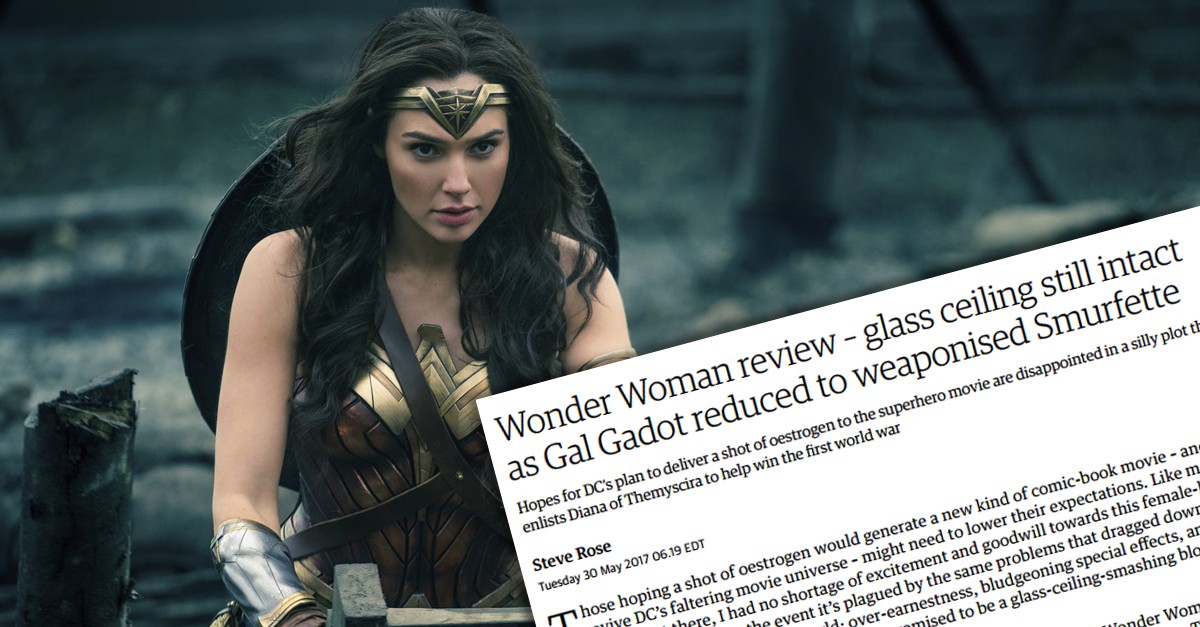
So to say, “feminists think…” is hugely problematic. What is the feminist position on the Wonder Woman movie? I’ve read dozens of different positions, all rightfully feminist. The people that paint feminism with a broad strokes don’t truly understand what feminism is and is not. I got some chuckles when I presented a paper at a conference in the late 1990s making the case that the Spice Girls were an effective vehicle for teaching tweens about feminist principles. Nearly 20 years later there are a lot of millennial feminists making that exact same case.

wonderwomanreview

What feminists of every stripe have in common is a belief in patriarchy, a power dynamic that advantages men. Some see that as a individual level thing, like men’s use of violence against women, some see it as a macro-level systemic thing, including any religion that defines God as “He.” Even more see it as both. But after that, all bets are off. I often argue that all women understand the presence of patriarchy, whether it’s the glass ceiling at their job, or their rapey uncle, or the constant pressure to “look good” in the face of the tick tock of age. They might not have the intellectual vocabulary to “frame the present discourse,” but all women are feminists IMHO. Even anti-feminist women have a feminist brain.

5bb8b3b32a3e46241560a6bc6c6cd9b3--feminist-men-feminist-apparel

There are plenty of aggro feminists who don’t think men can be a part of the dialogue, just as there are black activists that don’t think there is room at the table for white allies. I get it. As a white person, I can dip into the struggle for black liberation when I have time and pat myself on the back for being “woke.” My male privilege is the same thing. I can work to smash patriarchy, but I’m still benefitting from that patriarchy even when I’m in the middle of a woman’s march. “Look, it’s a man here to save us!” I’ve been tackling both the issue of male privilege and white privilege in my Recovering Asshole podcast and some of the conversations have been challenging for this “woke” white boy.

There is this emerging concept of “solidarity work” – showing up to the liberation work of groups you don’t belong to.  It’s all about being ready to take a backseat and asking how to help. That means men can be feminists but they have to know when to shut up and listen to their female compatriots. Since men have traditionally been the “voice of authority,” it can be a new experience for guys to STFU, especially when males have been taught to disregard female voices. Remember when Trump said he didn’t think Hillary Clinton had the stamina to be president? I guess by “president” he meant “playing golf every weekend.”

Without a doubt there are people who have hijacked feminism for their own purposes. This includes the “victim feminists” who see all women as inherent victims of men. This is not feminism. These fake feminists erase women’s agency, including to be sexual beings who want what they want and have every right to go after the shama-lama-ding-dong. Consenting adults, even the female ones, can get up to some freaky hanky skanky. (This is a theme in my recent book, The Dream Police.) No leading feminist, not Andrea Dworkin, not Catherine MacKinnon, has ever said “All sex is rape.” But the enemies of feminists repeat this fake feminist mantra, and it’s not just Rush Limbaugh doing it.

19642350_10156300620289307_1521911312314035147_n

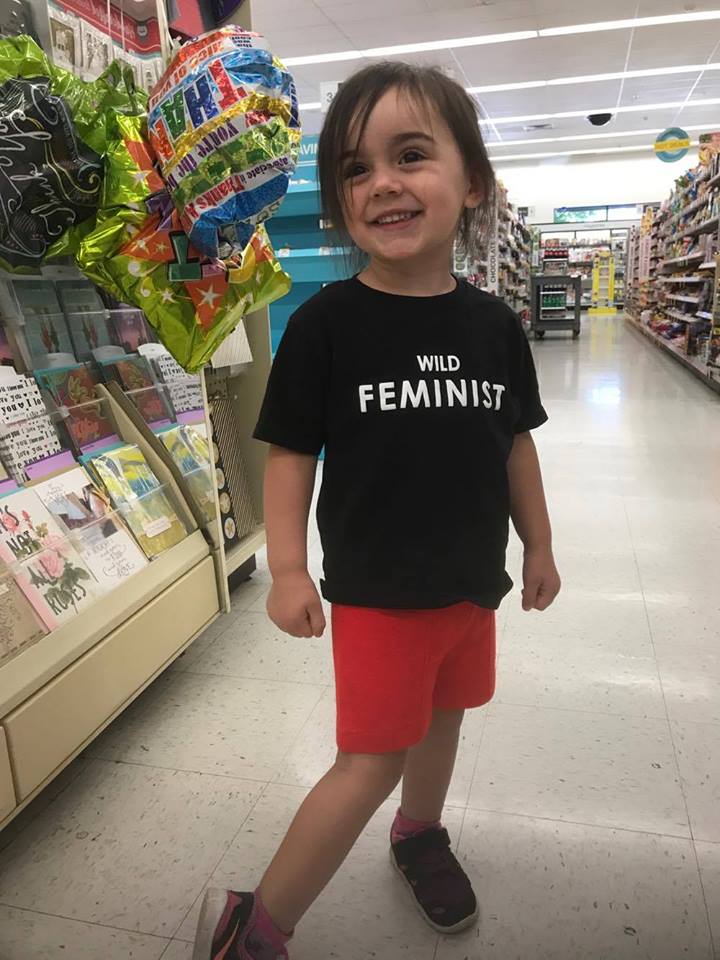
There’s a whole world of feminism to explore, something for everyone, and none of it is set in stone. People’s perspectives evolve. Just ask a roomful of feminists whether or not transwomen are part of their struggle. You’ll get lots of answers. Then ask that same room six-months later. My own feminist path as been a jagged path with plenty of missteps. Becoming a father of daughter certainly has played a role in that. So beware of anyone who claims to speak for all feminists. You just can’t have that many brains in one head.

SaveSave

Trump Lessons 1: Is this sexist?

December 22, 2016

In this holiday season, I’m looking for silver bells and silver linings. Barring a half dozen dead hookers being found in a closet in Trump Tower, this practical joke on America is going to be sworn in as president on January 20th. The educator in me wants to figure out how this is a “teachable moment.” How can we glean some value from watching the United States jump the shark?

screen-shot-2016-12-22-at-8-48-33-am

As a feminist scholar, there’s a game I play in the classroom when trying to reveal the nature of cultural power imbalances. It’s called, “Put the Stiletto on the Other Foot.” If you want to find out of something might be sexist, flip the sexes and see how plausible it might be. Would there be much a debate about abortion if men got pregnant? What if men were evaluated primarily on their looks instead of their acts? Hey, how about if sorority houses were known for sexually assaulting male students? What if all the men in congress dyed their grey hair and the women in congress didn’t? We could go on and on.

cqfj6pfxeaexoyd

One of the best examples of this was during the Trump-Clinton contest. A meme went around that asked what the media chat would be Hillary Clinton had five children with three different men? What if Hillary Clinton bragged about grabbing men’s penises and moving on them without restraint? What if Hillary Clinton walked into the dressing rooms to catch boys naked because she owned the contest they were in? Can you imagine?

The point is that there’s an ancient Affirmative Action program called patriarchy that gives men a lot more latitude for bad behavior. Just like our black president had to be the perfect scandal-free executive and it still wasn’t enough, women have to meet a standard far above their male colleagues. On the surface, there should have been no choice between an overly-qualified states-person and a ham-fisted, morally challenged (at best) buffoon. But one was female and held to a completely different and unrealistic standard. Welcome to the world of women.

15665769_10154358746931051_2964346752531070975_n

So, for the next four years, every time Trump gets a pass at something that Hillary Clinton (or any other woman, for that matter) would have been raked over the coals for, let’s all shout, “There’s the gender card!”

Much was written during the campaign about the sexist double standard in evaluating the candidates. This includes Trump’s countless and daily (hourly?) lies while castigating everyone else as a liar. “Lyin’ Ted,” “Crooked Hillary.” How did he pull it off? If she called him on his shit, she was instantly labeled a “bitch.” It was a no-win situation, invented long before Mr. Trump came along. Smile, honey, but not too much.

The campaign is over. The Russians, I mean, Trump won. But the shit show is just starting. The bar for both Donald and Melania has been dropped to the sub-basement by the droogs that voted for him and continued to support him even after he told them to their faces that 90% of what he said at his rallies was complete bullshit. “Yeah! Huh? Yeah! Drain the swamp!”

white_mans_burden

The Stiletto on the Other Foot game has lots of other applications, race being the most obvious one. This time imagine if Obama had five kids with three different women and bragged about sexually assaulting women and then tried to write it off as “locker talk.” These mental games often allow folks to get creative. There’s a clever 1995 film called White Man’s Burden, starring Harry Belafonte and John Travolta. It imagines an alternative America where black and white positions in society are switched. The movie bombed. Just too much to process I guess.

with-jews-you-lose-ben-garrison-310x165

I’ve been thinking lately what would being said right now if Trump was Jewish. With all his “conflicts of interests,” pay-for-play tactics, insider trading positioning, and cabinet filled with Goldman Sachs loyalists, he would be viewed as the worst stereotype of the Jew. As it is, his neo-Nazi (alt-right) followers haven’t even noticed. It’s good to be the king!

I imagine we’ll have a chance to play this game every day for the next four years (unless he quits because people stop believing his “just trust me” mantra). The silver lining here is that it should awake a whole new generation of feminists who start telling the men in their lives, “Don’t think you can get away with it just because Trump can.” Then the next question should be, “And why can he get away with it if you can’t?” Donald Trump is the poster boy for white male privilege and he’s going to exalt that to his dying day. He’s clueless. His presidency will do more to discredit unchecked male power than all the Women’s Studies classes in the world.

proxy

A Star Wars for Our Daughters

December 19, 2015

There are no major spoilers in this post about The Force Awakens, including anything about the Wookie-Ewok wedding at the end of the film.

Now that the long wait is over, I can reveal what makes The Force Awakens perhaps the best Star Wars film of the series. This opinion is greatly influenced by the fact that I am now the father of a little girl and have a vested interest in the world being a fairer and kinder place for females.

When the first Star Wars film came out in 1977 I was a 13-year-old boy waiting in line for the first screening at the Lefont Tara theater in Atlanta. The word was out among comic book and sci-fi fans that this was a different kind of space movie. I bought a program that listed all the actors who would soon be icons. When that giant Empire ship moved across the opening scene, all our jaws dropped. I don’t remember any girls in the audience but there must have been a few.

comicon77

Later that year, at the Atlanta Comicon, I entered a costume contest. We didn’t call it “cosplay” yet. In honor of the Marvel Kiss comic book, I went as Paul Stanley. I was beat out by a Jawa and a Sand Person. Star Wars had taken hold of the universe.


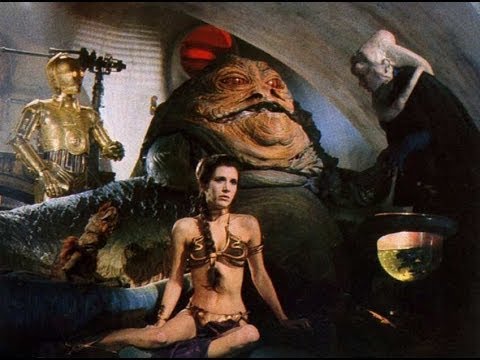
hqdefaultWhen the third Star Wars film, The Return of the Jedi, came out in 1983 I was a 19-year-old college boy (I saw it opening day at Phipps Plaza in Atlanta). This is the film where Princess Leia (Carrie Fischer) is enslaved by the grotesque Jaba the Hut and forced to wear a bikini with a chain around her neck. The image was featured prominently in the movie posters and promotional materials and is the only thing a lot of fanboys remember about that film. I should point out that badass Leia ends up strangling Jaba with that chain in what could be viewed the greatest feminist metaphor in all film history. (Similarly, I’m sure some claim Game of Thrones is feminist because a few of the many rapists on the show get beheaded. Um, no.)
Kim_Kardashian_Princess_Leia_costume-e1316495359256

But that image has remained iconic among the sci fi boy world. Not the killing of the slaver but the eroticizing of the slave. Carrie Fischer has said how much she resented director Richard Marquand putting her body on display in that scene. But how many boys wanted a slave Leia of their own? I’m willing to bet that 99% of comic conventions have at least one “Slave Leia” cosplayer in attendance with Jaba the Hut-like boys getting wood right and left. Even Kim Kardashian has worn the outfit. So there’s that.

I try not get sucked into the pop culture hype machine (Adele, meh.), but I would be lying if I didn’t say my 13-year-old self was reawakened by the fact that J.J. Abrams was doing the next chapter of Star Wars, the follow up to The Revenge of the Jedi. Besides the cool Star Trek/Star Wars link, Abrams is just two years younger than me and has the same reverence for the Skywalker mythology.

And a mythology it is, deeply rooted in the most ancient heroic tales. If you’ve never heard religion scholar Joseph Campbell (The Power of Myth) discuss the links between Star Wars and the ancient myth of the reluctant hero, you should. It’s a life-changing analysis. These are old tales. But they are typically stories about boys and men.

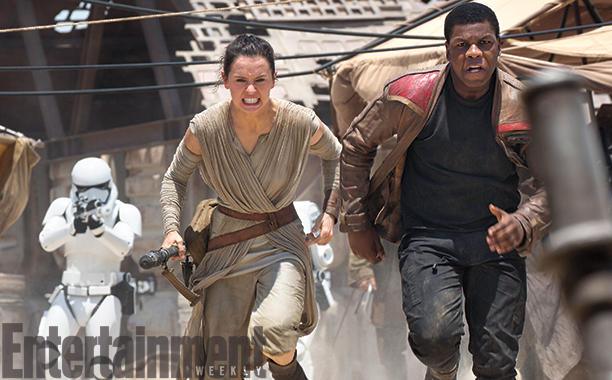
That’s why The Force Awakens is such an absolute joy. Yeah, it’s great to see our old heroes rolled out of the prop closet. (Harrison Ford looks only a bit more rusted than C-3P0.) But our reluctant Skywalker hero is now a female named Rey, played genderlessly by newcomer Daisy Ridley. The nearly all-male cast of the original has been expanded to include plenty of amazing female actors, including Fischer, Game of Thrones star Gwendoline Christie, and Oscar award winner Lupita Nyong’o.

The cast is also much more ethnically diverse, including Finn, the other reluctant-hero, played by black Brit John Moyega, and a Latino X-wing fighter named Poe (Oscar Isaac). This made my Mexican wife very happy but of course it infuriated racist trolls and Donald Trump supporters who lamented the “political correctness” of the casting and mounted a pointless #BoycottStarWarsVII campaign on Twitter.

star-wars-the-force-awakens-rey-finn

Having a female hero like Rey surely means a lot to the scores of female fans. When Finn tries to hold her hand during an attack by the bad guys, she rips her hand away and assures him that she can take care of herself. And that’s the sub-plot of the film. What at first appears to be a “damsel in distress” scenario gets turned on its head and here comes our girl to the rescue. (Sorry if that’s a spoiler.) Even Han Solo recognizes her badassness. She’s ultimately a Skywalker-Solo hybrid who drives a giant movie on her never uncovered shoulders.

There’s sort of a sad test to measure the “feministness” of a film called the Bechdel Test. Do two women in a movie have a conversation about something other than a man? Lots of  “chick-flicks” have a female heavy cast but the dialogue is often about their men (i.e. every Jennifer Lopez movie ever made). The Force Awakens has several scenes that pass including one with (now) General Leia Organa and Rey.

star_wars_poster_full.0.0

J. J. Abrams has a teenage daughter so I have to think he thought of her and how her experience sitting in a theater would be different than a girl sitting in the theater in 1977. Abrams and producer Kathleen Kennedy have given us an epic tale that puts a female protagonist at the center for at least three films (Star Wars 8 and 9 are scheduled for 2017 and 2019). Along with this year’s successful Mad Max film, it serves to rewrite the narrative that boys like action and girls like romance. (The other side of ledger would be films that deal with the romantic emotional lives of boys and men. Where is this generation’s Woody Allen?)

When we think about movies and video games that are targeted at boys and boyish men, there are usually lots of explosions, chases, shooting, and scantily clad women who need to be rescued. It’s a male-driven narrative. The Force Awakens has plenty of those tropes but seriously tweaks the primary one and that may be a game changer for a generation of fanboys and their sisters.

Like 1977 (and 1980 and 1983), I was in the theater Thursday for the opening night of The Force Awakens. I had our tickets months in advance. I could barely contain myself with excitement as I fell through a time hole to my adolescent self.  And like 1977, the theater audience was 90% male. (Do these guys have wives or girlfriends? Some brought Star Wars toys, though. That may be part of the puzzle of patriarchal pop culture.) When the John Williams score started and the Star Wars logo appeared on the screen, we all screamed with approval (as we did whenever any of the original cast of characters and spaceships appeared). The film was wonderfully loyal to the original trilogy in all the important ways, but was a huge departure in one very significant way. Hopefully that evolution continues. Carrie Fischer made it clear to her young female cast mates, “Avoid the slave girl costume.

Andrea and I always have a good conversation after a film and it was immediately clear how important it was to her to have a female protagonist in such a massively hyped film. She loved having a hero that looked like her. It was a subtle message buried inside an epic tale that all those boys in the audience will hopefully digest without even thinking, Oh, the main hero was a girl! That’s how change happens. After our post-film analysis, Andrea excitedly said, “I can’t wait until our daughter is old enough to show her this movie.” Me either.