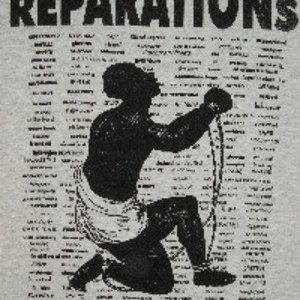
Thinking about Racial Reparations

June 10, 2018

Growing up in the Deep South you get to hear white people say a lot of foolish things. Things like, “I never owned a slave, why are black people angry at me?” And “racism ended with the Civil War. Black people need to get over it!” In 1992, a white student of mine at Reinhardt College (in rural Georgia) said this to me; “Racism ended in 1865. Black people are just complaining.” I asked him, “What day? There had be a day when there was racism and then a day when there was no racism that we can celebrate. There should at least be a stamp or a commemorative plate to honor the day that racism ended and black people just started complaining.” He had no response.

Unless you are Donald Trump, the self-proclaimed “least racist person,” you know that racism didn’t end with end of Confederate slavery in 1865. It folded into brutal lynchings and the madness of Jim Crow, and then institutionalized into the “war on crime” and every type of systematic racial bias you can imagine; housing, health care, hiring, and on and on. People of color know this in 2018. White people, not so much.

Obviously, this country still needs to have an on-going conversation about race, not a one-day Starbucks seminar. Having a successful black president for eight years didn’t solve the problem and kicking Roseanne Barr off ABC didn’t solve the problem. White people can’t switch on a Beyoncé song and proclaim themselves woke. I think some whites are figuring that out. But if you want to talk about racial reparations, all that white liberal wokenness goes right out the window.

923b1f378b7c14ec038ee5c2d2e9acf4_grande

I was one of those who was leery of the call for reparations for a crime from centuries ago but I should have not been so fragile. For decades I have lectured about the legacy of slavery and how the psychological effects of the enslavement of an entire race are still with us all, including with African-Americans. It’s not just rednecks waving the Confederate battle flag, declaring, “the South will rise again!” (That’s code, y’all, for bring back slavery.) It’s not even the persistent brutality towards young men of color by police. The dehumanization of the people of Africa is manifested in daily life. If you are black and your last name is Jackson or Lincoln, you family history starts with slavery. (Something those named Obama could sidestep.) If you’re black and worry that you’re not light-skinned enough or don’t have the “good hair,” that legacy is there. Do you think there might be a price tag for all that trauma?

Another thing you will hear white people say is, “Well, black people can be racist, too!” This is true but not in the way my cracker brethren think. Black people don’t think white people are inferior, but many think black people are inferior. Studies have demonstrated that many African-Americans have internalized the racism that the world has laid on them for centuries. Just ask a little black girl which is better, the black doll or the white doll. “Black is beautiful” tried to undo the imposed self-hatred but it’s still a light-skinned black person’s status that reminds those who are “too black” that not much has changed.

I was lucky enough to (briefly) serve on the dissertation committee of Dr. Joy DeGruy at Portland State University. She’s the author of Post Traumatic Slave Syndrome: America’s Legacy of Enduring Injury and Healing and it needs to be assigned reading for white people. She outlines the gut-wrenching inhumanity of slavery and how those deep psychological traumatic wounds are passed down from generation to generation. That blacks are savages, rapists, thugs, or (as Roseanne just tweeted) apes deserving of what pain comes their way persists to this minute. Where is the class action suite on that?

Screen Shot 2018-06-10 at 4.59.20 PM

There is a young black activist in Portland named Cameron Whitten who has really forced me to take the issues of reparations seriously. We are a long way from “40 acres and a mule,” but there are real ways we can talk about making an amends today for the sins of the past. He has started to host “reparation happy hours” (now “Power Hours,” since it doesn’t have to involve alcohol) where white people who get it can contribute to gatherings for black people. At these gatherings black people can build community, political agency, and, yes, leave with a little bit of cash. (There is something poetic about black people being handed a ten spot with abolitionist Alexander Hamilton on it.) It doesn’t make up for the cumulative impact of slavery but it’s a powerful symbolic act that has real, tangible value.

Of course the right flipped their shit. Fox News tried to paint Cameron as a huckster, playing on white guilt to put money in his pocket (a thought I probably have been guilty of in the past). For the record, he is doing this as a non-profit called Brown Hope. Still, the troll army came after him, lampooning the idea of racial reparations. “Get over it!” they screamed. “You had Obama! What more do you want?” Whitten appeared on a local NPR show last week and calmly laid out his case. I was in my car listening and a big ol’ black light bulb lit up over my head. It made perfect sense. Reparations are not some type of sociological blackmail and it is time to talk about it without fear of attack from the same old defenders of white supremacy, be they Fox News trolls or white liberals.
41EQlC7cDlL._SX322_BO1,204,203,200_

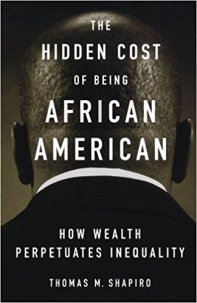
Think of being black in America as an invisible tax. Whether it’s the poorer health outcomes that come from discrimination in the health care system or decades of tobacco companies targeting black communities with their cigarette ads. Think of lost wages from job discrimination and lost wealth from housing discrimination that has prevented African-Americans from buying homes. (From 1934 to 1968, less than 2% of FHA loans for homes went to people of color.) Think of the cumulative stress of “driving while black” in a country that still sees police use-of-force disproportionately targeting minorities, not to mention all those traffic tickets I don’t have to pay because I’m not the one who is racially profiled. I could go on and on to the break of dawn, but I think you get the idea. There is a financial cost to being a person of color (this goes for brown, red, and yellow people, as well). This is a cost that I don’t have to pay and it translates to more money in my pocket. According to one measure, “for every dollar owned by the average white family in the United States, the average family of color has less than one dime.” My white privilege obscures the real reasons for this massive imbalance but it’s as real as the balance in your bank account.

We can’t undo the hell of racism in one happy hour or one generation. But we can acknowledge the price of racism financially. Don’t expect there ever to be a tax on white people to right the wrong. (You think racists like Trump are popular among “undereducated” white folk now…) But white people can think of ways to give to people of color in meaningful ways, even if it’s just supporting a black-owned business or buying someone lunch. Let’s deal with the actual cost of being black in America.
 

Confronting Ableism by “Looking” in the Mirror

February 5, 2018

I’ve got eighteen interviews in the bag for my Recovering Asshole podcast. Each of them has been a step on the path of me understanding my vast privileges. I’ve learned about white fragility and what it’s like to live in a large woman’s body. I’ve gained insight from transgendered, immigrant, and even left-handed perspectives. Perhaps the most revealing interview was the most recent one (#18) about disabilities and ableism. My desire to have this conversation was rooted in my fear about not knowing how to talk about and to people with physical and mental disabilities. My shame was the realization that, in my life, I had probably done more harm than good.

eugencartoon

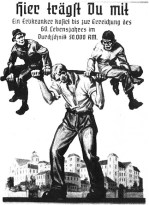
As a sociologist of extremism, I’ve lectured about the history of eugenics in Hitler’s Third Reich. The first act of the “Final Solution” was the “Law for the Prevention of Progeny with Hereditary Diseases.” All people with an “inherited disease” (which included everything from physical “deformities” to alcoholism) were ordered to be sterilized in an effort to perfect Germany’s Aryan “master race.” In 1939, Hitler began Operation T4 that killed over 70,000 disabled Germans and Austrians in one year, utilizing poison gas as a warm-up for the mass extermination of Jews and others in concentration camps. Of course, the United States had it’s own eugenics programs that included the forced sterilization of “unwanted” populations.

But, as usual, we are appropriately horrified by the extreme manifestations of such bigotries but are unable to identify the same tendencies and leanings in ourselves. “What could I possibly have in common with a Nazi?” we ask as we skip over a news story about the brutal genocide of the Rohingya occurring in 2018.

My podcast interview was with Grant Miller, who is a Portland disability activist who works with a great arts program called PHAME, and is working with Portland Art Museum on disability access issues.  I really wanted to dive into a conversation about how we even talk about people with disabilities. Does Grant “suffer” from a disability? Is he just “differently abled”? As I progressive as I think I am, I realized I didn’t even know what kind of language to use. I always tell folks, when in doubt about subjects like this, just ask the people themselves.

1928699_79721769306_7569519_n

I prefaced this conversation with caveat that my path towards empathy really began in 2002 when I had a brain hemorrhage and a subsequent stroke. I was in the hospital for almost a month and had to relearn how to walk. Suddenly, I was the guy holding up traffic as I slowly crossed the street with a cane. I reflected on all the times I had gotten angry because of the speedy norm of modern life. Hurry up!

You can listen to the interview yourself (or the read the transcription, which I hadn’t even considered until Grant pointed it out). It’s 60 minutes of me stepping in it. They are not “hearing impaired” people, they’re deaf. People aren’t confined to wheelchairs, they are wheelchair users. (Many people are, in fact, liberated by wheelchairs.) Even the way we use metaphors disregards the experience of the disabled. You can’t “walk in someone’s shoes” if they can’t walk themselves. You can’t have “you eyes opened” to an issue if you are blind. All this reflects our internalized ableism.

Sound_and_Fury

What we have in common with Hitler is the persistent belief that there is an absolute definition of what is “normal.” That if your hands, or legs, or brain don’t work the exact same way mine do, you are some sort of abhorrent deformity that needs to be fixed, no matter how invasive or traumatizing the process might be. My awareness of this was raised by a deaf student of mine at Portland State who shared a brilliant 2000 documentary about cochlear implants called Sound and Fury. Perhaps well-meaning doctors, with new technology on their side, have begun to “cure” deaf people with these fancy Star Trek-looking brain implants. What the documentary points out is that there is a thriving Deaf community that doesn’t need to be “fixed.” If we just bothered to learn their language (American Sign Language), we could’ve just asked them.

Screen Shot 2018-02-03 at 11.40.55 PM

And that’s the theme of the ableism – that “they” (people with various disabilities) should be more like “us” (people without disabilities) to be more “normal.” My city, Portland, had laws in the 1880s that are now known as Ugly Laws. They made it virtually illegal to be in public if you were “crippled” or “deformed.” You could be arrested and fined. There’s an amazing 2007 movie called The Music Within that’s about the birth of the disability rights movement, and there’s a scene in that movie (filmed in Portland) where a man with a severe case of cerebral palsy is trying to dine in a Portland restaurant in 1974 and is arrested under one of these Ugly Laws. That act was the genesis of the movement that gave us the Americans with Disabilities Act of 1990. It’s a powerful scene. How dare this man be disabled in public? He was making “normal” people feel uncomfortable!

Why were they uncomfortable? Could it possibly be their ableist privilege that was poking  them in their chest? But then maybe before getting all high and mighty about a scene in the movie I should look in the mirror.

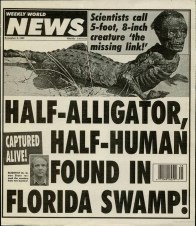
Alligator boy hoax specimen in Weekly World News

I was in high school in Stone Mountain, Georgia in the late 1970s and early 1980s. It was the period before the ADA began making institutions more accessible but after the period when the best career trajectory for the disabled was in a circus sideshow. (Although, I am old enough to remember the Florida sideshow attraction known as Alligator Boy.) It was a time when kids with disabilities were beginning to be “streamlined” into the general public school population and, like those white students at Little Rock Central High School in 1957, we weren’t exactly welcoming.

1910257_58602489306_3887_n

It sickens me to say this, but not only did we give those kids a wide birth, like their disabilities were contagious, we shared “funny” nicknames for them behind their backs. (I won’t repeat any here. Just know I am in tears as I write this.) I know teenagers can be cruel, but I have to think the obstacles these fellow Redan Raiders faced just to make it to the end of sixth period had to have been greater than anything I could imagine. And no doubt they suffered from their social isolation. I missed out not only their potential friendship, but being a better person by witnessing their courage in just showing up. I participated in their marginalization, no doubt diminishing their high school experience, but I also hurt myself in the process. I’m thinking of digging out my yearbook and trying to track them down to see if it’s not too late.

All forms of bigotry are based on dehumanizing people who don’t fit into the dominant group’s definition of “normal.” Blacks, homosexuals, Muslims, and even the left-handed have, at times, been defined as less-than or even sub-human. Slave traders believed Africans had no souls. (That was B.A. – Before Aretha.) People from Latin America without proper immigration papers are “illegals” or “aliens,” not human beings. There is no clearer example of how this tendency works than how we have demonized people with disabilities as “abnormal.” We might not be overtly racist in polite company anymore, but saying, “That’s so retarded” barely gets a reaction. Add racism, sexism, anti-Semitism, Islamophobia, homophobia to the recipients of those bigotries to someone who is also disabled and you get a recipe for some old fashioned hate.

csm_Rights-based-Model_01_55e64c53ad

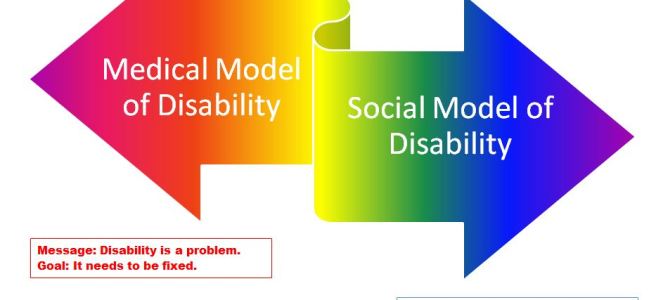
Our current way of thinking about disabilities, whether congenital or acquired, is rooted in the medical model. Disabled people have a problem and therefore are a problem, but one that can be, at least partially, fixed. And if not fixed, then we can find a place for them, either out of sight or working (for reduced wages) at Goodwill. The disability community is pushing for a more social model that places the root of the problem, not on the person, but how society is organized to marginalize that person. The barriers can be physical. (Are doors wide enough to accommodate people who use wheelchairs?) The barriers can also be our attitudes, including falling into the classic “us vs. them” dichotomy. There is only us.

According to the 2010 census, nearly one in five Americans experiences some form of disability, and yet so many of these physical and attitudinal barriers remain. I’d like to highlight that that means four in five Americans might be missing out on the benefit of the full participation of the the other fifth because of our fear or ignorance or indifference or belief that we are somehow more “normal”  than the disabled. Thanks to my conversation with Grant, I understand (I didn’t say “see”) this issue more deeply and am ready to be the advocate I should have been in high school. I see you. All of you.

SaveSave

It’s not the KKK in masks and hoods: Fighting hate without violence

September 15, 2017

I’ve been doing this anti-racism work for a long time. Thirty years ago I walked into the middle of a Klan rally in rural Georgia and held up a sign that said, “Racism is ignorance” and was dragged out by a National Guardsman. Racist skinheads set my scooter on fire, left threatening notes on my doorstep, and stalked me at my gym and outside my classes at Portland State. One night they plotted to severely beat me at a meeting in a bar, but I was tipped off to the plan and slipped out the back door. (I said I was going the john and just kept going.) I’ve had neo-Nazis post pictures of my house and car on the internet, post lies about me on gossip websites, and even post a fake Wikipedia entry about me. I was antifa before antifa was cool.

So when some snot-nosed teenage (white) anarchist tells me I’m a “privileged white guy” who doesn’t know how to stand up to racists, I just laugh. It’s kinda cute.

I’ve written in this blog about the legitimate political philosophy of anarchism as opposed to the black masked kids who think setting trashcans on fire will somehow “smash capitalism.” I’ve also written about how violence against the alt-right idiots only helps the alt-right idiots. And I will keep banging the drum of civil political discourse as long as there is something to (non-violently) bang on.

Pioneer

The alt-right gang was back in Stumptown this past Sunday, bleating about “free speech” and not making much of case for anything, other than how much they hate the “communists” who don’t like their free speech. Of course, being Portland, lots of amazing folks came out to protest them, to make their case loud and clear that Portland stands united against hate. There were Buddhists meditating, and school kids, grandmothers, and clergy, peacefully marching in opposition to the alt-right’s message of intolerance and division. I’m proud that my city’s values are so clear here.

Slingshot

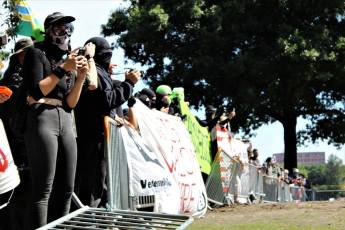
But there were also thugs. “Anti-Racist Thug,” as one of their t-shirts said. I don’t believe these are the core activists of Rose City Antifa. Antifa is not an organization, let alone a “terrorist organization.” Antifa is a movement against fascism and fascism has never seemed more like a real possibility in my lifetime than it does right now. Movements are inherently disorganized and can attract people for many reasons, including those who care more about thrill of the moment (and being in a riot can be a real hoot). Some are motivated by their own completely unrelated psychological issues. (I hate my father so I’m going to throw a rock at a cop!) Some are just followers, much like their hate group counterparts on the right, who are looking for a simple analysis of the world and a simple action plan to go with it. Like I said, I’ve ben doing this work for a long time and I have seen all of the above. Antifa has attracted all of the above and it might destroy their movement like so many movements before it. Calling Occupy Wall Street. Hello? Anyone there?

BlackClock

The events on Sunday were a mess. Alleged “Black Block” members allegedly threw bottles at cops and knocked down police barricades. Police allegedly threw a distraction grenade at counter-protestors and pushed a person allegedly video-taping the skirmish to the ground. An alleged Trump supporter in a parallel event across the river in Vancouver, Washington, backed his pick-up truck, with its confederate flag, into a group of counter-protestors, evoking the deadly car-attack in Charlottesville on August 12th. There were seven arrests made after some counter-protestors threw rocks and smoke bombs at the police. The guy that drove his truck into the crowd, strangely, was not arrested. I was glad I allegedly stayed home. Donald Trump has already used Portland’s “antifa violence” to justify his ignorant comments about Charlottesville, making more calls for Nixonian law and order. The greatest gift to fascists in this country might just be the thugs antifa is attracting.

I was frustrated that these agitators in masks and black hoodies were hurting our cause by driving away potential allies and giving Fox News more footage for their “violent liberals” narrative. Who wants to come out to a rally when masked trustafarians are throwing bottles at cops?  I administer the Facebook page for the Coalition Against Hate Crime and I posted, “FYI: When I protest racism, I don’t hide my face under a mask like a Klansman.”

Screen Shot 2017-09-14 at 11.36.02 PM

I should have expected the blowback from the fascisticly anti-fascist gang, one calling for me to be banned from the page (that I’m the admin of). When I tried to explain that one should be proud of protesting and showing their face at these rallies, I got accused of being a privileged media whore. When I said becoming a parent has reinforced my desire for nonviolence and empathy for the haters themselves, one woman said she couldn’t wait for my daughter to be old enough to call me on my “bullshit.” When one said they could care less how their violence played on Fox News, I said maybe they should if they care about the end goal. One antifan said I didn’t have to worry about Nazis coming after me.  I tried to let him know I’ve had to deal with Nazis coming after me for 30 years. I could hear Beyoncé singing, “You must not know about me.”

But there were some valid points made, including the fear of alt righter Nazis coming after counter-protesters, trolling them on the internet, or showing up at their workplace. They have a reason to fear this as it’s been their tactic against racists for years. Here we go round the mulberry bush. An eye for an eye. I get that much of this is a radical performance for radical peers. “Look how well I defend the black flag. I told Blazak to STFU!” And we get absolutely nowhere.

Screen Shot 2017-09-14 at 11.45.31 PM

I ended up taking down the post because it just became an attack on me by people who I had assumed were my allies in the struggle against racism. They consider me a collaborator because I work with the police and not against them. I might have accused some of them as being agent provocateurs working for the Trump camp, handing the alt-right evidence of their claims on a silver antifa platter. It wasn’t very productive. They’d ask me my solution to the problem and I said the hard work to reform the system. “Fuck that, revolution!” You let me know how that goes. How many burned-out cops are watching department budgets shift funds from community policing to over-time for this week’s alt-right/antifa wrestling match? How many city resources are spent cleaning up after the extremist boys on the right and left masturbate on our streets?

Notafraid

In the end, I think there are many paths and tactics in this cause. I admire the youth who are taking to the streets to stop our slide backwards. I was them at one point. Idealistic with simplistic solutions. I was fueled by the music of The Clash, not the analysis of NPR. Those kids are a big part of the struggle and should be supported but also guided by those of us who have done our time in the trenches. The one thing that we know absolutely does not work is violence. If fact, it only makes things worse. Young males have long romanticized marching off to heroic macho combat. Older veterans know nothing is won in the end. There’s a reason Martin Luther King, Jr. adopted the non-violent resistance tactics of Gandhi. Of course there were casualties in Gandhi’s struggle of Indian independence (and King’s). Heather Heyer, killed in Charlottesville, was just one of many casualties in the long non-violent struggle against violence in this country. And there will be more.

Hating the haters is not the solution. Understanding the haters is. I’ve said this many times; inside almost every alt-right Nazi white supremacist/separatist/nationalist asshole is an amazing anti-hate activist waiting to be released. You don’t stop a Nazi by punching him. You might by hugging him. Only love undoes hate.

A friend saw me in the weeds with these “revolutionaries” on Facebook and bailed me out by posting a video from a musician I dearly love, Michael Franti. I’ve followed his career from the Beatnigs, through the Disposable Heroes of Hiphoprisy, to Spearhead. I don’t doubt that most of these beautiful radical youth know his music as well. In a voice much more articulate than my post, he said exactly what I was trying to say. Stand up for love.

I’m working on crafting a statement of non-violence for our coalition. We can’t sink to the fascists’ level. We have a right to defend ourselves but if the alt-right is not actually using violence and we are, it just makes Donald Trump (God, I hate to say this) appear to be right. We have love on our side. We don’t need smoke bombs. If you want to wear a mask, that’s your choice. But I hope you will stand proudly as my ally and willingly be counted. Dr. King didn’t wear a mask, but the people he marched against did.

MLKhate

#PowerToThePeaceful

Postscript: It’s an important point that I, as a privileged white person, can walk away from the anti-racism struggle when I need a break from it. People of color cannot.

The Need to Work

June 22, 2017

Screen Shot 2017-06-21 at 11.07.55 PM

It was a blessing in disguise. My paternity leave from Portland State University was involuntarily extended thanks to a bizarre collaboration between a clinically psychotic felon and a couple of administrators with a clear agenda. That time away from full-time work has allowed be to help my daughter transition from a baby into a little person. It’s also allowed me to publish a book, teach on a tropical island, write this weekly blog, start a podcast, and “man” the homefront while my wife advances in the work world. And I got to be home with Cozy from the first gurgle to her saying things like “Let’s check it out,” and “I ran like a cheetah.” It’s been a beautiful experience filled with art, adventure, and great love.

And now it’s time for it to end.

Avengers

The truth is I’ve been looking for work ever since I jumped off the gangplank at PSU. But I had a nice cushion made up of a settlement, savings, some publishing money, and a perfect collection of rare Avengers and Hulk comic books that now (sadly) belong to someone else. A $50,000 loan from my retirement was going to get us through to my next gig. Now, suddenly, I can see the bottom of the well. The money is about gone. Invest the last bucket in Powerball tickets?

Two years ago I thought I could just make a local lateral transition. There was a visiting professorship at Reed College (they wanted a quantitative methods teacher and I’m a qualitative schmoe) and a tenure-track gig at the University of Portland (they could have me but only with my tenure). I was sad but not shocked when those didn’t pan out. (They must not have known how awesome I was.) So I branched out and got an interview at CUNY in Manhattan and then a second interview with the provost. (I must have asked for too much money for that one.) What seemed like it would be a relatively smooth “mid-career” move looked increasingly more and more difficult. On top of the fact that universities are replacing tenure-line professorships with the academic slave-labor known as “adjuncts” and “on-line education,” the person that was applying was me, and, according the rumor mill, I have baggage.

What started off as a few disheartening roadblocks became dozens of rejections. Some positions I was a stretch to qualify for. (I would have made an awesome dean at Eastern Oregon University.) Some positions I was definitely an over-qualified candidate. (After my great interview, nobody could tell me why I didn’t get the job teaching Intro Sociology at Green River Community College.) Some jobs would have pushed me out of my comfort zone. (Oh, how I wanted to be the new executive director of Caldera Arts.) And some jobs were tailor-made for my experience and skills. (Whoever ends up being the new Diversity Program Specialist for the Portland Police, I challenge you to an equity duel.)

Screen Shot 2017-06-21 at 11.14.08 PM

Why am I not getting these jobs? You’d think people would want an award-winning professor, published in his field, with a long record of community service, who is likely quoted in your copy of the New York Times or making points on CNN while you’re on the treadmill. Are all the other candidates that much better? Or is something else going on?

I left PSU under a cloud of suspicion. It’s no secret that there were a few higher-ups that had it in for me. They were fueled by the rumor and innuendo that I was some type of campus playboy. A old bogus post on an internet gossip site that had a picture of me with my girlfriend of almost three years and the assertion that she “slept with me for an A” gave them additional ammo. There was never anything of the sort ever in my academic career. No human can say they got any special treatment in any of my classes for anything. But when gossip rules, you can’t win. (Hillary Clinton, I feel your pain.)

189852_206461599364854_4341883_n

Then a “former racist skinhead” named Steven Stroud decided he was going to try everything he could think of to attack me for some perceived slight that existed in his psychotic mind. He began writing numerous letters from his prison cell to the university, accusing me of everything under the sun. Out of pure luck, he finally hit on one thing these powerful few could use.

My crime: My wife was a former student.

That’s all it took. Forget that Andrea and I were consenting adults. Forget that she was the one who first asked me me out (after the class had ended). That was it. I had signed an agreement five years earlier that I would never date a PSU student after a stalker went all Basic Instinct on me and it was a quick way to resolve the matter. Now the torches were relit. They even traveled out to Eastern Oregon to visit this guy in prison to see if there were any more salacious details he could add to their “case.” They were giddy.

debacgf14209599631510031254

I have zero regrets about my relationship with Andrea. We are incredibly happy and more in love every day. And that love produced our beautiful daughter. Cozy is the sun my little planet was destined to revolve around. She will change history. I would do it all over again in a heartbeat. My only regret is that I quickly settled my lawsuit against the university. I had the moral high ground and could have won, especially if I took the story to my colleagues, students, and the general public. But we had a new baby and I was scared I would burn up our nest egg on lawyer fees while they used tuition and taxpayer dollars to fund their highly skilled legal team. I settled and thought I could just leave my academic home of twenty years and move on.

18556255_10156124595989307_6168626835703788832_n

Now over two years later it feels like I have been blacklisted; that the rumor-mongers are still waging their campaign against me. I need to work. The loan has to be repaid, the mortgage is due, and my daughter deserves the life I waited 50 years to give her. (I was one of those people who said, for decades, “I can’t have children, I’m not financially stable enough!”) She is so excited to exist in this world, I should be able to give her some security (although I will be eternally grateful to WIC for making sure my child at least had $8 worth of fruits and vegetables each month). This kid already deserves more than I will be able to give her.

So here’s the deal: I’m a passionate worker with a PhD. from Emory University and a long employment record. My last full time salary was $82,000 for a 9-month contract. I will work for less than that, but it’s gotta cover the bills. And I need benefits. Republicans  have made it clear they want to kill the Affordable Care Act which, at the moment, provides health care to my family. We’d like to stay in Portland but for a decent job we’ll move to Arkansas and just annoy the locals by playing Bikini Kill and drawing Hitler mustaches on Trump posters.

Screen Shot 2017-06-21 at 11.27.46 PM

I was an awesome professor. There’s plenty of people who will tell you that my classes at Portland State changed lives. I’d like a job that makes the world a better place. If you can convince me that selling vacuum cleaners can do that, I’ll listen. But it’s time for me to get back to work. My family is depending on me.

Please share this with anyone who might be able to help. References and my mother’s secret cheesecake recipe available on request. Email: blazakr@gmail.com

SaveSaveSaveSave

SaveSave

Living with hate in Portland

June 1, 2017

It’s been a long time since my city had such an emotional week. Maybe in November 1988 when three skinheads murdered an Ethiopian immigrant named Mulugeta Seraw, ripping the scab off the supposedly liberal wonderland of Portland, Oregon. It showed us the ugliness underneath that had been there since Oregon was founded as the nation’s only “whites only” state in 1859. Last Friday that wound was opened times three.

170528-jeremy-christian-437p-rs_50e82a15c3f5776321b9dc9f6392bba9.nbcnews-fp-360-360

A local “patriot activist” named Jeremy Christian had been bouncing around on the fringes of the alt right movement. He had been seen seig heiling at a “free speech” rally earlier in the spring and around town going on racist, Islamophobic, and anti-immigrant rants. His Facebook page was all over the place, hoping Trump would be his new Hitler, idolizing the Oklahoma City Bomber, briefly defending Bernie Sanders against Hillary Clinton, and, most recently, wanting to kill those who perform circumcisions. He was an equal opportunity hate machine. And as the world now knows, last Friday that hate became lethal.

I used to ride Portland’s Max train a lot when I was single. It was often a source of free entertainment and a bit of sociological research. It’s a busted circus train where the human zoo gets to mingle. It might be obnoxious teenagers trying to size up an elderly woman dressed like she just climbed down from the Russian steppe. Or maybe a suave hobo trying to make small talk with a tightly-pressed banker. It’s never the same and always seasoned with a dash of risk. At any stop the anti-Christ might step on board and take the train to hell.

That’s what happened Friday when Jeremy Christian got on the Green Line on my side of town and started harassing two teenage girls who had gotten on the wrong train on their way to the mall. Homeless Christian started ranting that it was his train because he paid taxes and they should leave his country. One of the girls was black and the other wore a hijab, so Christian launched into a racist, anti-Muslim tirade. The poor girls had nowhere to go. Three passengers, Ricky Best, Micah David-Cole Fletcher and Taliesin Myrddin Namkai-Meche, tried to get the maniac to back down and Christian quickly pulled out a knife and stabbed each man in the neck, killing Best and Namkai-Meche.

Screen Shot 2017-05-31 at 11.13.14 PM

On Friday afternoon, while this was happening, I was on my way back from the University of Oregon in Eugene where I had attended a workshop on implicit bias. My thoughts were on beating the traffic to pick up Cozy from daycare. My mind drifted to my wife’s new job at an immigration law firm and the family of squirrels that had made a home in my attic, threatening to chew through our home’s wiring. While I was trying to pick which lane would get me home the fastest a man my same age, also a father, was laying on the Hollywood Max platform, bleeding to death and thinking his last thought. There’s a good chance I had met Ricky Best. He worked for the city and we often take city employees on our Fair Housing Council bus tour where we discuss Oregon’s dark history and encourage people to stand up to hate. Our bus driver is sure that we was one our riders.

18740549_10156157569119307_2796744250167759025_n

Those three men were the best of Portland; a Republican army veteran, a recent college graduate with a new job, and a PSU student who did spoken word poetry about Islamophobia. They were white men, not girls of color. They could have just thought, “Hey, this is not about me.” But it was about them. It was about us and how we stand together against the darkness. Riders on the train took off their clothes to try to stop the blood gushing from their necks while Christian, waving his knife, ran away. As Namkai-Meche gasped for life he managed to say, “I want everyone one the train to know I love them.”

When I first heard the news, I went into “official” mode. As the chair of Oregon’s Coalition Against Hate Crime I had to alert the network of community partners and start talking to our contacts in the Portland Police Bureau and the Department of Justice about an appropriate response. There were vigils to speak at and interviews to give to put this horrific crime in context, including on NPR’s All Things Considered. The “hate crime expert” hat was on and there was important work to do.

18788650_10156164860054307_1160053745_n

On Tuesday, I told a CNN crew I would meet them for an interview at the growing memorial at the Hollywood Max station. That’s when my expert hat fell off.

The Max station is now covered in chalk messages of love and tolerance, flowers, candles, and pictures of the stabbing victims. It was overwhelming, this complete coming together in an outpouring of collective grief and appreciation for these heroes. Two little girls were drawing chalk hearts on the pavement with Rick’s, Michah’s and Taliesin’s name in then. I thought about how much Cozy loves to chalk on the sidewalk and I broke down. How do you explain this kind of hate to a child? The next two interviews I gave they had to stop because I broke into tears in the middle of them. This wasn’t academic anymore, this was my community.

We’ve made so much progress as a society. All the measures show kids are much more tolerant than previous generations. HR departments have equity managers and police departments do trainings on implicit bias. Even in the middle of Trump’s wink and nod to our worst qualities which has unleashed a new permissiveness for hate and bullying, we’re still better than we were. Trump and his thugs are a passing fad. The moral arc of the universe is long but it bends away from bullies.

18767646_10104571223184098_1417967727855578614_n

At the memorial, I wept because I forgot that. I thought my 30 years of work on this issue amounted to nothing if hate mongers were still slaying good people on commuter trains. But all the work we do has paid off. We are better. There will always be monsters like Jeremy Christian, who see themselves as righteous patriots. They will fall through the cracks no matter how small we make them. Let us stand up to them each and every time. We’ve come to far to turn back now.

I got home from a series of interviews last night and saw that our cat had killed one of the parents of the baby squirrel that was living in our attic and just felt the weight of the grey Portland sky.

18882117_10156168340654307_8924107735561685801_n

An Anarchist and a Cop Walk Into a Bar

May 4, 2017

Little Beirut: It’s not completely untrue that May Day in Portland, Oregon is more celebrated than Christmas Day. May Day marches can bring thousands to the streets to show support for workers’ rights around the globe and whatever issue has people’s collective goat that spring. My first Portland march was in 1996 and there were some signs protesting Mumia Abu-Jamal’s death sentence and Bill Clinton’s deregulation of the internet mixed among the calls for worker solidarity. I had my union card in my pocket and probably a Smashing Pumpkins song in my head.

culture_1991-bushprotest1_ww_4227

Portland has long skewed left-of-center. If you’re a registered Democrat, you’ll likely get sneers, not from registered Republicans, but kids in Che Guevara t-shirts. The city was dubbed “Little Beirut” in 1990 by a member of the George H.W. Bush administration after Vice President Dan Quayle came to town for a fundraiser at the Hilton. There had been several anti-Bush demonstrations between 1989 and 1991, but this one unfolded in true Portland style, with Reed College students vomiting in red, white, and blue up-chucks and a man taking a dump on a picture of the Vice President. Now that the city has a rad nickname, each generation of radicals feels the pressure to raise the bar.

db24ac47-dfb2-432e-8f62-27258801e4d0-MayDayriot

The first May Day of the Trump Administration put Portland back on the CNN map. An initially peaceful protest Monday was quickly hijacked by Black Bloc anarchists, garden-variety trouble-makers, and probably a few agent provocateurs. By afternoon there was a fire burning in the middle of 10th Street, the windows of a cop car had been knocked out, and some 22-year-old  “revolutionary” smashed out the window of the downtown Target and threw a lit flare into the store full of people. I don’t think this is what Karl Marx had in mind when he wrote that capitalism “sows the seeds of its own destruction.” The Portland Police Bureau declared the formerly permitted march a “riot” and most peaceful protestors got the hell out of the sustained barrage. Even Portland State cancelled some evening classes, perhaps depriving some students from a lesson on what anarchy actually is.

Clash_tix82-06-02

Look, I get the excitement. I have all Rage Against the Machines CDs and used to play them really loud and scream along. “Fuck you, motherfuckerrrrrrs!” I was a punk in the early 1980s and spray-painted my fair share of anarchy symbols around Atlanta, including on a daycare facility. (I’m so sorry about that.) I even took a swing at a cop once. It was after a Clash concert in 1982. After the show, a brawl erupted in the sweaty summer street in front of the Fox Theater between members of the Revolutionary Communist Party and some Nazi-wannabees. Everybody else, charged up by the combat rock (The Clash’s final song was “I Fought the Law”), jumped in. Peachtree Street was full of punks and cops on horseback and 18-year-old Randy, who thought punching a police officer was the appropriate thing to do in such a setting. Luckily, I missed the guy who had more serious threats to attend to and I went off to the punk club and bragged about rioting in the streets to anyone who would listen.

There is a psychology of these events. Lord knows how many we’ve had over the decades. Social scientists have long looked at how angry mobs take on a life of their own and how a “herd mentality” emerges. When a like-minded crowd, excited about roughly the same thing and dressed similarly (whether its sports fans or black-clad anarchists), get together, there is a tipping point where the rational individual mind shuts down and the emotional collective mind ramps up. This is especially true when there is outside confrontation, usually with the cops. And it has to be added that most of the rioters are males acting out a hyper-masculine script in their “us vs. them battle.” I’ve seen it first-hand plenty of times and have been pepper-sprayed and tear-gassed for my observations. “Smash the state! Quick, lets get a selfie first.”

KILLCOPS

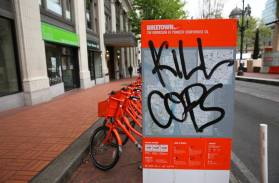
Monday’s riot took Little Beirut to a different level. It seemed to be motivated by a hatred of the police. Law enforcement officers had everything not nailed down thrown at them, including rocks, bottles, and fireworks. Besides the shop windows that were smashed and the bike tires that were slashed, “KILL COPS” was spray-painted on a street sign. I know these folks are opposed to the militarization of the police, but they’re pretty much encouraging the militarization of the police. It makes you think some of these supposed radicals are on the payroll of a defense contractor.

If you’ve read this blog you know that I’m anti-fascist. And the Trump presidency has moved this country closer to fascism than it has ever been. I also think intellectual anarchists, like Noam Chomsky, offer a path away from oppressive social systems. I get the antifa philosophy of “countering” fascism directly. (The FAQ on the Rose City Antifa website fairly clearly articulates their positions on the matter.) My whole life has been dedicated to countering neo-Nazis. I risked my life for years studying Nazi skinheads to learn how to do this. And I learned the best approach is to turn a Nazi into a former Nazi, not beat them into submission. That tends to have the opposite effect.  I’ve been to Klan rallies, Aryan Nations meeting, and had a couple of skinheads plan to severely beat me in a Portland strip club. I know Nazis and the Portland Police are not Nazis.

Kendra

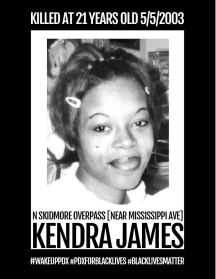
Like most metropolitan police departments, The Portland Police Bureau has had its share of issues, including the shooting of unarmed African-American citizens. (Every time I pass the spot on the Skidmore Bridge where Kendra James was killed in 2003, I get a chill.) And there was one officer who was probably a little too fond of Nazis, which didn’t help the matter. In 2000, the city commissioned a panel to study racial profiling and found, surprise, the bureau did engage in racial profiling. In 2012, the Department of Justice filed a civil rights lawsuit against the city because of police interactions with mentally ill civilians and the Portland Police are currently engaged in reforms based on the DOJ settlement. That’s a good thing. We’re moving forward together.

There’s no doubt that racism is an issue woven within the institutions of our society, including the various institutions of law enforcement, that devalues non-white lives. Based on our actions, the evidence is clear; all lives don’t matter. But there’s a seriously wide continuum between old school Bull Conner racist cops and harm done by seemingly invisible implicit bias. Post-Ferguson Report, these issues are now out in the open. Although, I don’t have much hope that our new Attorney General, Jeff Sessions, will continue the reforms being made in police oversight.

I know an awful lot of Portland police officers who don’t go to work every day to prop up capitalism or put down the little guy. The officers I know have more of a social work approach to policing and probably have more in common with the core values of true anarchists than the “boys in black” might guess. (I will exclude the “Anarchy!” thugs who just want to “fuck shit up” from this observation.) Sgt. Pete Simpson is the Portland cop you always see on TV talking to the local media. He’s a friend and former student of mine and I asked him what he would want the anarchists to know about his line of work:

SgtP

“I have been a police officer for nearly 23 years and I have worked with cops from all across the United States. Never once have I met one that said they look forward to going to work to support corporate America and oppress minorities. Quite the opposite really. Most officers I’ve ever been around want to go make their corner of the world slightly better every day — and a lot of those corners are occupied by local businesses and people of color who officers work to protect and serve. At a core level, officers might philosophically agree in some ways with “anarchists” about the things that are wrong in the country — but police officers have a different approach rather than to slash and burn.”

Screen Shot 2017-05-03 at 11.02.44 PM

I also know many anarchists and former-anarchists. They are on their own journey to make sense of the world how to most effectively address the serious problems we face. Like the Nazi skinheads I’ve studied for 25 years, some get pulled into a simple world of black and white with a subsequent action plan of “destroy everything and hope something beautiful arises from the ashes.” When I was 21, that seemed incredibly appealing and romantic. As a 53-year-old parent, I know the black and white analysis (“Capitalism is always evil!”) is problematic, at best. (Starbucks is not 100% evil. I’d say only 40-60% evil, depending on my need for caffeine.) I also know it’s better to get inside the machine and “fix shit up.” Maybe I’m just an optimistic 50-something, but I believe real reform happens.

There was a moment before one of the many Portland marches against George W. Bush’s pointless 2003 invasion of Iraq. We were making signs in the Park Blocks and a young anarchists with a red bandana over his face asked the crowd for some good quotes for his signs. I offered a few. “Government is not the solution to the problem, government IS the problem,” “Freedom is never more than one generation away from extinction,” and a few others. He scribbled them down furiously. “These are perfect! Who said them?” he asked.

“An anarchist named Ronald Reagan,” I said. He was not amused.

portland-arrests_custom-818bbea6beee412b8f8e378f85cdf5818fef01c2-s300-c85

Anarchism is a legitimate and important philosophy. I’ve taught its basics for years in my Contemporary Theory class. I’m guessing the rocket scientist who tried to set the Target on fire on May 1st would not pass the test on the subject. When people hear the word “anarchist” now they just think of violent thugs who want to murder the members of our community who work in law enforcement. Black Bloc might not all be agent provocateurs on Trump’s payroll, but they sure are reinforcing Trump’s narrative about the “violent left.” Not the best strategy of creating support for social change. Cool, in a Rage Against the Machine/rebellious youth sort of way, but not effective in reality. The 25 “protesters” who were arrested in the riot can only claim to adding fuel to the fire driving the drivel on Fox News. Capitalism remains unfazed.

On May 2nd, I was having an email chat with PPB’s chaplain. He had a little anecdote that said so much about the situation. “This morning at coffee I had a conversation with a young women who is friends with many of the Antifa people, and who was asking about racism and police brutality.  I think, from a honest position, her friends claim that there is out of control police brutality. And that none of the things the police claim are true, like destruction of property, aggressive actions, etc..  She came over to me and the officers seated at coffee with me and just didn’t know who or what to believe anymore.”

Karl

What if we got the anarchists and cops in a room together? What could they learn from each other? It might serve to humanize both sides. I was on one side of the “battle” until I started actually listening to people I thought I was somehow fighting. Turns out we’re all on the same side. As someone who has pretty much read everything Karl Marx has written (The picture of me at his grave in England in 1991 will surely surface if I ever run for office), let me end with a quote; “Let us seek our salvation through solidarity.” I promise that’s from Karl and not Ronald Reagan.

POSTSCRIPT: I realize this blog post might annoy some police officers AND sone radicals. If that’s so then my mission as a teenage anarchist is complete. Now dig this song.

The Dream Police Are Inside My Head

October 6, 2016

How do you go back in time and fix a mistake to change the course of your life? How do you channel all the things you are passionate about into one story of redemption or escape?

41adhf4m9gl

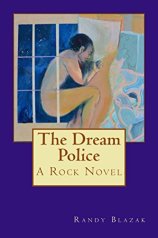
These were the questions I faced when I sat down to write The Dream Police early last year. The follow up to The Mission of the Sacred Heart was published this week and the Kindle version is available today. Like Mission, it is rooted in the true events of my life. Like Mission, it is a “rock novel,” a work of musical fiction, inspired by a classic rock album from my youth. And like Mission, it is a complex piece of literature that can’t easy be described in a quick elevator speech. But I think it is an important work that emerged from the plasma in my veins and the neurons in my synapses. So let me try to share with you why you might be interested in this story.

10001313_10152654051049307_1156545696_n

First and foremost, anyone who reads this will probably be able to understand why I had to leave my tenured position at Portland State University last year. There is a sexual paranoia that has invaded college campuses. Disguised as the important and real work that is earnestly meant to stop sexual harassment and aggression in an institution that often turns a blind eye, it is a form of fake feminism that undermines actual feminism. It sees all women as victims and all men as aggressors and ignores the agency of women and the complexity of the sexual dance between consulting adults.

As a male feminist, I’ve wanted to write about this sticky swamp for years. Then it happened to me. I was the subject of a witch hunt that stopped cold the important work I was doing at the university, including raising awareness of the importance of dismantling patriarchal power. The question was what to do with my anger at the real villains in this true-life tale. I didn’t want to go on a workplace shooting spree (Who would the local media ask to comment on it?), so I chose to write this story.

sdp-page-lawn-sign-site

Second, as a Portland sociologist, there are a host of sociological issues I confront on a regular basis. Portland has been named the most gentrified city in America. My neighborhood tienda is being turned into an artisan salt shop as I write this. My first academic  publication in 1991 dealt with issue (although I called it “yupification”). Gentrification is changing the face of urban America and I feel like I’m in a good position to write about it. It becomes a metaphor for how are lives change around us in ways we both love and hate.

45499785-cached

My research on white supremacist groups began moving into prisons about ten years ago. White prison gangs, like the Aryan Brotherhood and European Kindred, have become a growing problem outside prisons, including a recent murder just outside of Portland. A former racist skinhead incarcerated in an Oregon prison instigated my nightmare at PSU, so it was a perfect opportunity to bring a bit of light to the issue.

There are plenty of other issues floating around, including how your favorite rock song becomes your least favorite commercial, the backlash against unionization, the grieving process following the death of loved ones, and the dangers of spending too much time online scrolling through your social media. All this gets folded into The Dream Police.

unknown

Then there is the unifying theme of lucid dreaming. If you could be conscious in your dreams, what would you do? My first thought is that I’d go see The Beatles play. Maybe I’d revisit the woods I played in as a child. How about a beer with Karl Marx and Halle Berry? It’s wide open. Some people lucid dream every night. Andrea and I practiced it while I was writing the book and had some cool experiences. Zak and Lenny, the central characters of The Dream Police, use lucid dreaming to visit some musical landmarks, but also revisit moments in their own lives to explore alternative paths. Zak’s pregnant wife was killed in a car crash, so he’s fixated on going back in time to change just one small thing.

cheap_trick_dream_police

Finally, this book is about music and how music moves us forward in life. When I was teenager, I spent a lot of time in my room listening to albums. This included Cheap Trick’s 1979 Dream Police LP. The record was a whole world to me and I constructed this book around that themes in that album and dozens of Cheap Trick songs. The book also deals with the growing voice of women in rock and the shrinking opportunities for musicians to capitalize on their own music.

I think it’s important to tackle the minefield of gender politics. I was honored to do it in the classroom for over twenty years. Social research and punditry are also forums for it and fiction is another. I was thrilled to be listed as one of the representatives of the new genre of musical fiction in Wikipedia. It’s a great opportunity to be like my teenage heroes, The Clash, and use a good backbeat to get people to think about big issues.

In the end, I just want to tell a good story and maybe take readers to some unexpected places. Author Brian Paone, in his review, wrote, “Blazak pushes the reader through an endless web of a chess game that every time you think you have checkmate, a pawn appears out of nowhere, sending everything you thought was real into a tailspin.” In the last few years I’ve been through a lot. I’ve also thought a lot and grown a lot. It all goes into a story that reflects the complexity and dream-like state of my own journey. It feels good to have created a piece of literary fiction that my daughter could read some day. I hope you will read it now.

NOTE: Because, as a parent I feel I have to do something about the children of Aleppo, 10% of all book sales are going to UNICEF’s Syrian relief fund.

dreaming