The James Bond Project #4: Thunderball (1965)

January 8, 2025

This series is intended to evaluate each product of the James Bond film franchise through a feminist lens, and the relevance of the Bond archetype to shifting ideas of masculinity in the 2020s.

Thunderball (1965, directed by Terence Young)

Adjusted for inflation, Thunderball is the largest grossing of all Bond films. And it looked big, being the first Bond flick shot in widescreen Panavision. This was supposed to be the first Bond feature in 1962, but a legal dispute held it up in court. However, original director Terence Young was back at the helm so it had a very “classic Bond” feel. We end up back in the Caribbean (the Bahamas this time) so we see more black faces, including Bond team member Pinder, played by Earl Cameron (who some will remember from Dr. Who). And also sharks. Lots of sharks.
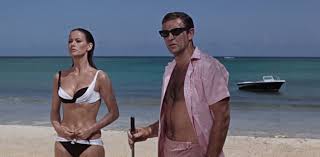
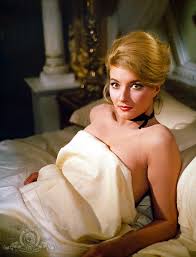
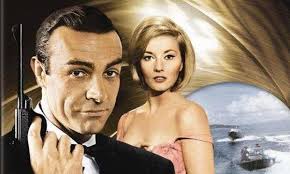
My initial thought watching this film was that all these “Bond Girls” look alike. Same cheek bones, same hair style, same dubbed in voice. Maybe it was just post-holiday malaise, but I found myself repeatedly confused as to which actress Sean Connery’s Bond was making the moves on. By film #4, they were virtually cookie cutter. The primary Bond girl in Thunderball is Domino. Producers originally considered Julie Christie, Raquel Welch, and Faye Dunaway for the part, but settled on beauty queen Claudine Auger (Miss France!). By film four you get the feeling that half the draw of a Bond film is just the cavalcade of beautiful women for James to plow through. However, there is a scene where SPECTRE assassin Fiona Volpe (played by Italian actress Luciana Paluzzi) blows up a car with rockets on her motorcycle and then takes off her helmet to reveal her flowing red hair that is pretty, um, empowering.

Thunderball premiered in Tokyo on December 9, 1965 at a time when the anti-Vietnam War movement was gaining steam in the U.S.. (On November 27, tens of thousands of protestors marched from the LBJ White House to the Washington Monument.) Thunderball skirts Cold War tensions by, again, making SPECTRE the bad guys. This time, #2, Emilio Largo (played by Italian actor Adolfo Celi), is ransoming NATO for £100 million in diamonds after stealing two nuclear bombs (a plot later spoofed in the first Austin Powers movie).

What this Bond film is most famous for is not the women or the evil plot (both a bit tired by 1965), but the extensive underwater filming. A quarter of this film takes place underwater, including shots of cool submersible vehicles and a massive speargun battle between the good guys and the bad guys. It must have been spectacular to see it on the widescreen in the mid-1960s. Apparently, the ocean shooting in Nassau had to be done at low tide because of the constant threat of sharks and the scene where Bond is in a salt water pool full of sharks almost ended with Connery getting chomped. The tropical locale means we get plenty of bikinis and bare-chested Bond as well as boats exploding (now a Bond film staple).

Let’s plug Thunderball into our feminist matrix.

Driver of Action – For the first time, we almost get Bond as a part of a team. Presumably assembled by MI-6, we get an on-the-ground team in Nassau put together to help James avert nuclear catastrophe, including familiar faces like CIA bro Felix Leiter (this time played by Rik Van Nutter) and MI-6 gadget guy Q, who, in Bermuda shorts, laments having to meet 007 “in the field.” He’s also joined by Pinder, another unnamed Afro-Caribbean dude, and CIA agent Paula Caplan, played by Martine Beswick (back from her role as “Gypsy Girl #2” in From Russia with Love). It’s mainly Felix who bales James out (in his handy CIA helicopter), but it should be noted that Paula is kidnapped by SPECTRE and commits suicide rather than rat on James. She’s the DDID. (Dead Damsel in Distress.) But it’s still Bond in the driver seat, whether he’s dodging sharks or ordering Beluga caviar.
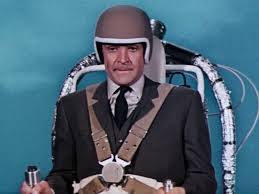
Role of ViolenceThunderball opens with Bond killing SPECTRE assassin Jacques Bouvar (who is dressed as a woman, so there’s that) and then escaping with a supercool (for 1965) jetpack. There’s a few henchmen (dressed in black, like an episode of Batman, which debuted the following year) that Bond kills, although they may just be stunned. Some henchmen throw another henchman into a pool of sharks. And whole bunch of frogmen, good, bad, and otherwise, get shot by spearguns in the Caribbean, some likely by 007. Other than the epic underwater battle, the body count is not giant and those scuba dudes who are killed are probably then eaten by sharks, so, the circle of life.

Vulnerability – It’s 007, so audiences don’t expect an inner window into Bond’s heart and it seems even more walled up than ever. He’s less dependent on technology than in Goldfinger, but James swallowing a radioactive pill so the CIA can track him seems like some kind of weird acknowledgement that maybe James can’t do everything by himself. There’s also a moment where James is trying to rescue Paula from Largo’s compound and he accidentally drops his gun off the roof he’s on. The look on his face seems to say, “Uh oh. My dick just fell off.”

Sexual Potency – Here’s where Thunderball goes off the rails. The first part of the movie, Bond is camped out at an English health spa called Shrublands, where he continually sexually harasses a masseuse (physiotherapist?) named Patricia (played by Molly Peters, featured in Playboy’s 1965 “James Bond’s Girls” spread). He forcefully kisses her and then when she thinks Bond’s bad experience on a, more Medieval than medicinal, stretching rack is her fault (it was a henchman) she frets that if her boss finds out, she could lose her spa job. “My silence could have a price,” James says then pulls her away for some quid pro quo sex. In the end, they’re in bed, with Bond doing the massaging.

Then there’s James’ relationship with SPECTRE agent Volpe. Her red hair is a classic signifier of a libidinous woman and when Bond walks uninvited into her bathroom to find her naked in her bathtub, he smirks with the recognition that he’s about to get another notch in his belt, “as if it was intended.” Because she’s a wicked redhead, she takes off Bond’s clothes and they end up in the sack where he tells her, “you should be locked up in a cage.” Rawr. Post coitus, she (and her henchmen) turn the tables on Bond, who seems shocked that he got caught with his pants down. In a moment for the Bond Girl demographic, she says, “But of course, I forgot your ego, Mr. Bond. James Bond, who only has to make love to a woman and she starts to hear heavenly choirs singing. She repents, and immediately returns to the side of right and virtue. But not this one.” Snap.

The final scenes are about rescuing Miss France/Domino from bad guy Largo. Bond sucks sea urchin poison from her foot and then they make love on the beach. When 007 says he needs her help catching Largo, she dejectedly says, “Of course. That’s why you make love to me.” Sex as transactional in Bond films. And also now cemented as a cliche, the film ends with Bond and Domino in a boat, this time a rescue raft floating in the Caribbean.

ConnectionThunderball begins and ends with Bond alone, acting or celebrating (with his prize) his actions. We do get to see a section of the Bond working with a team, but it’s sort of like Superman and his super-friends. Bond is in the lead. Again, as by Film 4, Bond is now the archetype of the man alone. He mocks love (including with Moneypenny), but he never actually has it. I wonder if writers ever considered developing a bromance between James and Felix. Maybe, at some point in this chronology, we’ll meet a James Bond who cares about somebody.

Toxic Masculinity Scale: 8

Summary By 1965, James Bond had officially become a franchise, produced by men to maximize 007 revenue. In the opening credits, the only females listed are “continuity girl” and “wardrobe mistress.” The fledgeling second wave feminist movement hadn’t yet turned its attention to Hollywood and the impact of this picture of gender. The normalization of sexual harassment in the 1960s (here, Bond’s treatment of spa worker Patricia) would later be unpacked by the brilliant AMC series Mad Men (2007 – 2015). But Bond is such a cad in Thunderball it makes watching his witty banter with the other characters in the film a lot less fun to watch. 

We do get tastes of gender subversions. There’s Volpe (Italian for “fox”) blowing stuff up, motorcycle between her legs, and later removing 007’s clothes and then sexually besting him. (“But not this one.”) Again, we get a female hotel concierge ogling Bond’s backside and Paula, the female CIA agent (who dies because, you know, lady CIA agents). But it all stands in the shadow of Bond’s hyper-masculinity. He even tries to feminize Largo by saying of his skeet shooting rifle, “That gun looks more fitting for a woman.” Huh?
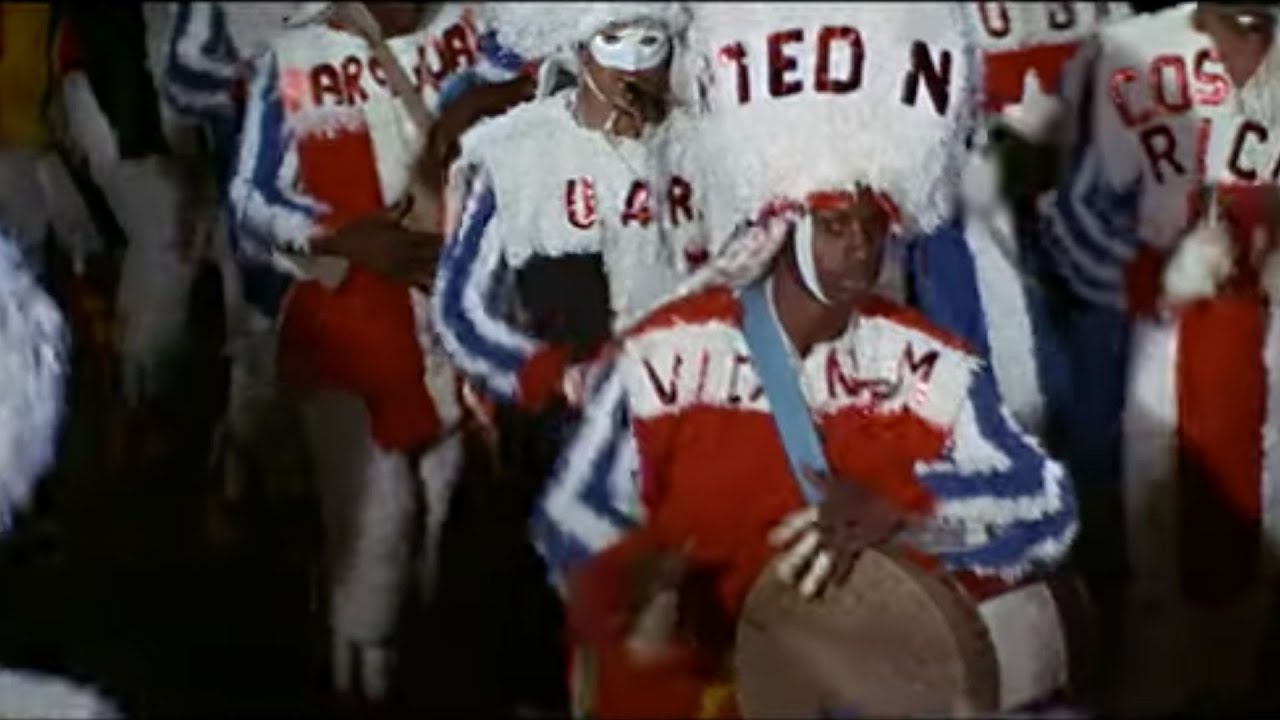
On a personal note, I appreciated the return to the Caribbean, especially Nassau where I experienced a particular “man making” experience as a 17-year-old boy. I loved the scenes shot during Junkanoo; Carnival in the Bahamas. It caught a glimpse of the decolonization that was happening in the black world in the 1960s and while there was no dreadlock rasta in Thunderball, behind the highly paid white actors in the camera’s focus there were a bunch of black faces who knew the world was changing. Those are the Bahamians I met when I was there as a teenager in the 1980s.

Next: Casino Royale (1967)

The James Bond Project #3: Goldfinger (1964)

The James Bond Project #2: From Russia With Love (1963)

The James Bond Project: #1: Dr. No (1962)

The James Bond Project #3: Goldfinger (1964)
December 30, 2024

Goldfinger (1964, directed by Guy Hamilton)

“That’s my James!” Welcome to the James Bond blockbuster. With the massive success of From Russia With Love came an even bigger budget (and a new director). Goldfinger gave us franchise staples, like the pre-credits action scene, the bouncy Bond quips, infinite gadgets (including the loaded Aston Martin), the epic theme song, and multiple exotic locations (including rural Kentucky). And of course there are multiple women who are branded as Bond “girls” in the film who find their way into 007’s beefy arms.

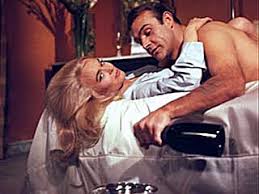
The box office smash surely benefited from the 1964 British Invasion and the American obsession with all things English. Bond even has a snarky line about the Fab Four after he beds Goldfinger’s girl Jill Masterson, chiding her not understanding his standards for chilled Champaign. “My dear girl, there are some things that just aren’t done, such as drinking Dom Pérignon ’53 above 38 degrees Fahrenheit. That’s as bad as listening to the Beatles without earmuffs.” (It should be noted that two of the actors in Goldfinger, Richard Vernon (Colonel Smithers) and Margaret Nolán (Dink), had just appeared in the Beatles’ film A Hard Days Night and the Beatles 1965 film, Help!, would be a send up of Goldfinger.)

Goldfinger cemented the formula for what a Bond film would be for decades to come. It was released in September of 1964, in a world that was increasingly surrendering to the ennui of the East-West Cold War, the same month as Lyndon Johnson’s apocalyptic “Daisy” campaign ad that ended with a mushroom cloud. I had been born 7 months earlier and would be socialized into a world that saw Bond as the modern model of masculinity. Let’s check Goldfinger with our five reference criteria.

Driver of Action – Goldfinger is the archetypical Bond film, the begins with him blowing some shit up in Mexico and ends with him making sweet love to Bond Girl #3 Pussy Galore on a desert island, telling her “This is no time to be rescued.” There is no “buddy,” as in the previous two films, just Bond, and his MI-6 and CIA supporters (who play minimal roles). Even the nefarious plotting by Goldfinger (played by former Nazi Gert Fröbe after Orson Welles proved to be too expensive) to irradiate all the gold in Fort Knox is a minor subplot. Goldfinger is all about watching Sean Connery as Bond move from scene to scene; Mexico, Miami, London, Switzerland, Kentucky. In the opening scene, he steps out of his wetsuit dressed in a white dinner jacket and you know this going to be 110 minutes of pure Connery.

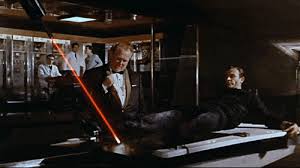
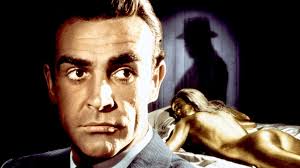
Role of Violence – Again, Bond has a relatively low bodycount in this film. People do die, especially women, including Jill Masterson. For her flirtation with Bond, she is painted gold and dies of “skin suffocation.” Her sister Tilly is killed by Oddjob, Goldfinger’s Korean henchman. But Mr. License-to-Kill is mostly restrained. A Mexican assassin gets an electric fan tossed into his bathtub. Some henchmen go over a cliff in a fiery crash after Bond shoots slick oil out of his Aston Martin. In the climatic scene in Fort Knox, Bond throws a henchman off a ledge and electrocutes Oddjob. (Apparently actor Harold Sakata was severely burned in the stunt.) Mostly Bond is the recipient of violence, including a laser beam aimed at his most manly parts while he is strapped to a table.

Vulnerability – Yeah, no. You wonder if we have to wait until the ‘90s to get new age sensitive James Bond. Whether strapped to a table with a laser heading toward his junk or locked in a Kentucky holding cell, or in a plane plummeting to the earth, we never see James break a sweat. 

Sexual PotencyGoldfinger is balls out on the message that Bond is the conquerer of women. In the opening sequence, he goes after a Mexican dancer and then uses her body to deflect an assassin. In Miami, he’s getting a poolside massage from his Florida fling, Dink (who’s cleavage was also featured in A Hard Days Night). Then there’s the romp with Jill who gets painted gold. In Switzerland, when a blonde passes him by in a ’64 Mustang convertible, he resists the urge to chase after her. “Discipline, 007, discipline,” he says to himself. She turns out to be Jill’s sister and they have a moment before Oddball kills her with his killer hat.

That brings us to Pussy Galore (the character, not the male fantasy). The Bond double entendres hit a new level here and Pussy’s name is mentioned constantly in the second half of the film. Galore is played by Honor Blackman, who was Diana Rigg’s predecessor on the highly popular British spy show, The Avengers. So she was coming in to Bondland a Judo-flipping badass, not a submissive DID (Damsel In Distress). In Goldfinger, she’s the leader of Goldfinger’s team of female pilots, playing a role in his grand slam plan. But there’s a scene in Goldfinger’s barn where James manhandles Pussy and the subsequent judo fight ends up with the two literally rolling in the hay. Galore tries to push Bond off her, but no woman can resist 007 and his assault ends in a passionate kiss. Woot, there it is.

Connection – Unbeknownst to the viewer, Pussy Galore’s Stockholm Syndrome turns her into an ally of Bond’s and Goldfinger’s evil plot is thwarted. As has already become an uber-cliche in Bond films, their end scene, making out under the parachute, casts no allusion that it’s the beginning of a beautiful relationship between James and Pussy. We know how this works. Women are transitory and co-workers are support players. Does Bond have any friends? A love that got away? He is supremely untethered. A man alone.

Toxic Masculinity Scale: 7

Summary –  Like an explosion of everything that was 1960s before LSD, Goldfinger is a magnum opus of a spy action film. The clever crime attempted (to irradiate the gold in Fort Knox to drive up the value of personal stocks of the metal) takes a back seat to watching Connery leap frog from woman to woman, often with his suped-up Bondmobile (Oh, to have stock in Aston Martin in 1964). Connery’s Bond is the Id unrestrained. One wonders what MI-6’s HR department would say about the workplace flirtations between Bond and Miss Moneypenny in the post #metoo era. But it’s the scene between Bond and Galore in the barn that reminds us that the debonair spy is not immune from the misogynistic value of male entitlement. A generation of boys learned women are to be taken by men, even if they resist. Pussy galore, indeed.

While contemporary audiences my get a bit of a creepy vibe from Goldfinger’s Bond, there’s a creeping trend that may be less noticed today. The third Bond film sees 007 more dependent on the technology provided by his employer. It may be a homing device in his shoe or an ejection seat in his car, but 1964 Bond is becoming less a man left to his own devices and more to the devices Q builds for him. Bond is the halfway point between the archetypical cowboy, fending for himself on the frontier, and Modern Man, juggling apps and monitoring social media, never not wired to the electronic collective. Where would Bond be without Q? Where would we be if the internet went down? One imagines that Bond would be better off, but not by much.

Next: Thunderball (1965)


The James Bond Project: #1 – Dr. No (1962)
The James Bond Project #2: From Russia With Love (1963)

The James Bond Project #2: From Russia With Love (1963)

December 28, 2024

From Russia With Love (1963, directed by Terence Young)

With the unexpected success of Dr. No, United Artists doubled the budget for the sequel and the bet paid off. (The $2 million film took in more than $78 million worldwide.) We are now firmly in a franchise of films made by men for men and their dates, starring manly man Sean Connery. Although it should be noted that Johanna Harwood, who had worked on the script for Dr. No, played a large role in the screenplay for From Russia With Love. Producers cast Italian beauty queen Daniela Bianchi as Bond Girl #2 Tatiana Romanova, after actress Elga Gimba Andersson refused to sleep with a United Artists executive. Bianchi, who could barely speak English, had her lines dubbed by a British actress.

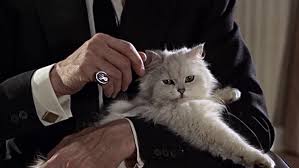
The film starts the Bond tradition of the opening credits being projected on to the bodies of scantily clad or nude women, firmly establishing that these are stories for boys. Instead of Jamaica, most of the action takes place in Turkey, although there are obligatory scenes in London and wherever SPECTRE Island is. There we meet the Dr. Evil of the Bond cinematic universe, Blofeld (or at least his cute cat). Leaving the Caribbean means we leave any and all black actors, and the primary Turkish character, Ali Kerim Bey, is played by Mexican actor Pedro Armendáriz. (In a bizarre side note, Armendáriz contracted neck cancer after filming a Howard Hughes film near a nuclear test site in Utah, and before he finished shooting his parts for From Russia With Love, shot himself with a gun that he snuck into his hospital room.)

From Russia With Love was filmed as the Cold War intensified and SPECTRE agents replaced Russian agents (who were the villains in Ian Fleming’s original Bond novel) to not further inflame tensions. President Kennedy told Life Magazine that From Russia With Love was one of his favorite novels. The film version premiered on October 10, 1963, the same day U.S. Attorney General Robert Kennedy (crazy guy’s dad) approved J. Edgar Hoover’s wiretapping of Martin Luther King, Jr.. The film was screened at the White House for JFK before he left for Dallas, where he was assassinated. From Russia With Love received mixed reviews, some saying it was slower than Dr. No, but has gone on to be held up as one of the best of the Bond series.

Here’s how FRWL charts with our five evaluations.

Driver of Action – Director Terrence Young had established a formula and he’s not going to break it on the sophomore outing. This is Bond in all his glory, now supplied with cool gadgets by MI-6’s Agent Q (played by Desmond Llewelyn, who remained as Q to 1999’s The World is Not Enough). There is a great “buddy” feature between Bond and Bey (similar to Dr. No’s Quarrel role) and a fun subplot about SPECTRE operatives Rosa Klebb and Kronsteen, groveling before Blofeld as they attempt to kill Bond for offing Dr. No. (The “R” in SPECTRE is for “revenge”- Special Executive for Counter-intelligence, Terrorism, Revenge and Extortion. FYI.) But the story doesn’t happen without their dastardly plot to kill Bond and the delight of our man James foiling their fiendishness.

Role of Violence – There is considerably less violence in Dr. No’s sequel. There are some cool explosions after a helicopter attack and a boat chase, but 007 only kills one person, SPECTRE assassin Donald Grant (played by Robert Shaw, who will always be Captain Quint in Jaws to me). Grant’s death is the result of a beautifully choreographed fight scene in a train car on the Orient Express. (Fight scenes in train cars become something of a trope in the Bond franchise.) The most shocking violence in the film is Bond’s full-handed smack across Russian agent Tatiana’s face, after which she repeatedly tells him that she loves him. I bet that clip has showed up in a few “Sexism in Film” classes.

Vulnerability – Again, there’s no chink in James Bond’s armor. No glimpse inside. Even when Bond is literally on his knees prostrate before assassin Grant, we know he has a plan to quickly turn the tables.

Sexual Potency – The first shot of Bond in the film is him making out with Sylvia Trench (from Dr. No) in a floating punt, probably on the banks of the River Cam in Cambridge. He’s playing hooky from MI-6 to work his way around the bases with Trench. (Is there a cricket version of “third base”?). When Bond first meets Tatiana, she is naked in his Istanbul hotel bed. Later she asks him, “James, will you make love to me in London?” He answers, “Day and night.” There’s another strange segment where Bond must decide which of two young, attractive “gypsy” women will be awarded the man they both want. They arrive at his room to seductive music. “This might take some time,” he says. We see the women the next morning with broad smiles as James leaves. All these women are happy for a piece of 007’s sexual mojo, even when he slaps them.

Connection – The scenes with Pedro Armendáriz as Ali Kerim Bey sparkle. They have immense chemistry, enhanced by the knowledge of the great pain he was in from his cancer. Had he lived, one could see Armendáriz as Bond’s Morocco Mole sidekick in future Bond films. But both Armendáriz and his character are dead by the end of the film. His relationship with Tatiana is less mutual, even though they have to pretend to be a married couple while on the train, and she dreams of marrying him when they reach London. She even saves him from the venomous boots of Rosa Klebb in a hotel room in Venice and his heart is unmoved. Like the closing scene in Dr. No, we end with Bond and Bond Girl #2 romantically floating together in a boat, this time a gondola, with end credits urging viewers to get ready for Bond #3, Goldfinger, which will most certainly present us with Bond Girl #3.

Toxic Masculinity Scale: 7/10

Summary From Russia With Love really front loads the male gaze on women’s bodies thing. From the opening credits, to the (very) long shot of Ali Kerim Bey’s girlfriend’s cleavage, to a very oily masseuse on SPECTRE Island, to the camera endlessly hovering on a belly dancer’s torso, there’s plenty to ogle. Then there’s the weirdly placed “duel” between two scantily glad “gypsy girls” that has zip to do with the plot. If there’s any sense of balance, we do get Bond wrapped in a towel, which probably had some men wondering what they needed to do to grow crops of hair on their chests.

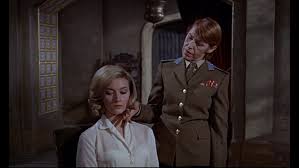
There’s also an odd lesbian subtext with Rosa Klebb. Props to having a female antagonist in the second Bond film. In 1963, there was a narrative that Russian (i.e. “communist”) women were more manly, so that tracks. But to make the point that women on the other side of the Iron Curtain are not bound by the same gender rules, they add a suggestion of sexual predation when Klebb is informing Tatiana of her mission to seduce Bond. And Romanova doesn’t seem to shirk as Klebb evaluates her body and places her hand on her leg. Russians, they not like us. (Or are they?)

From Russia With Love is rough film to place. It’s the most realistic of all the Bond films from the classic era. There’s a nice complexity to the plot but we know even less about the person of James Bond. It’s almost like Sean Connery is playing James Bond pretending to be a caricature of James Bond. A lot of people think this is one of the greatest British films ever made, but it felt flat to me. And the slapping scene seemed very un-Bond, even if it served as a reminder of how normalized violence against women is in film. Where is Wonder Woman when you need her?

Next: Goldfinger (1964)

The James Bond Project: #1: Dr. No

Reelin’ in the Tens: What was this decade about anyway?

December 29, 2019

Decades used to have a definitive feel, a look, a sound. The Eighties were so different from the Seventies, which shared little with the Sixties. As we put this decade to bed, there’s no real sense of collective experience. We don’t even have a name for the last ten years. The Teens?

2010 began with the Obama presidency digging us out of the Great Recession and the quasi-fascist Tea Party movement and ended with the impeachment of the quasi-fascist Donald Trump and another recession looming. The first #1 song of 2010 was “Tik Tok” by Kesha and the last #1 song of 2019 is a Mariah Carey Christmas song from 1994 (and then a dozen Post Malone songs). Do those bookends offer any clue to the history that unfolded in the intervening days, weeks, months, and years between?

Unknown

I imagine the historians will dub this the Decade of Social Media. People retreated from cruising malls and bars to shopping and dating online. The fashion of the decade was the laptop and the smartphone. It was the decade where people stayed home and when they went out they were permanently hunched over their devices while the world burned down around them. Why look for a scene when you can just Netflix and chill?

It was a fairly epic ten years for me. I became a parent in 2014, which completely changed my connection to the outside world. And becoming a parent of a girl grounded my feminist ideals into a moral imperative in a world of “Grab ‘em by the pussy” presidents. 2014 was the also the year I pushed my faculty union to strike against a bloated administration which was a factor in that bloated administration cancelling my secure faculty contract. But after a few years of scrounging, that freedom gave birth to a professional and creative revival. I got to spend the second half of the decade traveling the globe and writing volumes, including books, academic chapters, an ode to Bowie published in the Gay & Lesbian Review, and an article in Huffington Post on masculinity and right wing violence. Having a wonderful partner, who never tolerated my decades old bullshit, pushed me to unexpected accomplishments.

Unknown-1.jpeg

I have a theory about decades (discussed in my 2011 book, The Mission of the Sacred Heart). There are two albums released in the seventh year of every decade that define both what’s happening on the surface and what’s bubbling underneath. For 1967, it was Sgt. Pepper’s Lonely Hearts Club Band and The Velvet Underground & Nico. 1977 was Saturday Night Fever and Never Mind the Bollocks, Here’s the Sex Pistols, and so on. For 2017 it would have to be Taylor Swift’s Reputation and Kendrick Lamar’s Damn. Both represented the dominant themes of the decade, the empowerment of women in the face of institutional abuse (hats off to artists like Kesha and films like Bombshell) and the transformative Black Lives Matter movement (much love to artists like D’Angelo and films like Moonlight).

It was a decade that moved the ball on the leveling playing field, for transgender kids that need to pee and black kids who don’t need to get shot by the cops. But there was a massive attempt to turn back the hands of time to the bad old days, when America was (right) “great.” The rebellion against the global community sparked nationalism across the world; Trump and Putin, Brexit, mass murdering racists in Norway, neo-Nazis in Ukraine, and on and on. 2020 seems like it will be the beginning of decade of civil war. Can Harry Styles save us?

Unknown-2

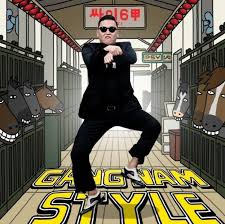
It usually takes a while to get a feel for what a decade was all about. Give it a few years before we determine the relevance of The Bachelor and brand new pants pre-torn in Chinese sweatshops. The last decade of the “American Century” will have an official haircut and dance (Twerking?). There will be 2010s nights at clubs where they play all your old Katy Perry favorites and people dress like various Kardashians and joke about apps and Tim Tebow and they play the “Gangnam Style” video over and over again. I’ll remember it as the decade where I found my real purpose. There was no app for that.

Your biography is history: Taking in the Trump impeachment

October 3, 2019

When I was a teenager in the late-1970s, I wished I had been a teenager in the 1960s, so I could have swum in the countercultural revolution. Of course, I was already in history. It was called the punk rock rebellion, and there are a million kids now who wished they could have been in my shoes, buying Ramones albums (on vinyl!) as they came out. I was just too close to it to see it as a moment in history. It was just my life.

41qCZndDFNL._BO1,204,203,200_

The great sociologist C. Wright Mills argued that for people to start to understand how society works they have to understand their own biographies as history. When we read a biography, we see it as a reflection of the history that was unfolding around that person’s life, whether it’s the biography of George Washington or Judy Garland. My students are reading The Autobiography of Malcolm X this quarter and you can’t view the life of Malcolm Little/Malcolm X/Malik Shabazz outside of the context of the racially oppressive twentieth century. His biography is the history of hi century.

And so is yours. The goal of any individual should be to create a biography that both reflects the times and impacts the times. Live in the moment and shape the moment. You are living history. Most fascinating of all histories is the present.

Screen Shot 2019-10-02 at 11.06.37 PM

This couldn’t be any truer than right now. This era will be analyzed for centuries. People are still debating whether or not the French Revolution worked. That won’t hold a candle to the late night conversations students, history buffs, and robots will have about the spectacular rise and fall of Donald J. Trump. We are in perhaps the most significant turning point in U.S. history since the test of World War II. This generation may be witnessing the end of the American Century or the birth of a global youth revolution to save the Earth, sparked by a Swedish kid with Aspergers who demonstrates more class and intelligence than our president does on his very best day (which, I know, isn’t saying much).

screen-shot-2017-02-23-at-11-12-57-pm

I cut my political teeth on the Watergate hearings in 1973. I was 9-years-old and watched it with rapt attention. When Nixon named Gerald Ford as his vice-president in 1974, I knew there was a quid pro quo that would lead to Ford’s pardon of Tricky Dick. My first trip to the White House was while Nixon was deciding to bug out instead of enduring impeachment proceedings. I probably could have stolen the china and they would have assumed Pat Nixon was looting the place before their shameful exodus.

It felt like history was happening and it feels that way again. The impeachment of Bill Clinton felt more like politics as usual. Bill’s shenanigan’s definitely sparked a national conversation about what constitutes “sex.” (To future generations, blow jobs are, in fact, sexual relations.) It all unfolded during my disastrous first marriage and I don’t doubt that couples across the country were having uncomfortable conversations about the nature of infidelity thanks to the Oval Office antics of Slick Willy. But it didn’t seem monumental, just sad. This feels monumental.

R1325_FEA_Cortez1

History is always happening and always has a soundtrack. Yeah, the upheaval of 1968 had the Beatles’ “Revolution” and the Rolling Stones’ “Street Fighting Man,” but you better believe the “look backs” 20 years from now will have Billie Eilish and Lizzo playing along. (“Why men great ’til they gotta be great? Don’t text me, tell it straight to my face.”) This moment in history is framed by news apps, bipartisan divides, and generational warfare. The old white men would rather die guns blazing and burn the house down on their way out than see young women (especially young women of color) even the playing field. Sorry Mitch McConnell, the future of America looks more and more like Alexandria Ocasio-Cortez every day. We’re no longer being handed history by Walter Cronkite on the CBS Evening News, we’re finding it on our phones and Twitter feeds. And we’re sharing the news that the Orange Emperor has no clothes. (Cannot unsee!)

MV5BMTM4NjY1MDQwMl5BMl5BanBnXkFtZTcwNTI3Njg3NA@@._V1_UX182_CR0,0,182,268_AL_

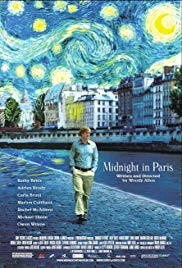
There’s a great 2011 Woody Allen film called Midnight in Paris all about how we over-romanticize the past. It was always better in some previous era. I’ve often thought about how great it would be to live in the Bohemia of 1840’s Paris or 1950’s San Francisco. No doubt the food would suck in both and no wi-fi to boot. The same is true for the Make America Great Again suckers who think the country was better off back in the days of Jim Crow. (Also no wifi.) This is the moment to be in. This crisis. This opportunity for transformation.

I’m committed to taking all this in, every presidential tweet storm, every unhinged Rudy Giuliani interview, every cabinet member indictment, every smirking Stephen Colbert monologue. Future generations will ask us what it was like to witness the compete collapse of America’s mad king. I’ll tell them I LMAO. They’ll have no idea what I’m talking about.

Gender – Nature vs. Nurture 7: Baby – Toddler – Girl

January 25, 2018

It’s a common refrain around here – “Where did the baby go?” She’s just grown up so fast (said pretty much every family ever). Besides becoming a full on person, somewhere this past year, she became a full on girl. As a sociologist, for decades I’ve harped on the mantra that we are products of our environment and that gender is social construct. So I’m not quite sure how this happened. Is it my fault?

Screen Shot 2018-01-25 at 11.14.16 AM

We really worked on the gender neutral thing from day one, including dressing her in “boy” clothes, but the girl just loves all things pink. She’s had her stay-at-home dad as her primary caretaker but she’d still rather put on make-up with mom. And it’s not that her working mom is the most girly-girl. (Mexican women seem to have a bad-ass streak woven into them, but you didn’t hear that from me.) All our plans to dominate her nurture seem to have been thwarted by her nature.

Or have they?

katy-perry-at-minnie-mouse-honored-with-star-on-hollywood-walk-of-fame-ceremony-01-22-2018-6

I’ve said it before. You don’t raise children in a vacuum. Cozy is not a lab project. She has countless influences outside of mom and dad, including little friends, teachers, grandmas and tias, and, of course, the media. All play a part in the nurturing of her gender cues. I blame Minnie Mouse. I think that was her first role model. Minnie, who just got her star on Hollywood Boulevard last week (40 years after Mickey), is not exactly an action hero. She’s come a long way, baby, but she still plays her cute card. Just watch where her knees go (in) compared to Mickey’s (out). Is Minnie a virgin to Mickey’s playa? We love Minnie Mouse around here but I’m betting that rodent has her own #metoo story. (I’m looking at you, Harvey Weinstein.)

ns-paw-patrol-landing-downloads

Cozy’s moved off Disney (maybe because we lost our Disney Channel connection) and on to the Paw Patrol. I don’t quite know what to make of this cartoon that has been mass marketed beyond belief. (Yes, she is wearing Paw Patrol undies today.) I like the positive go get ‘em attitude – “No job is too big, no pup is too small! – but it’s not like they are taking all that canine energy to improve access to the treehouse for dogs with disabilities or out defending the Paw Pussy Cats from being grabbed by the evil Drumpf. The gang is mostly male but there are two females (don’t call them bitches) named Skye and Everest. And Cozy is obsessed with them. She named her cat Skye and she has Everest socks. The patrol is led by a male (Chase), so we’re going to have to have a little Paw Patrol talk. “Wouldn’t the Patrol get more done if Skye took over?”

lefotif-03

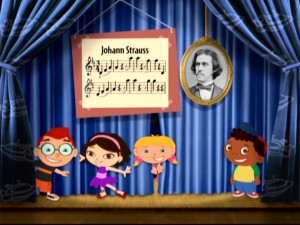
She recently discovered the Little Einstein cartoon series. It’s another gang led by a (white) boy. These four kids fly around in their rocket, and have adventures based in famous works of art and classical music. It’s pretty cool, actually. There’s an episode based on on Strauss’ “Blue Danube Waltz” and Warhol’s Fish painting. My kid is humming Bizet and talking about Van Gogh’s Starry Night. Her favorite character is June, the dancer, and Cozy will dance to some Edvard Grieg like she was auditioning for the Bolshoi. I love my classical music-loving kid!

25442902_10156872943319307_2913918804066795517_n

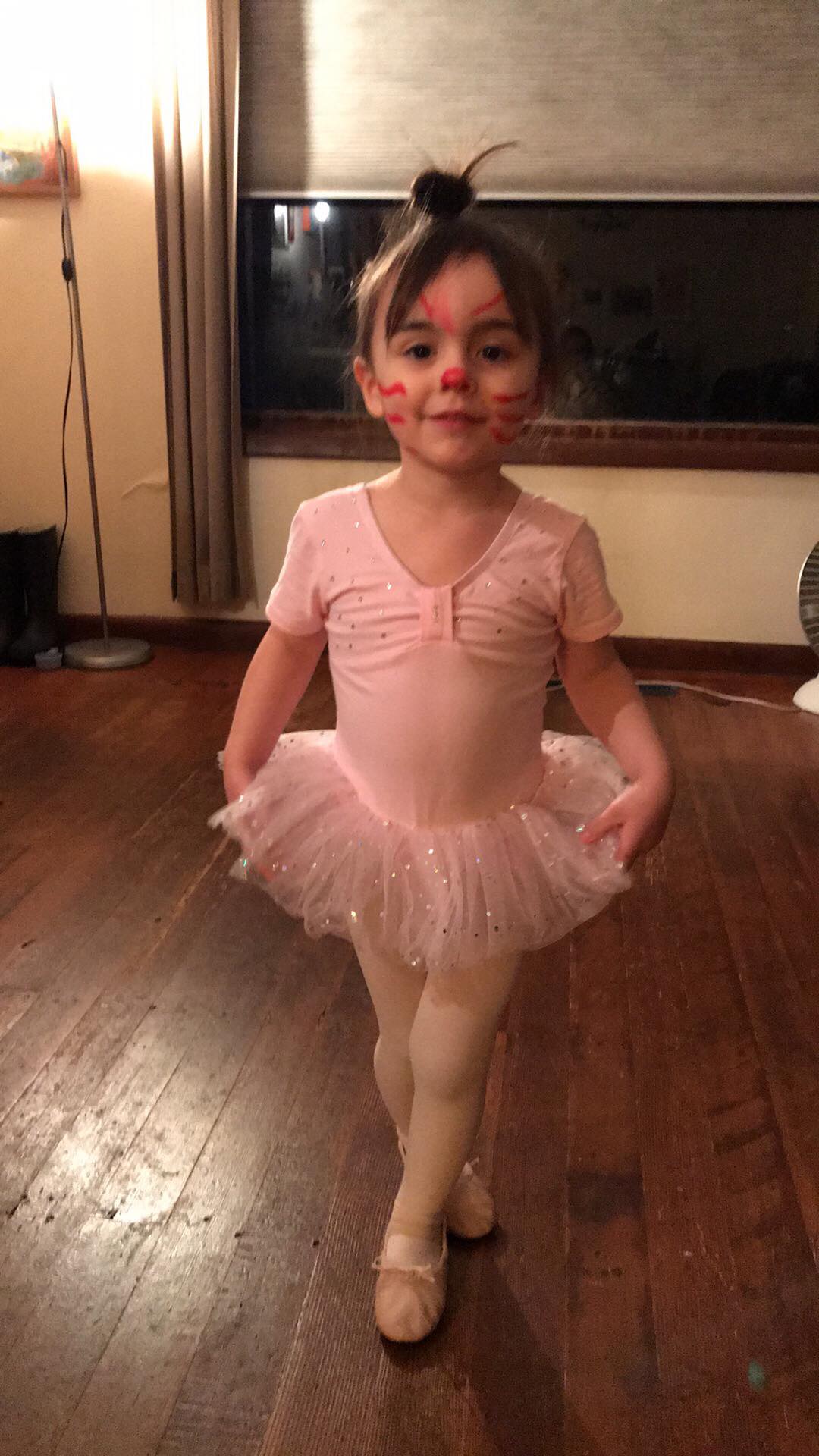
I think seeing the Nutcracker last month was a turning point in her gendered idea of herself. It wasn’t the Nutcracker, or the Rat King that ignited her. It was the Sugar Plum Fairy. She just started glowing when the SPF tiptoed onto the stage. It reminded me of when I saw Elvis Presley in concert at age 9. “That looks like a good job,” I remember thinking. Cozy got to meet the ballerina who performed the role after the show and she was hooked. Now she is constantly dancing in her own ballet for one in a way that’s making us think she might actually be a natural at this. It’s feminine and flowing. How did this happen and how much are ballet lessons? And can she be a ballet dancer and community organizer at the same time?

I recently asked Cozy if she thought there was a difference between boys and girls. She told me that girls can jump higher and then started talking about the difference between kids and grown-ups. I think that’s still the main binary in her head. She still mixes up “she” and “he,” and I purposely don’t correct her. She’s “gender-fluid” on her own but suddenly really cares about being “beautiful.” Maybe it’s just a phase and by this summer she’ll want to be a basketball player. But at the moment, there is very pretty ballerina dancing in our living room.

SPFairy

Dad Love 10: We Become Gendered

GENDER – Nature vs. Nurture 6: Fierce Fashionistia in a Fiercer World

GENDER – Nature vs. Nurture 5: Elmo is queer

GENDER – Nature vs. Nurture 4: She’s gotta be free

GENDER – Nature vs. Nurture 3: How babies queer gender

GENDER – Nature vs. Nurture 2: Ain’t I a black girl?

GENDER – Nature vs. Nurture: Round 1

And Jill came tumbling after. Why? Purging sexist kids’ stories.

September 22, 3017

I am Bunny

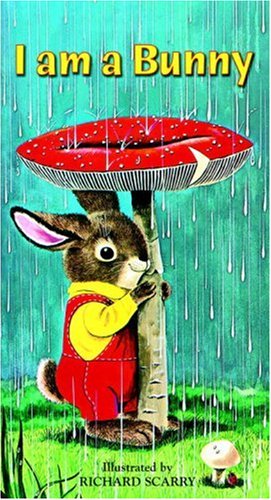
My mother has always been on the verge of serious hoarding. “Don’t throw that away! It might be worth something someday!” I heard that a thousand times. When Cozy was born, I was grateful. Stuff my mom had held onto for 50 years started to come our way, including my 1960s Batman sweatshirt. And a ton of kids books. Each one zapped my brain backwards. I just have to open I Am Bunny, and I’m sitting on my mommy’s lap, fascinated by the artwork and stories. And my mom read to me a lot.

I was excited to introduce Cozy to my love of books (Thanks, Mom!), so I wasted no time reading to my daughter. I took about two seconds to realize that the message that this father was sending to his girl was dramatically different than the one that my mother had sent to her boy. On the one hand it was exciting to see these books sold for only 39 cents when I was little, but on the other side the messages about gender were heartbreaking. From the time when Donald “Dotard” Trump thought America was “great.”

Scary Mom

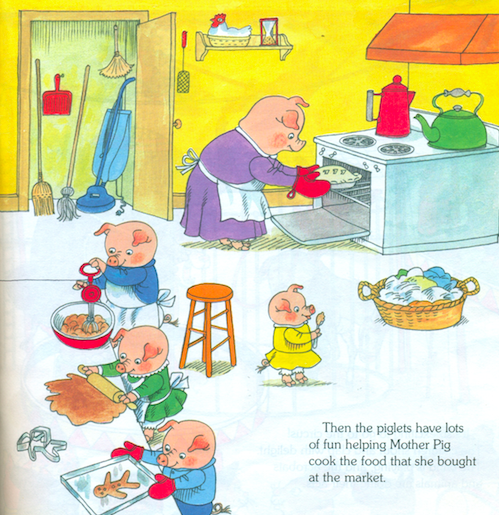
Many of the stories are a continuation of the fairytale traditions from Hans Christian Anderson where some damsel in distress or dainty princess has to be rescued by a dashing prince. So much of the classic Disney filmography is rooted in this sexist trope that has, thankfully, been exploded by Frozen and Moana. These two movies mean so much to Cozy and now I understand why. (Mulan had too much fighting. “I don’t like this, Daddy. Turn it off.”) More of these books followed the domestic dynamic of the mid-century model. There’s mom in the kitchen. A legion of my friends reminded me how messed up the Berenstain Bears books are when you read them through a gendered lens. The same is true for most of the books by Richard Scary and Dr. Seuss. (But I still have a soft spot for Cindy Lou Who.)

Jump

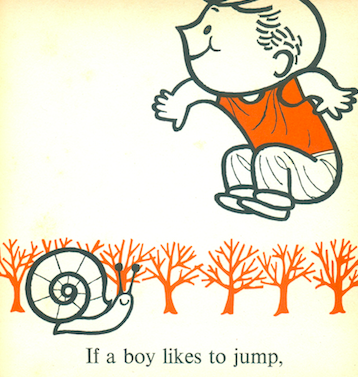
Even more books are just male-driven stories. How can my daughter find herself in Where the Wild Things Are? The imbalance really hit me when I was reading Cozy a book called Jumping. It’s about how much boys love to jump. Seriously. I grew up reading the adventures of the Hardy Boys. Will Cozy be left with the Bobbsey Twins? Was Nancy Drew a feminist? Can we get a 21st Century reboot? I do not like green eggs and misogyny.

It became a real struggle to find a book in the boxes that were arriving that had a female character that was somehow equal to the males, let alone in the lead role. Cozy was getting that in her contemporary cartoons, like Disney’s Elena of Avalor and PBS’s Peg + Cat. It was time to update my girl’s library. So we took a walk up to Green Bean Books.

GreenBean

Cozy loves any store that has a “kids’ section.” She appreciates any space that is carved out for “kids not people” (adults are “people” – we have to work on that one). Green Bean is all kids’ section and she loves the feeling that it’s all there for her. (Wait, I’m smelling the seeds of a generation gap.) When I asked for a storybook for a three year-old, the clerk had the perfect recommendation, The Princess in Black. Cozy set down her book about dinosaurs and grabbed the book, plopped down on the little sofa and pretended to start reading.

Princess

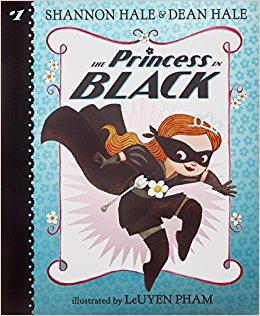
The Princess in Black is a five-part series by Dean Hale and Shannon Hale. It follows the adventures of prim and proper Princess Magnolia who sneaks into her broom closet to become… The Princess in Black; a superhero who fights monsters. Cozy loves both princesses and superheroes. (Ask her to do her Spiderman imitation.) Seeing her respond to this book was fascinating. It’s 15 short chapters, cleverly crafted, that we’ve read pretty much every night since we got the book. She’s got the whole story memorized and has even picked up on hints that our superhero may get a sidekick in future volumes – the Goat Avenger (aka, the mild mannered Goat Boy).

It was almost like a shock to the system after all these books about male characters, including Richard Scary’s male bunnies, to have a female-driven story. It must have been like women 200 years ago reading a Jane Austen novel for the first time. (I’m not equating The Princess in Black and the Mysterious Playdate to Pride and Prejudice, but I kind of am.) As a male, I could read all these male-driven kids’ stories to Cozy and not notice the impact of it all on her, as girls and women were pushed to the background (and draped in aprons). But three pages in to the PIB and I saw the shift. She has a place in the world of stories.

PIB Bounce

Of course, there is a debate worth having that this place is in occupying the traditionally male-dominated world of superheroes, which often relies on violence to solve problems.  The Princes in Black does open a can of whoop ass on a big blue monster. Sparkle kick! This is at the heart of the debate between liberal and radical feminists. Does gender equality mean that females should want half of the world that patriarchy created. When 50% of serial killers are females can we raise a toast and say, “Equality!” Or are their other ways of organizing ourselves that don’t don’t involve trying to beat men at their own game? As a parent of an evolving girl, I wrestle with this question. A female version of Trump saying she is going to “totally destroy” a nation of millions of people would not be progress.

Mother

For now, story time will be about a consistent messaging that Cozy will not be marginalized because she is a girl. Andrea has been reading her Good Night Stories for Rebel Girls. My mother sent a new book about Frida Kahlo, Viva Frida by Yuyi Morales, that Cozy fell madly in love with. And I know that there are now tons of others out there. (Please feel free to make any recommendations.) Seeing how my daughter responded to this one book pierced a gaping hole in my male privilege bubble. It might be time to put The Cat in the Hat on the bottom of the stack. What would you do if your mother asked you?

How I Learned to Stop Fearing Teenage Girls and Started Loving Harry Styles

June 8, 2017

I love the new Harry Styles album and I don’t care who knows.

Obviously gender socialization has played a role in the music I’ve loved (I was a sergeant in the Kiss Army in 1977, after all), but it has also played a part in the music I am supposed to hate. So much of the “Disco Sucks” movement in the 70s was steeped in deep-rooted homophobia (and racism). Real (white) guys liked ROCK and anybody who liked the Bee Gees must be a “fag.” I chanted “Disco sucks!” with the rest of the boys but secretly thought “Staying Alive” was a pretty damn good song.

This was especially true with teen idols. I was taught to hate them the most. If teenage girls loved them, they must be devoid of any musical quality whatsoever. Those screaming girls care more about their haircuts and cute smiles than their musical chops. I mean, seriously, what kind of name is “The Beatles”? What will they ever accomplish?

Mybesttoyou

So here’s a secret. Circa 1973, 9-year-old Randy was seriously into The Osmond Brothers. (If you’ve never heard “Crazy Horses,” listen to it now, loud.) They had a cool Saturday morning cartoon (as did the Jackson 5 and Rick Springfield), and since there was no MTV, it was how I first “saw” my music. I would put their records on on my parents’ hifi and go into my bedroom and pretend “my brothers” were rehearsing in the living room. I was the Osmond they never talked about, Randy Osmond. I even had Donny’s album, My Best To You, so “Puppy Love” played in my house.

926da88d65f47d499bb321306b3fd89f

I would read Tiger Beat magazine to keep up on all the latest news about my Saturday morning stars, including Michael Gray (Shazam!), Vince Van Patten and Kristy McNichol (Apple’s Way) and Johnny Whitaker (Sigmund & the Sea Monsters). I even learned a bit about religion. The Osmonds were Mormons and the Jackson 5 were Jehovah’s Witnesses. (I’m not sure what Sigmund and the Sea Monsters were. Lutherans?) That was until one day in late 1974.

I remember it as clear as a bell. I was standing in the hallway in our house with a copy of Tiger Beat trying to pull out a pinup of some fresh faced star (Anybody remember the DeFranco Family?). I already had one of David Cassidy on my wall. Then my 32-year-old father said, “Randy, you know those magazines are for girls, right?” It was a gender bomb dropped on my world. He signed me up for Boy Scouts, got me a subscription to Boy’s Life magazine and I quit the Osmond Brothers and switched my allegiance to Elton John. (I really hope you can see the irony in all this.)

Screen Shot 2017-06-07 at 10.50.32 PM

It was the beginning of bashing of all things teen idol related. Selling my soul to rock and roll was, at least in part, a way of publicly affirming my masculinity. When teen heartthrob Leif Garrett set a concert at Six Flag’s Over Georgia my friends and I made plans to go and throw tomatoes. (We didn’t.) And it’s been like that for every moppet that’s come along since then. Bay City Rollers? How about the Gay City Rollers. O-Town? More like O-Crap.  N’Sync = N”Suck. All the way through to Justin Bieber. I started a Twitter account to troll him called “Justin Bieber’s colon” and the Biebs himself started following my snark.

Now I couldn’t name you a single One Direction song. I know the tween lassies went potty for them in the early 2010’s, so they must suck, right? I just knew that they had stupid haircuts (unlike the stupid haircuts I had at that age that were perfectly cool). Just that week’s version of the Osmond Brothers filling the need for poster material in Tiger Beat.

30730-image_58f387e33ccfe

Then I saw the one with the stupidest haircut perform a track from his “solo” record (barf) on Saturday Night Live. It was Harry Styles and the song was “Sign of the Times.” Fuck me, it was good. Really good. Like Elton John good. It’s the kind of music that has been missing from Top 40 radio this millennium. Could there be more? The second song on SNL, “Ever Since New York,” was even better. Young Harry was playing guitar and there was a serious Badfinger influence. I wanted more.

When the album came out I wanted it and so did my wife. We were at Music Millennium Record Store and I completely chickened out and made her buy it. What would these lords of vinyl think of me if I plopped this CD down on the counter? Even if I stuck it between CDs by Sun Ra and Flogging Molly. Guys don’t buy this kind of dreck. She was slight angry at me about that one.

Unknown-1

Harry Styles has been spinning non-stop ever since. Pure pop bliss, with a dose of T. Rex and 70’s flair to sail over the heads of the One Direction Fan Club. It’s still the modern production formula with teams of songwriters helping Harry write the songs (Beyoncé does the same thing), so you never know if the sentiment belongs to the artist or one of the other five other guys credited. The producer is the guy who gave us “Uptown Funk.” There are plenty of reasons to hate it out of gate, but somehow it works. Every song is a gem and I am fully out as a Harry Styles fan.

The whole thing has caused me to reflect on over 30 years of a knee-jerk reaction that anything embraced by teenage girls is, by default, crap. It’s steeped in patriarchal thinking that somehow the musical tastes of 13-year-old boys are inherently superior to their female “teenybopper” counterparts and that the tastes and emotional lives of girls are irrelevant and to be devalued and mocked. Writer Barbara Ehrenreich once wrote that the wave of Beatlemania that swept America in 1964 was the first real flush of feminism for many baby boom girls. They were loudly proclaiming their sexual freedom as a collective voice. “Ringo! We want to rip your clothes off!” When I see the boys in the crowds at those Fab Four mob scenes, I always think they must really have been secure in their fledgling masculinity to be there (and incredibly lucky).

C9s8cNvUIAAHDRx

Evolving is all about checking the crap you do without thinking. It’s time to stop writing off music because “girls” like it. I bet there might be a New Kids on the Block or Jonas Brothers song that’s not too bad. Frank Sinatra and The Monkees were in this category once. Maybe I actually should be paying more attention to what these screaming girls like. They were right about The Beatles. So thanks, Harry, for helping me to see the light.

SaveSaveSaveSave

I stand with the women who march: Anatomy of a backlash

January 18, 2017

Politics would make a great spectator sport. How many years did Donald Trump question President Obama’s legitimacy, spreading the cockamamie lie that he wasn’t born in America? One soft-spoken Congress member from Georgia questions Trump’s legitimacy and Baby Hands has a full scale meltdown. It’s entertaining! But it’s not funny. It’s real. And people know this and they’re getting involved. And I don’t mean on Twitter.

womensmarch

Instead of focusing on the circus of Inauguration Day (No wonder Ringling Brothers is calling it quits. Who can compete!), my focus is on the day after and the Women’s March on Washington. Trump may have secured Pat Boone to sing at his event (Glad to know Pat’s still alive!), but the real star power will be in the streets with an estimated 200,000 marchers in DC. Julianne Moore, Jessica Chastain, and Chelsea Handler will be there and a lot of other women who Baby Hands will surely tweet about. (“She’s totally overrated. A real dog.”) And an estimated million people will join sister marches around the country, including here in Portland. You should see my wife and daughter there.

Unlike a lot of “pop culture feminism,” the march promises to be truly intersectional. I’ve written about intersectionality in this blog. Let’s just say, for now, that feminism doesn’t just belong to middle-class white females with degrees in Women’s Studies. The organizers of the march have made a point of making it open to all identities who see the new oppression of sexually harassing politicians as a growing problem and the liberationist positions of feminism as the solution. Their four-page statement says upfront, “Our liberation is bound in each other’s.” So expect to see bell hooks marching alongside Katy Perry and Malala Yousafzai next to Scarlett Johansson. Trump may have 3 Doors Down, but they’ve got Solange. You can read the full statement here:

Guiding Vision and Definition of Principles

9780385425070

I wanted to locate this march historically and sociologically, because this isn’t just about a president who brags about sexually assaulting women. The election of Donald Trump represents a significant backlash against the empowerment and true equality of women and girls. Susan Faludi popularized the concept in her award-winning 1991 book, Backlash: The Undeclared War Against American Women. The text was a crucial theoretical component of my doctoral dissertation on the rise of racist skinheads and I just pray she is working on a 2017 edition.

So here’s the mini-version of her thesis. Faludi argues, with convincing evidence, that each time women make collective gains of empowerment there is a corresponding backlash that tries to push them back into their second class role. She lays out three historical periods in the twentieth century.

suffraget

First was the women’s suffrage movement and what has become known as first wave feminism. Among the gains made were things like access to birth control and, in 1920, the right to vote. This political empowerment was met in the 1920s with the double backlash of the flapper and the housewife. One was cute and ditzy, like cartoon Betty Boop, the other was obsessed with care for the home, the children, and a new invention, fashion magazines.  The message was clear, women don’t politically organize, they have fun or wash their hair before hubby gets home.

ww2dame

The second wave was about women’s economic empowerment during World War II. As men were off at war, many women were in factories and shipyards, building the weapons of war. Their symbol was Rosie the Riveter. The federal government funded daycare. Theaters were showing films starring Betty Davis, Lauren Bacall on other dames who didn’t take any guff from men. And women had their own money with no men telling them how to spend it. When the war ended in 1945 and the men came home, it was time for women to leave the tank factory and go back to the kitchen. Betty Davis was replaced with Marilyn Monroe and the 1950s became the glamor era when women were meant to be seen and not heard. Backlash #2.

Women's Liberation Parade

The second wave feminist movement socially empowered women in the 1960s and 1970s. Betty Friedan’s book 1963 book, The Feminine Mystique, and her National Organization of Women brought women into the streets on a range of issues, including workplace harassment, pornography, and abortion rights. “Women’s Lib” became a part of the counterculture of the baby boom generation and every aspect of culture was inspected through  feminist lens (although it was typically a white feminist lens). The great attack on patriarchy was met with the third backlash in the 1980s, Ronald Reagan and the ultimate weapon – THE SUPERMODEL. More than ever women were bombarded with the message that they were their looks and would only lose power as they aged instead of gaining it.

It has been argued that Faludi helped launch third wave feminism in the 1990s. Third wave is more intersectional and not afraid to take on micro-aggressions along with macro power structures. But Faludi’s model would predict that the turn of century wave of personal empowerment for women (including transwomen, lipstick lesbians, Muslim feminists, and a bunch of other cool categories) would be met with yet another backlash. Who would have guessed that this backlash would have come in the form of a TV gameshow host with a fake tan, fake hair, and a wall of fake news stories.

grab

The new War on Women began before the Trump candidacy. But the fact that the first female major party candidate for president was defeated by a guy who runs beauty pageants and brags about never having heard his latest wife fart was the tipping point. More disturbing than Trump’s “grab ‘em by the pussy” comments were his flock, chanting “Trump the bitch” at his rallies. It was like an army of anti-feminists had suddenly been released from the gates of hell. And now their fake “Good ol boy” (Lordy) and his porn-model wife are moving into the people’s house. Don’t expect much support for women’s issues for the next four years. They’re already going after Planned Parenthood.

My cousin, Chamisa Kellogg, is in DC for the march. She’s an incredible artist who has created the piece below to commemorate this moment in history. She just sent me this message – “The ‘Pussy Grabs Back’ drawing was based on a photo I took at a protest in Portland, Oregon two days after the 2016 Presidential Election. As the Million Women’s March 2017 draws near, I find myself reiterating my goals and beliefs in gender equality, and the importance of affordable healthcare for all, including women (who may sometimes need abortions). I’m selling high-quality archival prints of this drawing on my etsy shop, and all profits from sales will go to Planned Parenthood.”

You can purchase a print at THIS LINK.

pussy-riot

So women will be marching in 2017 just like they marched in 1917. But the beautiful thing about Faludi’s model is the backlash never pushes women all the way back to where they were. Once women have tasted political, economic, social, and personal empowerment, that genie doesn’t go back into the bottle. It may be one step backwards, but there were two steps forward first. Donald Trump may want to make America great “again,” back to a time when women were more like Melania, seen and not “being a bitch,” counting calories and not wage gap data, but he’s looking at more than one march coming his way. The future is female.

See you in the streets.

future

2016: End of a Rough Year

December 31, 2016

I don’t think I’ve ever seen people so angry at a year, a manmade block of twelve months, like it was some independent actor. “2016 kicked my ass!” Granted, 2016 was the year that took away Carrie Fisher and gave us President-Elect Donald “Pussy Grabber” Trump, but it’s not the damn year’s fault. We’re all glad it’s over, but there’s little hope that 2017 is gonna be any better as America suffers the results of the greatest con in history and deals with even more cultural icon deaths. (Can I get $20 on Hugh Hefner by Valentines Day?)

screen-shot-2016-12-30-at-10-27-31-pm

On the home front, it was a wonderful year as I watched our daughter Cozy go from a toddling toddler to an articulate 2-year-old who is happy to argue that Mickey and Minnie Mouse are really the same person/mouse and knows the proper usage of no, nope, and “No way, Mommy.” She can also sing “Hey Jude” all the way through. (Well, at least the good bits.) It’s been an insane year watching her transition from “baby” to “person.” A highlight of each day has been picking up Andrea from her job at the law firm and relaying what amazing feat she’s accomplished that day. Yesterday she put on a dress by herself and then put a little Santa figure on a spinning turntable and screamed, “Help, Daddy!” over and over again. Poor Santa.

images-2

This blog has been a great way to chart both her development and the development of the world she is growing up in. I’ve been able to bounce back from macro to micro on a weekly basis. From her potty training to the terrorist attack in Brussels, it’s all been here, warm and fuzzy moments and moments of shear horror. Of the 54 posts in 2016, the most popular  (over 9,200 reads) and discussed (30 comments) was one of my several pieces on rape culture, entitled Why we can’t have good things: Men and rape culture (June 2). My favorite piece was actually written by Andrea, a powerful guest essay on her border crossing, that was latter published in the collection, A Journey of Words.

Donald Trump’s name was in the title of seven blogposts but, in a way, his tiny fingers were in all of them as he is the figurehead of the cultural backlash that our Cozy must live in. If Russian Stooge Trump (or Crooked Trump, either works) makes it to the end of his first term, Cozy will be six-years-old and we’ll be hoping there will still be public schools to send her to. Let’s hope there’s still a United States, as well.

There has been plenty of commentary on Cozy’s gendered (or non-gendered) development, as well as commentary on shows we watched while she was asleep or at her abuela’s (The Walking Dead, The Good Wife, Stranger Things, etc.). A little bit about sports, Sigmund Freud, and maybe not enough about why saying “all lives matter” makes you sound racist.

screen-shot-2016-01-11-at-7-08-45-am

The blog has really helped me with my writing. The piece on Bowie’s passing was published in a magazine and two of my pieces on Trump, “Thugs, Bullies, and Donald J. Trump: The Perils of Wounded Masculinity” and “Who the hell is supporting Donald Trump?”, were published in Counterpunch. Three of my favorite pieces were written far from Portland. My piece on Patti Smith was written in a coffee shop in Greenwich Village, New York that she hangs out in, the post on the Orlando gay bar shooting was written in Washington, DC, and the piece about sexism in Cuba was written on a flight from Havana to Mexico. Like a rolling stone.

unknown

Who knows were 2017 will take us. It feels like the Trump trolls, Trump billionaires, and Trump generals want to roll America back to a dark time where the freedom of anyone who wasn’t a straight white cis-gendered Christian male was just a far off dream. But I think they underestimate our will to defend what we’ve won and fight on every single front, including on-line. My sincere hope is that Donald will realize this job is a bit harder than he hoped and go back to his tacky gold castle after a few months of trying to understand how the Constitution actually works.

In the meantime, we will be raising our daughter to stand strong against the next generation of pussy grabbers that Trump has been fostering. We will travel, write, make art, and continue to rage against those in power who rage for the machine. And maybe dad will take a great job somewhere on earth to help move the wheels of justice in the right direction.

Here are the Watching the Wheels posts of 2016. Thank you for letting me share these thoughts with you.

The Kid’s First Trip to the ER: Anatomy of a Panic (January 4)

My Little New York Patti Smith Dream (January 9)

How David Bowie Bent My Gender (January 11)

I’m in charge of your butthole: The intimate world of parenting (January 20)

What does the Bundy militia really want? (January 25)

Violence is the answer: I’m over football. (February 2)

Pushing back against trolls (February 10)

A Valentines Poem for My Beloved Wife (February 14)

18 thoughts for Cozy’s 18-month birthday (February 17)

Ben Carson is not retarded: The language of marginalization (February 23)

A Coyote brought her to us – Cozy’s birth week (March 2)

Who the hell is supporting Donald Trump? (March 10)

Me and My Shadow: More baby brain fun (March 17)

Living in an age of terror: Brussels (March 22)

A Zombie Ate My Baby! Social anxiety and The Walking Dead (March 28)

A Year as a Penniless Writer (April 6)

The Feminine Mystique: Stay-at-Home Dad Edition (April 14)

We need a Rosa Parks of genitals: North Carolina and the need to pee (April 21)

Prince Died for Your Sins: Prophecy and Phallacy (April 28)

Farewell to my Good Wife (May 4)

Cinco de Mayo guest essay: A Conversation with the Serpent (May 5)

Saying “No” to Elmo: The Superego vs. the red monster (May 13)

The Millennial Effect: Here comes Generation Z (May 18)

Douchebags, Thugs, Bullies, and Donald J. Trump: The perils of wounded masculinity (May 25)

Why we can’t have nice things: MEN and rape culture (June 1)

Sometimes you really need a moment. (June 12)

Ode to a Gay Bar (June 15)

Gender – Nature vs. Nurture 6: Fierce fashionista for a fiercer world (June 22)

Dad Love 8 – I’m on drugs (June 30)

Photo on 6-28-16 at 3.51 PM

The Man Way: The stupidity of fighting terrorism with more terrorism (July 6)

Here’s Why Saying “All Lives Matter” Makes You Sound Racist (July 12)

The Casual Sociologist: Causally watching race and races from Mexico (July 26)

Empathy and PTSD in Rape Culture: Maybe a veteran would understand (better than Trump) (August 3)

Dad Love 9: I Become Winona Ryder in Stranger Things (August 8)

Feministing in Havana (August 14)

I found a 2-year-old! (August 22)

My Unintended Gap Year: The humility of looking for work (September 1)

So I Married an Alien (September 8)

The Princess Problem (September 15)

Owning My White Privilege: Stories I won’t (have to) tell my children (September 21)

How Donald Trump makes me a better feminist (September 28)

The Dream Police Are Inside My Head (October 6)

Donald Trump for President of Rape Culture (October 10)

Can you lead an authentic life in this mortgaged world? (October 20)

What drugs go well with a toddler? (October 26)

My toddler has flown the nest and I don’t know what to do with my hands. (November 3)

11/8 > 9/11: Trump’s body count starts now (November 10)

Bring on the anal phase! (November 15)

Watching the Wheels turns 2 and can use the potty! (November 23)

Butterflies for the Children of Aleppo (December 1)

Delayed gratification and Santa’s Advent calendar (December 7)

Writing to Live: The birth of the “rock novel” (December 14)

Trump Lessons 1: Is this sexist? (December 22)

Father Randy’s Top 20 for 2016, Back to Vinyl (December 27)